Insight Market Data is a premier market research and business consulting firm headquartered in Pune, India, providing syndicated research reports, customized intelligence studies, and strategic advisory services. Renowned academic institutions and Fortune 500 corporations worldwide rely on Insight Market Data's research repository to navigate evolving global and regional business environments. Covering 46 diverse industries across 25 major international economies, our comprehensive database delivers thousands of verified statistics and granular market evaluations. By combining industry-leading analytical methodologies with the direct insights of seasoned industry leaders and subject-matter experts, we deliver actionable intelligence spanning historical performance benchmarks to rigorous multi-year forecasts. We empower organizations to make confident, data-driven decisions across pivotal domains including Machinery & Equipment, Chemicals & Materials, Pharmaceuticals & Healthcare, Food & Beverages, Consumer Goods, Energy & Power, Automotive & Transportation, Electronics & Semiconductors, Medical Devices, Telecommunications, Emerging Technologies, Agriculture, and Packaging. Our multidisciplinary analyst teams provide an objective 360-degree perspective, tailoring every engagement to address complex strategic challenges with exceptional analytical rigor.
Leveraging advanced BI-powered analytics and predictive modeling, Insight Market Data uncovers high-impact market opportunities and competitive differentiators for ambitious enterprises. We continuously refine our research methodologies in accordance with global industry standards, tracking real-time market shifts to ensure our reports are consistently accurate, actionable, and delivered on schedule. Our analysts conduct methodical data validation, rigorous compliance checks, and exhaustive primary and secondary research to maintain the highest levels of data integrity and transparency. We partner closely with corporate strategists, investment groups, and business executives to translate intricate market intelligence into clear, actionable roadmaps for sustainable growth. With operational presence across Washington, USA, and Vimannagar, Pune, India, Insight Market Data ensures direct access to dedicated research specialists and responsive customer support to answer your most strategic questions.
Intracardiac Echocardiography Market | Insight Market Data
Intracardiac Echocardiography Market by Product Type (Catheters, Ultrasound Systems, Others), by Technology (2D Imaging, 3D Imaging, 4D Imaging), by Application (Electrophysiology, Left Atrial Appendage Closure, Transcatheter Valve Interventions, Others), by End User (Hospitals, Ambulatory Surgical Centers, Others), by North America (USA, Canada, Mexico), by Europe (Germany, UK, France, Italy, Spain), by Asia Pacific (China, Japan, India, South Korea, Australia), by South America (Brazil, Argentina), by Middle East & Africa (South Africa, Saudi Arabia, UAE) Forecast 2026-2034
India EHR market at USD 726.1 Million in 2025, growing at 8.01% CAGR to reach USD 1,483.4 Million by 2034. Explore ABDM-driven adoption, cloud EHR trends & vendors.
The blood temperature indicator market is valued at USD 277.1 million in 2026 and is projected to reach USD 418.1 million by 2036, growing at a CAGR of 4.2%.
Nov 2026|187 pages
$4480
OSA treatment market to grow at 15.56% CAGR, reaching $4.74B by 2036 from $923.7M in 2025, driven by GLP-1 therapies and device innovation.
Nov 2026|263 pages
$2900.00
The Clinical Trial Management System market is valued at USD 2.52 Billion in 2025 and is projected to reach USD 8.34 Billion by 2035, growing at a 12.7% CAGR.
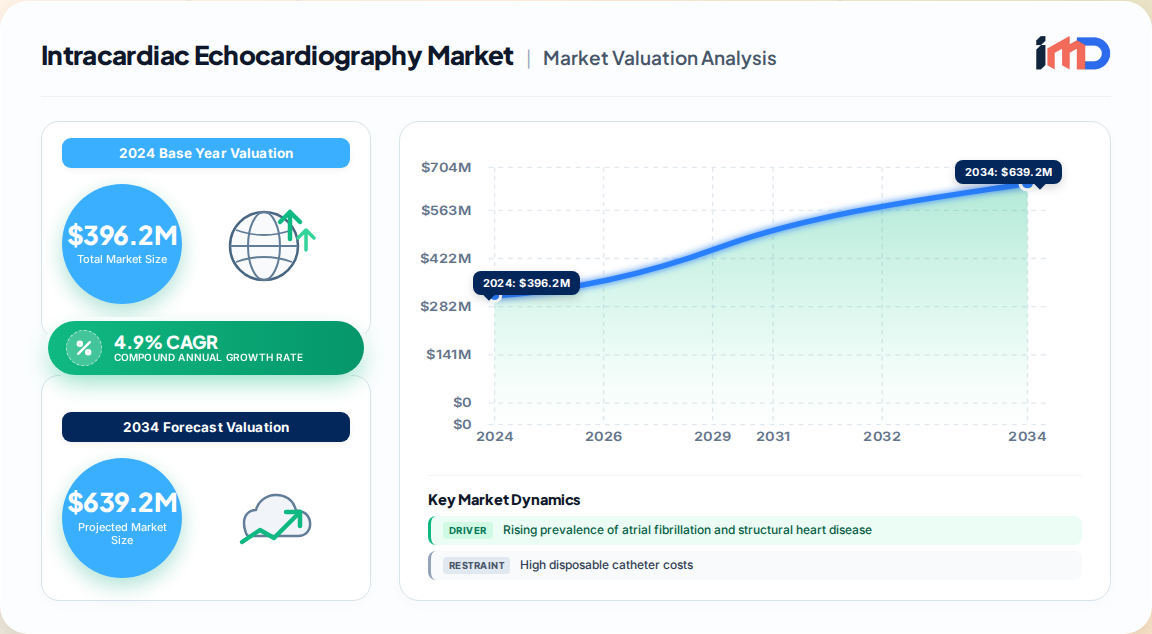
The global intracardiac echocardiography (ICE) market is undergoing a structural transformation, moving from a niche adjunct in electrophysiology (EP) laboratories to a mainstream imaging backbone across structural heart and interventional cardiology suites. Our proprietary primary research and expert interview program estimates the market at USD 396.2 million in 2024, with a projected expansion to USD 639.2 million by 2034, representing a 4.9% CAGR over the forecast horizon. This growth trajectory is underpinned by an aging demographic with a rising burden of atrial fibrillation (AF) and structural heart disease, alongside a rapid technology upgrade cycle toward 3D and 4D volumetric imaging catheters.
Intracardiac Echocardiography Market Market Size (In Million)
750.0M
600.0M
450.0M
300.0M
150.0M
0
416.0 M
2025
436.0 M
2026
457.0 M
2027
480.0 M
2028
503.0 M
2029
528.0 M
2030
554.0 M
2031
North America remains the dominant regional market, commanding 42.5% of global revenue in 2024, driven by favorable reimbursement codes (notably CPT +93662), high procedure volumes, and early adoption of advanced ICE platforms. Asia-Pacific is forecast to register the highest growth rate as healthcare infrastructure investments accelerate in China, India, and Southeast Asia, closing the capability gap with Western markets.
Market Drivers & Restraints
The ICE market is propelled by several mutually reinforcing demand drivers, though adoption remains tempered by cost and workflow constraints in lower-volume centers.
Key Demand Drivers:
Rising AF and Structural Heart Disease Burden: The U.S. alone recorded approximately 6.7 million adults diagnosed with AF in 2024, a figure projected to exceed 8 million by 2030. This surge amplifies demand for catheter ablation and left atrial appendage closure (LAAC) procedures, both of which rely on ICE for transseptal puncture guidance and real-time anatomical visualization.
Shift Toward Minimally Invasive and Radiation-Sparing Workflows: ICE enables reduced fluoroscopy dependence and, in selected procedures, can eliminate the need for general anesthesia or transesophageal echocardiography (TEE), supporting faster recovery and lower procedural risk.
Technological Progress in 3D/4D Catheters: The commercial introduction of 4D volumetric ICE catheters with AI-assisted chamber recognition is elevating image fidelity and shortening operator learning curves. Our analysis suggests the 4D catheter sub-segment could expand at a 7.05% CAGR through 2034.
Favorable Reimbursement in Developed Markets: In the U.S., CMS add-on code +93662 permits separate payment for ICE during therapeutic cardiac interventions, exempting it from the Multiple Procedure Payment Reduction rule. This has accelerated hospital investment in premium ICE consoles.
Integration with Pulsed Field Ablation (PFA): The rapid rollout of PFA platforms for AF ablation is creating a pull-through effect for real-time ultrasound guidance, as PFA procedures require precise catheter positioning.
Key Market Restraints:
High Disposable Catheter Costs: Single-use ICE catheters carry significant per-procedure costs, which can be prohibitive for ambulatory surgical centers (ASCs) and low-volume hospitals in emerging markets.
Capital Equipment Budget Constraints: Although ICE console prices are moderate relative to other cardiac imaging systems, hospitals often face competing capital priorities, particularly in cost-contained healthcare systems.
Operator Training Requirements: While ICE reduces reliance on TEE, it introduces a new skill requirement for interventionalists. Training programs are expanding but remain a bottleneck for rapid adoption in tier-2 and tier-3 cities.
Value Chain Analysis
The ICE value chain comprises four distinct tiers, each with specialized participants and distinct margin structures.
Hospitals, ASCs, EP labs, cardiac catheterization labs
The upstream segment is characterized by moderate concentration, with piezoelectric material supply and precision micro-cabling representing the most technically demanding inputs. The manufacturing tier is dominated by a small number of global OEMs that have secured regulatory clearances for 2D and 3D/4D ICE catheters. Downstream, the hospital segment accounts for 63.5% of revenue, reflecting the concentration of complex cardiac procedures in tertiary care centers.
Segmentation Analysis
Our proprietary segmentation framework reveals a market where catheters dominate product revenue, electrophysiology leads application demand, and hospitals remain the primary end user.
Segmentation Dimension
Leading Segment
Share (2024)
Fastest-Growing Segment
Growth Outlook
Product Type
Catheters
58.7%
4D volumetric catheters
~7.05% CAGR
Application
Electrophysiology
54.2%
Transcatheter valve interventions (TAVI)
~8.23% CAGR
End User
Hospitals
63.5%
Ambulatory surgical centers (ASCs)
~6.86% CAGR
Technology
2D imaging
47.86%
4D imaging
~6.90% CAGR
The catheter segment's dominance is attributable to its consumable nature and the expanding installed base of ultrasound consoles. Within applications, electrophysiology holds the largest share, but structural heart interventions—particularly transcatheter aortic valve implantation (TAVI) and tricuspid valve repair—represent the fastest-growing application, driven by the launch of catheter-delivered valve systems that require continuous ultrasound guidance. The hospital segment leads end-user revenue, yet ASCs are gaining traction, particularly in the U.S., where single-operator cost models and site-neutral payment policies are encouraging migration of lower-acuity EP procedures.
Fastest-growing; infrastructure investment and training initiatives
South America
~7%
Emerging, concentrated in Brazil and Mexico
Middle East & Africa
~6%
Nascent, reliant on imports and donor-funded programs
North America's leadership is anchored in high procedure volumes and a favorable reimbursement architecture. The U.S. CMS add-on code +93662 has been instrumental in hospital adoption of ICE as a standalone imaging modality, reducing dependence on TEE. Europe follows with a strong clinical evidence base and rapid adoption of contrast-free workflows. Asia-Pacific is the growth engine of the forecast period, with healthcare systems in China and India leapfrogging to 3D/4D catheter solutions as they upgrade catheterization laboratories. Government initiatives and expanding clinician training programs are expected to accelerate demand.
The ICE market exhibits medium concentration, with a handful of global OEMs dominating the catheter and console segments. Competitive strategy is increasingly centered on volumetric imaging, AI-assisted workflow automation, and integration with electroanatomical mapping and PFA platforms.
Recent Developments:
2024: Siemens Healthineers received FDA clearance for the AcuNav Lumos 4D catheter, introducing volumetric views with AI-based chamber recognition to reduce operator workload.
2024: Edwards Lifesciences' EVOQUE tricuspid system received FDA approval, reinforcing the role of ICE in transcatheter tricuspid repair.
2025: Philips launched the VeriSight Pro in Europe, emphasizing contrast-free ICE workflows and compatibility with structural heart procedures.
Strategic Priorities for Market Participants:
Portfolio Expansion: Leading OEMs are broadening their ICE catheter portfolios to address both EP and structural heart applications, with a focus on 4D volumetric imaging.
Software Integration: Partnerships with electroanatomical mapping system providers are enabling integrated imaging-and-mapping workflows that reduce radiation and contrast use.
Emerging Market Localization: Manufacturers are investing in localized training programs and distribution partnerships to capture growth in Asia-Pacific and Latin America.
Cost Optimization: Development of single-operator and ASC-compatible ICE systems is a key focus to expand the addressable market beyond tertiary hospitals.
Strategic White-Space Analysis
Our analysis identifies three high-potential white spaces for investment and product development:
ASC-Compatible ICE Platforms: The ASC segment is growing faster than hospitals, yet few ICE systems are specifically designed for the ASC workflow, where space, staffing, and capital budgets are constrained. A lower-cost, compact console with simplified catheter handling could unlock this segment.
AI-Driven Automated Guidance: While AI-assisted chamber recognition is emerging, there is a significant opportunity to develop automated transseptal puncture guidance and real-time anatomical labeling, which would reduce the operator learning curve and improve procedural consistency.
Emerging Market Training Infrastructure: The adoption gap in Asia-Pacific, Latin America, and the Middle East is primarily a training bottleneck. Companies that establish local training academies and proctoring networks can accelerate adoption and build brand loyalty.
Import/Export & Supplier Dynamics
The ICE market is a globally integrated supply chain, with finished catheters and ultrasound consoles flowing primarily from manufacturing hubs in the United States, Europe, Japan, and increasingly China. Trade data from official sources indicates that the U.S. and Germany are the largest exporters of diagnostic ultrasound equipment, while China is a rapidly growing importer and, increasingly, a domestic manufacturer of ICE catheters.
Supply Chain Risk Assessment:
Concentration Risk: The supply of piezoelectric crystals and precision micro-cables is concentrated among a small number of specialty suppliers, creating potential vulnerability to geopolitical disruptions or capacity constraints.
Regulatory Variability: Import clearance timelines vary significantly across markets, with China's NMPA and the U.S. FDA representing the most rigorous review processes. Companies must plan for 12–24 month regulatory lead times for new catheter platforms.
Logistics and Cold Chain: While ICE catheters do not require cold-chain logistics, they are sensitive to sterilization and packaging integrity, requiring specialized distribution capabilities in emerging markets.
Overall, the supply chain is moderately resilient, but manufacturers are increasingly pursuing dual-sourcing strategies for critical components and regional manufacturing footprints to mitigate risk.
1What is the current size of the global intracardiac echocardiography market?
The global intracardiac echocardiography market was valued at approximately USD 396.2 million in 2024 and is projected to reach USD 639.2 million by 2034, growing at a 4.9% CAGR. North America accounts for the largest share at 42.5% of global revenue.
2Which application segment dominates the intracardiac echocardiography market?
Electrophysiology procedures represent the largest application segment, accounting for 54.2% of the market in 2024. This is driven by the rising prevalence of atrial fibrillation and the increasing volume of catheter ablation procedures.
3Why is intracardiac echocardiography preferred over transesophageal echocardiography?
ICE offers several advantages over TEE, including the elimination of the need for general anesthesia in many procedures, reduced risk of esophageal complications, and real-time imaging from within the heart. It also supports reduced fluoroscopy exposure and improved procedural efficiency.
4Which region is expected to grow fastest in the intracardiac echocardiography market?
Asia-Pacific is forecast to register the highest CAGR through 2034, driven by healthcare infrastructure development, rising cardiovascular disease prevalence, and expanding clinician training programs. Emerging economies are upgrading catheterization laboratories and adopting advanced 3D/4D ICE platforms.
5What are the key trends shaping the intracardiac echocardiography market?
Key trends include the growing adoption of 3D and 4D volumetric imaging catheters, integration with electroanatomical mapping systems, expansion into structural heart interventions such as TAVI and tricuspid repair, and increasing focus on AI-assisted imaging automation.
6How is intracardiac echocardiography reimbursed in the United States?
In the U.S., ICE is reimbursed through CMS add-on code +93662, which covers imaging supervision and interpretation during therapeutic or diagnostic cardiac interventions. This code is exempt from the Multiple Procedure Payment Reduction rule, supporting hospital adoption.
Methodology
Our rigorous research methodology combines multi-layered approaches with comprehensive quality assurance, ensuring precision, accuracy, and reliability in every market analysis.
Primary Research
70–80% of our research input is derived from primary interviews, surveys, and direct consultations with industry stakeholders across the ICE value chain.
We conduct semi-structured interviews with interventional cardiologists, electrophysiologists, cardiac catheterization lab directors, and hospital procurement managers to capture real-world adoption patterns and pricing dynamics.
Company types interviewed include: ICE catheter OEMs, ultrasound console manufacturers, contract manufacturers of medical transducers, hospital group purchasing organizations (GPOs), and specialized cardiac imaging distributors.
Stakeholder job titles include: Director of Electrophysiology, Interventional Cardiologist, Cardiac Catheterization Lab Manager, and Hospital Procurement Director.
Quantitative metrics captured include procedural volumes by indication (EP ablation, LAAC, TAVI), catheter utilization rates per procedure, average selling prices (ASPs) by catheter type, and capital equipment replacement cycles.
Key Stakeholders Interviewed
Key Stakeholders Interviewed
Stakeholder Role
Interview Share (%)
Interventional Cardiologists
35%
Electrophysiologists
25%
Cardiac Catheterization Lab Managers
22%
Hospital Procurement Directors
18%
Industry Ecosystem Breakdown
Industry Ecosystem Breakdown
Company Type
Representation (%)
ICE Catheter OEMs
30%
Ultrasound Console Manufacturers
20%
Contract Manufacturers & Component Suppliers
20%
Hospital GPOs & Distributors
18%
Clinical & Regulatory Consultants
12%
Secondary Research & Industry Benchmarking
20–30% of our research input is sourced from secondary data, including peer-reviewed clinical literature, FDA and EMA regulatory filings, and official trade statistics.
We benchmark against data from official multilateral institutions such as the World Bank, OECD, and Eurostat, as well as recognized non-profit trade associations including the Heart Rhythm Society (HRS), the American College of Cardiology (ACC), and the European Society of Cardiology (ESC).
Financial databases used for corporate and market intelligence include Bloomberg, Factiva, Hoovers, and PitchBook. All data is cross-validated against company 10-K filings, investor presentations, and clinical registry data.
Every report is updated to the date of purchase to reflect the most recent regulatory clearances, product launches, and reimbursement changes.
Demand Modeling & Market Estimation
We employ a dual top-down and bottom-up methodology, simultaneously estimating market size from procedure volume data (bottom-up) and from company revenue disclosures and trade flows (top-down).
Bottom-up modeling is anchored on procedure volume forecasts for EP ablation, LAAC, and structural heart interventions, multiplied by ICE catheter penetration rates and average selling prices.
Top-down modeling reconciles these estimates with aggregate revenue reported by leading OEMs and with import/export data from official customs agencies.
Multi-level data triangulation is performed to validate estimates across segment, regional, and end-user dimensions, with discrepancies resolved through expert re-interviews.
Our guaranteed data accuracy level is 85–90%, reflecting the maturity of the clinical evidence base and the transparency of reimbursement coding.
Data Accuracy & Quality Check
All primary interview data is subjected to consistency checks and cross-validated against secondary sources before incorporation into the model.
We conduct sensitivity analysis on key assumptions, including procedure volume growth rates, ICE penetration rates, and pricing trajectories, to establish confidence intervals around our forecasts.
Regional and segment-level estimates are reviewed by in-house domain experts with clinical and commercial experience in interventional cardiology.
Final outputs are audited against company financial disclosures and official trade statistics to ensure internal consistency and external validity.