1How big is the India Electronic Health Records market in 2025?
The India EHR market was valued at approximately USD 726.1 Million in 2025. It is projected to reach USD 1,483.4 Million by 2034, growing at a CAGR of 8.01% during the forecast period.
Insight Market Data is a premier market research and business consulting firm headquartered in Pune, India, providing syndicated research reports, customized intelligence studies, and strategic advisory services. Renowned academic institutions and Fortune 500 corporations worldwide rely on Insight Market Data's research repository to navigate evolving global and regional business environments. Covering 46 diverse industries across 25 major international economies, our comprehensive database delivers thousands of verified statistics and granular market evaluations. By combining industry-leading analytical methodologies with the direct insights of seasoned industry leaders and subject-matter experts, we deliver actionable intelligence spanning historical performance benchmarks to rigorous multi-year forecasts. We empower organizations to make confident, data-driven decisions across pivotal domains including Machinery & Equipment, Chemicals & Materials, Pharmaceuticals & Healthcare, Food & Beverages, Consumer Goods, Energy & Power, Automotive & Transportation, Electronics & Semiconductors, Medical Devices, Telecommunications, Emerging Technologies, Agriculture, and Packaging. Our multidisciplinary analyst teams provide an objective 360-degree perspective, tailoring every engagement to address complex strategic challenges with exceptional analytical rigor.
Leveraging advanced BI-powered analytics and predictive modeling, Insight Market Data uncovers high-impact market opportunities and competitive differentiators for ambitious enterprises. We continuously refine our research methodologies in accordance with global industry standards, tracking real-time market shifts to ensure our reports are consistently accurate, actionable, and delivered on schedule. Our analysts conduct methodical data validation, rigorous compliance checks, and exhaustive primary and secondary research to maintain the highest levels of data integrity and transparency. We partner closely with corporate strategists, investment groups, and business executives to translate intricate market intelligence into clear, actionable roadmaps for sustainable growth. With operational presence across Washington, USA, and Vimannagar, Pune, India, Insight Market Data ensures direct access to dedicated research specialists and responsive customer support to answer your most strategic questions.
 INDIA Electronic Health Records Market
 by Product (Web/Cloud-based EHR, On-premise EHR), by Type (Acute, Ambulatory, Post Acute), by Business Model (Licensed Software, Technology Resale, Subscriptions, Professional Services, Others), by Application (Cardiology, Neurology, Radiology, Oncology, Mental and Behavioral Health, Nephrology and Urology, Gastroenterology, Pediatrics, General Medicine, Physical Therapy and Rehabilitation, Others), by End Use (Hospitals, Ambulatory Surgical Centers, Others), by North India, by South India, by East India, by West India Forecast 2026-2034

Research Analyst


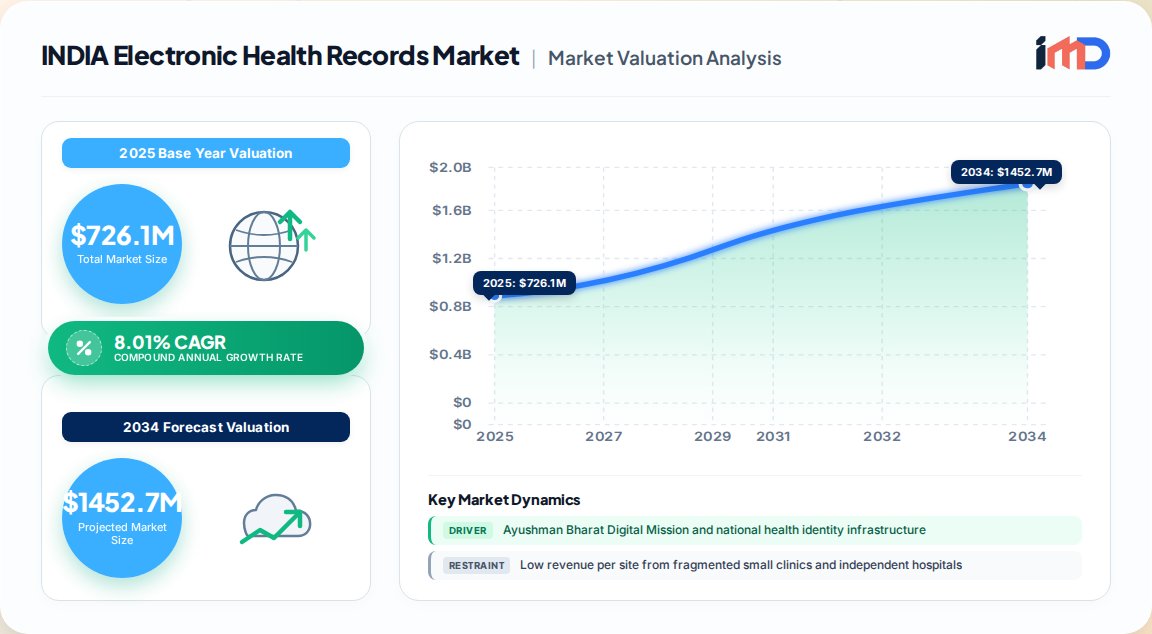
The India Electronic Health Records (EHR) market represents one of the most structurally compelling digitization opportunities in global healthcare IT. Our proprietary primary research and expert-interview program estimates the market at USD 726.1 Million in 2025, expanding at a CAGR of 8.01% to reach approximately USD 1,483.4 Million by 2034.
Unlike mature Western markets where EHR penetration is largely saturated, India's adoption curve is being reshaped simultaneously by three forces: national digital public infrastructure (ABDM), cloud-first vendor economics, and a rapidly consolidating private hospital sector. By August 2025, India had issued 79.91 crore ABHA accounts and linked 67.19 crore health records, establishing the demand infrastructure for identity-linked, consent-based longitudinal records.
The commercial centre of gravity is shifting from license-centric hospital installations toward recurring cloud subscriptions, ABDM integration APIs, and AI-enabled clinical documentation. This transition is broadening the addressable base to independent hospitals, ambulatory clinics, and diagnostic networks while compressing average revenue per newly digitized facility.
| Driver | Mechanism | Evidence / Metric |
|---|---|---|
| ABDM & national health identity | Consent architecture, ABHA linking, registry coverage lower integration friction | 2.72 lakh ABDM-enabled facilities by July 2026 vs 1.59 lakh in Feb 2025 |
| Cloud-based EHR economics | Low capex, remote access, scalability for small hospitals and clinics | Cloud/web segment is the dominant and fastest-growing product |
| Chronic disease burden & value-based care | Unified acute-ambulatory-post-acute records for coordinated care | Rising multispecialty hospital count across Tier-2 and Tier-3 cities |
| AI-enabled clinical documentation | Ambient scribing and CDS reduce clinician burnout and accelerate upgrades | Vendor launches such as AI-powered EHR workflow tools in 2025 |
| Telemedicine expansion | Documentation density rises with remote consultation volume | Digital health market projected at ~19.8% CAGR through 2033 |
| Restraint | Mechanism |
|---|---|
| Fragmented provider base | Low revenue per site and high cost-to-serve for clinics and small hospitals |
| Data privacy and consent compliance | DPDP Act obligations raise the compliance and security burden |
| Interoperability heterogeneity | Legacy departmental applications and non-standard data models persist |
| Implementation and training capacity | Shortage of trained clinical informatics staff slows deployments |
Our bottom-up segmentation confirms that web/cloud-based EHR dominates product revenue, while acute EHR retains the largest type share and hospitals remain the anchor end-use segment. Business-model migration toward subscriptions is the single most important profit-pool shift in the forecast period.
| Segment Dimension | Leading Segment | Structural Observation |
|---|---|---|
| Product | Web/Cloud-based EHR | Cloud delivery reduces implementation barriers for smaller hospitals and physician practices |
| Type | Acute EHR | Largest share; enterprise grade workflows and interoperability spending dominate |
| Business Model | Subscriptions (fastest growing) | Shift from licensed software toward recurring cloud subscriptions and managed services |
| Application | General Medicine, Cardiology, Radiology | Specialty workflows drive module attach rates and analytics monetization |
| End Use | Hospitals | Ambulatory surgical centers show the steepest incremental adoption curve |
Application-level demand is broadening beyond general medicine into cardiology, neurology, radiology, oncology, mental and behavioural health, nephrology and urology, gastroenterology, paediatrics, and physical therapy and rehabilitation. Specialty-specific templates and decision-support modules are now the primary differentiation lever among Indian EHR vendors.
South India represents the most important commercialization and health-technology development hub in the country, anchored by Bengaluru and Chennai-based vendors serving providers nationally. Bengaluru-headquartered HealthPlix reports more than 14,000 doctors, over 60 million patients, and coverage across 370-plus cities, demonstrating how clinic-oriented EHR platforms scale nationally from concentrated technology clusters.
| Region | Market Share (2025) | Key Characteristics |
|---|---|---|
| South India | ~31% | Health-tech vendor cluster; high cloud adoption; enterprise hospital chains |
| North India | ~28% | NCR and Delhi NCR private hospital density; public-sector digitization push |
| West India | ~24% | Mumbai and Ahmedabad; diagnostic networks and corporate hospitals |
| East India | ~17% | Faster percentage growth off a smaller base; public facility onboarding |
The India EHR competitive field is moderately fragmented, with 40-plus active players spanning global enterprise suites, domestic clinic-first platforms, and hospital information system incumbents. The leading companies operating in this market include Practo Technologies Pvt. Ltd., HealthPlix Technologies Pvt. Ltd., Eka Care, eClinicalWorks India, and Oracle Health, alongside enterprise platforms such as Epic Systems Corporation, Veradigm LLC, MEDITECH, athenahealth, NextGen Healthcare, Greenway Health, and Practice Fusion, Inc.
Key strategic imperatives observed across vendor interviews:
The value chain spans clinical software platforms, interoperability middleware and APIs, implementation and integration services, cybersecurity and compliance layers, and supporting hardware. Cloud infrastructure providers and ABDM integrators occupy an increasingly strategic position because record exchange and consent enforcement concentrate value at the integration layer.
Procurement decisions are shifting from department-level purchases to CEO and CIO-sponsored enterprise decisions. The dominant evaluation criteria in our interview program are interoperability with ABDM, total cost of ownership over five years, clinician productivity impact, cybersecurity posture under the DPDP Act, and vendor implementation capacity outside metro locations.
The highest-conviction white-space opportunities identified through our analysis:
| Metric | Value |
|---|---|
| 2025 Market Size | USD 726.1 Million |
| 2034 Projected Market Size | USD 1,483.4 Million |
| CAGR (2026-2034) | 8.01% |
| Largest Region | South India |
| Fastest Growing Product Segment | Web/Cloud-based EHR |
| Market Structure | Moderately fragmented (40+ players) |
The forecast assumes cloud subscription economics continue to lower adoption barriers while larger health systems increase spending on interoperability, analytics, cybersecurity, clinical decision support, and migration from fragmented departmental applications to unified longitudinal patient records. Vendors with recurring subscriptions, ABDM-native APIs, AI documentation, and managed-services revenue are positioned to capture disproportionate profit-pool growth through 2034.
| Aspects | Details |
|---|---|
| Study Period | 2020-2034 |
| Base Year | 2025 |
| Estimated Year | 2026 |
| Forecast Period | 2026-2034 |
| Historical Period | 2020-2025 |
| Growth Rate | CAGR of 8.01% from 2020-2034 |
| Segmentation |
|
By Business Model
By Application
By End Use
| By Geography |
|
The India EHR market was valued at approximately USD 726.1 Million in 2025. It is projected to reach USD 1,483.4 Million by 2034, growing at a CAGR of 8.01% during the forecast period.
Key drivers include the Ayushman Bharat Digital Mission with over 79.91 crore ABHA accounts created, rising adoption of cloud-based EHR systems, AI-enabled clinical documentation, and increasing digitization among hospitals, clinics, and diagnostic chains.
Web/cloud-based EHR is the dominant and fastest-growing product segment. Its low upfront cost, scalability, and remote accessibility make it attractive for small hospitals, independent clinics, and ambulatory care providers across Tier-2 and Tier-3 cities.
South India leads the market with an estimated 31% revenue share, anchored by health-technology vendors in Bengaluru and Chennai. North India follows at approximately 28%, driven by private hospital density in Delhi NCR.
Leading companies include Practo Technologies Pvt. Ltd., HealthPlix Technologies Pvt. Ltd., Eka Care, eClinicalWorks India, and Oracle Health, alongside global enterprise platforms such as Epic Systems Corporation, Veradigm LLC, MEDITECH, athenahealth, and NextGen Healthcare.
By July 2026, over 2.72 lakh facilities were using ABDM-enabled software, up from 1.59 lakh in February 2025, and more than 105 crore health records were linked to ABHA. This infrastructure makes consent-based record exchange a procurement prerequisite for EHR vendors.
Our rigorous research methodology combines multi-layered approaches with comprehensive quality assurance, ensuring precision, accuracy, and reliability in every market analysis.
| Stakeholder Role | Interview Share (%) |
|---|---|
| Chief Information Officer / Head of IT Procurement | 34% |
| Chief Medical Information Officer / Clinical Informatics Lead | 26% |
| Hospital Operations Director | 22% |
| CEO / Founder, EHR Vendor | 18% |
| Company Type | Representation (%) |
|---|---|
| Cloud EHR Platform Vendors | 32% |
| Acute/Hospital Information System Providers | 24% |
| Interoperability & ABDM Middleware Integrators | 18% |
| Ambulatory Clinics & Diagnostic Chains | 16% |
| Health IT Implementation & Managed Services | 10% |
 Related Reports


Analyst at Providence Strategic Partners at Petaling Jaya
I have received the report already. Thanks you for your help.it has been a pleasure working with you. Thank you again for a good quality report

Internationalization Director
Yes, as a matter of fact we are totally satisfied with both reports that we have purchased and will continue to do so during this process of the internationalization of our brand.

Head of Product Management and Marketing
We are using your report, and it gave us valuable information."

Regional Director, Marketing and Business Development
We've received the report and have reviewed the content. Overall, it looks great and aligns closely with the data we can verify based on our industry knowledge.

VP of Sales
Thank you very much for sharing the report. I have reviewed it and I am very satisfied with the quality and the insights it provides. It will certainly be valuable for our internal discussions.