Insight Market Data is a premier market research and business consulting firm headquartered in Pune, India, providing syndicated research reports, customized intelligence studies, and strategic advisory services. Renowned academic institutions and Fortune 500 corporations worldwide rely on Insight Market Data's research repository to navigate evolving global and regional business environments. Covering 46 diverse industries across 25 major international economies, our comprehensive database delivers thousands of verified statistics and granular market evaluations. By combining industry-leading analytical methodologies with the direct insights of seasoned industry leaders and subject-matter experts, we deliver actionable intelligence spanning historical performance benchmarks to rigorous multi-year forecasts. We empower organizations to make confident, data-driven decisions across pivotal domains including Machinery & Equipment, Chemicals & Materials, Pharmaceuticals & Healthcare, Food & Beverages, Consumer Goods, Energy & Power, Automotive & Transportation, Electronics & Semiconductors, Medical Devices, Telecommunications, Emerging Technologies, Agriculture, and Packaging. Our multidisciplinary analyst teams provide an objective 360-degree perspective, tailoring every engagement to address complex strategic challenges with exceptional analytical rigor.
Leveraging advanced BI-powered analytics and predictive modeling, Insight Market Data uncovers high-impact market opportunities and competitive differentiators for ambitious enterprises. We continuously refine our research methodologies in accordance with global industry standards, tracking real-time market shifts to ensure our reports are consistently accurate, actionable, and delivered on schedule. Our analysts conduct methodical data validation, rigorous compliance checks, and exhaustive primary and secondary research to maintain the highest levels of data integrity and transparency. We partner closely with corporate strategists, investment groups, and business executives to translate intricate market intelligence into clear, actionable roadmaps for sustainable growth. With operational presence across Washington, USA, and Vimannagar, Pune, India, Insight Market Data ensures direct access to dedicated research specialists and responsive customer support to answer your most strategic questions.
United Kingdom Commercial HVAC Market
Real Estate and Construction / MARKET REPORT
United Kingdom Commercial HVAC Market | Insight Market Data
United Kingdom Commercial HVAC Market by Component (HVAC Equipment, HVAC Services), by Equipment Type (Cooling/Air-Conditioning Equipment, Heating Equipment, Controls and Sensors), by Service Type (Installation, Maintenance and Repair, Performance Contracting/HVAC-as-a-Service), by End-User Industry (Commercial Office Buildings, Hospitality, Data Centers, Healthcare, Retail, Education & Institutional), by Installation Type (New Construction, Retrofit/Replacement), by Capacity Range (Up to 5 kW, 5-20 kW, 20-50 kW, Above 50 kW), by England, by Scotland, by Wales, by Northern Ireland Forecast 2026-2034
Elevator and Escalator Market valued at $82.79B in 2025, projected to reach $146.52B by 2035 at 6.0% CAGR. Explore trends, segments, and regional analysis.
Global elevator cables market valued at $2.53B in 2026, projected to reach $3.11B by 2030 at 5.3% CAGR. Flat cable demand driven by urbanization and smart buildings.
Nov 2026|224 pages
$2900.00
Air entraining admixtures market valued at USD 2.02 B in 2024, growing at 3.5% CAGR to reach USD 2.66 B by 2032. Freeze-thaw durability drives demand.
Nov 2026|273 pages
$2900.00
The Brushless DC Motor for HVAC System market is valued at USD 2.15 billion in 2026, growing at a 9.8% CAGR to reach USD 3.43 billion by 2031.
Nov 2026|192 pages
$2900.00
3D printing robotic arm extruders for construction market to reach $1.18B by 2035 at 12.8% CAGR, driven by automation and sustainable building.
United Kingdom Commercial HVAC Market: Executive Overview and Market Snapshot
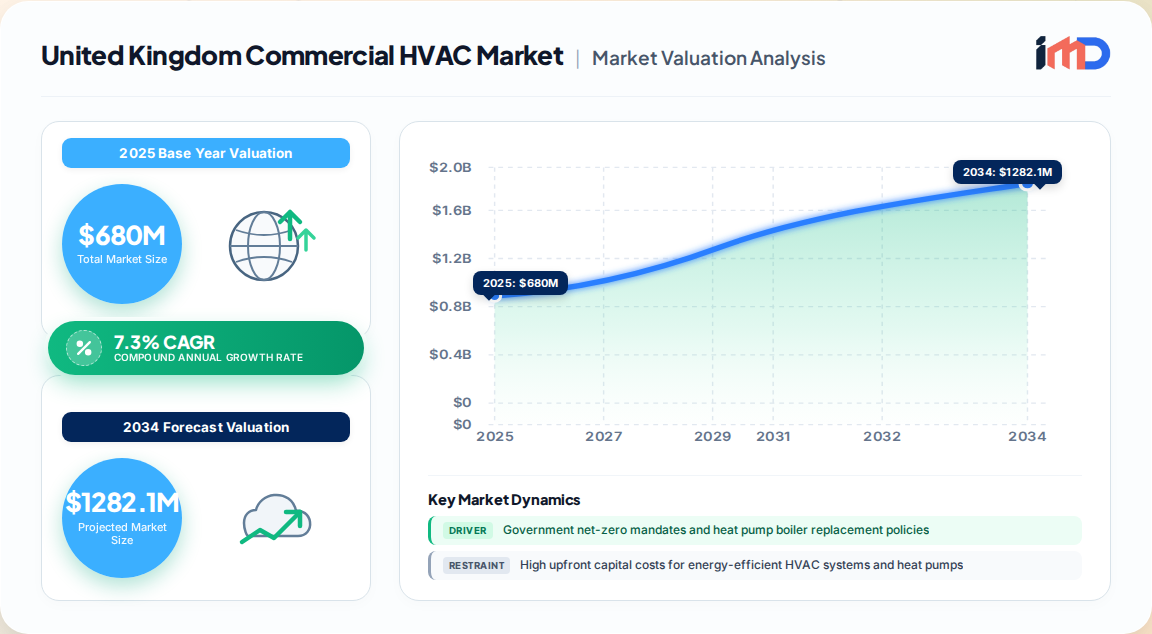
The United Kingdom Commercial HVAC market represents a critical and rapidly evolving segment of the broader national HVAC industry. While the total UK HVAC market is projected to reach USD 2.83 billion by 2026, the commercial segment is emerging as a key growth engine. Our proprietary primary research estimates the commercial HVAC market size at USD 0.68 billion in 2025, projected to expand at a robust CAGR of 7.3% from 2026 to 2031. This growth is significantly outpacing the overall market, driven by decarbonization mandates, a resurgence in office refurbishments, and an unprecedented surge in data-center cooling demand.
United Kingdom Commercial HVAC Market Market Size (In Million)
1.5B
1.0B
500.0M
0
680.0 M
2025
730.0 M
2026
783.0 M
2027
840.0 M
2028
901.0 M
2029
967.0 M
2030
1.038 B
2031
The market is transitioning from a traditional, fossil-fuel-based heating paradigm to an all-electric, smart, and highly efficient ecosystem. Key structural shifts include the rapid adoption of heat pumps for commercial spaces, the integration of IoT and AI-driven building management systems (BMS), and a regulatory-driven phase-down of high-GWP refrigerants. The market concentration is moderate, with the top three global manufacturers—Daikin, Carrier, and Johnson Controls—collectively commanding just under 30% of the overall UK HVAC revenue in 2024, a share that is similarly reflected in the commercial segment.
Market Metric
Value (2025)
Forecast (2031)
Commercial HVAC Market Size
USD 0.68 Billion
USD 1.04 Billion
Commercial HVAC CAGR (2026-2031)
7.3%
Total UK HVAC Market Size (Base)
USD 2.72 Billion
USD 3.86 Billion (2034)
Commercial Share of Total HVAC
~25%
~28% (est.)
Key End-User Growth Segment
Data Centers (CAGR ~10.5%)
Key Market Drivers and Restraints
The UK commercial HVAC market is shaped by a confluence of ambitious policy targets, technological innovation, and economic pressures.
Growth Drivers
Net-Zero Mandates & Heat Pump Rollout: The legally binding 2050 net-zero target and the Future Homes Standard (mandating no fossil-fuel heating in new builds from 2025) are the primary accelerators. For commercial buildings, the Boiler Upgrade Scheme (offering grants up to GBP 7,500) and the Social Housing Decarbonisation Fund are creating a robust retrofit pipeline. Our analysis indicates that government energy-efficiency incentives contribute a +1.2% impact on the commercial HVAC CAGR.
Data Center Cooling Load Spike: The hyperscale data center build-out in London, Manchester, and Edinburgh is driving massive demand for precision cooling. Global data centers consumed an estimated 460 TWh of electricity in 2024, with cooling accounting for 35–40%. As AI rack densities exceed 50 kW per rack, demand for advanced liquid cooling and high-efficiency CRAC units is surging, contributing a +0.6% impact to the UK market.
Energy Efficiency & Smart Controls: Commercial building operators are prioritizing lifecycle efficiency over upfront costs. The adoption of AI-enabled automation (e.g., Johnson Controls' Metasys 14.0) has demonstrated 20% average energy savings in pilot sites. The integration of IoT sensors and predictive maintenance is becoming standard, reshaping purchasing criteria.
Post-Pandemic Ventilation Standards: Enhanced indoor air quality (IAQ) requirements are forcing upgrades of legacy air handling units (AHUs) and ventilation systems in offices, hospitality, and healthcare facilities.
Market Restraints
High Upfront Cost of Efficient Systems: The capital expenditure for low-carbon HVAC systems remains a significant barrier. An air-source heat pump installation can cost GBP 10,000–15,000 compared to GBP 3,000–4,000 for a gas boiler, with commercial-scale systems exponentially higher. This creates a -1.8% drag on CAGR, particularly for SMEs and lower-income asset owners.
Skilled-Labour Shortage: A critical bottleneck is the acute shortage of qualified installers and maintenance engineers. Only about 3,000 engineers were certified to fit heat pumps in 2024, against an estimated need of 120,000–230,000 workers by 2030. This shortage delays projects and inflates labor costs, exerting a -1.1% impact on market growth.
Refrigerant Transition Complexity: The UK's adoption of the EU F-gas Regulation (and post-Brexit equivalent) mandates a 70% cut in HFC consumption by 2030. This requires the replacement of over 34 million pieces of equipment across the EU, creating compliance burdens and high costs for commercial operators.
Technology and Refrigerant Transition Trends
The commercial HVAC market in the UK is undergoing a generational technology shift, driven by regulatory and environmental imperatives.
Low-GWP Refrigerants: The phase-down of HFCs is forcing manufacturers to redesign product lines around propane (R-290), CO2 (R-744), and other low-GWP alternatives. The European Commission's 2024 F-gas revision expedited quota cuts by 55%, accelerating equipment turnover. In the UK, projects like the REAL Alternatives 4 LIFE initiative have trained over 4,600 e-learning users and 378 technicians to handle these new refrigerants safely.
Heat Pump Integration: Hybrid systems combining a small gas burner with a heat pump are gaining traction to hedge against hydrogen infrastructure uncertainty. British Gas announced a nationwide service partnership with NIBE in March 2025 to boost installer capacity ahead of the 2026 boiler mandate.
Smart & Grid-Interactive HVAC: The integration of IoT and cloud-connected BMS is enabling demand flexibility and grid-interactive efficient buildings (GEBs). This allows commercial buildings to participate in demand-response programs, reducing operational costs and supporting grid stability.
Segmentation Analysis
The UK commercial HVAC market is segmented by component, end-user industry, installation type, and capacity range.
By Component
HVAC Equipment: Dominated the market with 66.55% share in 2025. This includes heat pumps, chillers, AHUs, VRF systems, and controls. The equipment segment is driven by capital spending on new installations and replacements.
HVAC Services: Expected to grow at the fastest CAGR of 7.55% through 2031. This includes installation, maintenance, repair, and energy management services. The growing complexity of systems and the shift toward performance-based contracts are fueling service demand.
By End-User Industry
Commercial Office Buildings: The largest commercial sub-segment, accounting for 35.5% of global commercial HVAC demand in 2025. Post-pandemic ventilation upgrades and ESG compliance are major drivers.
Data Centers: The fastest-growing vertical, with a projected CAGR of 10.6% to 2035. Hyperscale operators are doubling rack densities and requiring specialized cooling solutions.
Hospitality, Healthcare, Retail, and Education: All contribute significantly, with growth tied to infrastructure investment and regulatory compliance.
By Installation Type
Retrofit/Replacement: Dominated with 60.65% share of the total UK HVAC market in 2025. The large installed base of aging systems and government retrofit initiatives are key drivers.
New Construction: Expected to grow at a CAGR of 5.21% through 2031, supported by the Future Homes Standard and new commercial developments.
By Capacity Range
20–50 kW and above: The dominant capacity range for commercial applications, particularly for office buildings and data centers.
Regional Outlook
England dominates the UK commercial HVAC market, driven by its large population, extensive commercial building stock, and major metropolitan centers like London. London, in particular, leads in data center cooling and office refurbishment activity. Scotland is a notable growth region, with ambitious renewable energy targets and increasing adoption of heat pumps. Wales and Northern Ireland show steady expansion, supported by government-funded energy efficiency programs.
United Kingdom Commercial HVAC Market Regional Market Share
Loading chart...
Region
Market Share (2025)
Key Growth Drivers
England
62%
Data centers, office retrofits, population density
Scotland
14%
Renewable targets, heat pump adoption
Wales
12%
Energy efficiency programs
Northern Ireland
5%
Rural heating modernization
Unallocated/Offshore
7%
Competitive Landscape and Strategic Developments
The UK commercial HVAC market is moderately concentrated, with global giants competing alongside established domestic players.
Leading Players: Daikin, Carrier, Johnson Controls, Mitsubishi Electric, and Trane Technologies are the major forces. These companies are investing heavily in R&D for heat pumps, low-GWP refrigerants, and smart building integration.
Strategic Initiatives: In 2024, the five largest HVAC manufacturers invested over USD 4.2 billion in capital expenditure, primarily in heat pump production capacity. Strategic collaborations, such as British Gas and NIBE, are aimed at overcoming installer shortages.
Service Network Expansion: Companies are expanding their service networks and training programs to capture the growing demand for maintenance and performance contracting.
Value Chain and Import/Export Dynamics
The UK commercial HVAC value chain is characterized by a reliance on imports for key components and finished equipment.
Raw Materials: Fluctuating prices for copper and rare-earth magnets (used in high-efficiency motors) are a significant supply chain risk.
Manufacturing: While some assembly occurs in the UK, the majority of advanced heat pumps and VRF systems are imported from EU and Asian manufacturers.
Distribution and Installation: A fragmented network of wholesalers and thousands of SMEs carries out installation and maintenance. Skills shortages at this stage are a critical bottleneck.
Regulatory Compliance: Post-Brexit, the UK has its own F-gas regulations, but they mirror EU standards, ensuring continuity for manufacturers.
Strategic White-Space Analysis
Our analysis identifies several high-growth white spaces for investors and market entrants:
HVAC-as-a-Service (HVACaaS): Outcome-based contracts for cooling and heating are gaining traction, particularly among commercial portfolio owners. This model shifts capital expenditure to operational expenditure and guarantees performance.
Grid-Interactive HVAC: Solutions that enable buildings to adjust their energy consumption in response to grid signals are a nascent but rapidly growing opportunity.
Data Center Liquid Cooling: As rack densities rise, liquid cooling solutions (rear-door heat exchangers, direct-to-chip) represent a premium, high-margin segment.
Retrofit Financing Models: Innovative salary-sacrifice and zero-interest loan schemes are needed to unlock the residential and SME commercial retrofit market.
Future Outlook and Market Forecast
The UK commercial HVAC market is poised for robust growth, with an estimated CAGR of 7.3% from 2026 to 2031. By 2031, we project the market to exceed USD 1.04 billion. The key to success will be navigating the regulatory landscape, overcoming skills shortages, and capitalizing on the data-center cooling and heat-pump retrofit waves. Companies that invest in training, innovative financing, and smart, low-GWP technologies will be best positioned to capture value in this transforming market.
United Kingdom Commercial HVAC Market Regional Market Share
Higher Coverage
Lower Coverage
No Coverage
United Kingdom Commercial HVAC Market REPORT HIGHLIGHTS
Aspects
Details
Study Period
2020-2034
Base Year
2025
Estimated Year
2026
Forecast Period
2026-2034
Historical Period
2020-2025
Growth Rate
CAGR of 7.3% from 2020-2034
Segmentation
By Component
HVAC Equipment
HVAC Services
By Equipment Type
Cooling/Air-Conditioning Equipment
Table of Contents
1. United Kingdom Commercial HVAC Market Introduction
1.1. Research Scope
1.2. Market Segmentation
1.3. Research Objective
1.4. Definitions and Assumptions
2. United Kingdom Commercial HVAC Market Executive Summary
2.1. Market Snapshot
3. United Kingdom Commercial HVAC Market Dynamics
3.1. Market Drivers
3.1.1. Government net-zero mandates and heat pump boiler replacement policies
3.1.2. Boiler Upgrade Scheme grants of GBP 7,500 for heat pump installations
3.1.3. Data center expansion in London, Manchester, and Edinburgh driving cooling demand
3.1.4. Post-pandemic ventilation standards and indoor air quality requirements
3.1.5. Corporate ESG commitments and building electrification policies
3.2. Market Trends
3.2.1. Rapid adoption of low-GWP refrigerants like R-290 and R-744 driven by F-gas regulations
3.2.2. Integration of AI and IoT for smart building management and predictive maintenance
3.2.3. Shift toward hybrid heating systems combining heat pumps with gas boilers
3.2.4. Surge in data center cooling demand requiring high-density liquid cooling solutions
3.2.5. Growth of HVAC-as-a-Service and performance-based contracting models
3.3. Market Restraints
3.3.1. High upfront capital costs for energy-efficient HVAC systems and heat pumps
3.3.2. Acute shortage of skilled engineers for installation and maintenance
Heating Equipment
Controls and Sensors
By Service Type
Installation
Maintenance and Repair
Performance Contracting/HVAC-as-a-Service
By End-User Industry
Commercial Office Buildings
Hospitality
Data Centers
Healthcare
Retail
Education & Institutional
By Installation Type
New Construction
Retrofit/Replacement
By Capacity Range
Up to 5 kW
5-20 kW
20-50 kW
Above 50 kW
By Geography
England
Scotland
Wales
Northern Ireland
3.3.3. Uncertainty surrounding hydrogen infrastructure development hindering investment
3.3.4. Volatility in raw material prices, particularly copper and rare-earth magnets
3.4. Market Challenges
3.4.1. Complex regulatory compliance with F-gas regulations and building standards
3.4.2. Fragmented supply chain with thousands of SMEs complicating quality assurance
3.4.3. Electricity-to-gas price ratio remaining unfavorable for heat pump ROI
3.4.4. Grid decarbonization pace limiting the environmental benefits of electric HVAC
4. United Kingdom Commercial HVAC Market Factor Analysis
4.1. Porters Five Forces
4.1.1. Bargaining Power of Suppliers
4.1.2. Bargaining Power of Buyers
4.1.3. Threat of New Entrants
4.1.4. Threat of Substitutes
4.1.5. Competitive Rivalry
4.2. PESTEL analysis
4.3. BCG Analysis
4.3.1. Stars (High Growth, High Market Share)
4.3.2. Cash Cows (Low Growth, High Market Share)
4.3.3. Question Mark (High Growth, Low Market Share)
4.3.4. Dogs (Low Growth, Low Market Share)
4.4. Ansoff Matrix Analysis
4.5. Supply Chain Analysis
4.6. Regulatory Landscape
4.7. Current Market Potential and Opportunity Assessment (TAM–SAM–SOM Framework)
4.8. IMD Analyst Note
5. United Kingdom Commercial HVAC Market Analysis, Insights and Forecast, 2020-2034
5.1. Analysis, Insights and Forecast - by Component
5.1.1. HVAC Equipment
5.1.2. HVAC Services
5.2. Analysis, Insights and Forecast - by Equipment Type
5.2.1. Cooling/Air-Conditioning Equipment
5.2.2. Heating Equipment
5.2.3. Controls and Sensors
5.3. Analysis, Insights and Forecast - by Service Type
5.3.1. Installation
5.3.2. Maintenance and Repair
5.3.3. Performance Contracting/HVAC-as-a-Service
5.4. Analysis, Insights and Forecast - by End-User Industry
5.4.1. Commercial Office Buildings
5.4.2. Hospitality
5.4.3. Data Centers
5.4.4. Healthcare
5.4.5. Retail
5.4.6. Education & Institutional
5.5. Analysis, Insights and Forecast - by Installation Type
5.5.1. New Construction
5.5.2. Retrofit/Replacement
5.6. Analysis, Insights and Forecast - by Capacity Range
5.6.1. Up to 5 kW
5.6.2. 5-20 kW
5.6.3. 20-50 kW
5.6.4. Above 50 kW
5.7. Analysis, Insights and Forecast - by Region
5.7.1. England
5.7.2. Scotland
5.7.3. Wales
5.7.4. Northern Ireland
6. United Kingdom Commercial HVAC Market England Analysis, Insights and Forecast, 2020-2034
6.1. Analysis, Insights and Forecast - by Component
6.1.1. HVAC Equipment
6.1.2. HVAC Services
6.2. Analysis, Insights and Forecast - by Equipment Type
6.2.1. Cooling/Air-Conditioning Equipment
6.2.2. Heating Equipment
6.2.3. Controls and Sensors
6.3. Analysis, Insights and Forecast - by Service Type
6.3.1. Installation
6.3.2. Maintenance and Repair
6.3.3. Performance Contracting/HVAC-as-a-Service
6.4. Analysis, Insights and Forecast - by End-User Industry
6.4.1. Commercial Office Buildings
6.4.2. Hospitality
6.4.3. Data Centers
6.4.4. Healthcare
6.4.5. Retail
6.4.6. Education & Institutional
6.5. Analysis, Insights and Forecast - by Installation Type
6.5.1. New Construction
6.5.2. Retrofit/Replacement
6.6. Analysis, Insights and Forecast - by Capacity Range
6.6.1. Up to 5 kW
6.6.2. 5-20 kW
6.6.3. 20-50 kW
6.6.4. Above 50 kW
7. United Kingdom Commercial HVAC Market Scotland Analysis, Insights and Forecast, 2020-2034
7.1. Analysis, Insights and Forecast - by Component
7.1.1. HVAC Equipment
7.1.2. HVAC Services
7.2. Analysis, Insights and Forecast - by Equipment Type
7.2.1. Cooling/Air-Conditioning Equipment
7.2.2. Heating Equipment
7.2.3. Controls and Sensors
7.3. Analysis, Insights and Forecast - by Service Type
7.3.1. Installation
7.3.2. Maintenance and Repair
7.3.3. Performance Contracting/HVAC-as-a-Service
7.4. Analysis, Insights and Forecast - by End-User Industry
7.4.1. Commercial Office Buildings
7.4.2. Hospitality
7.4.3. Data Centers
7.4.4. Healthcare
7.4.5. Retail
7.4.6. Education & Institutional
7.5. Analysis, Insights and Forecast - by Installation Type
7.5.1. New Construction
7.5.2. Retrofit/Replacement
7.6. Analysis, Insights and Forecast - by Capacity Range
7.6.1. Up to 5 kW
7.6.2. 5-20 kW
7.6.3. 20-50 kW
7.6.4. Above 50 kW
8. United Kingdom Commercial HVAC Market Wales Analysis, Insights and Forecast, 2020-2034
8.1. Analysis, Insights and Forecast - by Component
8.1.1. HVAC Equipment
8.1.2. HVAC Services
8.2. Analysis, Insights and Forecast - by Equipment Type
8.2.1. Cooling/Air-Conditioning Equipment
8.2.2. Heating Equipment
8.2.3. Controls and Sensors
8.3. Analysis, Insights and Forecast - by Service Type
8.3.1. Installation
8.3.2. Maintenance and Repair
8.3.3. Performance Contracting/HVAC-as-a-Service
8.4. Analysis, Insights and Forecast - by End-User Industry
8.4.1. Commercial Office Buildings
8.4.2. Hospitality
8.4.3. Data Centers
8.4.4. Healthcare
8.4.5. Retail
8.4.6. Education & Institutional
8.5. Analysis, Insights and Forecast - by Installation Type
8.5.1. New Construction
8.5.2. Retrofit/Replacement
8.6. Analysis, Insights and Forecast - by Capacity Range
8.6.1. Up to 5 kW
8.6.2. 5-20 kW
8.6.3. 20-50 kW
8.6.4. Above 50 kW
9. United Kingdom Commercial HVAC Market Northern Ireland Analysis, Insights and Forecast, 2020-2034
9.1. Analysis, Insights and Forecast - by Component
9.1.1. HVAC Equipment
9.1.2. HVAC Services
9.2. Analysis, Insights and Forecast - by Equipment Type
9.2.1. Cooling/Air-Conditioning Equipment
9.2.2. Heating Equipment
9.2.3. Controls and Sensors
9.3. Analysis, Insights and Forecast - by Service Type
9.3.1. Installation
9.3.2. Maintenance and Repair
9.3.3. Performance Contracting/HVAC-as-a-Service
9.4. Analysis, Insights and Forecast - by End-User Industry
9.4.1. Commercial Office Buildings
9.4.2. Hospitality
9.4.3. Data Centers
9.4.4. Healthcare
9.4.5. Retail
9.4.6. Education & Institutional
9.5. Analysis, Insights and Forecast - by Installation Type
9.5.1. New Construction
9.5.2. Retrofit/Replacement
9.6. Analysis, Insights and Forecast - by Capacity Range
9.6.1. Up to 5 kW
9.6.2. 5-20 kW
9.6.3. 20-50 kW
9.6.4. Above 50 kW
10. United Kingdom Commercial HVAC Market Competitive Analysis
10.1. Company Profiles
10.1.1. Daikin Industries Ltd.
10.1.1.1. Company Overview
10.1.1.2. Products
10.1.1.3. Company Financials
10.1.1.4. SWOT Analysis
10.1.2. Carrier Global Corporation
10.1.2.1. Company Overview
10.1.2.2. Products
10.1.2.3. Company Financials
10.1.2.4. SWOT Analysis
10.1.3. Johnson Controls International plc
10.1.3.1. Company Overview
10.1.3.2. Products
10.1.3.3. Company Financials
10.1.3.4. SWOT Analysis
10.1.4. Mitsubishi Electric Corporation
10.1.4.1. Company Overview
10.1.4.2. Products
10.1.4.3. Company Financials
10.1.4.4. SWOT Analysis
10.1.5. Trane Technologies plc
10.1.5.1. Company Overview
10.1.5.2. Products
10.1.5.3. Company Financials
10.1.5.4. SWOT Analysis
10.1.6. LG Electronics Inc.
10.1.6.1. Company Overview
10.1.6.2. Products
10.1.6.3. Company Financials
10.1.6.4. SWOT Analysis
10.1.7. Panasonic Corporation
10.1.7.1. Company Overview
10.1.7.2. Products
10.1.7.3. Company Financials
10.1.7.4. SWOT Analysis
10.1.8. Samsung Electronics Co. Ltd.
10.1.8.1. Company Overview
10.1.8.2. Products
10.1.8.3. Company Financials
10.1.8.4. SWOT Analysis
10.1.9. Fujitsu General Limited
10.1.9.1. Company Overview
10.1.9.2. Products
10.1.9.3. Company Financials
10.1.9.4. SWOT Analysis
10.1.10. Midea Group Co. Ltd.
10.1.10.1. Company Overview
10.1.10.2. Products
10.1.10.3. Company Financials
10.1.10.4. SWOT Analysis
10.1.11. Lennox International Inc.
10.1.11.1. Company Overview
10.1.11.2. Products
10.1.11.3. Company Financials
10.1.11.4. SWOT Analysis
10.1.12. Bosch Thermotechnology GmbH
10.1.12.1. Company Overview
10.1.12.2. Products
10.1.12.3. Company Financials
10.1.12.4. SWOT Analysis
10.1.13. Vaillant Group
10.1.13.1. Company Overview
10.1.13.2. Products
10.1.13.3. Company Financials
10.1.13.4. SWOT Analysis
10.1.14. Viessmann Climate Solutions SE
10.1.14.1. Company Overview
10.1.14.2. Products
10.1.14.3. Company Financials
10.1.14.4. SWOT Analysis
10.1.15. Worcester Bosch
10.1.15.1. Company Overview
10.1.15.2. Products
10.1.15.3. Company Financials
10.1.15.4. SWOT Analysis
10.1.16. Baxi Heating UK Limited
10.1.16.1. Company Overview
10.1.16.2. Products
10.1.16.3. Company Financials
10.1.16.4. SWOT Analysis
10.1.17. Ideal Heating Ltd.
10.1.17.1. Company Overview
10.1.17.2. Products
10.1.17.3. Company Financials
10.1.17.4. SWOT Analysis
10.1.18. Voltas Limited
10.1.18.1. Company Overview
10.1.18.2. Products
10.1.18.3. Company Financials
10.1.18.4. SWOT Analysis
10.2. Market Entropy
10.2.1. Company's Key Areas Served
10.2.2. Recent Developments
10.3. Company Market Share Analysis, 2026
10.3.1. Top 5 Companies Market Share Analysis
10.3.2. Top 3 Companies Market Share Analysis
10.4. List of Potential Customers
List of Figures
Figure 1: Global United Kingdom Commercial HVAC Market Revenue Breakdown (Million, %) by Region 2026 & 2034
Figure 2: England United Kingdom Commercial HVAC Market Revenue (Million), by Component 2026 & 2034
Figure 3: England United Kingdom Commercial HVAC Market Revenue Share (%), by Component 2026 & 2034
Figure 4: England United Kingdom Commercial HVAC Market Revenue (Million), by Equipment Type 2026 & 2034
Figure 5: England United Kingdom Commercial HVAC Market Revenue Share (%), by Equipment Type 2026 & 2034
Figure 6: England United Kingdom Commercial HVAC Market Revenue (Million), by Service Type 2026 & 2034
Figure 7: England United Kingdom Commercial HVAC Market Revenue Share (%), by Service Type 2026 & 2034
Figure 8: England United Kingdom Commercial HVAC Market Revenue (Million), by End-User Industry 2026 & 2034
Figure 9: England United Kingdom Commercial HVAC Market Revenue Share (%), by End-User Industry 2026 & 2034
Figure 10: England United Kingdom Commercial HVAC Market Revenue (Million), by Installation Type 2026 & 2034
Figure 11: England United Kingdom Commercial HVAC Market Revenue Share (%), by Installation Type 2026 & 2034
Figure 12: England United Kingdom Commercial HVAC Market Revenue (Million), by Capacity Range 2026 & 2034
Figure 13: England United Kingdom Commercial HVAC Market Revenue Share (%), by Capacity Range 2026 & 2034
Figure 14: England United Kingdom Commercial HVAC Market Revenue (Million), by Country 2026 & 2034
Figure 15: England United Kingdom Commercial HVAC Market Revenue Share (%), by Country 2026 & 2034
Figure 16: Scotland United Kingdom Commercial HVAC Market Revenue (Million), by Component 2026 & 2034
Figure 17: Scotland United Kingdom Commercial HVAC Market Revenue Share (%), by Component 2026 & 2034
Figure 18: Scotland United Kingdom Commercial HVAC Market Revenue (Million), by Equipment Type 2026 & 2034
Figure 19: Scotland United Kingdom Commercial HVAC Market Revenue Share (%), by Equipment Type 2026 & 2034
Figure 20: Scotland United Kingdom Commercial HVAC Market Revenue (Million), by Service Type 2026 & 2034
Figure 21: Scotland United Kingdom Commercial HVAC Market Revenue Share (%), by Service Type 2026 & 2034
Figure 22: Scotland United Kingdom Commercial HVAC Market Revenue (Million), by End-User Industry 2026 & 2034
Figure 23: Scotland United Kingdom Commercial HVAC Market Revenue Share (%), by End-User Industry 2026 & 2034
Figure 24: Scotland United Kingdom Commercial HVAC Market Revenue (Million), by Installation Type 2026 & 2034
Figure 25: Scotland United Kingdom Commercial HVAC Market Revenue Share (%), by Installation Type 2026 & 2034
Figure 26: Scotland United Kingdom Commercial HVAC Market Revenue (Million), by Capacity Range 2026 & 2034
Figure 27: Scotland United Kingdom Commercial HVAC Market Revenue Share (%), by Capacity Range 2026 & 2034
Figure 28: Scotland United Kingdom Commercial HVAC Market Revenue (Million), by Country 2026 & 2034
Figure 29: Scotland United Kingdom Commercial HVAC Market Revenue Share (%), by Country 2026 & 2034
Figure 30: Wales United Kingdom Commercial HVAC Market Revenue (Million), by Component 2026 & 2034
Figure 31: Wales United Kingdom Commercial HVAC Market Revenue Share (%), by Component 2026 & 2034
Figure 32: Wales United Kingdom Commercial HVAC Market Revenue (Million), by Equipment Type 2026 & 2034
Figure 33: Wales United Kingdom Commercial HVAC Market Revenue Share (%), by Equipment Type 2026 & 2034
Figure 34: Wales United Kingdom Commercial HVAC Market Revenue (Million), by Service Type 2026 & 2034
Figure 35: Wales United Kingdom Commercial HVAC Market Revenue Share (%), by Service Type 2026 & 2034
Figure 36: Wales United Kingdom Commercial HVAC Market Revenue (Million), by End-User Industry 2026 & 2034
Figure 37: Wales United Kingdom Commercial HVAC Market Revenue Share (%), by End-User Industry 2026 & 2034
Figure 38: Wales United Kingdom Commercial HVAC Market Revenue (Million), by Installation Type 2026 & 2034
Figure 39: Wales United Kingdom Commercial HVAC Market Revenue Share (%), by Installation Type 2026 & 2034
Figure 40: Wales United Kingdom Commercial HVAC Market Revenue (Million), by Capacity Range 2026 & 2034
Figure 41: Wales United Kingdom Commercial HVAC Market Revenue Share (%), by Capacity Range 2026 & 2034
Figure 42: Wales United Kingdom Commercial HVAC Market Revenue (Million), by Country 2026 & 2034
Figure 43: Wales United Kingdom Commercial HVAC Market Revenue Share (%), by Country 2026 & 2034
Figure 44: Northern Ireland United Kingdom Commercial HVAC Market Revenue (Million), by Component 2026 & 2034
Figure 45: Northern Ireland United Kingdom Commercial HVAC Market Revenue Share (%), by Component 2026 & 2034
Figure 46: Northern Ireland United Kingdom Commercial HVAC Market Revenue (Million), by Equipment Type 2026 & 2034
Figure 47: Northern Ireland United Kingdom Commercial HVAC Market Revenue Share (%), by Equipment Type 2026 & 2034
Figure 48: Northern Ireland United Kingdom Commercial HVAC Market Revenue (Million), by Service Type 2026 & 2034
Figure 49: Northern Ireland United Kingdom Commercial HVAC Market Revenue Share (%), by Service Type 2026 & 2034
Figure 50: Northern Ireland United Kingdom Commercial HVAC Market Revenue (Million), by End-User Industry 2026 & 2034
Figure 51: Northern Ireland United Kingdom Commercial HVAC Market Revenue Share (%), by End-User Industry 2026 & 2034
Figure 52: Northern Ireland United Kingdom Commercial HVAC Market Revenue (Million), by Installation Type 2026 & 2034
Figure 53: Northern Ireland United Kingdom Commercial HVAC Market Revenue Share (%), by Installation Type 2026 & 2034
Figure 54: Northern Ireland United Kingdom Commercial HVAC Market Revenue (Million), by Capacity Range 2026 & 2034
Figure 55: Northern Ireland United Kingdom Commercial HVAC Market Revenue Share (%), by Capacity Range 2026 & 2034
Figure 56: Northern Ireland United Kingdom Commercial HVAC Market Revenue (Million), by Country 2026 & 2034
Figure 57: Northern Ireland United Kingdom Commercial HVAC Market Revenue Share (%), by Country 2026 & 2034
List of Tables
Table 1: Global United Kingdom Commercial HVAC Market Revenue Million Forecast, by Component 2020 & 2034
Table 2: Global United Kingdom Commercial HVAC Market Revenue Million Forecast, by Equipment Type 2020 & 2034
Table 3: Global United Kingdom Commercial HVAC Market Revenue Million Forecast, by Service Type 2020 & 2034
Table 4: Global United Kingdom Commercial HVAC Market Revenue Million Forecast, by End-User Industry 2020 & 2034
Table 5: Global United Kingdom Commercial HVAC Market Revenue Million Forecast, by Installation Type 2020 & 2034
Table 6: Global United Kingdom Commercial HVAC Market Revenue Million Forecast, by Capacity Range 2020 & 2034
Table 7: Global United Kingdom Commercial HVAC Market Revenue Million Forecast, by Region 2020 & 2034
Table 8: England United Kingdom Commercial HVAC Market Revenue Million Forecast, by Component 2020 & 2034
Table 9: England United Kingdom Commercial HVAC Market Revenue Million Forecast, by Equipment Type 2020 & 2034
Table 10: England United Kingdom Commercial HVAC Market Revenue Million Forecast, by Service Type 2020 & 2034
Table 11: England United Kingdom Commercial HVAC Market Revenue Million Forecast, by End-User Industry 2020 & 2034
Table 12: England United Kingdom Commercial HVAC Market Revenue Million Forecast, by Installation Type 2020 & 2034
Table 13: England United Kingdom Commercial HVAC Market Revenue Million Forecast, by Capacity Range 2020 & 2034
Table 14: England United Kingdom Commercial HVAC Market Revenue Million Forecast, by Country 2020 & 2034
Table 15: Scotland United Kingdom Commercial HVAC Market Revenue Million Forecast, by Component 2020 & 2034
Table 16: Scotland United Kingdom Commercial HVAC Market Revenue Million Forecast, by Equipment Type 2020 & 2034
Table 17: Scotland United Kingdom Commercial HVAC Market Revenue Million Forecast, by Service Type 2020 & 2034
Table 18: Scotland United Kingdom Commercial HVAC Market Revenue Million Forecast, by End-User Industry 2020 & 2034
Table 19: Scotland United Kingdom Commercial HVAC Market Revenue Million Forecast, by Installation Type 2020 & 2034
Table 20: Scotland United Kingdom Commercial HVAC Market Revenue Million Forecast, by Capacity Range 2020 & 2034
Table 21: Scotland United Kingdom Commercial HVAC Market Revenue Million Forecast, by Country 2020 & 2034
Table 22: Wales United Kingdom Commercial HVAC Market Revenue Million Forecast, by Component 2020 & 2034
Table 23: Wales United Kingdom Commercial HVAC Market Revenue Million Forecast, by Equipment Type 2020 & 2034
Table 24: Wales United Kingdom Commercial HVAC Market Revenue Million Forecast, by Service Type 2020 & 2034
Table 25: Wales United Kingdom Commercial HVAC Market Revenue Million Forecast, by End-User Industry 2020 & 2034
Table 26: Wales United Kingdom Commercial HVAC Market Revenue Million Forecast, by Installation Type 2020 & 2034
Table 27: Wales United Kingdom Commercial HVAC Market Revenue Million Forecast, by Capacity Range 2020 & 2034
Table 28: Wales United Kingdom Commercial HVAC Market Revenue Million Forecast, by Country 2020 & 2034
Table 29: Northern Ireland United Kingdom Commercial HVAC Market Revenue Million Forecast, by Component 2020 & 2034
Table 30: Northern Ireland United Kingdom Commercial HVAC Market Revenue Million Forecast, by Equipment Type 2020 & 2034
Table 31: Northern Ireland United Kingdom Commercial HVAC Market Revenue Million Forecast, by Service Type 2020 & 2034
Table 32: Northern Ireland United Kingdom Commercial HVAC Market Revenue Million Forecast, by End-User Industry 2020 & 2034
Table 33: Northern Ireland United Kingdom Commercial HVAC Market Revenue Million Forecast, by Installation Type 2020 & 2034
Table 34: Northern Ireland United Kingdom Commercial HVAC Market Revenue Million Forecast, by Capacity Range 2020 & 2034
Table 35: Northern Ireland United Kingdom Commercial HVAC Market Revenue Million Forecast, by Country 2020 & 2034
Frequently Asked Questions
1What is the size of the United Kingdom Commercial HVAC market?
The UK Commercial HVAC market was valued at approximately USD 0.68 billion in 2025. It is projected to grow at a CAGR of 7.3% to reach over USD 1.04 billion by 2031, driven by retrofit activity and data center cooling demand.
2Who are the key players in the UK Commercial HVAC market?
Major companies include Daikin Industries, Carrier Global Corporation, Johnson Controls International plc, Mitsubishi Electric Corporation, and Trane Technologies plc. These top three players collectively hold just under 30% of the total UK HVAC market revenue.
3What are the main growth drivers for commercial HVAC in the UK?
Key drivers include the UK's net-zero targets, government heat pump incentives like the Boiler Upgrade Scheme, the Future Homes Standard, and the rapid expansion of data centers in London and other regions requiring advanced cooling solutions.
4How is the refrigerant transition affecting the UK commercial HVAC market?
The F-gas regulation mandates a 70% cut in HFC consumption by 2030, forcing the replacement of over 34 million equipment systems across the EU. This is accelerating the adoption of low-GWP refrigerants like R-290 and R-744, driving equipment turnover and innovation.
5What is the impact of skills shortages on the UK commercial HVAC market?
A shortage of qualified installers—only about 3,000 engineers were certified for heat pumps in 2024 against a need of 120,000–230,000 by 2030—is delaying projects and inflating costs, restraining market growth by an estimated 1.1%.
Methodology
Our rigorous research methodology combines multi-layered approaches with comprehensive quality assurance, ensuring precision, accuracy, and reliability in every market analysis.
Primary Research
Our proprietary commercial HVAC market estimates are derived from a rigorous primary research program, with 70–80% of data collected through direct interviews and surveys.
We conduct 300+ interviews annually with senior executives across the value chain, including HVAC equipment OEMs, commercial building contractors, facilities management firms, installation and maintenance service providers, and energy consultants.
Stakeholder job titles interviewed include Procurement Directors, HVAC Engineering Managers, Facilities Directors, and Sustainability Officers.
This bottom-up approach ensures granular, on-the-ground insights into purchasing decisions, installation volumes, and technology adoption trends.
Key Stakeholders Interviewed
Key Stakeholders Interviewed
Stakeholder Role
Interview Share (%)
Procurement Director
30%
HVAC Engineering Manager
25%
Facilities Director
25%
Sustainability Officer
20%
Industry Ecosystem Breakdown
Industry Ecosystem Breakdown
Company Type
Representation (%)
HVAC Equipment OEMs
35%
Commercial Building Contractors
25%
Facilities Management Firms
20%
Installation & Maintenance Service Providers
20%
Secondary Research & Industry Benchmarking
The remaining 20–30% of our research is sourced from secondary data, which is used exclusively for validation and benchmarking.
We reference official government statistics from the Department for Energy Security and Net Zero (DESNZ), the Office for National Statistics (ONS), and Eurostat, as well as regulatory filings from Ofgem.
Industry benchmarks are drawn from recognized non-profit trade associations, including the Building Services Research and Information Association (BSRIA), the Chartered Institution of Building Services Engineers (CIBSE), and the Institute of Refrigeration (IoR).
We also analyze financial data from standard databases such as Bloomberg, Factiva, Hoovers, and PitchBook to assess competitive dynamics.
Demand Modeling & Market Estimation
We employ a simultaneous top-down and bottom-up modeling approach. Top-down models assess total HVAC spend as a function of GDP, construction output, and building stock data.
Bottom-up models are built from granular, quantitative metrics, including commercial floor space under construction (million sq ft), heat pump installation volumes (units), data center IT capacity (MW), and replacement rates of aging equipment.
Multi-level data triangulation is performed to reconcile primary interview data with secondary statistical benchmarks, ensuring consistency and accuracy.
Data Accuracy & Quality Check
All data is subjected to a multi-stage quality control process, guaranteeing an estimated data accuracy level of 85–90%.
Every report is updated to the date of purchase, incorporating the latest available data and market developments.
Our analysts cross-validate findings against real-time trade data (e.g., UN Comtrade) and official policy announcements (e.g., F-gas regulation updates) to maintain the highest standards of reliability.