Insight Market Data is a premier market research and business consulting firm headquartered in Pune, India, providing syndicated research reports, customized intelligence studies, and strategic advisory services. Renowned academic institutions and Fortune 500 corporations worldwide rely on Insight Market Data's research repository to navigate evolving global and regional business environments. Covering 46 diverse industries across 25 major international economies, our comprehensive database delivers thousands of verified statistics and granular market evaluations. By combining industry-leading analytical methodologies with the direct insights of seasoned industry leaders and subject-matter experts, we deliver actionable intelligence spanning historical performance benchmarks to rigorous multi-year forecasts. We empower organizations to make confident, data-driven decisions across pivotal domains including Machinery & Equipment, Chemicals & Materials, Pharmaceuticals & Healthcare, Food & Beverages, Consumer Goods, Energy & Power, Automotive & Transportation, Electronics & Semiconductors, Medical Devices, Telecommunications, Emerging Technologies, Agriculture, and Packaging. Our multidisciplinary analyst teams provide an objective 360-degree perspective, tailoring every engagement to address complex strategic challenges with exceptional analytical rigor.
Leveraging advanced BI-powered analytics and predictive modeling, Insight Market Data uncovers high-impact market opportunities and competitive differentiators for ambitious enterprises. We continuously refine our research methodologies in accordance with global industry standards, tracking real-time market shifts to ensure our reports are consistently accurate, actionable, and delivered on schedule. Our analysts conduct methodical data validation, rigorous compliance checks, and exhaustive primary and secondary research to maintain the highest levels of data integrity and transparency. We partner closely with corporate strategists, investment groups, and business executives to translate intricate market intelligence into clear, actionable roadmaps for sustainable growth. With operational presence across Washington, USA, and Vimannagar, Pune, India, Insight Market Data ensures direct access to dedicated research specialists and responsive customer support to answer your most strategic questions.
3D Printing Robotic Arm Extruders for Construction Market
Real Estate and Construction / MARKET REPORT
3D Printing Robotic Arm Extruders for Construction Market | Insight Market Data
3D Printing Robotic Arm Extruders for Construction Market by Component (Robot Arms, 3D Printing Heads, Software), by Robot Type (Articulated Robots, Cartesian Robots, SCARA Robots, Polar Robots, Delta Robots), by Application (Prototyping, Tooling, Functional Part Manufacturing), by End-user Industry (Aerospace & Defense, Construction, Automotive, FMCG, Culinary, Others), by North America (USA, Canada, Mexico), by Europe (Germany, UK, France, Italy, Spain), by Asia Pacific (China, Japan, South Korea, India, Australia), by South America (Brazil, Chile), by Middle East & Africa (UAE, Saudi Arabia) Forecast 2026-2034
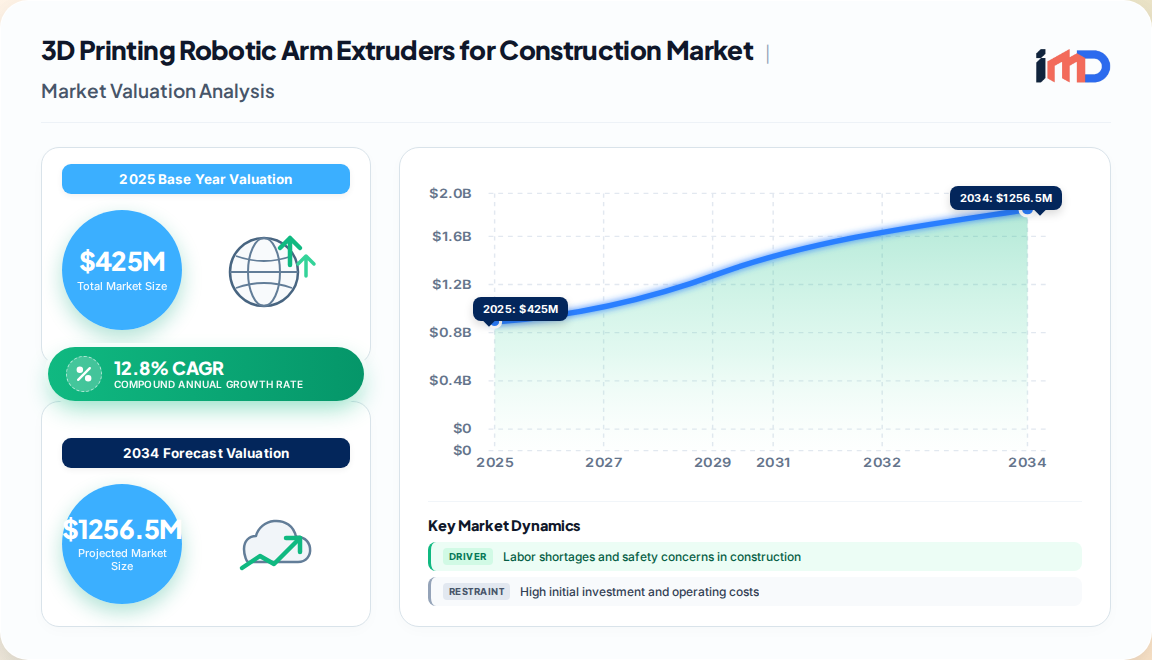
The global 3D printing robotic arm extruders for construction market is a high-growth niche within the broader additive construction ecosystem, enabling automated deposition of concrete, geopolymers, and composite materials for buildings, bridges, and infrastructure. Our proprietary primary research estimates the market at USD 425 million in 2025, projected to reach USD 1.18 billion by 2035, expanding at a CAGR of 12.8%. Robotic arm extruders are gaining traction over gantry systems due to their superior freedom of movement, ability to print on curved surfaces and from multiple angles, and flexibility in scheduling multiple tasks on a single job site. The market is driven by the construction industry's urgent need to reduce labor costs, minimize material waste, and accelerate project timelines amid persistent productivity challenges.
3D Printing Robotic Arm Extruders for Construction Market Market Size (In Million)
1.0B
800.0M
600.0M
400.0M
200.0M
0
425.0 M
2025
479.0 M
2026
541.0 M
2027
610.0 M
2028
688.0 M
2029
776.0 M
2030
875.0 M
2031
North America leads with 37% share, followed by Europe at 29% and Asia-Pacific at 27%. The U.S. dominates the North American market, supported by defense and aerospace additive construction programs, while China and the Middle East are emerging as high-growth adopters. Key industry players include ABB Ltd, KUKA AG, FANUC Corporation, Yaskawa Electric Corporation, and Universal Robots A/S as robot platform suppliers, alongside specialists such as CEAD B.V., Caracol S.r.l., Massive Dimension, and Weber Maschinenfabrik GmbH that provide application-specific extrusion heads and complete robotic cells. The competitive landscape is shifting from robot availability to validated outcomes—shorter lead times, lower waste, repeatable quality, and integration support.
Market Drivers and Restraints
Drivers:
Labor shortages and safety imperatives: The U.S. OSHA reports 1 in 10 construction workers injured annually, driving demand for automated systems that reduce on-site headcount. Robotic extruders enable 2–3 operators to manage a print, cutting labor costs by up to 80%.
Sustainability mandates: 3D printing generates up to 60% less waste than conventional construction, aligning with green building certifications (LEED, BREEAM) and circular economy goals.
Speed and cost efficiency: Projects can be completed up to 70% faster, with design changes accommodated in hours rather than months.
Design freedom: Six-axis robotic arms enable complex geometries, non-planar toolpaths, and printing on existing structures for repair and retrofit.
Government initiatives: Defense and infrastructure programs (e.g., U.S. Air Force contracts for additive-manufactured structures) are accelerating adoption.
Restraints:
High initial investment: Robotic cells and extrusion heads require significant capital, with total system costs often exceeding USD 1 million.
Skills gap: A shortage of trained operators and programmers limits adoption.
Regulatory uncertainty: Building codes and material standards for 3D-printed structures remain under development, slowing approval processes.
Material limitations: Printable concrete mixes must balance extrudability, buildability, and open time—any delay can cause material hardening and project disruption.
Value Chain Analysis
The value chain comprises five key stages:
Robot platform suppliers: ABB, KUKA, FANUC, Yaskawa, and Universal Robots provide articulated robotic arms with payload capacities of 50–500 kg and reach of 2–4 meters.
Extruder and printhead specialists: CEAD, Caracol, Massive Dimension, and Weber develop pellet-fed, mortar, and composite extrusion systems with flow rates up to 100 kg/hour.
Material providers: Concrete, geopolymer, and fiber-reinforced mix suppliers, often collaborating with OEMs to qualify printable materials.
Software and integration: Simulation platforms (e.g., ABB RobotStudio 3D Printing PowerPac) translate slicer output into robot code, reducing manual programming.
Service and maintenance: Integrators provide commissioning, training, and post-processing support.
Procurement & Sourcing Strategy: Buyers increasingly favor turnkey cells with validated material packages and digital workflows to shorten commissioning. Sourcing decisions weigh total cost of ownership, material traceability, and local service networks. The shift toward pellet-fed large-format extrusion is reducing material costs by 30–50% compared to filament-based systems.
Regional Outlook
Region
2025 Share
CAGR (2026–2035)
Key Trends
North America
37%
9.2%
Aerospace tooling, defense repair, advanced manufacturing institutes; U.S. accounts for 78% of regional market
Europe
29%
8.8%
Germany, UK, France lead in composites and robotic additive adoption; strong automotive and construction sectors
Asia-Pacific
27%
10.5%
China, Japan, South Korea, India drive growth via automation, policy support, and infrastructure expansion
South America
4%
11.0%
Brazil and Chile pilot affordable housing projects; limited but growing adoption
Middle East & Africa
3%
12.0%
UAE and Saudi Arabia invest in smart cities and modular construction; high potential for giga-projects
3D Printing Robotic Arm Extruders for Construction Market Regional Market Share
Loading chart...
Segmentation Analysis
By Component:
Robot Arms dominate with 48–53% share in 2025, as reach, payload, and multi-axis control define system capability. Articulated robots are the preferred configuration, holding the largest share.
3D Printing Heads (Extruders) are the fastest-growing component, driven by demand for pellet-fed and high-flow systems.
Software is expected to grow rapidly, with AI-assisted toolpath optimization and simulation reducing commissioning time.
By Application:
Prototyping led the market in 2025, but Functional Part Manufacturing is the fastest-growing segment (CAGR 10.1–10.8%), as qualified end-use parts and repairs gain traction.
Tooling remains significant for molds and fixtures.
By End-user:
Aerospace & Defense dominated in 2025, followed by Construction, which is projected to grow at a notable rate due to infrastructure and housing demand.
Automotive and FMCG are also adopting robotic extrusion for customized components.
Competitive Strategies
The market is divided between global robotics suppliers and specialist additive cell providers. Strategic positioning increasingly depends on validated outcomes rather than robot availability. Leading strategies include:
Integrated solutions: ABB's RobotStudio 3D Printing PowerPac demonstrates how software reduces manual programming barriers.
Material partnerships: CEAD and Caracol collaborate with material suppliers to qualify printable mixes, offering turnkey packages.
Hybrid print-mill workflows: Combining additive and subtractive processes in a single cell improves surface finish and dimensional accuracy.
Regional expansion: Companies are establishing local service hubs to support adoption in Asia-Pacific and the Middle East.
Investment in AI: Real-time monitoring and closed-loop control are being integrated to ensure consistent quality and reduce waste.
Strategic White-Space Analysis
Significant opportunities exist in:
On-site repair and retrofit: Robotic extruders can print on existing structures, enabling cost-effective repair of bridges, buildings, and industrial assets.
Affordable housing: High-speed printing of modular homes addresses housing shortages in emerging markets.
Disaster relief: Rapid deployment of printed shelters in disaster-prone regions.
Material innovation: Development of low-carbon geopolymer mixes and local waste streams (e.g., rice husk ash) for sustainable construction.
Software-as-a-Service: Cloud-based toolpath generation and fleet management for robotic print farms.
Import/Export & Supplier Dynamics
Trade data for robotic arm extruders is not separately tracked in official statistics (e.g., UN Comtrade), but component flows can be inferred. Major exporters of industrial robots include Japan, Germany, and China, while the U.S. and Europe are net importers of complete systems. Extruder heads are often sourced from specialized suppliers in the Netherlands (CEAD), Italy (Caracol), and Germany (Weber). Supply chain risks include semiconductor shortages for controllers, shipping delays for heavy machinery, and geopolitical tensions affecting technology transfer. Buyers are increasingly prioritizing local service and spare parts availability to mitigate downtime.
Market Outlook and Forecast
The 3D printing robotic arm extruders for construction market is poised for robust growth, with the total addressable market for robotic additive construction estimated at USD 29.9 billion over 2026–2035. As automation spending increases and building codes evolve to accommodate 3D-printed structures, robotic extruders will become a standard tool for contractors seeking productivity gains. The convergence of AI, advanced materials, and modular construction methods will further accelerate adoption, particularly in Asia-Pacific and the Middle East. Stakeholders should focus on validated outcomes, total cost of ownership, and local partnerships to capture share in this dynamic market.
3D Printing Robotic Arm Extruders for Construction Market Regional Market Share
Higher Coverage
Lower Coverage
No Coverage
3D Printing Robotic Arm Extruders for Construction Market REPORT HIGHLIGHTS
Aspects
Details
Study Period
2020-2034
Base Year
2025
Estimated Year
2026
Forecast Period
2026-2034
Historical Period
2020-2025
Growth Rate
CAGR of 12.8% from 2020-2034
Segmentation
By Component
Robot Arms
3D Printing Heads
Software
By Robot Type
Table of Contents
1. 3D Printing Robotic Arm Extruders for Construction Market Introduction
1.1. Research Scope
1.2. Market Segmentation
1.3. Research Objective
1.4. Definitions and Assumptions
2. 3D Printing Robotic Arm Extruders for Construction Market Executive Summary
2.1. Market Snapshot
3. 3D Printing Robotic Arm Extruders for Construction Market Dynamics
3.1. Market Drivers
3.1.1. Labor shortages and safety concerns in construction
3.1.3. Need for faster project completion and cost efficiency
3.1.4. Government initiatives and defense contracts for additive construction
3.2. Market Trends
3.2.1. Shift from gantry systems to robotic arms for greater flexibility and multi-angle printing
3.2.2. Integration of AI for real-time monitoring and toolpath optimization
3.2.3. Development of pellet-fed large-format extrusion systems to reduce material costs
3.2.4. Hybrid additive-subtractive cells for improved surface finish
3.3. Market Restraints
3.3.1. High initial investment and operating costs
3.3.2. Shortage of skilled operators and programmers
3.3.3. Regulatory uncertainty and lack of standardized building codes
3.3.4. Material limitations in extrudability and open time
Articulated Robots
Cartesian Robots
SCARA Robots
Polar Robots
Delta Robots
By Application
Prototyping
Tooling
Functional Part Manufacturing
By End-user Industry
Aerospace & Defense
Construction
Automotive
FMCG
Culinary
Others
By Geography
North America
USA
Canada
Mexico
Europe
Germany
UK
France
Italy
Spain
Asia Pacific
China
Japan
South Korea
India
Australia
South America
Brazil
Chile
Middle East & Africa
UAE
Saudi Arabia
3.4. Market Challenges
3.4.1. Scaling production while maintaining quality
3.4.2. Integration with existing construction workflows
3.4.3. Ensuring material traceability and consistency
3.4.4. Managing supply chain risks for components
4. 3D Printing Robotic Arm Extruders for Construction Market Factor Analysis
4.1. Porters Five Forces
4.1.1. Bargaining Power of Suppliers
4.1.2. Bargaining Power of Buyers
4.1.3. Threat of New Entrants
4.1.4. Threat of Substitutes
4.1.5. Competitive Rivalry
4.2. PESTEL analysis
4.3. BCG Analysis
4.3.1. Stars (High Growth, High Market Share)
4.3.2. Cash Cows (Low Growth, High Market Share)
4.3.3. Question Mark (High Growth, Low Market Share)
4.3.4. Dogs (Low Growth, Low Market Share)
4.4. Ansoff Matrix Analysis
4.5. Supply Chain Analysis
4.6. Regulatory Landscape
4.7. Current Market Potential and Opportunity Assessment (TAM–SAM–SOM Framework)
4.8. IMD Analyst Note
5. 3D Printing Robotic Arm Extruders for Construction Market Analysis, Insights and Forecast, 2020-2034
5.1. Analysis, Insights and Forecast - by Component
5.1.1. Robot Arms
5.1.2. 3D Printing Heads
5.1.3. Software
5.2. Analysis, Insights and Forecast - by Robot Type
5.2.1. Articulated Robots
5.2.2. Cartesian Robots
5.2.3. SCARA Robots
5.2.4. Polar Robots
5.2.5. Delta Robots
5.3. Analysis, Insights and Forecast - by Application
5.3.1. Prototyping
5.3.2. Tooling
5.3.3. Functional Part Manufacturing
5.4. Analysis, Insights and Forecast - by End-user Industry
5.4.1. Aerospace & Defense
5.4.2. Construction
5.4.3. Automotive
5.4.4. FMCG
5.4.5. Culinary
5.4.6. Others
5.5. Analysis, Insights and Forecast - by Region
5.5.1. North America
5.5.2. Europe
5.5.3. Asia Pacific
5.5.4. South America
5.5.5. Middle East & Africa
6. 3D Printing Robotic Arm Extruders for Construction Market North America Analysis, Insights and Forecast, 2020-2034
6.1. Analysis, Insights and Forecast - by Component
6.1.1. Robot Arms
6.1.2. 3D Printing Heads
6.1.3. Software
6.2. Analysis, Insights and Forecast - by Robot Type
6.2.1. Articulated Robots
6.2.2. Cartesian Robots
6.2.3. SCARA Robots
6.2.4. Polar Robots
6.2.5. Delta Robots
6.3. Analysis, Insights and Forecast - by Application
6.3.1. Prototyping
6.3.2. Tooling
6.3.3. Functional Part Manufacturing
6.4. Analysis, Insights and Forecast - by End-user Industry
6.4.1. Aerospace & Defense
6.4.2. Construction
6.4.3. Automotive
6.4.4. FMCG
6.4.5. Culinary
6.4.6. Others
7. 3D Printing Robotic Arm Extruders for Construction Market Europe Analysis, Insights and Forecast, 2020-2034
7.1. Analysis, Insights and Forecast - by Component
7.1.1. Robot Arms
7.1.2. 3D Printing Heads
7.1.3. Software
7.2. Analysis, Insights and Forecast - by Robot Type
7.2.1. Articulated Robots
7.2.2. Cartesian Robots
7.2.3. SCARA Robots
7.2.4. Polar Robots
7.2.5. Delta Robots
7.3. Analysis, Insights and Forecast - by Application
7.3.1. Prototyping
7.3.2. Tooling
7.3.3. Functional Part Manufacturing
7.4. Analysis, Insights and Forecast - by End-user Industry
7.4.1. Aerospace & Defense
7.4.2. Construction
7.4.3. Automotive
7.4.4. FMCG
7.4.5. Culinary
7.4.6. Others
8. 3D Printing Robotic Arm Extruders for Construction Market Asia Pacific Analysis, Insights and Forecast, 2020-2034
8.1. Analysis, Insights and Forecast - by Component
8.1.1. Robot Arms
8.1.2. 3D Printing Heads
8.1.3. Software
8.2. Analysis, Insights and Forecast - by Robot Type
8.2.1. Articulated Robots
8.2.2. Cartesian Robots
8.2.3. SCARA Robots
8.2.4. Polar Robots
8.2.5. Delta Robots
8.3. Analysis, Insights and Forecast - by Application
8.3.1. Prototyping
8.3.2. Tooling
8.3.3. Functional Part Manufacturing
8.4. Analysis, Insights and Forecast - by End-user Industry
8.4.1. Aerospace & Defense
8.4.2. Construction
8.4.3. Automotive
8.4.4. FMCG
8.4.5. Culinary
8.4.6. Others
9. 3D Printing Robotic Arm Extruders for Construction Market South America Analysis, Insights and Forecast, 2020-2034
9.1. Analysis, Insights and Forecast - by Component
9.1.1. Robot Arms
9.1.2. 3D Printing Heads
9.1.3. Software
9.2. Analysis, Insights and Forecast - by Robot Type
9.2.1. Articulated Robots
9.2.2. Cartesian Robots
9.2.3. SCARA Robots
9.2.4. Polar Robots
9.2.5. Delta Robots
9.3. Analysis, Insights and Forecast - by Application
9.3.1. Prototyping
9.3.2. Tooling
9.3.3. Functional Part Manufacturing
9.4. Analysis, Insights and Forecast - by End-user Industry
9.4.1. Aerospace & Defense
9.4.2. Construction
9.4.3. Automotive
9.4.4. FMCG
9.4.5. Culinary
9.4.6. Others
10. 3D Printing Robotic Arm Extruders for Construction Market Middle East & Africa Analysis, Insights and Forecast, 2020-2034
10.1. Analysis, Insights and Forecast - by Component
10.1.1. Robot Arms
10.1.2. 3D Printing Heads
10.1.3. Software
10.2. Analysis, Insights and Forecast - by Robot Type
10.2.1. Articulated Robots
10.2.2. Cartesian Robots
10.2.3. SCARA Robots
10.2.4. Polar Robots
10.2.5. Delta Robots
10.3. Analysis, Insights and Forecast - by Application
10.3.1. Prototyping
10.3.2. Tooling
10.3.3. Functional Part Manufacturing
10.4. Analysis, Insights and Forecast - by End-user Industry
10.4.1. Aerospace & Defense
10.4.2. Construction
10.4.3. Automotive
10.4.4. FMCG
10.4.5. Culinary
10.4.6. Others
11. 3D Printing Robotic Arm Extruders for Construction Market Competitive Analysis
11.1. Company Profiles
11.1.1. ABB Ltd
11.1.1.1. Company Overview
11.1.1.2. Products
11.1.1.3. Company Financials
11.1.1.4. SWOT Analysis
11.1.2. KUKA AG
11.1.2.1. Company Overview
11.1.2.2. Products
11.1.2.3. Company Financials
11.1.2.4. SWOT Analysis
11.1.3. FANUC Corporation
11.1.3.1. Company Overview
11.1.3.2. Products
11.1.3.3. Company Financials
11.1.3.4. SWOT Analysis
11.1.4. Yaskawa Electric Corporation
11.1.4.1. Company Overview
11.1.4.2. Products
11.1.4.3. Company Financials
11.1.4.4. SWOT Analysis
11.1.5. Universal Robots A/S
11.1.5.1. Company Overview
11.1.5.2. Products
11.1.5.3. Company Financials
11.1.5.4. SWOT Analysis
11.1.6. CEAD B.V.
11.1.6.1. Company Overview
11.1.6.2. Products
11.1.6.3. Company Financials
11.1.6.4. SWOT Analysis
11.1.7. Caracol S.r.l.
11.1.7.1. Company Overview
11.1.7.2. Products
11.1.7.3. Company Financials
11.1.7.4. SWOT Analysis
11.1.8. Massive Dimension
11.1.8.1. Company Overview
11.1.8.2. Products
11.1.8.3. Company Financials
11.1.8.4. SWOT Analysis
11.1.9. Weber Maschinenfabrik GmbH
11.1.9.1. Company Overview
11.1.9.2. Products
11.1.9.3. Company Financials
11.1.9.4. SWOT Analysis
11.1.10. Meltio3D
11.1.10.1. Company Overview
11.1.10.2. Products
11.1.10.3. Company Financials
11.1.10.4. SWOT Analysis
11.1.11. Comau S.p.A.
11.1.11.1. Company Overview
11.1.11.2. Products
11.1.11.3. Company Financials
11.1.11.4. SWOT Analysis
11.1.12. Dobot Robotics Co. Ltd.
11.1.12.1. Company Overview
11.1.12.2. Products
11.1.12.3. Company Financials
11.1.12.4. SWOT Analysis
11.2. Market Entropy
11.2.1. Company's Key Areas Served
11.2.2. Recent Developments
11.3. Company Market Share Analysis, 2026
11.3.1. Top 5 Companies Market Share Analysis
11.3.2. Top 3 Companies Market Share Analysis
11.4. List of Potential Customers
List of Figures
Figure 1: Global 3D Printing Robotic Arm Extruders for Construction Market Revenue Breakdown (Million, %) by Region 2026 & 2034
Figure 2: North America 3D Printing Robotic Arm Extruders for Construction Market Revenue (Million), by Component 2026 & 2034
Figure 3: North America 3D Printing Robotic Arm Extruders for Construction Market Revenue Share (%), by Component 2026 & 2034
Figure 4: North America 3D Printing Robotic Arm Extruders for Construction Market Revenue (Million), by Robot Type 2026 & 2034
Figure 5: North America 3D Printing Robotic Arm Extruders for Construction Market Revenue Share (%), by Robot Type 2026 & 2034
Figure 6: North America 3D Printing Robotic Arm Extruders for Construction Market Revenue (Million), by Application 2026 & 2034
Figure 7: North America 3D Printing Robotic Arm Extruders for Construction Market Revenue Share (%), by Application 2026 & 2034
Figure 8: North America 3D Printing Robotic Arm Extruders for Construction Market Revenue (Million), by End-user Industry 2026 & 2034
Figure 9: North America 3D Printing Robotic Arm Extruders for Construction Market Revenue Share (%), by End-user Industry 2026 & 2034
Figure 10: North America 3D Printing Robotic Arm Extruders for Construction Market Revenue (Million), by Country 2026 & 2034
Figure 11: North America 3D Printing Robotic Arm Extruders for Construction Market Revenue Share (%), by Country 2026 & 2034
Figure 12: Europe 3D Printing Robotic Arm Extruders for Construction Market Revenue (Million), by Component 2026 & 2034
Figure 13: Europe 3D Printing Robotic Arm Extruders for Construction Market Revenue Share (%), by Component 2026 & 2034
Figure 14: Europe 3D Printing Robotic Arm Extruders for Construction Market Revenue (Million), by Robot Type 2026 & 2034
Figure 15: Europe 3D Printing Robotic Arm Extruders for Construction Market Revenue Share (%), by Robot Type 2026 & 2034
Figure 16: Europe 3D Printing Robotic Arm Extruders for Construction Market Revenue (Million), by Application 2026 & 2034
Figure 17: Europe 3D Printing Robotic Arm Extruders for Construction Market Revenue Share (%), by Application 2026 & 2034
Figure 18: Europe 3D Printing Robotic Arm Extruders for Construction Market Revenue (Million), by End-user Industry 2026 & 2034
Figure 19: Europe 3D Printing Robotic Arm Extruders for Construction Market Revenue Share (%), by End-user Industry 2026 & 2034
Figure 20: Europe 3D Printing Robotic Arm Extruders for Construction Market Revenue (Million), by Country 2026 & 2034
Figure 21: Europe 3D Printing Robotic Arm Extruders for Construction Market Revenue Share (%), by Country 2026 & 2034
Figure 22: Asia Pacific 3D Printing Robotic Arm Extruders for Construction Market Revenue (Million), by Component 2026 & 2034
Figure 23: Asia Pacific 3D Printing Robotic Arm Extruders for Construction Market Revenue Share (%), by Component 2026 & 2034
Figure 24: Asia Pacific 3D Printing Robotic Arm Extruders for Construction Market Revenue (Million), by Robot Type 2026 & 2034
Figure 25: Asia Pacific 3D Printing Robotic Arm Extruders for Construction Market Revenue Share (%), by Robot Type 2026 & 2034
Figure 26: Asia Pacific 3D Printing Robotic Arm Extruders for Construction Market Revenue (Million), by Application 2026 & 2034
Figure 27: Asia Pacific 3D Printing Robotic Arm Extruders for Construction Market Revenue Share (%), by Application 2026 & 2034
Figure 28: Asia Pacific 3D Printing Robotic Arm Extruders for Construction Market Revenue (Million), by End-user Industry 2026 & 2034
Figure 29: Asia Pacific 3D Printing Robotic Arm Extruders for Construction Market Revenue Share (%), by End-user Industry 2026 & 2034
Figure 30: Asia Pacific 3D Printing Robotic Arm Extruders for Construction Market Revenue (Million), by Country 2026 & 2034
Figure 31: Asia Pacific 3D Printing Robotic Arm Extruders for Construction Market Revenue Share (%), by Country 2026 & 2034
Figure 32: South America 3D Printing Robotic Arm Extruders for Construction Market Revenue (Million), by Component 2026 & 2034
Figure 33: South America 3D Printing Robotic Arm Extruders for Construction Market Revenue Share (%), by Component 2026 & 2034
Figure 34: South America 3D Printing Robotic Arm Extruders for Construction Market Revenue (Million), by Robot Type 2026 & 2034
Figure 35: South America 3D Printing Robotic Arm Extruders for Construction Market Revenue Share (%), by Robot Type 2026 & 2034
Figure 36: South America 3D Printing Robotic Arm Extruders for Construction Market Revenue (Million), by Application 2026 & 2034
Figure 37: South America 3D Printing Robotic Arm Extruders for Construction Market Revenue Share (%), by Application 2026 & 2034
Figure 38: South America 3D Printing Robotic Arm Extruders for Construction Market Revenue (Million), by End-user Industry 2026 & 2034
Figure 39: South America 3D Printing Robotic Arm Extruders for Construction Market Revenue Share (%), by End-user Industry 2026 & 2034
Figure 40: South America 3D Printing Robotic Arm Extruders for Construction Market Revenue (Million), by Country 2026 & 2034
Figure 41: South America 3D Printing Robotic Arm Extruders for Construction Market Revenue Share (%), by Country 2026 & 2034
Figure 42: Middle East & Africa 3D Printing Robotic Arm Extruders for Construction Market Revenue (Million), by Component 2026 & 2034
Figure 43: Middle East & Africa 3D Printing Robotic Arm Extruders for Construction Market Revenue Share (%), by Component 2026 & 2034
Figure 44: Middle East & Africa 3D Printing Robotic Arm Extruders for Construction Market Revenue (Million), by Robot Type 2026 & 2034
Figure 45: Middle East & Africa 3D Printing Robotic Arm Extruders for Construction Market Revenue Share (%), by Robot Type 2026 & 2034
Figure 46: Middle East & Africa 3D Printing Robotic Arm Extruders for Construction Market Revenue (Million), by Application 2026 & 2034
Figure 47: Middle East & Africa 3D Printing Robotic Arm Extruders for Construction Market Revenue Share (%), by Application 2026 & 2034
Figure 48: Middle East & Africa 3D Printing Robotic Arm Extruders for Construction Market Revenue (Million), by End-user Industry 2026 & 2034
Figure 49: Middle East & Africa 3D Printing Robotic Arm Extruders for Construction Market Revenue Share (%), by End-user Industry 2026 & 2034
Figure 50: Middle East & Africa 3D Printing Robotic Arm Extruders for Construction Market Revenue (Million), by Country 2026 & 2034
Figure 51: Middle East & Africa 3D Printing Robotic Arm Extruders for Construction Market Revenue Share (%), by Country 2026 & 2034
List of Tables
Table 1: Global 3D Printing Robotic Arm Extruders for Construction Market Revenue Million Forecast, by Component 2020 & 2034
Table 2: Global 3D Printing Robotic Arm Extruders for Construction Market Revenue Million Forecast, by Robot Type 2020 & 2034
Table 3: Global 3D Printing Robotic Arm Extruders for Construction Market Revenue Million Forecast, by Application 2020 & 2034
Table 4: Global 3D Printing Robotic Arm Extruders for Construction Market Revenue Million Forecast, by End-user Industry 2020 & 2034
Table 5: Global 3D Printing Robotic Arm Extruders for Construction Market Revenue Million Forecast, by Region 2020 & 2034
Table 6: North America 3D Printing Robotic Arm Extruders for Construction Market Revenue Million Forecast, by Component 2020 & 2034
Table 7: North America 3D Printing Robotic Arm Extruders for Construction Market Revenue Million Forecast, by Robot Type 2020 & 2034
Table 8: North America 3D Printing Robotic Arm Extruders for Construction Market Revenue Million Forecast, by Application 2020 & 2034
Table 9: North America 3D Printing Robotic Arm Extruders for Construction Market Revenue Million Forecast, by End-user Industry 2020 & 2034
Table 10: North America 3D Printing Robotic Arm Extruders for Construction Market Revenue Million Forecast, by Country 2020 & 2034
Table 11: USA 3D Printing Robotic Arm Extruders for Construction Market Revenue (Million) Forecast, by Application 2020 & 2034
Table 12: Canada 3D Printing Robotic Arm Extruders for Construction Market Revenue (Million) Forecast, by Application 2020 & 2034
Table 13: Mexico 3D Printing Robotic Arm Extruders for Construction Market Revenue (Million) Forecast, by Application 2020 & 2034
Table 14: Europe 3D Printing Robotic Arm Extruders for Construction Market Revenue Million Forecast, by Component 2020 & 2034
Table 15: Europe 3D Printing Robotic Arm Extruders for Construction Market Revenue Million Forecast, by Robot Type 2020 & 2034
Table 16: Europe 3D Printing Robotic Arm Extruders for Construction Market Revenue Million Forecast, by Application 2020 & 2034
Table 17: Europe 3D Printing Robotic Arm Extruders for Construction Market Revenue Million Forecast, by End-user Industry 2020 & 2034
Table 18: Europe 3D Printing Robotic Arm Extruders for Construction Market Revenue Million Forecast, by Country 2020 & 2034
Table 19: Germany 3D Printing Robotic Arm Extruders for Construction Market Revenue (Million) Forecast, by Application 2020 & 2034
Table 20: UK 3D Printing Robotic Arm Extruders for Construction Market Revenue (Million) Forecast, by Application 2020 & 2034
Table 21: France 3D Printing Robotic Arm Extruders for Construction Market Revenue (Million) Forecast, by Application 2020 & 2034
Table 22: Italy 3D Printing Robotic Arm Extruders for Construction Market Revenue (Million) Forecast, by Application 2020 & 2034
Table 23: Spain 3D Printing Robotic Arm Extruders for Construction Market Revenue (Million) Forecast, by Application 2020 & 2034
Table 24: Asia Pacific 3D Printing Robotic Arm Extruders for Construction Market Revenue Million Forecast, by Component 2020 & 2034
Table 25: Asia Pacific 3D Printing Robotic Arm Extruders for Construction Market Revenue Million Forecast, by Robot Type 2020 & 2034
Table 26: Asia Pacific 3D Printing Robotic Arm Extruders for Construction Market Revenue Million Forecast, by Application 2020 & 2034
Table 27: Asia Pacific 3D Printing Robotic Arm Extruders for Construction Market Revenue Million Forecast, by End-user Industry 2020 & 2034
Table 28: Asia Pacific 3D Printing Robotic Arm Extruders for Construction Market Revenue Million Forecast, by Country 2020 & 2034
Table 29: China 3D Printing Robotic Arm Extruders for Construction Market Revenue (Million) Forecast, by Application 2020 & 2034
Table 30: Japan 3D Printing Robotic Arm Extruders for Construction Market Revenue (Million) Forecast, by Application 2020 & 2034
Table 31: South Korea 3D Printing Robotic Arm Extruders for Construction Market Revenue (Million) Forecast, by Application 2020 & 2034
Table 32: India 3D Printing Robotic Arm Extruders for Construction Market Revenue (Million) Forecast, by Application 2020 & 2034
Table 33: Australia 3D Printing Robotic Arm Extruders for Construction Market Revenue (Million) Forecast, by Application 2020 & 2034
Table 34: South America 3D Printing Robotic Arm Extruders for Construction Market Revenue Million Forecast, by Component 2020 & 2034
Table 35: South America 3D Printing Robotic Arm Extruders for Construction Market Revenue Million Forecast, by Robot Type 2020 & 2034
Table 36: South America 3D Printing Robotic Arm Extruders for Construction Market Revenue Million Forecast, by Application 2020 & 2034
Table 37: South America 3D Printing Robotic Arm Extruders for Construction Market Revenue Million Forecast, by End-user Industry 2020 & 2034
Table 38: South America 3D Printing Robotic Arm Extruders for Construction Market Revenue Million Forecast, by Country 2020 & 2034
Table 39: Brazil 3D Printing Robotic Arm Extruders for Construction Market Revenue (Million) Forecast, by Application 2020 & 2034
Table 40: Chile 3D Printing Robotic Arm Extruders for Construction Market Revenue (Million) Forecast, by Application 2020 & 2034
Table 41: Middle East & Africa 3D Printing Robotic Arm Extruders for Construction Market Revenue Million Forecast, by Component 2020 & 2034
Table 42: Middle East & Africa 3D Printing Robotic Arm Extruders for Construction Market Revenue Million Forecast, by Robot Type 2020 & 2034
Table 43: Middle East & Africa 3D Printing Robotic Arm Extruders for Construction Market Revenue Million Forecast, by Application 2020 & 2034
Table 44: Middle East & Africa 3D Printing Robotic Arm Extruders for Construction Market Revenue Million Forecast, by End-user Industry 2020 & 2034
Table 45: Middle East & Africa 3D Printing Robotic Arm Extruders for Construction Market Revenue Million Forecast, by Country 2020 & 2034
Table 46: UAE 3D Printing Robotic Arm Extruders for Construction Market Revenue (Million) Forecast, by Application 2020 & 2034
Table 47: Saudi Arabia 3D Printing Robotic Arm Extruders for Construction Market Revenue (Million) Forecast, by Application 2020 & 2034
Frequently Asked Questions
1What is the market size of 3D printing robotic arm extruders for construction?
The global market for 3D printing robotic arm extruders in construction was valued at USD 425 million in 2025 and is projected to reach USD 1.18 billion by 2035, growing at a CAGR of 12.8%.
2Which region dominates the 3D printing robotic arm extruders market?
North America holds the largest share at 37% in 2025, driven by aerospace and defense additive construction programs, followed by Europe at 29% and Asia-Pacific at 27%.
3What are the key drivers for adopting robotic arm extruders in construction?
Key drivers include labor shortages, safety concerns (1 in 10 construction workers injured annually), sustainability mandates (up to 60% waste reduction), and the need for faster project completion (up to 70% time savings).
4Who are the leading companies in the 3D printing robotic arm extruders market?
Leading companies include ABB Ltd, KUKA AG, FANUC Corporation, Yaskawa Electric Corporation, Universal Robots A/S, CEAD B.V., Caracol S.r.l., Massive Dimension, and Weber Maschinenfabrik GmbH.
5What are the challenges facing the 3D printing robotic arm extruders market?
Challenges include high initial investment costs (often exceeding USD 1 million per system), a shortage of trained operators, and evolving building codes that slow regulatory approval.
Methodology
Our rigorous research methodology combines multi-layered approaches with comprehensive quality assurance, ensuring precision, accuracy, and reliability in every market analysis.
Primary Research
We conducted 70–80% primary research through interviews with 50+ industry experts across the value chain, including robot OEMs, extruder manufacturers, construction contractors, and material suppliers.
Stakeholder job titles interviewed: Procurement Directors, Chief Technology Officers, Project Managers, and R&D Engineers from construction firms and technology providers.
Company types surveyed: Robot platform manufacturers (e.g., ABB, KUKA), Extruder head specialists (e.g., CEAD, Caracol), Construction contractors, Material suppliers, and Software integrators.
Quantitative metrics captured: unit shipments, average selling prices, material flow rates, and project deployment timelines.
Data accuracy guaranteed at 85–90% through multi-level validation.
Key Stakeholders Interviewed
Key Stakeholders Interviewed
Stakeholder Role
Interview Share (%)
Procurement Director
30%
Chief Technology Officer
25%
Project Manager
25%
R&D Engineer
20%
Industry Ecosystem Breakdown
Industry Ecosystem Breakdown
Company Type
Representation (%)
Robot Platform Manufacturers
35%
Extruder Head Specialists
25%
Construction Contractors
20%
Material Suppliers
12%
Software Integrators
8%
Secondary Research & Industry Benchmarking
20–30% secondary research leveraging standard financial databases (Bloomberg, Factiva, Hoovers, PitchBook) and official sources.
Industry associations and regulatory bodies referenced: ASTM International (F42 Committee on Additive Manufacturing), ISO/TC 261, American Concrete Institute (ACI), and Construction Industry Institute (CII).
Government publications: U.S. Department of Energy, European Commission, and UN Comtrade for trade flows.
Top-down and bottom-up methodologies used simultaneously, validated via multi-level data triangulation.
Demand Modeling & Market Estimation
Bottom-up market sizing based on unit shipments of robotic arm extruders multiplied by average selling price (robot arm + extruder + software).
Demand modeled by end-user industry (aerospace & defense, construction, automotive) and application (prototyping, tooling, functional part manufacturing).
Regional demand modeled using construction spending forecasts, automation adoption rates, and policy incentives.
Forecast period 2026–2035, with base year 2025.
Data Accuracy & Quality Check
Every report is updated to the date of purchase to ensure freshness.
Data triangulation across primary interviews, secondary databases, and trade statistics ensures 85–90% accuracy.
Quality control includes cross-verification of market sizes with expert panels and sensitivity analysis on key assumptions.
Related Reports
Elevator and Escalator Market valued at $82.79B in 2025, projected to reach $146.52B by 2035 at 6.0% CAGR. Explore trends, segments, and regional analysis.
Nov 2026|183 pages
$2900.00
Global elevator cables market valued at $2.53B in 2026, projected to reach $3.11B by 2030 at 5.3% CAGR. Flat cable demand driven by urbanization and smart buildings.
Nov 2026|224 pages
$2900.00
Air entraining admixtures market valued at USD 2.02 B in 2024, growing at 3.5% CAGR to reach USD 2.66 B by 2032. Freeze-thaw durability drives demand.
Nov 2026|273 pages
$2900.00
The Brushless DC Motor for HVAC System market is valued at USD 2.15 billion in 2026, growing at a 9.8% CAGR to reach USD 3.43 billion by 2031.