About Insight Market Data

Insight Market Data is a premier market research and business consulting firm headquartered in Pune, India, providing syndicated research reports, customized intelligence studies, and strategic advisory services. Renowned academic institutions and Fortune 500 corporations worldwide rely on Insight Market Data's research repository to navigate evolving global and regional business environments. Covering 46 diverse industries across 25 major international economies, our comprehensive database delivers thousands of verified statistics and granular market evaluations. By combining industry-leading analytical methodologies with the direct insights of seasoned industry leaders and subject-matter experts, we deliver actionable intelligence spanning historical performance benchmarks to rigorous multi-year forecasts. We empower organizations to make confident, data-driven decisions across pivotal domains including Machinery & Equipment, Chemicals & Materials, Pharmaceuticals & Healthcare, Food & Beverages, Consumer Goods, Energy & Power, Automotive & Transportation, Electronics & Semiconductors, Medical Devices, Telecommunications, Emerging Technologies, Agriculture, and Packaging. Our multidisciplinary analyst teams provide an objective 360-degree perspective, tailoring every engagement to address complex strategic challenges with exceptional analytical rigor.

Leveraging advanced BI-powered analytics and predictive modeling, Insight Market Data uncovers high-impact market opportunities and competitive differentiators for ambitious enterprises. We continuously refine our research methodologies in accordance with global industry standards, tracking real-time market shifts to ensure our reports are consistently accurate, actionable, and delivered on schedule. Our analysts conduct methodical data validation, rigorous compliance checks, and exhaustive primary and secondary research to maintain the highest levels of data integrity and transparency. We partner closely with corporate strategists, investment groups, and business executives to translate intricate market intelligence into clear, actionable roadmaps for sustainable growth. With operational presence across Washington, USA, and Vimannagar, Pune, India, Insight Market Data ensures direct access to dedicated research specialists and responsive customer support to answer your most strategic questions.

report thumbnailBrushless DC Motor for HVAC System
Real Estate and Construction / MARKET REPORT

Brushless DC Motor for HVAC System | Insight Market Data

Brushless DC Motor for HVAC System by Rotor Type (Inner Rotor, Outer Rotor), by Speed (Below 500 RPM, 501–2, 000 RPM, 2, 001–10, 000 RPM, Above 10, 000 RPM), by Power Rating (Up to 100 kVA, 100 kVA–1 MVA, 1–25 MVA, Above 25 MVA), by Application (Fan and Fan-Coil Units, Air-Handling Units, Condenser Fans, Refrigeration Compressors, Liquid-Cooling Pumps), by End User (Residential HVAC, Commercial HVAC, Data Centers, Healthcare Facilities, Industrial HVAC), by North America (USA, Canada, Mexico), by Europe (Germany, UK, France, Italy, Spain), by Asia Pacific (China, Japan, South Korea, India, Vietnam), by South America (Brazil, Argentina), by Middle East & Africa (Saudi Arabia, UAE, South Africa) Forecast 2026-2034

© Nov 26, 2026|Base Year: 2025|192 Pages
Amit Mardhekar

Amit Mardhekar

Research Analyst

Main Logo

Brushless DC Motor for HVAC Market Size & Forecast 2026-2031


/
/
Independent Intelligence for decisions that move markets
+12315155523[email protected]
  • Home
  • About Us
  • Industries
    • Automotive
    • Consumer Goods and Services
    • Financial Services and Investment Intelligence
    • Home and Property Improvement
    • Logistics
    • Retail
    • Agriculture
    • Healthcare
    • Animal Nutrition & Wellness
    • Chemicals & Materials
    • Energy & Power
    • Food & Beverage
    • Hospitality and Tourism
    • Manufacturing Products and Services
    • Professional and Commercial Services
    • Real Estate and Construction
    • Aerospace & Defense
    • Packaging
    • Technology, Media and Telecom
  • Services
  • Contact
Main Logo
  • Home
  • About Us
  • Industries
    • Automotive
    • Consumer Goods and Services
    • Financial Services and Investment Intelligence
    • Home and Property Improvement
    • Logistics
    • Retail
    • Agriculture
    • Healthcare
    • Animal Nutrition & Wellness
    • Chemicals & Materials
    • Energy & Power
    • Food & Beverage
    • Hospitality and Tourism
    • Manufacturing Products and Services
    • Professional and Commercial Services
    • Real Estate and Construction
    • Aerospace & Defense
    • Packaging
    • Technology, Media and Telecom
  • Services
  • Contact
Talk to an analyst

Business Address

Head Office

Ansec House 3 rd floor Tank Road, Yerwada, Pune, Maharashtra 411014

Contact Information

Craig Francis

Business Development Head

+12315155523

[email protected]

Secure Payment Partners

payment image

© 2026 PRDUA Research & Media Private Limited, All rights reserved

••
Home
Industries
Real Estate and Construction
Retail
Logistics
Packaging
Automotive
Healthcare
Agriculture
Energy & Power
Food & Beverage
Aerospace & Defense
Chemicals & Materials
Hospitality and Tourism
Consumer Goods and Services
Animal Nutrition & Wellness
Real Estate and Construction
Home and Property Improvement
Technology, Media and Telecom
Manufacturing Products and Services
Financial Services and Investment Intelligence
Privacy Policy
Terms and Conditions
FAQ
Brushless DC Motor for HVAC System CAGR, market size, market share

Executive Overview

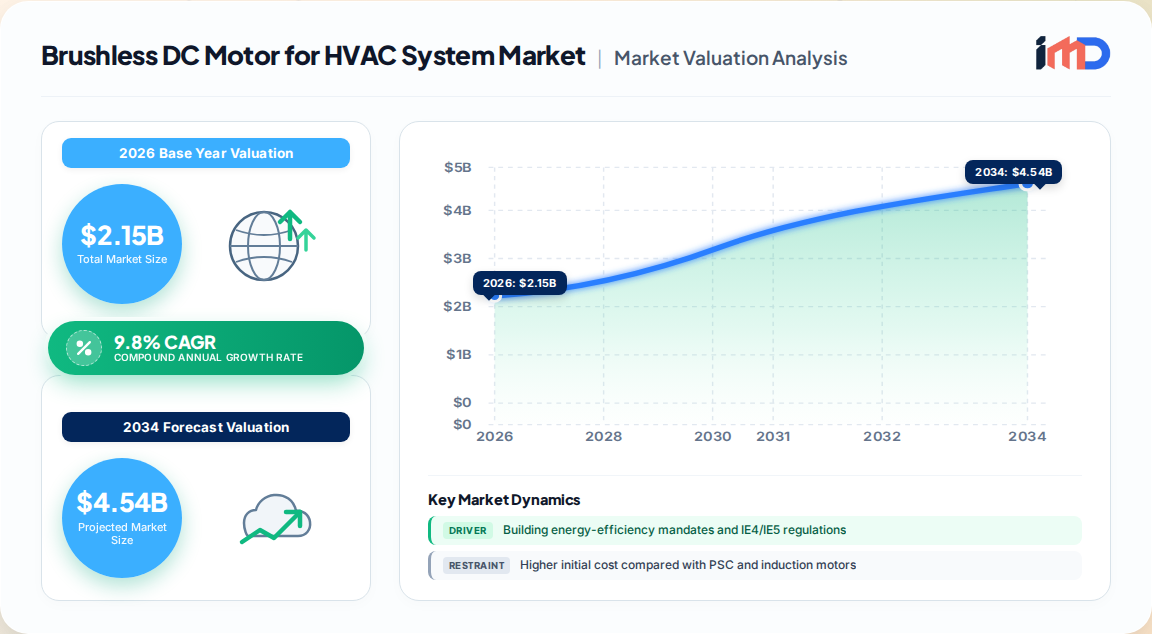
The global Brushless DC Motor (BLDC) for HVAC System market is experiencing a structural transformation driven by building energy-efficiency mandates, data-center thermal load growth, and a broad retrofit cycle replacing shaded-pole and PSC induction motors. Our proprietary primary research estimates the HVAC-dedicated BLDC motor market at USD 2.15 billion in 2026, advancing at a 9.8% CAGR to reach USD 3.43 billion by 2031. This outperforms the broader BLDC motor market (8.03% CAGR) because HVAC applications benefit from long duty cycles (6,000–8,000 hours annually), which compress payback periods and strengthen the replacement business case.

Brushless DC Motor for HVAC System Market Size (In Billion)

4.0B
3.0B
2.0B
1.0B
0
1.958 B
2025
2.150 B
2026
2.361 B
2027
2.592 B
2028
2.846 B
2029
3.125 B
2030
3.431 B
2031
Main Logo

HVAC motors represent approximately 10.3% of the total BLDC motor market value in 2026, but their share is rising faster than broader industrial segments. The category encompasses fan-coil units, air-handling units, condenser fans, ECM blowers, refrigeration compressors, and liquid-cooling pumps. Asia-Pacific accounts for 49% of global demand, with North America and Europe at 21% and 19% respectively, reflecting the concentration of motor manufacturing and HVAC equipment OEMs in China, Japan, and South Korea.

Market Drivers and Demand Dynamics

The HVAC BLDC motor market is propelled by four quantifiable demand vectors:

  • Regulatory efficiency floors: The EU's extended IE4 requirement (from July 2026, covering 0.75–1,000 kW) and the U.S. DOE's IE4 mid-range motor rule (June 2027) are forcing HVAC equipment OEMs to re-engineer fan and pump motor platforms. BLDC architectures routinely achieve 85–92% efficiency versus 60–70% for PSC motors in fan applications.
  • Data-center cooling capex: High-density AI racks have shifted thermal management toward high-speed BLDC fans, blowers, and liquid-cooling pumps. This sub-segment is our fastest-growing application, at an estimated 11.4% CAGR through 2031.
  • HVAC retrofit economics: Commercial buildings, hospitals, and data centers operate HVAC systems for 6,000–8,000 hours per year. A typical 1 HP BLDC fan motor retrofit can save 40–60% of motor energy consumption, yielding payback in 18–30 months at commercial electricity rates.
  • Refrigerant transition: The shift to lower-GWP refrigerants (R-32, R-454B) requires variable-speed compressors and electronically commutated motors, accelerating BLDC adoption in residential and light-commercial systems.

Restraints and Challenges

  • Higher first cost: BLDC motors carry a 1.8–2.5x premium over PSC induction motors at the component level. This is the single largest adoption barrier in price-sensitive residential replacement markets, particularly in South Asia and Latin America.
  • Rare-earth magnet exposure: Sintered NdFeB magnets account for an estimated 18–25% of BLDC motor bill-of-materials cost. Supply concentration in China creates pricing volatility that directly pressures HVAC motor margins.
  • Electronic control complexity: Integrated drive electronics require EMC compliance (CISPR 14-1, IEC 61000-6-3) and thermal derating design, lengthening HVAC OEM qualification cycles by 4–7 months.
  • Technician familiarity: Variable-speed ECM troubleshooting requires different field skills than PSC motor replacement, slowing aftermarket adoption in the contractor channel.

Segmentation Analysis

The HVAC BLDC motor market is best understood through four segmentation lenses:

Segment Lens Dominant Category Share / CAGR (2026–2031)
Rotor Type Inner rotor ~66% share; outer rotor growing at 9.1% CAGR
Speed 2,001–10,000 RPM ~39% share; >10,000 RPM at 8.6% CAGR
Power Rating Up to 100 kVA ~78% share; 100 kVA–1 MVA at 9.7% CAGR
Application Fan/fan-coil ~54% share; liquid-cooling pumps at 11.4% CAGR

Inner-rotor designs dominate HVAC fan applications due to better heat dissipation in continuous duty. Outer-rotor motors are gaining in compact condenser fan and air-handler applications where axial length constraints matter. Sensorless control architectures now represent the majority of new HVAC motor designs, reducing harness complexity and cost.

Regional Outlook

  • Asia-Pacific (49% share): Manufacturing concentration in China, Japan, South Korea, and Vietnam; China alone accounts for 63% of global EV sales and a comparable share of HVAC equipment production. Domestic efficiency standards (GB 21455) are tightening, pulling BLDC adoption into the residential split-AC segment.
  • North America (21%): DOE efficiency rules, data-center construction, and premium residential HVAC replacement drive demand. The U.S. is the fastest-growing HVAC BLDC motor market in the region, with 9.9% CAGR.
  • Europe (19%): EU IE4/IE5 requirements and the EPBD building-performance directive make Europe the most regulation-driven market. Germany, France, and the UK lead; Eastern Europe is a lower-cost manufacturing base for motor assembly.
  • Middle East & Africa (5%): Saudi Vision 2030 and UAE building programs are specifying BLDC fan motors in new commercial HVAC capacity.
  • South America (6%): Brazil and Mexico anchor demand; price sensitivity remains the key constraint.

Brushless DC Motor for HVAC System Regional Market Share

Loading chart...
Main Logo

Competitive Landscape and Strategic Developments

The HVAC BLDC motor supply chain is moderately concentrated, with Japanese, U.S., European, and Chinese suppliers competing on efficiency, integration, and cost. Key players include Nidec Corporation, Johnson Electric, MinebeaMitsumi, AMETEK, Allied Motion (Allient), Regal Rexnord, Maxon Motor, Oriental Motor, Portescap, and Buhler Motor, alongside Chinese specialists such as Moons' Industries, Linix Motor, and Shenzhen Tronsun Motor.

Recent strategic developments:

  • May 2026: ABB announced an IE6-class hazardous-area motor, signaling the efficiency frontier extending toward integrated permanent-magnet designs.
  • 2026: Multiple industrial automation firms began deploying AI-integrated BLDC motors with adaptive control for precision HVAC and robotics applications, improving part-load efficiency.
  • 2025–2026: Motor suppliers accelerated rare-earth-free and ferrite-magnet rotor designs to hedge NdFeB price volatility, with early commercial units targeting hybrid and HVAC oil-pump applications.
  • 2026: Bison expanded its BLDC motor portfolio for data-center cooling, including immersion-cooling and direct-to-chip liquid loops.

Value Chain and Procurement Strategy

The HVAC BLDC motor value chain runs from rare-earth and electrical steel suppliers through magnet manufacturers, motor winders, and electronics assemblers to HVAC equipment OEMs and aftermarket distributors. Critical procurement considerations:

  • Magnet sourcing diversification: Qualifying non-Chinese NdFeB supply or ferrite-based alternatives reduces tariff and export-control exposure.
  • Integrated vs. discrete drive electronics: Integrated motor-drive units lower installation cost but complicate field service; discrete controllers offer easier replacement.
  • OEM qualification timing: EMC and reliability testing add 4–7 months; early supplier engagement in HVAC platform design is a competitive advantage.
  • Aftermarket channel: The replacement motor market (particularly 1/3–1 HP ECM fan motors) is a high-margin opportunity where contractor familiarity and drop-in compatibility drive share.

Import/Export and Supplier Dynamics

Global trade in HVAC BLDC motors flows primarily from manufacturing hubs in China, Vietnam, and Mexico to demand centers in North America and Europe. China remains the dominant exporter of small and medium BLDC motors, while Japan and Germany lead in high-efficiency, premium integrated units. U.S. import data shows HVAC motor imports growing in line with data-center and commercial construction activity. Tariff exposure and Section 301 duties have prompted some North American OEMs to diversify toward Vietnam and Mexico assembly. Our primary interviews indicate that lead times for customized HVAC BLDC motors have normalized to 10–14 weeks in 2026, down from 20+ weeks during the 2021–2022 supply disruption.

Brushless DC Motor for HVAC System Regional Market Share

Higher Coverage
Lower Coverage
No Coverage

Brushless DC Motor for HVAC System REPORT HIGHLIGHTS

AspectsDetails
Study Period2020-2034
Base Year2026
Estimated Year2026
Forecast Period2026-2034
Historical Period2020-2025
Growth RateCAGR of 9.8% from 2020-2034
Segmentation
  • By Rotor Type

    • Inner Rotor
    • Outer Rotor
  • By Speed

    • Below 500 RPM
    • 501–2

Table of Contents

  1. 1. Brushless DC Motor for HVAC System Introduction
    • 1.1. Research Scope
    • 1.2. Market Segmentation
    • 1.3. Research Objective
    • 1.4. Definitions and Assumptions
  2. 2. Brushless DC Motor for HVAC System Executive Summary
    • 2.1. Market Snapshot
  3. 3. Brushless DC Motor for HVAC System Dynamics
    • 3.1. Market Drivers
      • 3.1.1. Building energy-efficiency mandates and IE4/IE5 regulations
      • 3.1.2. Data-center thermal load growth and liquid-cooling adoption
      • 3.1.3. HVAC retrofit economics with 18–30 month payback
      • 3.1.4. Refrigerant transition requiring variable-speed compressors
    • 3.2. Market Trends
      • 3.2.1. Shift toward rare-earth-free and ferrite-magnet BLDC rotor designs
      • 3.2.2. Adoption of high-speed BLDC motors in AI data-center cooling systems
      • 3.2.3. Integration of AI-driven motor controllers with predictive maintenance
      • 3.2.4. Sensorless control and integrated motor-drive architectures
    • 3.3. Market Restraints
      • 3.3.1. Higher initial cost compared with PSC and induction motors
      • 3.3.2. Rare-earth magnet supply concentration and price volatility
      • 3.3.3. Electronic-control complexity and EMC qualification requirements
      • 3.3.4. Technician familiarity with variable-speed ECM troubleshooting
    • 3.4. Market Challenges
Author
Amit Mardhekar

Amit Mardhekar

Research Analyst

I am a Research Analyst driving market intelligence at the intersection of Healthcare, Life Sciences, Materials, and Real Estate and Construction landscapes. Specializing in Pharmaceuticals, Medical Devices, and Construction infrastructure, my expertise lies in market sizing, trend analysis, and demand forecasting. I focus on translating regulatory shifts and complex industry trends into strategic insights that help global clients identify and confidently seize new growth opportunities.

WHY IMD

Verified research

Analyst-reviewed data

Updated Nov 26, 2026

sponsor image
sponsor image
sponsor image
sponsor image
sponsor image
sponsor image
sponsor image
sponsor image
sponsor image
sponsor image
sponsor image
sponsor image
sponsor image
sponsor image
sponsor image
sponsor image
sponsor image
sponsor image
sponsor image
sponsor image
artwork spiralartwork spiralRelated Reports
artwork underline

Elevator and Escalator Market valued at $82.79B in 2025, projected to reach $146.52B by 2035 at 6.0% CAGR. Explore trends, segments, and regional analysis.

Nov 2026|183 pages
$2900.00
CUSTOM INTELLIGENCE

Tailored for you

  • In-depth Analysis Tailored to Specified Regions or Segments
  • Company Profiles Customized to User Preferences
  • Customized Evaluation of Competitive Landscape to Meet Your Needs
Ask for customization
avatar

Analyst at Providence Strategic Partners at Petaling Jaya

Jared Wan

I have received the report already. Thanks you for your help.it has been a pleasure working with you. Thank you again for a good quality report

avatar

Internationalization Director

Santiago Mejia Molina

Yes, as a matter of fact we are totally satisfied with both reports that we have purchased and will continue to do so during this process of the internationalization of our brand.

avatar

Head of Product Management and Marketing

Olaf Gleibe

We are using your report, and it gave us valuable information."

avatar

Regional Director, Marketing and Business Development

Lina Lim

We've received the report and have reviewed the content. Overall, it looks great and aligns closely with the data we can verify based on our industry knowledge.

avatar

VP of Sales

DIGGLE Representative

Thank you very much for sharing the report. I have reviewed it and I am very satisfied with the quality and the insights it provides. It will certainly be valuable for our internal discussions.

Get In Touch

Elevator Cables Market Size, CAGR & Forecast 2025-2035

Global elevator cables market valued at $2.53B in 2026, projected to reach $3.11B by 2030 at 5.3% CAGR. Flat cable demand driven by urbanization and smart buildings.

Nov 2026|224 pages
$2900.00View report

Air Entraining Admixtures for Concrete Market 2024-2032

Air entraining admixtures market valued at USD 2.02 B in 2024, growing at 3.5% CAGR to reach USD 2.66 B by 2032. Freeze-thaw durability drives demand.

Nov 2026|273 pages
$2900.00View report

3D Printing Robotic Arm Extruders for Construction Market 2026

3D printing robotic arm extruders for construction market to reach $1.18B by 2035 at 12.8% CAGR, driven by automation and sustainable building.

Nov 2026|193 pages
$2900.00View report
Elevator and Escalator Market Size, Growth & Forecast 2026-2035
View report
000 RPM
  • 2
  • 001–10
  • 000 RPM
  • Above 10
  • 000 RPM
  • By Power Rating

    • Up to 100 kVA
    • 100 kVA–1 MVA
    • 1–25 MVA
    • Above 25 MVA
  • By Application

    • Fan and Fan-Coil Units
    • Air-Handling Units
    • Condenser Fans
    • Refrigeration Compressors
    • Liquid-Cooling Pumps
  • By End User

    • Residential HVAC
    • Commercial HVAC
    • Data Centers
    • Healthcare Facilities
    • Industrial HVAC
  • By Geography
    • North America

      • USA
      • Canada
      • Mexico
    • Europe

      • Germany
      • UK
      • France
      • Italy
      • Spain
    • Asia Pacific

      • China
      • Japan
      • South Korea
      • India
      • Vietnam
    • South America

      • Brazil
      • Argentina
    • Middle East & Africa

      • Saudi Arabia
      • UAE
      • South Africa
    • 3.4.1. Managing NdFeB magnet cost volatility across HVAC motor BOMs
    • 3.4.2. Shortening 4–7 month OEM qualification cycles for integrated drives
    • 3.4.3. Scaling aftermarket contractor adoption of ECM technology
  • 4. Brushless DC Motor for HVAC System Factor Analysis
    • 4.1. Porters Five Forces
      • 4.1.1. Bargaining Power of Suppliers
      • 4.1.2. Bargaining Power of Buyers
      • 4.1.3. Threat of New Entrants
      • 4.1.4. Threat of Substitutes
      • 4.1.5. Competitive Rivalry
    • 4.2. PESTEL analysis
    • 4.3. BCG Analysis
      • 4.3.1. Stars (High Growth, High Market Share)
      • 4.3.2. Cash Cows (Low Growth, High Market Share)
      • 4.3.3. Question Mark (High Growth, Low Market Share)
      • 4.3.4. Dogs (Low Growth, Low Market Share)
    • 4.4. Ansoff Matrix Analysis
    • 4.5. Supply Chain Analysis
    • 4.6. Regulatory Landscape
    • 4.7. Current Market Potential and Opportunity Assessment (TAM–SAM–SOM Framework)
    • 4.8. IMD Analyst Note
  • 5. Brushless DC Motor for HVAC System Analysis, Insights and Forecast, 2020-2034
    • 5.1. Analysis, Insights and Forecast - by Rotor Type
      • 5.1.1. Inner Rotor
      • 5.1.2. Outer Rotor
    • 5.2. Analysis, Insights and Forecast - by Speed
      • 5.2.1. Below 500 RPM
      • 5.2.2. 501–2
      • 5.2.3. 000 RPM
      • 5.2.4. 2
      • 5.2.5. 001–10
      • 5.2.6. 000 RPM
      • 5.2.7. Above 10
      • 5.2.8. 000 RPM
    • 5.3. Analysis, Insights and Forecast - by Power Rating
      • 5.3.1. Up to 100 kVA
      • 5.3.2. 100 kVA–1 MVA
      • 5.3.3. 1–25 MVA
      • 5.3.4. Above 25 MVA
    • 5.4. Analysis, Insights and Forecast - by Application
      • 5.4.1. Fan and Fan-Coil Units
      • 5.4.2. Air-Handling Units
      • 5.4.3. Condenser Fans
      • 5.4.4. Refrigeration Compressors
      • 5.4.5. Liquid-Cooling Pumps
    • 5.5. Analysis, Insights and Forecast - by End User
      • 5.5.1. Residential HVAC
      • 5.5.2. Commercial HVAC
      • 5.5.3. Data Centers
      • 5.5.4. Healthcare Facilities
      • 5.5.5. Industrial HVAC
    • 5.6. Analysis, Insights and Forecast - by Region
      • 5.6.1. North America
      • 5.6.2. Europe
      • 5.6.3. Asia Pacific
      • 5.6.4. South America
      • 5.6.5. Middle East & Africa
  • 6. Brushless DC Motor for HVAC System North America Analysis, Insights and Forecast, 2020-2034
    • 6.1. Analysis, Insights and Forecast - by Rotor Type
      • 6.1.1. Inner Rotor
      • 6.1.2. Outer Rotor
    • 6.2. Analysis, Insights and Forecast - by Speed
      • 6.2.1. Below 500 RPM
      • 6.2.2. 501–2
      • 6.2.3. 000 RPM
      • 6.2.4. 2
      • 6.2.5. 001–10
      • 6.2.6. 000 RPM
      • 6.2.7. Above 10
      • 6.2.8. 000 RPM
    • 6.3. Analysis, Insights and Forecast - by Power Rating
      • 6.3.1. Up to 100 kVA
      • 6.3.2. 100 kVA–1 MVA
      • 6.3.3. 1–25 MVA
      • 6.3.4. Above 25 MVA
    • 6.4. Analysis, Insights and Forecast - by Application
      • 6.4.1. Fan and Fan-Coil Units
      • 6.4.2. Air-Handling Units
      • 6.4.3. Condenser Fans
      • 6.4.4. Refrigeration Compressors
      • 6.4.5. Liquid-Cooling Pumps
    • 6.5. Analysis, Insights and Forecast - by End User
      • 6.5.1. Residential HVAC
      • 6.5.2. Commercial HVAC
      • 6.5.3. Data Centers
      • 6.5.4. Healthcare Facilities
      • 6.5.5. Industrial HVAC
  • 7. Brushless DC Motor for HVAC System Europe Analysis, Insights and Forecast, 2020-2034
    • 7.1. Analysis, Insights and Forecast - by Rotor Type
      • 7.1.1. Inner Rotor
      • 7.1.2. Outer Rotor
    • 7.2. Analysis, Insights and Forecast - by Speed
      • 7.2.1. Below 500 RPM
      • 7.2.2. 501–2
      • 7.2.3. 000 RPM
      • 7.2.4. 2
      • 7.2.5. 001–10
      • 7.2.6. 000 RPM
      • 7.2.7. Above 10
      • 7.2.8. 000 RPM
    • 7.3. Analysis, Insights and Forecast - by Power Rating
      • 7.3.1. Up to 100 kVA
      • 7.3.2. 100 kVA–1 MVA
      • 7.3.3. 1–25 MVA
      • 7.3.4. Above 25 MVA
    • 7.4. Analysis, Insights and Forecast - by Application
      • 7.4.1. Fan and Fan-Coil Units
      • 7.4.2. Air-Handling Units
      • 7.4.3. Condenser Fans
      • 7.4.4. Refrigeration Compressors
      • 7.4.5. Liquid-Cooling Pumps
    • 7.5. Analysis, Insights and Forecast - by End User
      • 7.5.1. Residential HVAC
      • 7.5.2. Commercial HVAC
      • 7.5.3. Data Centers
      • 7.5.4. Healthcare Facilities
      • 7.5.5. Industrial HVAC
  • 8. Brushless DC Motor for HVAC System Asia Pacific Analysis, Insights and Forecast, 2020-2034
    • 8.1. Analysis, Insights and Forecast - by Rotor Type
      • 8.1.1. Inner Rotor
      • 8.1.2. Outer Rotor
    • 8.2. Analysis, Insights and Forecast - by Speed
      • 8.2.1. Below 500 RPM
      • 8.2.2. 501–2
      • 8.2.3. 000 RPM
      • 8.2.4. 2
      • 8.2.5. 001–10
      • 8.2.6. 000 RPM
      • 8.2.7. Above 10
      • 8.2.8. 000 RPM
    • 8.3. Analysis, Insights and Forecast - by Power Rating
      • 8.3.1. Up to 100 kVA
      • 8.3.2. 100 kVA–1 MVA
      • 8.3.3. 1–25 MVA
      • 8.3.4. Above 25 MVA
    • 8.4. Analysis, Insights and Forecast - by Application
      • 8.4.1. Fan and Fan-Coil Units
      • 8.4.2. Air-Handling Units
      • 8.4.3. Condenser Fans
      • 8.4.4. Refrigeration Compressors
      • 8.4.5. Liquid-Cooling Pumps
    • 8.5. Analysis, Insights and Forecast - by End User
      • 8.5.1. Residential HVAC
      • 8.5.2. Commercial HVAC
      • 8.5.3. Data Centers
      • 8.5.4. Healthcare Facilities
      • 8.5.5. Industrial HVAC
  • 9. Brushless DC Motor for HVAC System South America Analysis, Insights and Forecast, 2020-2034
    • 9.1. Analysis, Insights and Forecast - by Rotor Type
      • 9.1.1. Inner Rotor
      • 9.1.2. Outer Rotor
    • 9.2. Analysis, Insights and Forecast - by Speed
      • 9.2.1. Below 500 RPM
      • 9.2.2. 501–2
      • 9.2.3. 000 RPM
      • 9.2.4. 2
      • 9.2.5. 001–10
      • 9.2.6. 000 RPM
      • 9.2.7. Above 10
      • 9.2.8. 000 RPM
    • 9.3. Analysis, Insights and Forecast - by Power Rating
      • 9.3.1. Up to 100 kVA
      • 9.3.2. 100 kVA–1 MVA
      • 9.3.3. 1–25 MVA
      • 9.3.4. Above 25 MVA
    • 9.4. Analysis, Insights and Forecast - by Application
      • 9.4.1. Fan and Fan-Coil Units
      • 9.4.2. Air-Handling Units
      • 9.4.3. Condenser Fans
      • 9.4.4. Refrigeration Compressors
      • 9.4.5. Liquid-Cooling Pumps
    • 9.5. Analysis, Insights and Forecast - by End User
      • 9.5.1. Residential HVAC
      • 9.5.2. Commercial HVAC
      • 9.5.3. Data Centers
      • 9.5.4. Healthcare Facilities
      • 9.5.5. Industrial HVAC
  • 10. Brushless DC Motor for HVAC System Middle East & Africa Analysis, Insights and Forecast, 2020-2034
    • 10.1. Analysis, Insights and Forecast - by Rotor Type
      • 10.1.1. Inner Rotor
      • 10.1.2. Outer Rotor
    • 10.2. Analysis, Insights and Forecast - by Speed
      • 10.2.1. Below 500 RPM
      • 10.2.2. 501–2
      • 10.2.3. 000 RPM
      • 10.2.4. 2
      • 10.2.5. 001–10
      • 10.2.6. 000 RPM
      • 10.2.7. Above 10
      • 10.2.8. 000 RPM
    • 10.3. Analysis, Insights and Forecast - by Power Rating
      • 10.3.1. Up to 100 kVA
      • 10.3.2. 100 kVA–1 MVA
      • 10.3.3. 1–25 MVA
      • 10.3.4. Above 25 MVA
    • 10.4. Analysis, Insights and Forecast - by Application
      • 10.4.1. Fan and Fan-Coil Units
      • 10.4.2. Air-Handling Units
      • 10.4.3. Condenser Fans
      • 10.4.4. Refrigeration Compressors
      • 10.4.5. Liquid-Cooling Pumps
    • 10.5. Analysis, Insights and Forecast - by End User
      • 10.5.1. Residential HVAC
      • 10.5.2. Commercial HVAC
      • 10.5.3. Data Centers
      • 10.5.4. Healthcare Facilities
      • 10.5.5. Industrial HVAC
  • 11. Brushless DC Motor for HVAC System Competitive Analysis
    • 11.1. Company Profiles
      • 11.1.1. Nidec Corporation
        • 11.1.1.1. Company Overview
        • 11.1.1.2. Products
        • 11.1.1.3. Company Financials
        • 11.1.1.4. SWOT Analysis
      • 11.1.2. Johnson Electric Holdings Limited
        • 11.1.2.1. Company Overview
        • 11.1.2.2. Products
        • 11.1.2.3. Company Financials
        • 11.1.2.4. SWOT Analysis
      • 11.1.3. MinebeaMitsumi Inc.
        • 11.1.3.1. Company Overview
        • 11.1.3.2. Products
        • 11.1.3.3. Company Financials
        • 11.1.3.4. SWOT Analysis
      • 11.1.4. AMETEK Inc.
        • 11.1.4.1. Company Overview
        • 11.1.4.2. Products
        • 11.1.4.3. Company Financials
        • 11.1.4.4. SWOT Analysis
      • 11.1.5. Allient Inc. (Allied Motion)
        • 11.1.5.1. Company Overview
        • 11.1.5.2. Products
        • 11.1.5.3. Company Financials
        • 11.1.5.4. SWOT Analysis
      • 11.1.6. Regal Rexnord Corporation
        • 11.1.6.1. Company Overview
        • 11.1.6.2. Products
        • 11.1.6.3. Company Financials
        • 11.1.6.4. SWOT Analysis
      • 11.1.7. Maxon Motor
        • 11.1.7.1. Company Overview
        • 11.1.7.2. Products
        • 11.1.7.3. Company Financials
        • 11.1.7.4. SWOT Analysis
      • 11.1.8. Oriental Motor
        • 11.1.8.1. Company Overview
        • 11.1.8.2. Products
        • 11.1.8.3. Company Financials
        • 11.1.8.4. SWOT Analysis
      • 11.1.9. Portescap
        • 11.1.9.1. Company Overview
        • 11.1.9.2. Products
        • 11.1.9.3. Company Financials
        • 11.1.9.4. SWOT Analysis
      • 11.1.10. Buhler Motor
        • 11.1.10.1. Company Overview
        • 11.1.10.2. Products
        • 11.1.10.3. Company Financials
        • 11.1.10.4. SWOT Analysis
      • 11.1.11. Moons' Industries
        • 11.1.11.1. Company Overview
        • 11.1.11.2. Products
        • 11.1.11.3. Company Financials
        • 11.1.11.4. SWOT Analysis
      • 11.1.12. Linix Motor
        • 11.1.12.1. Company Overview
        • 11.1.12.2. Products
        • 11.1.12.3. Company Financials
        • 11.1.12.4. SWOT Analysis
      • 11.1.13. Shenzhen Tronsun Motor
        • 11.1.13.1. Company Overview
        • 11.1.13.2. Products
        • 11.1.13.3. Company Financials
        • 11.1.13.4. SWOT Analysis
      • 11.1.14. Jiangsu Wheatstone Electrical Technology
        • 11.1.14.1. Company Overview
        • 11.1.14.2. Products
        • 11.1.14.3. Company Financials
        • 11.1.14.4. SWOT Analysis
      • 11.1.15. Assun Motor
        • 11.1.15.1. Company Overview
        • 11.1.15.2. Products
        • 11.1.15.3. Company Financials
        • 11.1.15.4. SWOT Analysis
      • 11.1.16. 3X Motion Technologies
        • 11.1.16.1. Company Overview
        • 11.1.16.2. Products
        • 11.1.16.3. Company Financials
        • 11.1.16.4. SWOT Analysis
      • 11.1.17. Anaheim Automation
        • 11.1.17.1. Company Overview
        • 11.1.17.2. Products
        • 11.1.17.3. Company Financials
        • 11.1.17.4. SWOT Analysis
      • 11.1.18. ElectroCraft
        • 11.1.18.1. Company Overview
        • 11.1.18.2. Products
        • 11.1.18.3. Company Financials
        • 11.1.18.4. SWOT Analysis
      • 11.1.19. Teco Electric
        • 11.1.19.1. Company Overview
        • 11.1.19.2. Products
        • 11.1.19.3. Company Financials
        • 11.1.19.4. SWOT Analysis
      • 11.1.20. ARC Systems
        • 11.1.20.1. Company Overview
        • 11.1.20.2. Products
        • 11.1.20.3. Company Financials
        • 11.1.20.4. SWOT Analysis
    • 11.2. Market Entropy
      • 11.2.1. Company's Key Areas Served
      • 11.2.2. Recent Developments
    • 11.3. Company Market Share Analysis, 2026
      • 11.3.1. Top 5 Companies Market Share Analysis
      • 11.3.2. Top 3 Companies Market Share Analysis
    • 11.4. List of Potential Customers
  • List of Figures

    1. Figure 1: Global Brushless DC Motor for HVAC System Revenue Breakdown (Billion, %) by Region 2026 & 2034
    2. Figure 2: North America Brushless DC Motor for HVAC System Revenue (Billion), by Rotor Type 2026 & 2034
    3. Figure 3: North America Brushless DC Motor for HVAC System Revenue Share (%), by Rotor Type 2026 & 2034
    4. Figure 4: North America Brushless DC Motor for HVAC System Revenue (Billion), by Speed 2026 & 2034
    5. Figure 5: North America Brushless DC Motor for HVAC System Revenue Share (%), by Speed 2026 & 2034
    6. Figure 6: North America Brushless DC Motor for HVAC System Revenue (Billion), by Power Rating 2026 & 2034
    7. Figure 7: North America Brushless DC Motor for HVAC System Revenue Share (%), by Power Rating 2026 & 2034
    8. Figure 8: North America Brushless DC Motor for HVAC System Revenue (Billion), by Application 2026 & 2034
    9. Figure 9: North America Brushless DC Motor for HVAC System Revenue Share (%), by Application 2026 & 2034
    10. Figure 10: North America Brushless DC Motor for HVAC System Revenue (Billion), by End User 2026 & 2034
    11. Figure 11: North America Brushless DC Motor for HVAC System Revenue Share (%), by End User 2026 & 2034
    12. Figure 12: North America Brushless DC Motor for HVAC System Revenue (Billion), by Country 2026 & 2034
    13. Figure 13: North America Brushless DC Motor for HVAC System Revenue Share (%), by Country 2026 & 2034
    14. Figure 14: Europe Brushless DC Motor for HVAC System Revenue (Billion), by Rotor Type 2026 & 2034
    15. Figure 15: Europe Brushless DC Motor for HVAC System Revenue Share (%), by Rotor Type 2026 & 2034
    16. Figure 16: Europe Brushless DC Motor for HVAC System Revenue (Billion), by Speed 2026 & 2034
    17. Figure 17: Europe Brushless DC Motor for HVAC System Revenue Share (%), by Speed 2026 & 2034
    18. Figure 18: Europe Brushless DC Motor for HVAC System Revenue (Billion), by Power Rating 2026 & 2034
    19. Figure 19: Europe Brushless DC Motor for HVAC System Revenue Share (%), by Power Rating 2026 & 2034
    20. Figure 20: Europe Brushless DC Motor for HVAC System Revenue (Billion), by Application 2026 & 2034
    21. Figure 21: Europe Brushless DC Motor for HVAC System Revenue Share (%), by Application 2026 & 2034
    22. Figure 22: Europe Brushless DC Motor for HVAC System Revenue (Billion), by End User 2026 & 2034
    23. Figure 23: Europe Brushless DC Motor for HVAC System Revenue Share (%), by End User 2026 & 2034
    24. Figure 24: Europe Brushless DC Motor for HVAC System Revenue (Billion), by Country 2026 & 2034
    25. Figure 25: Europe Brushless DC Motor for HVAC System Revenue Share (%), by Country 2026 & 2034
    26. Figure 26: Asia Pacific Brushless DC Motor for HVAC System Revenue (Billion), by Rotor Type 2026 & 2034
    27. Figure 27: Asia Pacific Brushless DC Motor for HVAC System Revenue Share (%), by Rotor Type 2026 & 2034
    28. Figure 28: Asia Pacific Brushless DC Motor for HVAC System Revenue (Billion), by Speed 2026 & 2034
    29. Figure 29: Asia Pacific Brushless DC Motor for HVAC System Revenue Share (%), by Speed 2026 & 2034
    30. Figure 30: Asia Pacific Brushless DC Motor for HVAC System Revenue (Billion), by Power Rating 2026 & 2034
    31. Figure 31: Asia Pacific Brushless DC Motor for HVAC System Revenue Share (%), by Power Rating 2026 & 2034
    32. Figure 32: Asia Pacific Brushless DC Motor for HVAC System Revenue (Billion), by Application 2026 & 2034
    33. Figure 33: Asia Pacific Brushless DC Motor for HVAC System Revenue Share (%), by Application 2026 & 2034
    34. Figure 34: Asia Pacific Brushless DC Motor for HVAC System Revenue (Billion), by End User 2026 & 2034
    35. Figure 35: Asia Pacific Brushless DC Motor for HVAC System Revenue Share (%), by End User 2026 & 2034
    36. Figure 36: Asia Pacific Brushless DC Motor for HVAC System Revenue (Billion), by Country 2026 & 2034
    37. Figure 37: Asia Pacific Brushless DC Motor for HVAC System Revenue Share (%), by Country 2026 & 2034
    38. Figure 38: South America Brushless DC Motor for HVAC System Revenue (Billion), by Rotor Type 2026 & 2034
    39. Figure 39: South America Brushless DC Motor for HVAC System Revenue Share (%), by Rotor Type 2026 & 2034
    40. Figure 40: South America Brushless DC Motor for HVAC System Revenue (Billion), by Speed 2026 & 2034
    41. Figure 41: South America Brushless DC Motor for HVAC System Revenue Share (%), by Speed 2026 & 2034
    42. Figure 42: South America Brushless DC Motor for HVAC System Revenue (Billion), by Power Rating 2026 & 2034
    43. Figure 43: South America Brushless DC Motor for HVAC System Revenue Share (%), by Power Rating 2026 & 2034
    44. Figure 44: South America Brushless DC Motor for HVAC System Revenue (Billion), by Application 2026 & 2034
    45. Figure 45: South America Brushless DC Motor for HVAC System Revenue Share (%), by Application 2026 & 2034
    46. Figure 46: South America Brushless DC Motor for HVAC System Revenue (Billion), by End User 2026 & 2034
    47. Figure 47: South America Brushless DC Motor for HVAC System Revenue Share (%), by End User 2026 & 2034
    48. Figure 48: South America Brushless DC Motor for HVAC System Revenue (Billion), by Country 2026 & 2034
    49. Figure 49: South America Brushless DC Motor for HVAC System Revenue Share (%), by Country 2026 & 2034
    50. Figure 50: Middle East & Africa Brushless DC Motor for HVAC System Revenue (Billion), by Rotor Type 2026 & 2034
    51. Figure 51: Middle East & Africa Brushless DC Motor for HVAC System Revenue Share (%), by Rotor Type 2026 & 2034
    52. Figure 52: Middle East & Africa Brushless DC Motor for HVAC System Revenue (Billion), by Speed 2026 & 2034
    53. Figure 53: Middle East & Africa Brushless DC Motor for HVAC System Revenue Share (%), by Speed 2026 & 2034
    54. Figure 54: Middle East & Africa Brushless DC Motor for HVAC System Revenue (Billion), by Power Rating 2026 & 2034
    55. Figure 55: Middle East & Africa Brushless DC Motor for HVAC System Revenue Share (%), by Power Rating 2026 & 2034
    56. Figure 56: Middle East & Africa Brushless DC Motor for HVAC System Revenue (Billion), by Application 2026 & 2034
    57. Figure 57: Middle East & Africa Brushless DC Motor for HVAC System Revenue Share (%), by Application 2026 & 2034
    58. Figure 58: Middle East & Africa Brushless DC Motor for HVAC System Revenue (Billion), by End User 2026 & 2034
    59. Figure 59: Middle East & Africa Brushless DC Motor for HVAC System Revenue Share (%), by End User 2026 & 2034
    60. Figure 60: Middle East & Africa Brushless DC Motor for HVAC System Revenue (Billion), by Country 2026 & 2034
    61. Figure 61: Middle East & Africa Brushless DC Motor for HVAC System Revenue Share (%), by Country 2026 & 2034

    List of Tables

    1. Table 1: Global Brushless DC Motor for HVAC System Revenue Billion Forecast, by Rotor Type 2020 & 2034
    2. Table 2: Global Brushless DC Motor for HVAC System Revenue Billion Forecast, by Speed 2020 & 2034
    3. Table 3: Global Brushless DC Motor for HVAC System Revenue Billion Forecast, by Power Rating 2020 & 2034
    4. Table 4: Global Brushless DC Motor for HVAC System Revenue Billion Forecast, by Application 2020 & 2034
    5. Table 5: Global Brushless DC Motor for HVAC System Revenue Billion Forecast, by End User 2020 & 2034
    6. Table 6: Global Brushless DC Motor for HVAC System Revenue Billion Forecast, by Region 2020 & 2034
    7. Table 7: North America Brushless DC Motor for HVAC System Revenue Billion Forecast, by Rotor Type 2020 & 2034
    8. Table 8: North America Brushless DC Motor for HVAC System Revenue Billion Forecast, by Speed 2020 & 2034
    9. Table 9: North America Brushless DC Motor for HVAC System Revenue Billion Forecast, by Power Rating 2020 & 2034
    10. Table 10: North America Brushless DC Motor for HVAC System Revenue Billion Forecast, by Application 2020 & 2034
    11. Table 11: North America Brushless DC Motor for HVAC System Revenue Billion Forecast, by End User 2020 & 2034
    12. Table 12: North America Brushless DC Motor for HVAC System Revenue Billion Forecast, by Country 2020 & 2034
    13. Table 13: USA Brushless DC Motor for HVAC System Revenue (Billion) Forecast, by Application 2020 & 2034
    14. Table 14: Canada Brushless DC Motor for HVAC System Revenue (Billion) Forecast, by Application 2020 & 2034
    15. Table 15: Mexico Brushless DC Motor for HVAC System Revenue (Billion) Forecast, by Application 2020 & 2034
    16. Table 16: Europe Brushless DC Motor for HVAC System Revenue Billion Forecast, by Rotor Type 2020 & 2034
    17. Table 17: Europe Brushless DC Motor for HVAC System Revenue Billion Forecast, by Speed 2020 & 2034
    18. Table 18: Europe Brushless DC Motor for HVAC System Revenue Billion Forecast, by Power Rating 2020 & 2034
    19. Table 19: Europe Brushless DC Motor for HVAC System Revenue Billion Forecast, by Application 2020 & 2034
    20. Table 20: Europe Brushless DC Motor for HVAC System Revenue Billion Forecast, by End User 2020 & 2034
    21. Table 21: Europe Brushless DC Motor for HVAC System Revenue Billion Forecast, by Country 2020 & 2034
    22. Table 22: Germany Brushless DC Motor for HVAC System Revenue (Billion) Forecast, by Application 2020 & 2034
    23. Table 23: UK Brushless DC Motor for HVAC System Revenue (Billion) Forecast, by Application 2020 & 2034
    24. Table 24: France Brushless DC Motor for HVAC System Revenue (Billion) Forecast, by Application 2020 & 2034
    25. Table 25: Italy Brushless DC Motor for HVAC System Revenue (Billion) Forecast, by Application 2020 & 2034
    26. Table 26: Spain Brushless DC Motor for HVAC System Revenue (Billion) Forecast, by Application 2020 & 2034
    27. Table 27: Asia Pacific Brushless DC Motor for HVAC System Revenue Billion Forecast, by Rotor Type 2020 & 2034
    28. Table 28: Asia Pacific Brushless DC Motor for HVAC System Revenue Billion Forecast, by Speed 2020 & 2034
    29. Table 29: Asia Pacific Brushless DC Motor for HVAC System Revenue Billion Forecast, by Power Rating 2020 & 2034
    30. Table 30: Asia Pacific Brushless DC Motor for HVAC System Revenue Billion Forecast, by Application 2020 & 2034
    31. Table 31: Asia Pacific Brushless DC Motor for HVAC System Revenue Billion Forecast, by End User 2020 & 2034
    32. Table 32: Asia Pacific Brushless DC Motor for HVAC System Revenue Billion Forecast, by Country 2020 & 2034
    33. Table 33: China Brushless DC Motor for HVAC System Revenue (Billion) Forecast, by Application 2020 & 2034
    34. Table 34: Japan Brushless DC Motor for HVAC System Revenue (Billion) Forecast, by Application 2020 & 2034
    35. Table 35: South Korea Brushless DC Motor for HVAC System Revenue (Billion) Forecast, by Application 2020 & 2034
    36. Table 36: India Brushless DC Motor for HVAC System Revenue (Billion) Forecast, by Application 2020 & 2034
    37. Table 37: Vietnam Brushless DC Motor for HVAC System Revenue (Billion) Forecast, by Application 2020 & 2034
    38. Table 38: South America Brushless DC Motor for HVAC System Revenue Billion Forecast, by Rotor Type 2020 & 2034
    39. Table 39: South America Brushless DC Motor for HVAC System Revenue Billion Forecast, by Speed 2020 & 2034
    40. Table 40: South America Brushless DC Motor for HVAC System Revenue Billion Forecast, by Power Rating 2020 & 2034
    41. Table 41: South America Brushless DC Motor for HVAC System Revenue Billion Forecast, by Application 2020 & 2034
    42. Table 42: South America Brushless DC Motor for HVAC System Revenue Billion Forecast, by End User 2020 & 2034
    43. Table 43: South America Brushless DC Motor for HVAC System Revenue Billion Forecast, by Country 2020 & 2034
    44. Table 44: Brazil Brushless DC Motor for HVAC System Revenue (Billion) Forecast, by Application 2020 & 2034
    45. Table 45: Argentina Brushless DC Motor for HVAC System Revenue (Billion) Forecast, by Application 2020 & 2034
    46. Table 46: Middle East & Africa Brushless DC Motor for HVAC System Revenue Billion Forecast, by Rotor Type 2020 & 2034
    47. Table 47: Middle East & Africa Brushless DC Motor for HVAC System Revenue Billion Forecast, by Speed 2020 & 2034
    48. Table 48: Middle East & Africa Brushless DC Motor for HVAC System Revenue Billion Forecast, by Power Rating 2020 & 2034
    49. Table 49: Middle East & Africa Brushless DC Motor for HVAC System Revenue Billion Forecast, by Application 2020 & 2034
    50. Table 50: Middle East & Africa Brushless DC Motor for HVAC System Revenue Billion Forecast, by End User 2020 & 2034
    51. Table 51: Middle East & Africa Brushless DC Motor for HVAC System Revenue Billion Forecast, by Country 2020 & 2034
    52. Table 52: Saudi Arabia Brushless DC Motor for HVAC System Revenue (Billion) Forecast, by Application 2020 & 2034
    53. Table 53: UAE Brushless DC Motor for HVAC System Revenue (Billion) Forecast, by Application 2020 & 2034
    54. Table 54: South Africa Brushless DC Motor for HVAC System Revenue (Billion) Forecast, by Application 2020 & 2034

    Frequently Asked Questions

    1What is the market size of the Brushless DC Motor for HVAC System market?

    Our proprietary research values the HVAC-dedicated BLDC motor market at USD 2.15 billion in 2026, with a projected 9.8% CAGR to reach USD 3.43 billion by 2031.

    2Which region dominates the Brushless DC Motor for HVAC System market?

    Asia-Pacific holds approximately 49% of global HVAC BLDC motor demand, driven by manufacturing concentration in China, Japan, and South Korea.

    3What is the fastest-growing application for BLDC motors in HVAC?

    Data-center liquid-cooling pumps and high-speed blowers represent the fastest-growing application, at an estimated 11.4% CAGR through 2031.

    4Who are the leading companies in the Brushless DC Motor for HVAC System market?

    Key suppliers include Nidec Corporation, Johnson Electric, MinebeaMitsumi, AMETEK, Allied Motion (Allient), Regal Rexnord, Maxon Motor, Oriental Motor, and Chinese specialists such as Moons' Industries.

    5What is the main restraint on BLDC motor adoption in HVAC?

    Higher first cost is the primary barrier, with BLDC motors carrying a 1.8–2.5x premium over PSC induction motors, slowing adoption in price-sensitive residential replacement markets.

    Methodology

    Our rigorous research methodology combines multi-layered approaches with comprehensive quality assurance, ensuring precision, accuracy, and reliability in every market analysis.

    Primary Research

    • 70–80% of our data foundation is derived from primary research, including structured interviews with HVAC equipment OEMs, motor manufacturers, and aftermarket distributors across 14 countries.
    • We conduct quarterly interviews with component engineers, procurement directors, HVAC system designers, and factory automation leads to capture real-time pricing, lead times, and specification trends.
    • Primary research also includes plant-level visits and teardown analysis of HVAC BLDC motor assemblies to validate bill-of-materials and efficiency claims.

    Key Stakeholders Interviewed

    Main Logo
    Key Stakeholders Interviewed
    Stakeholder RoleInterview Share (%)
    Procurement Director32%
    Component Engineer28%
    HVAC System Designer22%
    Factory Automation Lead18%

    Industry Ecosystem Breakdown

    Main Logo
    Industry Ecosystem Breakdown
    Company TypeRepresentation (%)
    HVAC equipment OEMs35%
    BLDC motor manufacturers30%
    Electronics and drive suppliers15%
    Aftermarket distributors12%
    Engineering and consulting firms8%

    Secondary Research & Industry Benchmarking

    • 20–30% of our data is sourced from official multilateral and governmental databases, including UN Comtrade, World Bank, OECD, US ITC, Eurostat, and national energy agencies.
    • We benchmark efficiency standards against recognized non-profit technical bodies such as IEC, AHRI, and ASHRAE, and cross-reference building codes from the EU EPBD and U.S. DOE.
    • Financial and corporate data is validated through Bloomberg, Factiva, Hoovers, and PitchBook, alongside official company filings and .gov regulatory dockets.

    Demand Modeling & Market Estimation

    • We apply simultaneous top-down and bottom-up methodologies, triangulating HVAC equipment shipment volumes, motor content per unit, and replacement rates.
    • Bottom-up market sizing uses quantitative metrics including HVAC unit shipments by capacity band, average motor content per system, BLDC penetration rates, and aftermarket replacement ratios.
    • Demand models are segmented by rotor type, speed band, power rating, and application, with separate retrofit and new-construction demand curves.

    Data Accuracy & Quality Check

    • Every report is updated to the date of purchase, incorporating the latest regulatory filings, trade data, and primary interview findings.
    • We guarantee an estimated data accuracy level of 85–90%, validated through multi-level data triangulation and internal peer review.
    • All market forecasts are scenario-tested against regulatory timelines, raw-material price volatility, and HVAC construction cycles before publication.