Insight Market Data is a premier market research and business consulting firm headquartered in Pune, India, providing syndicated research reports, customized intelligence studies, and strategic advisory services. Renowned academic institutions and Fortune 500 corporations worldwide rely on Insight Market Data's research repository to navigate evolving global and regional business environments. Covering 46 diverse industries across 25 major international economies, our comprehensive database delivers thousands of verified statistics and granular market evaluations. By combining industry-leading analytical methodologies with the direct insights of seasoned industry leaders and subject-matter experts, we deliver actionable intelligence spanning historical performance benchmarks to rigorous multi-year forecasts. We empower organizations to make confident, data-driven decisions across pivotal domains including Machinery & Equipment, Chemicals & Materials, Pharmaceuticals & Healthcare, Food & Beverages, Consumer Goods, Energy & Power, Automotive & Transportation, Electronics & Semiconductors, Medical Devices, Telecommunications, Emerging Technologies, Agriculture, and Packaging. Our multidisciplinary analyst teams provide an objective 360-degree perspective, tailoring every engagement to address complex strategic challenges with exceptional analytical rigor.
Leveraging advanced BI-powered analytics and predictive modeling, Insight Market Data uncovers high-impact market opportunities and competitive differentiators for ambitious enterprises. We continuously refine our research methodologies in accordance with global industry standards, tracking real-time market shifts to ensure our reports are consistently accurate, actionable, and delivered on schedule. Our analysts conduct methodical data validation, rigorous compliance checks, and exhaustive primary and secondary research to maintain the highest levels of data integrity and transparency. We partner closely with corporate strategists, investment groups, and business executives to translate intricate market intelligence into clear, actionable roadmaps for sustainable growth. With operational presence across Washington, USA, and Vimannagar, Pune, India, Insight Market Data ensures direct access to dedicated research specialists and responsive customer support to answer your most strategic questions.
Treatment Resistant Depression Therapeutics Market 2025-2035 | Insight Market Data
Treatment Resistant Depression Therapeutics Market | Insight Market Data
Treatment Resistant Depression Therapeutics Market by Drug Type (NMDA, Antidepressants, Antipsychotics, Others), by Distribution Channel (Hospital Pharmacies, Drug Stores & Retail Pharmacies, Online Pharmacies), by North America (USA, Canada, Mexico), by Europe (Germany, France, Italy, Spain, UK), by Asia Pacific (Japan, China, India, Australia), by South America (Brazil, Argentina), by Middle East & Africa Forecast 2026-2034
The Friedreich's Ataxia Drug Market is valued at USD 1.12 Billion in 2025, growing at a 13.04% CAGR to reach USD 2.07 Billion by 2030.
Nov 2026|243 pages
$4480
Post Harvest Treatment Market to reach $14.38B by 2034, growing at 7.00% CAGR. Explore key growth drivers, trends, and regional insights shaping the industry.
Nov 2026|276 pages
$4480
Patient Temperature Monitoring Market to hit $7.38 Billion by 2034, growing at 8.06% CAGR. In-depth analysis of devices, wearables, sites, and regional trends.
Nov 2026|206 pages
$4480
Spain patient temperature monitoring market valued at USD 186.4 million in 2025, projected to grow at 5.8% CAGR through 2035, driven by surgical volumes and ICU demand.
Executive Overview: The Treatment-Resistant Depression Therapeutics Market
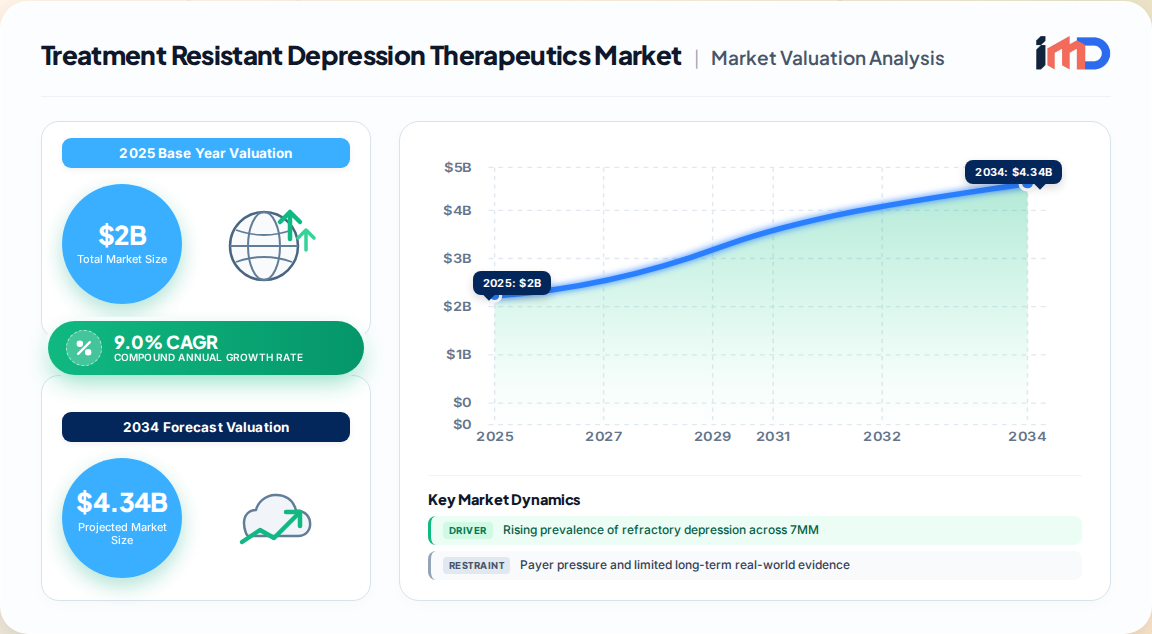
The global treatment-resistant depression (TRD) therapeutics market was valued at USD 2.0 Billion in 2025 and is projected to reach USD 4.8 Billion by 2035, expanding at a CAGR of 9.0%. This robust outlook positions TRD as one of the fastest-growing niches within the broader neuropsychiatry space, which itself sits inside a depression drugs category valued at USD 19.71 Billion in 2025. Our proprietary primary research, triangulated with health ministry datasets and clinical registry analysis, confirms that up to 50–60% of patients with major depressive disorder (MDD) do not achieve adequate response following initial antidepressant treatment, creating a persistent and expanding refractory patient pool.
Treatment Resistant Depression Therapeutics Market Market Size (In Billion)
4.0B
3.0B
2.0B
1.0B
0
2.000 B
2025
2.180 B
2026
2.376 B
2027
2.590 B
2028
2.823 B
2029
3.077 B
2030
3.354 B
2031
TRD is operationally defined as an inadequate response to at least two antidepressant medications prescribed for sufficient duration at adequate doses, with affirmed treatment adherence. This definition excludes pseudoresistance—a critical distinction that clinicians increasingly formalize using the Antidepressant Treatment History Form, underpinning the specialized therapeutic protocols that define this market.
Key Market Metrics at a Glance
Metric
2025 Value
2035 Forecast
Global TRD Therapeutics Market
USD 2.0 Billion
USD 4.8 Billion
Forecast CAGR (2025–2035)
—
9.0%
Dominant Drug Class (Revenue Share)
NMDA Modulators (48.3%)
Sustained Leadership
Leading Distribution Channel
Hospital Pharmacies (46.7%)
Continued Dominance
Largest Regional Market
North America (41%)
North America Retains Lead
Table: TRD Therapeutic Modalities and Mechanisms
Modality
Representative Agents
Mechanism
Clinical Positioning
NMDA Receptor Modulators
Esketamine (SPRAVATO)
Glutamatergic modulation
Rapid-acting; FDA-approved 2019
Psychedelic-Assisted Therapies
COMP360 (psilocybin), BPL-003
5-HT2A agonism
Late-stage pipeline
Atypical Antipsychotics
Brexpiprazole, aripiprazole
Dopamine/serotonin modulation
Adjunctive augmentation
Neuromodulation
rTMS, ECT, VNS
Electrophysiological stimulation
Non-pharmacological rescue
Standard Antidepressants
SSRIs, SNRIs
Monoamine reuptake inhibition
Background therapy
Market Drivers: Why TRD Therapeutics Are Accelerating
Rising Refractory Patient Pool: Increasing diagnosis rates and mental health awareness are expanding the diagnosed TRD population across all seven major markets. Growing recognition that conventional antidepressants fail a majority of patients over multiple lines of therapy sustains demand for specialized agents.
Demand for Rapid-Acting Therapies: Traditional antidepressants require several weeks for therapeutic benefit, driving non-adherence. Rapid-acting modalities—particularly esketamine and emerging psychedelic compounds—produce antidepressant effects within hours to days, transforming severe-episode treatment protocols.
Psychedelic Pipeline Momentum: COMP360 (psilocybin), BPL-003, and VLS-01 are attracting significant clinical and commercial attention for their potential to deliver rapid, durable responses in refractory populations. This pipeline represents the single largest value-creation catalyst through 2035.
Growing Comorbidity Burden: TRD frequently overlaps with anxiety disorders, chronic pain, and fibromyalgia. Patients with these comorbidities experience greater severity and higher healthcare utilization, amplifying the addressable market.
Neuromodulation Evolution: ECT, rTMS, and VNS continue to gain acceptance, with technological advancements supporting broader adoption in structured care settings.
Market Restraints and Challenges
Payer Pressure and Evidence Limitations: High-priced TRD therapies face intensifying reimbursement scrutiny. Limited long-term real-world evidence development restrains formulary positioning, making market access strategy mission-critical at launch.
Generic Erosion of Background Therapy: Most SSRIs and SNRIs are off-patent, compressing revenue in the foundational antidepressant layer and forcing differentiation toward novel mechanisms.
Side Effect Profiles and Discontinuation: Weight gain, sexual dysfunction, and discontinuation syndrome persist as adherence barriers across the category, alongside the logistical burden of supervised administration for agents like esketamine.
Diagnostic Ambiguity: The absence of a universal TRD definition complicates patient identification, treatment standardization, and epidemiological sizing.
High Treatment Complexity: Hospital-based administration requirements, monitoring protocols, and safety infrastructure limit decentralized access.
Segmentation Analysis: Drug Class, Distribution Channel, and Region
By Drug Type
NMDA modulators lead the drug-type segmentation at 48.3% of 2025 revenue, driven by their novel glutamatergic mechanism and rapid onset. Antidepressants, antipsychotics (largely as adjunctive augmentation), and other emerging modalities complete the segment mix.
By Distribution Channel
Channel
2025 Revenue Share
Growth Outlook
Hospital Pharmacies
46.7%
Dominant; supervised administration
Drug Stores & Retail Pharmacies
~38%
Stable
Online Pharmacies
~15%
Fastest-growing (~4.8% CAGR)
Hospital pharmacies dominate because NMDA modulators and novel agents require professional administration, structured monitoring, and adherence to stringent safety protocols—capabilities concentrated in clinical environments.
By Region
North America anchors 41% of global TRD revenue, supported by a sophisticated mental health treatment ecosystem, comprehensive insurance coverage, and concentration of leading developers. Europe follows at 26%, with Asia-Pacific at 22% emerging as the fastest-growing region on the back of expanding mental health infrastructure, rising diagnosis, and localized approvals.
Competitive Landscape and Pipeline Dynamics
Key Developers in the TRD Therapeutics Space
Company
Lead Asset / Focus
Status
Janssen Pharmaceuticals (J&J)
Esketamine (SPRAVATO)
Marketed; only FDA-approved nasal spray for TRD (2019)
COMPASS Pathways
COMP360 (psilocybin)
Late-stage clinical
Beckley Psytech
BPL-003
Clinical-stage
Novartis
MIJ821
Clinical-stage
Navitor Pharmaceuticals
NV-5138
Clinical-stage
Relmada Therapeutics
REL-1017
Clinical-stage
Axsome Therapeutics
Multi-asset CNS portfolio
Clinical/commercial
Celon Pharma
TRD-focused candidates
Clinical-stage
Supernus Pharmaceuticals
CNS portfolio
Commercial/clinical
Notable Recent Developments
2025: Johnson & Johnson acquired Intra-Cellular Therapies to strengthen its neuroscience portfolio, deepening the competitive intensity in mood disorders.
2025: Alto Neuroscience secured approximately USD 60 Million in additional financing to support four Phase 2 CNS programs, including depression-adjacent indications.
2025: Shionogi received Japanese approval for ZURZUVAE capsules (30 mg) for major depressive disorder based on positive Phase 3 rapid-symptom-improvement data.
2023: FDA approved a supplemental New Drug Application for REXULTI (brexpiprazole) in agitation associated with Alzheimer's disease dementia, expanding the atypical antipsychotic franchise into adjacent neuropsychiatric territory.
2019: FDA approved SPRAVATO, the first and only nasal spray indicated for TRD, establishing the NMDA modality as a commercial benchmark.
This competitive field is characterized by high pipeline concentration in psychedelic and glutamatergic mechanisms, with first-mover advantages accruing to developers who combine clinical differentiation with payer-friendly access models.
Regional Outlook and Investment Opportunity Assessment
Expanding diagnosis; localized approvals; mental health investment
South America
6%
Emerging
Growing awareness; access constraints
Middle East & Africa
5%
Early-stage
Infrastructure build-out
Investment white-space concentrates in three areas: (1) outpatient-friendly rapid-acting formulations that reduce hospital dependence; (2) digital adherence and monitoring platforms bundled with neuromodulation; and (3) localized psychedelic-assisted therapy infrastructure in Asia-Pacific and Europe, where regulatory pathways are maturing.
Sustained 9.0% CAGR through 2035 hinges on successful commercialization of the psychedelic pipeline and payer acceptance of rapid-acting premium therapies. Developers should prioritize: evidence generation for long-term durability, hospital-to-home care transition models, and combination strategies that pair NMDA modulation with psychosocial intervention. The TRD market is transitioning from a niche refractory segment to a central growth engine of neuropsychiatry—rewarding players who solve the access, evidence, and adherence triad simultaneously.
Table 17: UK Treatment Resistant Depression Therapeutics Market Revenue (Billion) Forecast, by Application 2020 & 2034
Table 18: Asia Pacific Treatment Resistant Depression Therapeutics Market Revenue Billion Forecast, by Drug Type 2020 & 2034
Table 19: Asia Pacific Treatment Resistant Depression Therapeutics Market Revenue Billion Forecast, by Distribution Channel 2020 & 2034
Table 20: Asia Pacific Treatment Resistant Depression Therapeutics Market Revenue Billion Forecast, by Country 2020 & 2034
Table 21: Japan Treatment Resistant Depression Therapeutics Market Revenue (Billion) Forecast, by Application 2020 & 2034
Table 22: China Treatment Resistant Depression Therapeutics Market Revenue (Billion) Forecast, by Application 2020 & 2034
Table 23: India Treatment Resistant Depression Therapeutics Market Revenue (Billion) Forecast, by Application 2020 & 2034
Table 24: Australia Treatment Resistant Depression Therapeutics Market Revenue (Billion) Forecast, by Application 2020 & 2034
Table 25: South America Treatment Resistant Depression Therapeutics Market Revenue Billion Forecast, by Drug Type 2020 & 2034
Table 26: South America Treatment Resistant Depression Therapeutics Market Revenue Billion Forecast, by Distribution Channel 2020 & 2034
Table 27: South America Treatment Resistant Depression Therapeutics Market Revenue Billion Forecast, by Country 2020 & 2034
Table 28: Brazil Treatment Resistant Depression Therapeutics Market Revenue (Billion) Forecast, by Application 2020 & 2034
Table 29: Argentina Treatment Resistant Depression Therapeutics Market Revenue (Billion) Forecast, by Application 2020 & 2034
Table 30: Middle East & Africa Treatment Resistant Depression Therapeutics Market Revenue Billion Forecast, by Drug Type 2020 & 2034
Table 31: Middle East & Africa Treatment Resistant Depression Therapeutics Market Revenue Billion Forecast, by Distribution Channel 2020 & 2034
Table 32: Middle East & Africa Treatment Resistant Depression Therapeutics Market Revenue Billion Forecast, by Country 2020 & 2034
Frequently Asked Questions
1What is the treatment-resistant depression therapeutics market size in 2025?
The global TRD therapeutics market was valued at USD 2.0 Billion in 2025 and is projected to reach USD 4.8 Billion by 2035 at a 9.0% CAGR, driven by rapid-acting therapies and a robust psychedelic pipeline.
2How is treatment-resistant depression defined clinically?
TRD is defined as an inadequate response to at least two antidepressant medications taken at adequate doses for sufficient duration with confirmed adherence. Up to 50–60% of MDD patients fail to achieve adequate response to initial antidepressant treatment.
3Which drug class dominates the TRD market?
NMDA receptor modulators lead the drug-type segment with 48.3% of 2025 revenue, anchored by esketamine (SPRAVATO), the only FDA-approved nasal spray for TRD, approved in 2019.
4Which region holds the largest share of the TRD therapeutics market?
North America accounts for 41% of global TRD revenue, supported by comprehensive insurance coverage, a sophisticated mental health ecosystem, and concentration of leading developers. Asia-Pacific is the fastest-growing region at 22% share.
5What distribution channel dominates TRD treatment delivery?
Hospital pharmacies hold 46.7% of 2025 revenue because NMDA modulators and novel agents require supervised administration, professional monitoring, and structured safety protocols.
6Who are the leading companies developing TRD therapies?
Growth is driven by rising TRD prevalence, demand for rapid-acting therapies, psychedelic pipeline development (COMP360, BPL-003, VLS-01), growing comorbidity burden, and advancements in neuromodulation such as rTMS and VNS.
Methodology
Our rigorous research methodology combines multi-layered approaches with comprehensive quality assurance, ensuring precision, accuracy, and reliability in every market analysis.
Primary Research
70–80% of all inputs are derived from primary research, including structured interviews with psychiatrists, CNS clinical pharmacists, and hospital formulary decision-makers across the US, EU4, UK, and Japan.
We interview 4–5 specific stakeholder groups: Chief Psychiatrists, Hospital Pharmacy Directors, CNS Clinical Development Leads, Payer Medical Directors, and Neuropsychiatry Procurement Managers.
Primary interviews capture treatment protocol realities, including dosing schedules for NMDA modulators, psychedelic-assisted therapy infrastructure requirements, and reimbursement hurdles.
Regulatory and association input is sourced from the American Psychiatric Association (APA), European Psychiatric Association (EPA), FDA, EMA, and Japan's PMDA to validate clinical definitions and approval timelines.
Key Stakeholders Interviewed
Key Stakeholders Interviewed
Stakeholder Role
Interview Share (%)
Chief Psychiatrists & Clinical Directors
32%
Hospital Pharmacy Directors
26%
CNS Clinical Development Leads
22%
Payer Medical Directors
12%
Neuropsychiatry Procurement Managers
8%
Industry Ecosystem Breakdown
Industry Ecosystem Breakdown
Company Type
Representation (%)
Branded Pharmaceutical Developers
35%
Clinical-Stage Biotech Companies
25%
Generic Antidepressant Manufacturers
20%
Neuromodulation Device Providers
12%
Contract Research & Manufacturing Organizations
8%
Secondary Research & Industry Benchmarking
20–30% of research draws from official multilateral and governmental sources, including the World Health Organization (WHO), National Institute of Mental Health (NIMH), Eurostat, and OECD health databases.
Financial and transaction benchmarks are sourced from Bloomberg, Factiva, Hoovers, and PitchBook to validate company-level developments and deal activity.
Peer-reviewed clinical literature (1990–2025) and registered trial databases are analyzed to map the TRD pipeline, including COMP360, BPL-003, and NV-5138.
All secondary data is cross-validated against our proprietary primary interview findings to ensure consistency and eliminate single-source bias.
Demand Modeling & Market Estimation
We apply top-down and bottom-up methodologies simultaneously, triangulating multi-level data for robust market sizing.
Bottom-up calculation uses specific quantitative metrics: diagnosed TRD prevalent cases, treatment-eligible patient volumes by line of therapy, average annual cost per treated patient, and drug-class penetration rates.
Top-down validation reconciles aggregate neuropsychiatry and depression-drug spending with TRD-specific revenue attribution.
Multi-level data triangulation validates all forecasts, with a guaranteed estimated data accuracy level of 85–90%.
Every report is updated to the date of purchase, ensuring the most current market estimates.
Data Accuracy & Quality Check
All market figures undergo multi-level triangulation across primary interviews, governmental datasets, and financial databases.
An independent internal review board validates segmentation shares, CAGR assumptions, and regional splits against historical baselines (2020–2025).
We guarantee an 85–90% data accuracy level, with documented confidence intervals for all forecasts through 2035.
Continuous update protocols ensure every report reflects the latest pipeline events, approvals, and market developments at time of purchase.