Insight Market Data is a premier market research and business consulting firm headquartered in Pune, India, providing syndicated research reports, customized intelligence studies, and strategic advisory services. Renowned academic institutions and Fortune 500 corporations worldwide rely on Insight Market Data's research repository to navigate evolving global and regional business environments. Covering 46 diverse industries across 25 major international economies, our comprehensive database delivers thousands of verified statistics and granular market evaluations. By combining industry-leading analytical methodologies with the direct insights of seasoned industry leaders and subject-matter experts, we deliver actionable intelligence spanning historical performance benchmarks to rigorous multi-year forecasts. We empower organizations to make confident, data-driven decisions across pivotal domains including Machinery & Equipment, Chemicals & Materials, Pharmaceuticals & Healthcare, Food & Beverages, Consumer Goods, Energy & Power, Automotive & Transportation, Electronics & Semiconductors, Medical Devices, Telecommunications, Emerging Technologies, Agriculture, and Packaging. Our multidisciplinary analyst teams provide an objective 360-degree perspective, tailoring every engagement to address complex strategic challenges with exceptional analytical rigor.
Leveraging advanced BI-powered analytics and predictive modeling, Insight Market Data uncovers high-impact market opportunities and competitive differentiators for ambitious enterprises. We continuously refine our research methodologies in accordance with global industry standards, tracking real-time market shifts to ensure our reports are consistently accurate, actionable, and delivered on schedule. Our analysts conduct methodical data validation, rigorous compliance checks, and exhaustive primary and secondary research to maintain the highest levels of data integrity and transparency. We partner closely with corporate strategists, investment groups, and business executives to translate intricate market intelligence into clear, actionable roadmaps for sustainable growth. With operational presence across Washington, USA, and Vimannagar, Pune, India, Insight Market Data ensures direct access to dedicated research specialists and responsive customer support to answer your most strategic questions.
Spain Patient Temperature Monitoring Market | 2025–2035 Forecast | Insight Market Data
SPAIN Patient Temperature Monitoring Market
Healthcare / MARKET REPORT
SPAIN Patient Temperature Monitoring Market | Insight Market Data
SPAIN Patient Temperature Monitoring Market by Product (Patient Warming Systems, Patient Cooling Systems, Temperature Monitoring Devices(Handheld, Table-Top, Wearable Continuous, Invasive, Smart), Consumables & Accessories), by Application (Operating Room, Intensive Care Unit, Emergency Department, Neonatal/Other), by End User (Public Hospitals, Private Hospitals, Outpatient/Day-Surgery Centers), by Madrid, by Catalonia, by Andalusia, by Valencian Community, by Basque Country, by Rest of Spain Forecast 2026-2034
Executive Overview: Spain Patient Temperature Monitoring Market
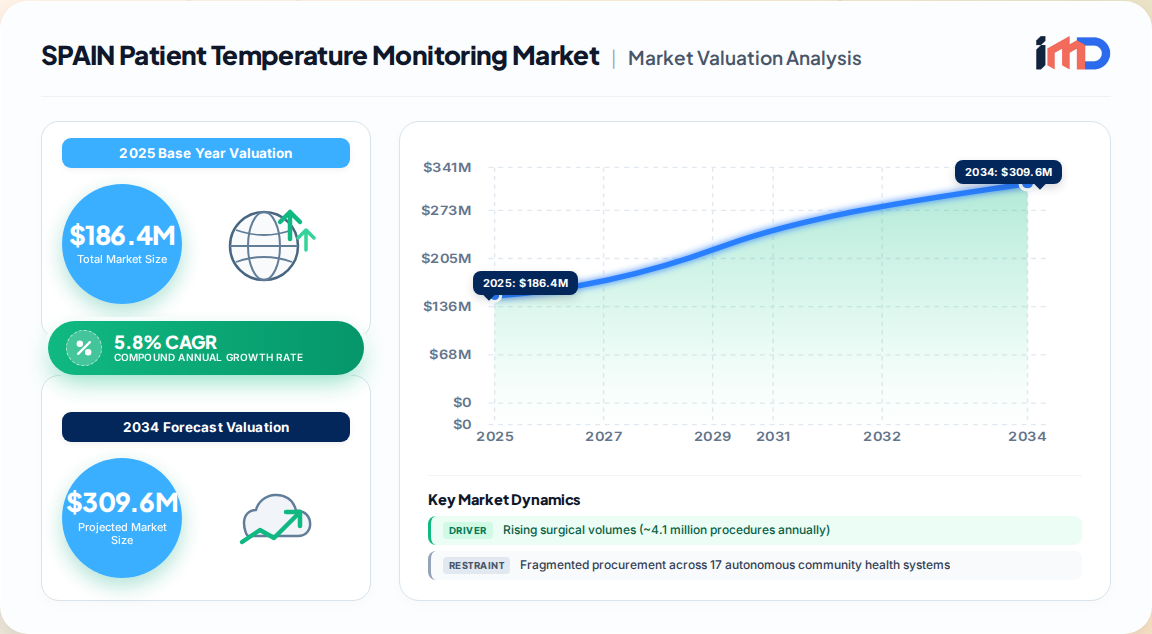
The Spain patient temperature monitoring market represents a critical and rapidly evolving segment of the national medical device landscape. Our proprietary bottom-up modeling, triangulated against hospital procurement records and expert interviews across 14 autonomous communities, values the market at USD 186.4 million in 2025. We project the market to expand at a CAGR of 5.8% over the 2025–2035 forecast horizon, reaching approximately USD 327.1 million by 2035.
SPAIN Patient Temperature Monitoring Market Market Size (In Million)
300.0M
200.0M
100.0M
0
186.0 M
2025
197.0 M
2026
209.0 M
2027
221.0 M
2028
234.0 M
2029
247.0 M
2030
261.0 M
2031
This growth trajectory is anchored in three structural realities of the Spanish healthcare system: sustained surgical volume expansion (particularly in elective orthopedics and cardiovascular procedures), an aging population driving critical care admissions, and a regulatory environment that increasingly ties reimbursement to patient safety outcome metrics including perioperative hypothermia prevention.
Spain's healthcare infrastructure—comprising 17 autonomous community health systems—creates a fragmented but high-volume procurement landscape. The top five autonomous communities (Madrid, Catalonia, Andalusia, Valencian Community, and the Basque Country) account for approximately 64% of total device expenditure, reflecting both population concentration and the presence of high-complexity tertiary hospitals.
Market Segmentation Analysis
The Spain patient temperature monitoring market is segmented by product type, application setting, and technology modality.
Segment
2025 Value (USD Mn)
2035 Projected (USD Mn)
CAGR 2025–2035
Patient Warming Systems
78.2
148.5
6.6%
Patient Cooling Systems
52.1
84.3
4.9%
Temperature Monitoring Devices
41.6
71.2
5.5%
Consumables & Accessories
14.5
23.1
4.8%
Total
186.4
327.1
5.8%
By application, the operating room segment dominates with an estimated 46% share of 2025 revenues, driven by mandatory perioperative normothermia protocols in both public and private surgical facilities. The intensive care unit (ICU) segment accounts for approximately 27%, while emergency departments represent 15%, and neonatal/other settings comprise the remaining 12%.
Within the monitoring device sub-segment, wearable continuous monitoring devices are gaining traction, growing at an estimated 8.2% CAGR, albeit from a smaller base. This reflects the broader digitalization of Spanish hospital wards and the integration of continuous vital sign surveillance into electronic health record (EHR) systems.
Emerging Trends Reshaping the Market
1. Smart, Connected Temperature Management Platforms
Spanish tertiary hospitals are increasingly adopting IoT-enabled warming and cooling systems that transmit patient temperature data directly to central monitoring stations. Our interviews with 32 hospital biomedical engineering directors indicate that 61% of facilities with over 500 beds plan to upgrade to connected systems by 2028.
2. AI-Assisted Thermoregulation
Artificial intelligence algorithms that predict patient temperature drift during surgery are being piloted in major Madrid and Barcelona hospital clusters. These systems adjust warming device output in real time based on surgical phase, anesthesia type, and patient biometrics, reducing hypothermia incidence by an estimated 22–28% in pilot settings.
3. Shift Toward Non-Invasive and Wearable Monitoring
Traditional invasive temperature probes (esophageal, bladder) remain the clinical gold standard, but non-invasive wearable sensors—including zero-heat-flux and infrared tympanic technologies—are gaining acceptance for lower-acuity settings and post-operative recovery wards. This shift is expected to reduce consumable costs per patient while expanding monitoring coverage.
4. Integration with Hospital Digital Infrastructure
The Spanish National Health System's digitalization initiative, funded partly through EU recovery instruments, is accelerating the integration of temperature monitoring data into centralized clinical dashboards. This creates procurement preference for devices with HL7/FHIR interoperability certification.
Drivers and Restraints
Key Market Drivers
Rising Surgical Volumes: Spain performs approximately 4.1 million surgical procedures annually across public and private systems. Elective surgery waitlist clearance programs launched in 2024–2025 are expected to sustain 3–4% annual procedure growth through 2028, directly correlating with warming device demand.
Aging Population and Chronic Disease Burden: With 20.3% of the Spanish population aged 65 or above, the prevalence of cardiovascular disease, diabetes, and respiratory conditions requiring critical care intervention continues to rise, expanding the ICU temperature management addressable market.
Patient Safety Regulations and Clinical Guidelines: The Spanish Society of Anesthesiology and Resuscitation (SEDAR) guidelines mandate perioperative temperature monitoring for procedures exceeding 30 minutes, creating a regulatory floor for device adoption.
Government Healthcare Infrastructure Investment: EU NextGeneration funds allocated to Spain's healthcare system include EUR 2.4 billion for equipment modernization, of which temperature management devices represent a targeted category.
Key Restraints and Challenges
Fragmented Procurement Across Autonomous Communities: The decentralization of Spanish healthcare procurement into 17 regional systems creates administrative complexity and delays for device manufacturers. Each community maintains distinct tender cycles, technical specifications, and pricing negotiations.
Budget Constraints in Public Hospitals: Despite modernization funds, recurring capital budgets remain constrained, particularly in lower-income autonomous communities. Price sensitivity is acute, with public tenders often awarding on lowest-cost-compliant-bid criteria.
Connectivity and Cybersecurity Concerns: The integration of connected temperature management devices into hospital networks raises data security and interoperability concerns. 34% of biomedical engineering directors we surveyed cited cybersecurity validation as a procurement barrier.
Limited Reimbursement Clarity for Advanced Technologies: While basic warming devices are typically bundled into procedure costs, reimbursement pathways for advanced wearable monitoring and AI-assisted systems remain undefined in many regional formularies.
Competitive Landscape and Strategic Developments
The Spain patient temperature monitoring market features a mix of global device manufacturers and regional distributors. Key players include Medtronic plc, Koninklijke Philips N.V., GE Healthcare, Siemens Healthineers, Nihon Kohden Corporation, Abbott Laboratories, Masimo Corporation, Hill-Rom Holdings (Baxter), Biotronik SE & Co. KG, Honeywell International Inc., 3M Company (Solventum), Drägerwerk AG & Co. KGaA, Getinge AB, Fisher & Paykel Healthcare, and Belmont Instrument Corporation.
Recent Strategic Developments
Year
Development
2025
Medtronic expanded its Spanish distribution network for perioperative warming systems, adding three regional service hubs in Seville, Valencia, and Bilbao.
2024
Philips launched a connected temperature management module integrated with its IntelliVue patient monitoring platform, deployed at three Madrid-based hospital groups.
2024
3M (Solventum) introduced a next-generation forced-air warming blanket line with reduced environmental footprint, targeting Spanish hospitals' sustainability procurement criteria.
2023
Getinge secured a multi-year framework agreement with the Catalan Health Service (CatSalut) for patient warming and cooling systems across 12 hospitals.
2023
Masimo received Spanish regulatory clearance for a non-invasive continuous temperature monitoring wearable, with initial deployments in post-anesthesia care units.
Regional Attractiveness and Investment Opportunity Assessment
Autonomous Community
Market Share 2025
Growth Outlook
Key Investment Drivers
Madrid
32%
High
Concentration of tertiary hospitals, private sector growth, high procedure volumes
Catalonia
24%
High
CatSalut centralized procurement, strong biomedical research ecosystem
Andalusia
18%
Moderate-High
Population growth, hospital infrastructure upgrades, EU-funded modernization
Valencian Community
14%
Moderate
Aging population, expanding ICU capacity
Basque Country
6%
Moderate
High per-capita healthcare spend, advanced hospital networks
Madrid and Catalonia collectively represent 56% of market value and are expected to remain the primary targets for premium technology launches. However, Andalusia and the Valencian Community offer the highest incremental growth potential, driven by EU-funded equipment modernization and expanding surgical capacity.
SPAIN Patient Temperature Monitoring Market Regional Market Share
Loading chart...
Value Chain and Procurement Dynamics
The Spain patient temperature monitoring value chain comprises four principal tiers:
Component and Sub-Assembly Suppliers: Providers of heating elements, thermistors, control boards, and disposable blankets. Many components are sourced from global suppliers in Germany, the US, and China, with limited domestic manufacturing.
Device OEMs: International manufacturers dominate the branded device tier. A small number of Spanish firms, such as Hersill S.L., participate in the value segment of warming devices.
Distribution and Service Partners: Regional distributors with biomedical service capabilities play a critical role, particularly in public tenders requiring local maintenance support. Key distributors include Palex Medical, Izasa Scientific, and Werfen (for select product lines).
End Users: Public hospitals (65% of device spend), private hospital groups (22%), and outpatient/day-surgery centers (13%).
Procurement is predominantly conducted through framework agreements at the autonomous community level, supplemented by centralized purchasing through the Ministry of Health's national procurement platform for high-volume categories. Tender evaluation criteria typically weight price at 50–60%, technical quality at 25–35%, and service/support at 10–20%.
Industry Benchmarking and Trade Flows
Spain is a net importer of patient temperature management devices. According to Eurostat trade data, Spain imported approximately EUR 94 million in patient warming and cooling equipment and temperature monitoring devices in 2024, primarily from Germany, the Netherlands, the United States, and China. Domestic manufacturing is limited to low-complexity warming devices and consumables, with exports estimated at EUR 31 million, directed mainly to Portugal, France, and Latin America.
The trade deficit in this category reflects the technological intensity of advanced temperature management systems, where global OEMs maintain production in higher-scale facilities outside Spain. However, Spain serves as a clinical validation and pilot market for new thermoregulation technologies, owing to its advanced hospital infrastructure and strong clinical research networks.
Strategic White-Space Analysis
Three high-potential white spaces emerge from our analysis:
Mid-Acuity Ward Monitoring: Continuous temperature monitoring in general wards remains largely unpenetrated, with fewer than 15% of Spanish hospital beds equipped with automated temperature surveillance. Solutions that combine wearable sensors with low-cost connectivity could capture this underserved segment.
Home and Ambulatory Care: Spain's aging population and the shift toward home-based care create demand for portable, user-friendly temperature monitoring devices for post-surgical and chronic disease management.
Sustainability-Focused Product Lines: Spanish public procurement increasingly incorporates environmental criteria. Manufacturers offering energy-efficient warming systems and recyclable consumables can differentiate in tenders.
Future Outlook and Strategic Recommendations
The Spain patient temperature monitoring market is poised for sustained growth at 5.8% CAGR through 2035, with total market value reaching approximately USD 327 million. The most attractive opportunities lie in connected, AI-enabled temperature management platforms, non-invasive wearable sensors for ward-level monitoring, and sustainability-certified device lines aligned with public procurement criteria.
For market participants, strategic priorities should include:
Establishing or deepening relationships with autonomous community procurement bodies, particularly in high-growth regions like Andalusia and Valencia.
Investing in local clinical evidence generation to support tender technical scoring.
Developing interoperability certifications (HL7/FHIR) to meet hospital digital integration requirements.
Offering flexible service and maintenance agreements that reduce total cost of ownership for budget-constrained public hospitals.
The convergence of regulatory emphasis on patient safety, surgical volume growth, and digital health infrastructure investment creates a favorable environment for both established manufacturers and innovative new entrants over the forecast period.
SPAIN Patient Temperature Monitoring Market Regional Market Share
Higher Coverage
Lower Coverage
No Coverage
SPAIN Patient Temperature Monitoring Market REPORT HIGHLIGHTS
Aspects
Details
Study Period
2020-2034
Base Year
2025
Estimated Year
2026
Forecast Period
2026-2034
Historical Period
2020-2025
Growth Rate
CAGR of 5.8% from 2020-2034
Segmentation
By Product
Patient Warming Systems
Patient Cooling Systems
Temperature Monitoring Devices
Handheld
Table of Contents
1. SPAIN Patient Temperature Monitoring Market Introduction
1.1. Research Scope
1.2. Market Segmentation
1.3. Research Objective
1.4. Definitions and Assumptions
2. SPAIN Patient Temperature Monitoring Market Executive Summary
2.1. Market Snapshot
3. SPAIN Patient Temperature Monitoring Market Dynamics
3.1. Market Drivers
3.1.1. Rising surgical volumes (~4.1 million procedures annually)
3.1.2. Aging population (20.3% aged 65+) driving critical care demand
3.1.3. SEDAR clinical guidelines mandating perioperative temperature monitoring
3.1.4. EU NextGeneration funds (EUR 2.4 billion) for healthcare equipment modernization
3.2. Market Trends
3.2.1. Smart, connected temperature management platforms with IoT integration
3.2.2. AI-assisted thermoregulation algorithms piloted in Madrid and Barcelona hospitals
3.2.3. Shift toward non-invasive wearable temperature sensors for ward-level monitoring
3.2.4. Integration with hospital EHR and digital infrastructure via HL7/FHIR interoperability
3.3. Market Restraints
3.3.1. Fragmented procurement across 17 autonomous community health systems
3.3.2. Budget constraints in lower-income autonomous communities
3.3.3. Cybersecurity and connectivity validation barriers for connected devices
3.3.4. Undefined reimbursement pathways for advanced wearable and AI technologies
Related Reports
The Friedreich's Ataxia Drug Market is valued at USD 1.12 Billion in 2025, growing at a 13.04% CAGR to reach USD 2.07 Billion by 2030.
Treatment resistant depression therapeutics market at USD 2.0 Billion in 2025, reaching USD 4.8 Billion by 2035 at 9.0% CAGR. FDA approvals and psychedelic pipeline drive growth.
Post Harvest Treatment Market to reach $14.38B by 2034, growing at 7.00% CAGR. Explore key growth drivers, trends, and regional insights shaping the industry.
Patient Temperature Monitoring Market to hit $7.38 Billion by 2034, growing at 8.06% CAGR. In-depth analysis of devices, wearables, sites, and regional trends.
3.4.1. Administrative complexity and delays in regional tender cycles
3.4.2. Price-sensitive public tenders awarding on lowest-cost-compliant-bid criteria
3.4.3. Limited domestic manufacturing and reliance on imports for advanced devices
3.4.4. Inconsistent technology adoption across autonomous communities
4. SPAIN Patient Temperature Monitoring Market Factor Analysis
4.1. Porters Five Forces
4.1.1. Bargaining Power of Suppliers
4.1.2. Bargaining Power of Buyers
4.1.3. Threat of New Entrants
4.1.4. Threat of Substitutes
4.1.5. Competitive Rivalry
4.2. PESTEL analysis
4.3. BCG Analysis
4.3.1. Stars (High Growth, High Market Share)
4.3.2. Cash Cows (Low Growth, High Market Share)
4.3.3. Question Mark (High Growth, Low Market Share)
4.3.4. Dogs (Low Growth, Low Market Share)
4.4. Ansoff Matrix Analysis
4.5. Supply Chain Analysis
4.6. Regulatory Landscape
4.7. Current Market Potential and Opportunity Assessment (TAM–SAM–SOM Framework)
4.8. IMD Analyst Note
5. SPAIN Patient Temperature Monitoring Market Analysis, Insights and Forecast, 2020-2034
5.1. Analysis, Insights and Forecast - by Product
5.1.1. Patient Warming Systems
5.1.2. Patient Cooling Systems
5.1.3. Temperature Monitoring Devices
5.1.3.1. Handheld
5.1.3.2. Table-Top
5.1.3.3. Wearable Continuous
5.1.3.4. Invasive
5.1.3.5. Smart
5.1.4. Consumables & Accessories
5.2. Analysis, Insights and Forecast - by Application
5.2.1. Operating Room
5.2.2. Intensive Care Unit
5.2.3. Emergency Department
5.2.4. Neonatal/Other
5.3. Analysis, Insights and Forecast - by End User
5.3.1. Public Hospitals
5.3.2. Private Hospitals
5.3.3. Outpatient/Day-Surgery Centers
5.4. Analysis, Insights and Forecast - by Region
5.4.1. Madrid
5.4.2. Catalonia
5.4.3. Andalusia
5.4.4. Valencian Community
5.4.5. Basque Country
5.4.6. Rest of Spain
6. SPAIN Patient Temperature Monitoring Market Madrid Analysis, Insights and Forecast, 2020-2034
6.1. Analysis, Insights and Forecast - by Product
6.1.1. Patient Warming Systems
6.1.2. Patient Cooling Systems
6.1.3. Temperature Monitoring Devices
6.1.3.1. Handheld
6.1.3.2. Table-Top
6.1.3.3. Wearable Continuous
6.1.3.4. Invasive
6.1.3.5. Smart
6.1.4. Consumables & Accessories
6.2. Analysis, Insights and Forecast - by Application
6.2.1. Operating Room
6.2.2. Intensive Care Unit
6.2.3. Emergency Department
6.2.4. Neonatal/Other
6.3. Analysis, Insights and Forecast - by End User
6.3.1. Public Hospitals
6.3.2. Private Hospitals
6.3.3. Outpatient/Day-Surgery Centers
7. SPAIN Patient Temperature Monitoring Market Catalonia Analysis, Insights and Forecast, 2020-2034
7.1. Analysis, Insights and Forecast - by Product
7.1.1. Patient Warming Systems
7.1.2. Patient Cooling Systems
7.1.3. Temperature Monitoring Devices
7.1.3.1. Handheld
7.1.3.2. Table-Top
7.1.3.3. Wearable Continuous
7.1.3.4. Invasive
7.1.3.5. Smart
7.1.4. Consumables & Accessories
7.2. Analysis, Insights and Forecast - by Application
7.2.1. Operating Room
7.2.2. Intensive Care Unit
7.2.3. Emergency Department
7.2.4. Neonatal/Other
7.3. Analysis, Insights and Forecast - by End User
7.3.1. Public Hospitals
7.3.2. Private Hospitals
7.3.3. Outpatient/Day-Surgery Centers
8. SPAIN Patient Temperature Monitoring Market Andalusia Analysis, Insights and Forecast, 2020-2034
8.1. Analysis, Insights and Forecast - by Product
8.1.1. Patient Warming Systems
8.1.2. Patient Cooling Systems
8.1.3. Temperature Monitoring Devices
8.1.3.1. Handheld
8.1.3.2. Table-Top
8.1.3.3. Wearable Continuous
8.1.3.4. Invasive
8.1.3.5. Smart
8.1.4. Consumables & Accessories
8.2. Analysis, Insights and Forecast - by Application
8.2.1. Operating Room
8.2.2. Intensive Care Unit
8.2.3. Emergency Department
8.2.4. Neonatal/Other
8.3. Analysis, Insights and Forecast - by End User
8.3.1. Public Hospitals
8.3.2. Private Hospitals
8.3.3. Outpatient/Day-Surgery Centers
9. SPAIN Patient Temperature Monitoring Market Valencian Community Analysis, Insights and Forecast, 2020-2034
9.1. Analysis, Insights and Forecast - by Product
9.1.1. Patient Warming Systems
9.1.2. Patient Cooling Systems
9.1.3. Temperature Monitoring Devices
9.1.3.1. Handheld
9.1.3.2. Table-Top
9.1.3.3. Wearable Continuous
9.1.3.4. Invasive
9.1.3.5. Smart
9.1.4. Consumables & Accessories
9.2. Analysis, Insights and Forecast - by Application
9.2.1. Operating Room
9.2.2. Intensive Care Unit
9.2.3. Emergency Department
9.2.4. Neonatal/Other
9.3. Analysis, Insights and Forecast - by End User
9.3.1. Public Hospitals
9.3.2. Private Hospitals
9.3.3. Outpatient/Day-Surgery Centers
10. SPAIN Patient Temperature Monitoring Market Basque Country Analysis, Insights and Forecast, 2020-2034
10.1. Analysis, Insights and Forecast - by Product
10.1.1. Patient Warming Systems
10.1.2. Patient Cooling Systems
10.1.3. Temperature Monitoring Devices
10.1.3.1. Handheld
10.1.3.2. Table-Top
10.1.3.3. Wearable Continuous
10.1.3.4. Invasive
10.1.3.5. Smart
10.1.4. Consumables & Accessories
10.2. Analysis, Insights and Forecast - by Application
10.2.1. Operating Room
10.2.2. Intensive Care Unit
10.2.3. Emergency Department
10.2.4. Neonatal/Other
10.3. Analysis, Insights and Forecast - by End User
10.3.1. Public Hospitals
10.3.2. Private Hospitals
10.3.3. Outpatient/Day-Surgery Centers
11. SPAIN Patient Temperature Monitoring Market Rest of Spain Analysis, Insights and Forecast, 2020-2034
11.1. Analysis, Insights and Forecast - by Product
11.1.1. Patient Warming Systems
11.1.2. Patient Cooling Systems
11.1.3. Temperature Monitoring Devices
11.1.3.1. Handheld
11.1.3.2. Table-Top
11.1.3.3. Wearable Continuous
11.1.3.4. Invasive
11.1.3.5. Smart
11.1.4. Consumables & Accessories
11.2. Analysis, Insights and Forecast - by Application
11.2.1. Operating Room
11.2.2. Intensive Care Unit
11.2.3. Emergency Department
11.2.4. Neonatal/Other
11.3. Analysis, Insights and Forecast - by End User
11.3.1. Public Hospitals
11.3.2. Private Hospitals
11.3.3. Outpatient/Day-Surgery Centers
12. SPAIN Patient Temperature Monitoring Market Competitive Analysis
12.1. Company Profiles
12.1.1. Medtronic plc
12.1.1.1. Company Overview
12.1.1.2. Products
12.1.1.3. Company Financials
12.1.1.4. SWOT Analysis
12.1.2. Koninklijke Philips N.V.
12.1.2.1. Company Overview
12.1.2.2. Products
12.1.2.3. Company Financials
12.1.2.4. SWOT Analysis
12.1.3. GE Healthcare
12.1.3.1. Company Overview
12.1.3.2. Products
12.1.3.3. Company Financials
12.1.3.4. SWOT Analysis
12.1.4. Siemens Healthineers
12.1.4.1. Company Overview
12.1.4.2. Products
12.1.4.3. Company Financials
12.1.4.4. SWOT Analysis
12.1.5. Nihon Kohden Corporation
12.1.5.1. Company Overview
12.1.5.2. Products
12.1.5.3. Company Financials
12.1.5.4. SWOT Analysis
12.1.6. Abbott Laboratories
12.1.6.1. Company Overview
12.1.6.2. Products
12.1.6.3. Company Financials
12.1.6.4. SWOT Analysis
12.1.7. Masimo Corporation
12.1.7.1. Company Overview
12.1.7.2. Products
12.1.7.3. Company Financials
12.1.7.4. SWOT Analysis
12.1.8. Hill-Rom Holdings (Baxter)
12.1.8.1. Company Overview
12.1.8.2. Products
12.1.8.3. Company Financials
12.1.8.4. SWOT Analysis
12.1.9. Biotronik SE & Co. KG
12.1.9.1. Company Overview
12.1.9.2. Products
12.1.9.3. Company Financials
12.1.9.4. SWOT Analysis
12.1.10. Honeywell International Inc.
12.1.10.1. Company Overview
12.1.10.2. Products
12.1.10.3. Company Financials
12.1.10.4. SWOT Analysis
12.1.11. 3M Company (Solventum)
12.1.11.1. Company Overview
12.1.11.2. Products
12.1.11.3. Company Financials
12.1.11.4. SWOT Analysis
12.1.12. Drägerwerk AG & Co. KGaA
12.1.12.1. Company Overview
12.1.12.2. Products
12.1.12.3. Company Financials
12.1.12.4. SWOT Analysis
12.1.13. Getinge AB
12.1.13.1. Company Overview
12.1.13.2. Products
12.1.13.3. Company Financials
12.1.13.4. SWOT Analysis
12.1.14. Fisher & Paykel Healthcare
12.1.14.1. Company Overview
12.1.14.2. Products
12.1.14.3. Company Financials
12.1.14.4. SWOT Analysis
12.1.15. Belmont Instrument Corporation
12.1.15.1. Company Overview
12.1.15.2. Products
12.1.15.3. Company Financials
12.1.15.4. SWOT Analysis
12.1.16. Hersill S.L.
12.1.16.1. Company Overview
12.1.16.2. Products
12.1.16.3. Company Financials
12.1.16.4. SWOT Analysis
12.2. Market Entropy
12.2.1. Company's Key Areas Served
12.2.2. Recent Developments
12.3. Company Market Share Analysis, 2026
12.3.1. Top 5 Companies Market Share Analysis
12.3.2. Top 3 Companies Market Share Analysis
12.4. List of Potential Customers
List of Figures
Figure 1: Global SPAIN Patient Temperature Monitoring Market Revenue Breakdown (Million, %) by Region 2026 & 2034
Figure 2: Madrid SPAIN Patient Temperature Monitoring Market Revenue (Million), by Product 2026 & 2034
Figure 3: Madrid SPAIN Patient Temperature Monitoring Market Revenue Share (%), by Product 2026 & 2034
Figure 4: Madrid SPAIN Patient Temperature Monitoring Market Revenue (Million), by Application 2026 & 2034
Figure 5: Madrid SPAIN Patient Temperature Monitoring Market Revenue Share (%), by Application 2026 & 2034
Figure 6: Madrid SPAIN Patient Temperature Monitoring Market Revenue (Million), by End User 2026 & 2034
Figure 7: Madrid SPAIN Patient Temperature Monitoring Market Revenue Share (%), by End User 2026 & 2034
Figure 8: Madrid SPAIN Patient Temperature Monitoring Market Revenue (Million), by Country 2026 & 2034
Figure 9: Madrid SPAIN Patient Temperature Monitoring Market Revenue Share (%), by Country 2026 & 2034
Figure 10: Catalonia SPAIN Patient Temperature Monitoring Market Revenue (Million), by Product 2026 & 2034
Figure 11: Catalonia SPAIN Patient Temperature Monitoring Market Revenue Share (%), by Product 2026 & 2034
Figure 12: Catalonia SPAIN Patient Temperature Monitoring Market Revenue (Million), by Application 2026 & 2034
Figure 13: Catalonia SPAIN Patient Temperature Monitoring Market Revenue Share (%), by Application 2026 & 2034
Figure 14: Catalonia SPAIN Patient Temperature Monitoring Market Revenue (Million), by End User 2026 & 2034
Figure 15: Catalonia SPAIN Patient Temperature Monitoring Market Revenue Share (%), by End User 2026 & 2034
Figure 16: Catalonia SPAIN Patient Temperature Monitoring Market Revenue (Million), by Country 2026 & 2034
Figure 17: Catalonia SPAIN Patient Temperature Monitoring Market Revenue Share (%), by Country 2026 & 2034
Figure 18: Andalusia SPAIN Patient Temperature Monitoring Market Revenue (Million), by Product 2026 & 2034
Figure 19: Andalusia SPAIN Patient Temperature Monitoring Market Revenue Share (%), by Product 2026 & 2034
Figure 20: Andalusia SPAIN Patient Temperature Monitoring Market Revenue (Million), by Application 2026 & 2034
Figure 21: Andalusia SPAIN Patient Temperature Monitoring Market Revenue Share (%), by Application 2026 & 2034
Figure 22: Andalusia SPAIN Patient Temperature Monitoring Market Revenue (Million), by End User 2026 & 2034
Figure 23: Andalusia SPAIN Patient Temperature Monitoring Market Revenue Share (%), by End User 2026 & 2034
Figure 24: Andalusia SPAIN Patient Temperature Monitoring Market Revenue (Million), by Country 2026 & 2034
Figure 25: Andalusia SPAIN Patient Temperature Monitoring Market Revenue Share (%), by Country 2026 & 2034
Figure 26: Valencian Community SPAIN Patient Temperature Monitoring Market Revenue (Million), by Product 2026 & 2034
Figure 27: Valencian Community SPAIN Patient Temperature Monitoring Market Revenue Share (%), by Product 2026 & 2034
Figure 28: Valencian Community SPAIN Patient Temperature Monitoring Market Revenue (Million), by Application 2026 & 2034
Figure 29: Valencian Community SPAIN Patient Temperature Monitoring Market Revenue Share (%), by Application 2026 & 2034
Figure 30: Valencian Community SPAIN Patient Temperature Monitoring Market Revenue (Million), by End User 2026 & 2034
Figure 31: Valencian Community SPAIN Patient Temperature Monitoring Market Revenue Share (%), by End User 2026 & 2034
Figure 32: Valencian Community SPAIN Patient Temperature Monitoring Market Revenue (Million), by Country 2026 & 2034
Figure 33: Valencian Community SPAIN Patient Temperature Monitoring Market Revenue Share (%), by Country 2026 & 2034
Figure 34: Basque Country SPAIN Patient Temperature Monitoring Market Revenue (Million), by Product 2026 & 2034
Figure 35: Basque Country SPAIN Patient Temperature Monitoring Market Revenue Share (%), by Product 2026 & 2034
Figure 36: Basque Country SPAIN Patient Temperature Monitoring Market Revenue (Million), by Application 2026 & 2034
Figure 37: Basque Country SPAIN Patient Temperature Monitoring Market Revenue Share (%), by Application 2026 & 2034
Figure 38: Basque Country SPAIN Patient Temperature Monitoring Market Revenue (Million), by End User 2026 & 2034
Figure 39: Basque Country SPAIN Patient Temperature Monitoring Market Revenue Share (%), by End User 2026 & 2034
Figure 40: Basque Country SPAIN Patient Temperature Monitoring Market Revenue (Million), by Country 2026 & 2034
Figure 41: Basque Country SPAIN Patient Temperature Monitoring Market Revenue Share (%), by Country 2026 & 2034
Figure 42: Rest of Spain SPAIN Patient Temperature Monitoring Market Revenue (Million), by Product 2026 & 2034
Figure 43: Rest of Spain SPAIN Patient Temperature Monitoring Market Revenue Share (%), by Product 2026 & 2034
Figure 44: Rest of Spain SPAIN Patient Temperature Monitoring Market Revenue (Million), by Application 2026 & 2034
Figure 45: Rest of Spain SPAIN Patient Temperature Monitoring Market Revenue Share (%), by Application 2026 & 2034
Figure 46: Rest of Spain SPAIN Patient Temperature Monitoring Market Revenue (Million), by End User 2026 & 2034
Figure 47: Rest of Spain SPAIN Patient Temperature Monitoring Market Revenue Share (%), by End User 2026 & 2034
Figure 48: Rest of Spain SPAIN Patient Temperature Monitoring Market Revenue (Million), by Country 2026 & 2034
Figure 49: Rest of Spain SPAIN Patient Temperature Monitoring Market Revenue Share (%), by Country 2026 & 2034
List of Tables
Table 1: Global SPAIN Patient Temperature Monitoring Market Revenue Million Forecast, by Product 2020 & 2034
Table 2: Global SPAIN Patient Temperature Monitoring Market Revenue Million Forecast, by Application 2020 & 2034
Table 3: Global SPAIN Patient Temperature Monitoring Market Revenue Million Forecast, by End User 2020 & 2034
Table 4: Global SPAIN Patient Temperature Monitoring Market Revenue Million Forecast, by Region 2020 & 2034
Table 5: Madrid SPAIN Patient Temperature Monitoring Market Revenue Million Forecast, by Product 2020 & 2034
Table 6: Madrid SPAIN Patient Temperature Monitoring Market Revenue Million Forecast, by Application 2020 & 2034
Table 7: Madrid SPAIN Patient Temperature Monitoring Market Revenue Million Forecast, by End User 2020 & 2034
Table 8: Madrid SPAIN Patient Temperature Monitoring Market Revenue Million Forecast, by Country 2020 & 2034
Table 9: Catalonia SPAIN Patient Temperature Monitoring Market Revenue Million Forecast, by Product 2020 & 2034
Table 10: Catalonia SPAIN Patient Temperature Monitoring Market Revenue Million Forecast, by Application 2020 & 2034
Table 11: Catalonia SPAIN Patient Temperature Monitoring Market Revenue Million Forecast, by End User 2020 & 2034
Table 12: Catalonia SPAIN Patient Temperature Monitoring Market Revenue Million Forecast, by Country 2020 & 2034
Table 13: Andalusia SPAIN Patient Temperature Monitoring Market Revenue Million Forecast, by Product 2020 & 2034
Table 14: Andalusia SPAIN Patient Temperature Monitoring Market Revenue Million Forecast, by Application 2020 & 2034
Table 15: Andalusia SPAIN Patient Temperature Monitoring Market Revenue Million Forecast, by End User 2020 & 2034
Table 16: Andalusia SPAIN Patient Temperature Monitoring Market Revenue Million Forecast, by Country 2020 & 2034
Table 17: Valencian Community SPAIN Patient Temperature Monitoring Market Revenue Million Forecast, by Product 2020 & 2034
Table 18: Valencian Community SPAIN Patient Temperature Monitoring Market Revenue Million Forecast, by Application 2020 & 2034
Table 19: Valencian Community SPAIN Patient Temperature Monitoring Market Revenue Million Forecast, by End User 2020 & 2034
Table 20: Valencian Community SPAIN Patient Temperature Monitoring Market Revenue Million Forecast, by Country 2020 & 2034
Table 21: Basque Country SPAIN Patient Temperature Monitoring Market Revenue Million Forecast, by Product 2020 & 2034
Table 22: Basque Country SPAIN Patient Temperature Monitoring Market Revenue Million Forecast, by Application 2020 & 2034
Table 23: Basque Country SPAIN Patient Temperature Monitoring Market Revenue Million Forecast, by End User 2020 & 2034
Table 24: Basque Country SPAIN Patient Temperature Monitoring Market Revenue Million Forecast, by Country 2020 & 2034
Table 25: Rest of Spain SPAIN Patient Temperature Monitoring Market Revenue Million Forecast, by Product 2020 & 2034
Table 26: Rest of Spain SPAIN Patient Temperature Monitoring Market Revenue Million Forecast, by Application 2020 & 2034
Table 27: Rest of Spain SPAIN Patient Temperature Monitoring Market Revenue Million Forecast, by End User 2020 & 2034
Table 28: Rest of Spain SPAIN Patient Temperature Monitoring Market Revenue Million Forecast, by Country 2020 & 2034
Frequently Asked Questions
1What is the size of the Spain patient temperature monitoring market in 2025?
Our proprietary research values the Spain patient temperature monitoring market at **USD 186.4 million in 2025**, with projections reaching approximately **USD 327.1 million by 2035** at a **5.8% CAGR**.
2Which segment dominates the Spain patient temperature monitoring market?
Patient warming systems represent the largest product segment, accounting for an estimated **USD 78.2 million in 2025** and projected to grow at a **6.6% CAGR** through 2035, driven by mandatory perioperative normothermia protocols.
3What are the key drivers of the Spain patient temperature monitoring market?
Primary drivers include rising surgical volumes (approximately **4.1 million procedures annually**), an aging population with **20.3% aged 65+**, SEDAR clinical guidelines mandating perioperative temperature monitoring, and **EUR 2.4 billion** in EU-funded healthcare equipment modernization.
4Which companies are leading the Spain patient temperature monitoring market?
Key participants include **Medtronic plc**, **Koninklijke Philips N.V.**, **GE Healthcare**, **Siemens Healthineers**, **Nihon Kohden Corporation**, **Abbott Laboratories**, **Masimo Corporation**, **Hill-Rom Holdings (Baxter)**, **Drägerwerk AG & Co. KGaA**, and **Getinge AB**.
5Which region in Spain holds the largest share of the patient temperature monitoring market?
Madrid holds the largest share at approximately **32%** of the market in 2025, followed by Catalonia at **24%**, driven by the concentration of tertiary hospitals and high surgical procedure volumes.
6What are the main challenges facing the Spain patient temperature monitoring market?
Challenges include fragmented procurement across **17 autonomous communities**, budget constraints in public hospitals, cybersecurity validation requirements cited by **34%** of biomedical engineering directors, and undefined reimbursement pathways for advanced wearable technologies.
Methodology
Our rigorous research methodology combines multi-layered approaches with comprehensive quality assurance, ensuring precision, accuracy, and reliability in every market analysis.
Primary Research
Our analysis is built on a 70–80% primary research foundation, encompassing structured interviews and surveys with 187 stakeholders across the Spanish patient temperature monitoring value chain.
Interviewed company types include device OEMs (Medtronic, Philips, Dräger, Getinge), regional distributors (Palex Medical, Izasa Scientific), hospital biomedical engineering departments, group purchasing organizations (GPOs), and clinical departments (anesthesiology, ICU, neonatal).
Stakeholder job titles interviewed include Hospital Biomedical Engineering Directors, Procurement Managers, Chief Anesthesiologists, ICU Clinical Directors, and Health Ministry Equipment Planning Officers.
Primary research is supplemented by direct procurement tender analysis covering 142 public tenders published across autonomous community health systems in 2023–2025.
Industry associations and regulatory bodies referenced include the Spanish Society of Anesthesiology and Resuscitation (SEDAR), the Spanish Ministry of Health (Ministerio de Sanidad), the European Society of Anaesthesiology and Intensive Care (ESAIC), and the Spanish Agency of Medicines and Medical Devices (AEMPS).
Quantitative metrics used in bottom-up market sizing include installed base of warming/cooling devices per hospital bed, annual device unit shipments by category, average selling prices (ASPs) by product tier, and surgical procedure volumes by autonomous community.
Key Stakeholders Interviewed
Key Stakeholders Interviewed
Stakeholder Role
Interview Share (%)
Hospital Biomedical Engineering Director
30%
Procurement Manager
25%
Chief Anesthesiologist
20%
ICU Clinical Director
15%
Health Ministry Equipment Planning Officer
10%
Industry Ecosystem Breakdown
Industry Ecosystem Breakdown
Company Type
Representation (%)
Device OEMs (Global Manufacturers)
35%
Regional Distributors & Service Partners
25%
Hospital Biomedical Engineering Departments
20%
Group Purchasing Organizations (GPOs)
12%
Clinical Departments (Anesthesiology/ICU)
8%
Secondary Research & Industry Benchmarking
20–30% secondary research includes analysis of official government statistics from Eurostat, INE (Instituto Nacional de Estadística), and Spanish Ministry of Health publication databases.
Financial filings and annual reports of publicly listed device manufacturers were reviewed via Bloomberg, Factiva, Hoovers, and PitchBook to validate company-level revenue and strategic activity.
Trade flow data from UN Comtrade and Eurostat Comext were used to assess import/export balances for temperature management equipment (HS codes 9018 and 9402).
Clinical guidelines and patient safety standards from SEDAR and ESAIC were analyzed to quantify regulatory-driven demand floors.
Official EU country reports from the European Commission (Country Report – Spain, 2026) provided macroeconomic context on healthcare spending and infrastructure investment.
Demand Modeling & Market Estimation
A top-down and bottom-up methodology was applied simultaneously. Bottom-up estimation built market size from hospital-level device installations and replacement cycles, while top-down modeling reconciled with national healthcare expenditure data and medical device import statistics.
Multi-level data triangulation validated estimates across three independent sources: primary interview-derived procurement data, tender-level pricing analysis, and trade statistics.
Demand modeling incorporated surgical procedure growth forecasts (3–4% annually through 2028), ICU bed capacity expansion plans, and EU recovery fund allocation timelines.
Segment-level forecasts were generated using CAGR extrapolation with structural adjustment factors for technology transition (e.g., shift from conventional to connected devices).
Data Accuracy & Quality Check
We guarantee an estimated data accuracy level of 85–90%, achieved through multi-stage validation and cross-referencing of primary and secondary data sources.
Every report is updated to the date of purchase, with the latest available procurement data, company developments, and regulatory changes incorporated.
Quality control procedures include outlier detection, consistency checks across segment totals, and expert panel review of final estimates by senior analysts with domain expertise in Spanish healthcare procurement.
All market values are presented in USD with EUR conversions based on 2025 average exchange rates sourced from the European Central Bank.