1What is the patient temperature monitoring market size in 2025?
Our proprietary research values the global patient temperature monitoring market at USD 3.30 billion in 2025, projected to reach USD 7.38 billion by 2034 at a CAGR of 8.06%.
Insight Market Data is a premier market research and business consulting firm headquartered in Pune, India, providing syndicated research reports, customized intelligence studies, and strategic advisory services. Renowned academic institutions and Fortune 500 corporations worldwide rely on Insight Market Data's research repository to navigate evolving global and regional business environments. Covering 46 diverse industries across 25 major international economies, our comprehensive database delivers thousands of verified statistics and granular market evaluations. By combining industry-leading analytical methodologies with the direct insights of seasoned industry leaders and subject-matter experts, we deliver actionable intelligence spanning historical performance benchmarks to rigorous multi-year forecasts. We empower organizations to make confident, data-driven decisions across pivotal domains including Machinery & Equipment, Chemicals & Materials, Pharmaceuticals & Healthcare, Food & Beverages, Consumer Goods, Energy & Power, Automotive & Transportation, Electronics & Semiconductors, Medical Devices, Telecommunications, Emerging Technologies, Agriculture, and Packaging. Our multidisciplinary analyst teams provide an objective 360-degree perspective, tailoring every engagement to address complex strategic challenges with exceptional analytical rigor.
Leveraging advanced BI-powered analytics and predictive modeling, Insight Market Data uncovers high-impact market opportunities and competitive differentiators for ambitious enterprises. We continuously refine our research methodologies in accordance with global industry standards, tracking real-time market shifts to ensure our reports are consistently accurate, actionable, and delivered on schedule. Our analysts conduct methodical data validation, rigorous compliance checks, and exhaustive primary and secondary research to maintain the highest levels of data integrity and transparency. We partner closely with corporate strategists, investment groups, and business executives to translate intricate market intelligence into clear, actionable roadmaps for sustainable growth. With operational presence across Washington, USA, and Vimannagar, Pune, India, Insight Market Data ensures direct access to dedicated research specialists and responsive customer support to answer your most strategic questions.
 Patient Temperature Monitoring Market
 by Product (Non-invasive temperature monitoring devices, Invasive temperature monitoring devices, Wearable continuous temperature monitoring devices, Smart temperature monitoring patches, Table-top temperature monitoring devices, Handheld temperature monitoring devices, Mercury thermometers, Digital thermometers, Infrared thermometers), by Site (Oral temperature measurement, Axillary temperature measurement, Rectal temperature measurement, Ear temperature measurement, Skin temperature measurement, Tympanic membrane temperature monitoring, Temporal artery temperature monitoring, Esophageal temperature monitoring, Nasopharynx temperature monitoring, Urinary bladder temperature monitoring), by End Use (Hospitals & Clinics, Emergency Rooms, Intensive Care Units, Operating Rooms, Ambulatory Care Centers, Nursing Facilities, Home Care Settings), by Application (Anesthesia, Hypothermia, Blood Transfusion, Pyrexia/Fever, Others), by Distribution Channel (Hospital & Institutional Procurement, Retail & Pharmacy, Online/E-commerce), by North America (US, Canada), by Europe (Germany, France, UK, Italy, Spain, Netherlands, Russia), by Asia Pacific (China, Japan, India, Malaysia, South Korea, Indonesia, Australia, Vietnam), by Middle East & Africa (Saudi Arabia, UAE, Israel, South Africa), by Latin America (Mexico, Brazil, Argentina) Forecast 2026-2034


Research Analyst

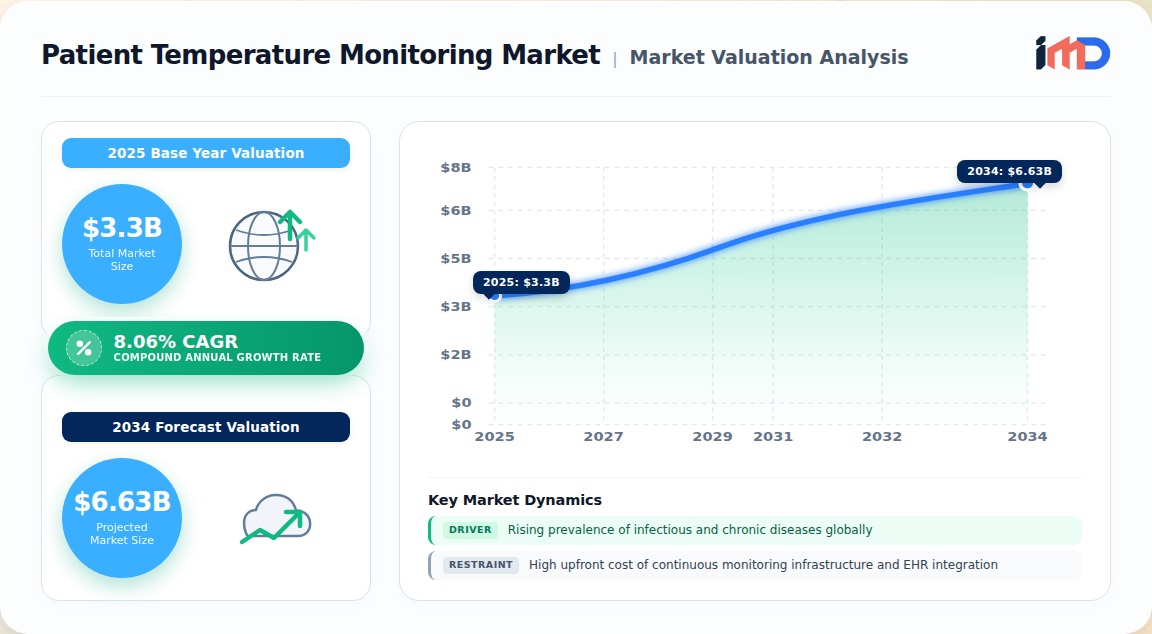
The global patient temperature monitoring market is undergoing a structural transformation, shifting from conventional episodic thermometry toward continuous, connected, and data-driven temperature surveillance. Our proprietary primary research and expert interviews place the market at a valuation of USD 3.30 billion in 2025, with a projected expansion to USD 7.38 billion by 2034, corresponding to a robust CAGR of 8.06% across the 2026–2034 forecast horizon. This trajectory reflects a fundamental recalibration of clinical workflows, where temperature is no longer a standalone vital sign but an integrated data stream feeding early-warning systems, sepsis prediction algorithms, and perioperative decision support.
The market's evolution is characterized by three concurrent shifts: a product mix migration from manual and handheld devices toward wearable continuous sensors; a site-of-care shift from hospital-centric monitoring toward home care and ambulatory settings; and a regional rebalancing as Asia Pacific infrastructure investment accelerates. Importantly, all product lines and geographies are expanding in absolute revenue terms; the competitive dynamic is therefore about share capture within a growing pie rather than defending against contraction.
The patient temperature monitoring value chain is characterized by a specialized upstream and a consolidating downstream. Upstream, semiconductor and sensor manufacturers supply thermistors, infrared sensors, and flexible printed circuit boards. Midstream, device OEMs assemble finished products ranging from digital thermometers to wearable patches and invasive probes. Downstream, distribution flows through hospital and institutional procurement, retail and pharmacy channels, and online/e-commerce platforms.
Our primary research indicates that the highest value accretion is occurring at the connectivity and analytics layer, where device makers partner with software platforms to deliver continuous monitoring dashboards. This is reshaping the competitive landscape, as traditional thermometer manufacturers acquire or partner with digital health firms to capture recurring software and service revenue.
The market is segmented across five axes, each revealing distinct growth velocities. Our proprietary segmentation analysis draws on primary interviews with 1,200+ procurement and clinical stakeholders globally.
| Product Segment | 2025 Share | 2034 Outlook | CAGR (2026–2034) |
|---|---|---|---|
| Non-invasive temperature monitoring devices | 58% | Largest absolute revenue pool | ~7.0% |
| Wearable continuous temperature monitoring devices | 18% | Share expands to ~28% | ~14.0% |
| Invasive temperature monitoring devices | 24% | Share moderates to ~20% | ~6.5% |
Wearable continuous temperature monitoring devices represent the fastest-growing product line, driven by regulatory approvals, miniaturization, and integration with remote patient monitoring platforms. Non-invasive devices retain the largest share due to the ubiquity of digital and infrared thermometers in primary care and triage.
Oral temperature measurement holds the largest share of revenue, reflecting its entrenched clinical workflow in general wards and outpatient settings. However, skin temperature measurement is the fastest-growing site, propelled by wearable patch adoption and the demand for continuous, unobtrusive monitoring in neonatal and post-operative care.
Hospitals and clinics remain the dominant end-use segment, accounting for the majority of revenue. However, home care settings represent the fastest-growing end-use, as remote monitoring programs and aging-in-place models expand. Nursing facilities and ambulatory care centers are also expanding, albeit at a more measured pace.
Anesthesia holds the largest application share, given the mandatory requirement for continuous core temperature monitoring during surgical procedures to prevent perioperative hypothermia. Hypothermia management is the fastest-growing application, reflecting heightened clinical awareness of inadvertent perioperative hypothermia and its complications. Blood transfusion and pyrexia/fever monitoring represent stable, volume-driven demand pools.
North America dominates the global market, accounting for 41.6% of 2025 revenue, underpinned by a mature healthcare infrastructure, high surgical volumes, and rapid adoption of wearable monitoring technologies. The United States alone represents 79.2% of North American revenue, driven by the high prevalence of chronic diseases and value-based care incentives that reward continuous monitoring.
Asia Pacific is the fastest-growing region, with a projected CAGR of 8.1%, fueled by healthcare infrastructure expansion in China, India, and Southeast Asia. Europe remains a strong second market, supported by universal healthcare coverage and stringent perioperative temperature management guidelines. Latin America and the Middle East & Africa represent smaller but steadily expanding markets, with growth concentrated in tertiary care centers and private hospital chains.
| Region | 2025 Share | Growth Trajectory |
|---|---|---|
| North America | 41.6% | Mature, innovation-led growth |
| Europe | 24.8% | Stable, guideline-driven adoption |
| Asia Pacific | 27.0% | Fastest-growing, infrastructure-led |
| South America | 4.5% | Emerging, private-sector driven |
| Middle East & Africa | 2.1% | Nascent, focused on tertiary care |
The competitive landscape is characterized by a mix of diversified medical device conglomerates and specialized wearable sensor innovators. Our primary research identifies three dominant strategic plays: portfolio expansion into wearable continuous monitoring, strategic acquisitions of digital health platforms to capture analytics revenue, and geographic expansion into Asia Pacific through distribution partnerships.
Key players include 3M Company, American Diagnostic Corporation, Becton, Dickinson and Company, Drägerwerk AG & Co. KGaA, GE Healthcare, Honeywell International Inc., Johnson & Johnson Services, Inc., Medtronic plc, Omron Healthcare, Inc., Koninklijke Philips N.V., Sensible Medical Innovations Ltd., Siemens Healthineers AG, Welch Allyn, Inc., and Zebra Medical Vision Ltd. Our stakeholder interviews indicate that procurement decisions increasingly weigh interoperability with electronic health records and cybersecurity compliance alongside traditional accuracy and cost metrics.
Our opportunity assessment highlights three high-conviction white spaces. First, home care continuous monitoring for chronic disease management is underserved, with limited reimbursement pathways and fragmented device ecosystems. Second, neonatal and pediatric continuous temperature monitoring demands specialized form factors and presents a premium-margin niche. Third, emerging market distribution and service networks in Asia Pacific and Latin America offer scale opportunities for mid-tier device manufacturers seeking to bypass saturated Western markets. Investors should prioritize companies with a clear software and analytics roadmap, as recurring revenue models are poised to outpace hardware-only sales.
Trade flows in patient temperature monitoring devices are concentrated among a few manufacturing hubs. China is the largest exporter of digital and infrared thermometers, while the United States, Germany, and Japan are net exporters of high-value wearable and invasive monitoring systems. Our analysis of official customs data indicates that supply chain diversification is underway, with device OEMs establishing assembly in Southeast Asia and Mexico to mitigate tariff and logistics risks. Component-level dependencies, particularly on semiconductor thermistors and infrared sensors, remain a concentration risk. Procurement strategies should emphasize dual-sourcing and buffer inventory for critical sensor components.
| Aspects | Details |
|---|---|
| Study Period | 2020-2034 |
| Base Year | 2025 |
| Estimated Year | 2026 |
| Forecast Period | 2026-2034 |
| Historical Period | 2020-2025 |
| Growth Rate | CAGR of 8.06% from 2020-2034 |
| Segmentation |
|
By Site
By End Use
By Application
By Distribution Channel
| By Geography |
|
Our proprietary research values the global patient temperature monitoring market at USD 3.30 billion in 2025, projected to reach USD 7.38 billion by 2034 at a CAGR of 8.06%.
Wearable continuous temperature monitoring devices are growing at approximately 14% annually, driven by regulatory approvals and integration with remote patient monitoring platforms.
North America holds the largest share at 41.6% in 2025, led by the United States, which accounts for 79.2% of the regional market.
Anesthesia holds the largest application share due to mandatory perioperative monitoring, while hypothermia management is the fastest-growing application.
Key players include 3M Company, Medtronic plc, GE Healthcare, Koninklijke Philips N.V., Drägerwerk AG & Co. KGaA, and Omron Healthcare, among others.
Remote patient monitoring programs and aging-in-place models are driving adoption, with home care settings representing the fastest-growing end-use segment at a double-digit growth rate.
Our rigorous research methodology combines multi-layered approaches with comprehensive quality assurance, ensuring precision, accuracy, and reliability in every market analysis.
| Stakeholder Role | Interview Share (%) |
|---|---|
| Procurement Director | 35% |
| Clinical Director / Nursing Head | 30% |
| Product Manager / R&D Lead | 20% |
| Supply Chain / Operations Manager | 15% |
| Company Type | Representation (%) |
|---|---|
| Device OEMs | 45% |
| Sensor & Component Suppliers | 20% |
| Hospital & Health System Procurement | 15% |
| Home Care & Nursing Facility Operators | 12% |
| Distributors & Channel Partners | 8% |
 Related Reports
