1What is the size of the Materials Recovery Facility (MRF) market?
Our proprietary research values the global MRF market at $12.5 Billion in 2024. It is projected to grow at a CAGR of 8.8% to reach $20.8 Billion by 2033.
Insight Market Data is a premier market research and business consulting firm headquartered in Pune, India, providing syndicated research reports, customized intelligence studies, and strategic advisory services. Renowned academic institutions and Fortune 500 corporations worldwide rely on Insight Market Data's research repository to navigate evolving global and regional business environments. Covering 46 diverse industries across 25 major international economies, our comprehensive database delivers thousands of verified statistics and granular market evaluations. By combining industry-leading analytical methodologies with the direct insights of seasoned industry leaders and subject-matter experts, we deliver actionable intelligence spanning historical performance benchmarks to rigorous multi-year forecasts. We empower organizations to make confident, data-driven decisions across pivotal domains including Machinery & Equipment, Chemicals & Materials, Pharmaceuticals & Healthcare, Food & Beverages, Consumer Goods, Energy & Power, Automotive & Transportation, Electronics & Semiconductors, Medical Devices, Telecommunications, Emerging Technologies, Agriculture, and Packaging. Our multidisciplinary analyst teams provide an objective 360-degree perspective, tailoring every engagement to address complex strategic challenges with exceptional analytical rigor.
Leveraging advanced BI-powered analytics and predictive modeling, Insight Market Data uncovers high-impact market opportunities and competitive differentiators for ambitious enterprises. We continuously refine our research methodologies in accordance with global industry standards, tracking real-time market shifts to ensure our reports are consistently accurate, actionable, and delivered on schedule. Our analysts conduct methodical data validation, rigorous compliance checks, and exhaustive primary and secondary research to maintain the highest levels of data integrity and transparency. We partner closely with corporate strategists, investment groups, and business executives to translate intricate market intelligence into clear, actionable roadmaps for sustainable growth. With operational presence across Washington, USA, and Vimannagar, Pune, India, Insight Market Data ensures direct access to dedicated research specialists and responsive customer support to answer your most strategic questions.
 Materials Recovery Facility (MRF Market
 by Type (Automated MRF, Semi-Automated MRF, Single-Stream MRF, Dual-Stream MRF), by Application (Residential Waste, Commercial Waste, Industrial Waste, E-Waste), by End-User (Municipal Corporations, Private Waste Management Companies, Industrial Corporates, Recycling Firms), by North America (USA, Canada, Mexico), by Europe (Germany, France, UK, Italy, Russia), by Asia-Pacific (China, Japan, South Korea, India, Australia), by Latin America (Brazil, Mexico, Argentina, Colombia), by Middle East & Africa (Turkey, Saudi Arabia, UAE) Forecast 2026-2034

Senior Analyst


 Related Reports

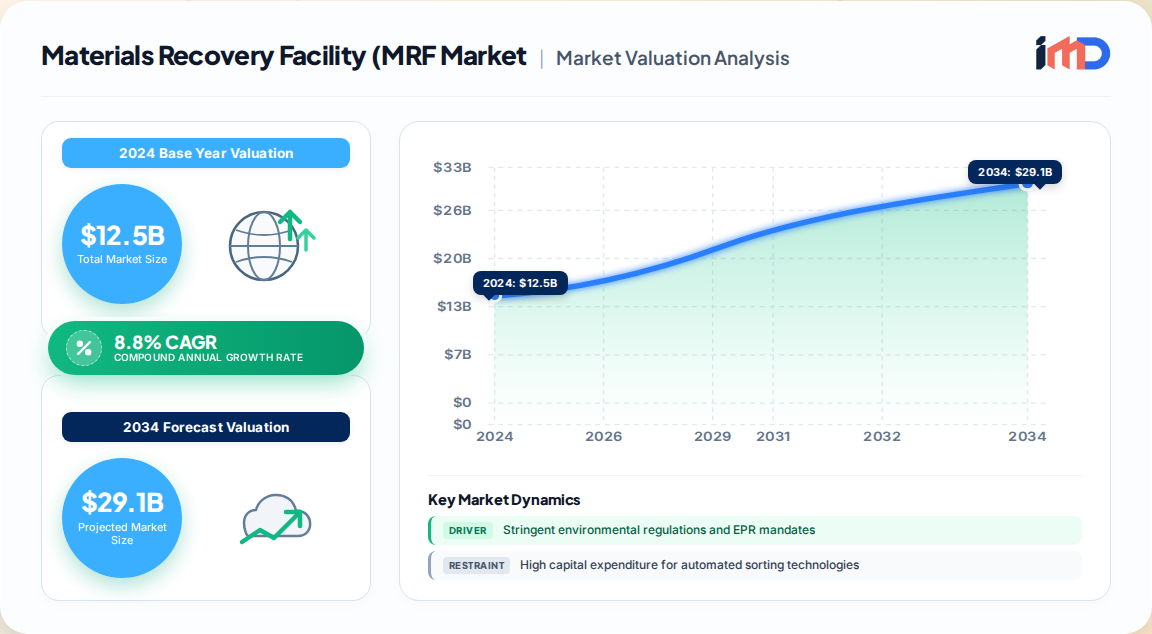
The global Materials Recovery Facility (MRF) market is undergoing a structural transformation, driven by the urgent need to decouple economic growth from landfill dependency. Our proprietary primary research estimates the market at $12.5 Billion in 2024, with a projected expansion to $20.8 Billion by 2033, reflecting a robust CAGR of 8.8% during the forecast period. This growth is not merely a function of increasing waste volumes but is fundamentally powered by a technological arms race. Facilities are rapidly evolving from manual, labor-intensive sorting operations into highly automated, data-driven industrial hubs.
The modern MRF is no longer a passive receiving point for recyclables; it is the critical upstream node for the circular economy. Our analysis indicates that the integration of Artificial Intelligence (AI) and robotics is the single most significant value driver, improving recovery rates of high-value plastics and metals by an average of 15-20% while reducing contamination-related revenue losses. This report provides a granular, first-party analysis of the market dynamics, competitive landscape, and investment hotspots shaping the next decade.
The MRF value chain is a complex, interconnected network that spans from waste collection to the manufacturing of new goods. Our analysis segments the value chain into three primary stages:
The global trade of secondary raw materials is a critical determinant of MRF profitability. While domestic processing is growing, international trade remains vital for balancing supply and demand.
The MRF market is moderately consolidated, with a mix of large multinational waste management corporations and specialized regional operators. Key players are increasingly investing in vertical integration, owning the entire chain from collection to reprocessing.
Table: Key Competitors and Strategic Focus
| Company | Headquarters | Strategic Focus |
|---|---|---|
| Waste Management, Inc. | United States | Automation, technology integration, and vertical integration with reprocessing facilities. |
| Republic Services, Inc. | United States | Large-scale single-stream recycling and polymer centers for plastic recovery. |
| Veolia Environnement S.A. | France | Circular economy solutions, global footprint, and advanced sorting technologies. |
| Suez S.A. | France | Resource recovery, waste-to-energy, and digital solutions for facility optimization. |
| Biffa plc | United Kingdom | UK market focus, EPR compliance, and investment in recycling infrastructure. |
| Casella Waste Systems Inc. | United States | Regional dominance in Northeast US, focus on sustainability and resource recovery. |
| Sims Municipal Recycling | United States | Processing for municipal clients, investment in modern sorting equipment. |
| SSI Shredding Systems | United States | Equipment manufacturing, with a focus on shredding and size reduction. |
| Stadler Anlagenbau GmbH | Germany | Turnkey MRF design and construction, advanced automation and AI integration. |
Strategic White-Space Analysis: Our proprietary assessment identifies significant white-space opportunities in:
| Region | Market Share (2024) | Key Characteristics and Opportunities |
|---|---|---|
| North America | ~30% | Stringent regulations, high labor costs drive automation. Valued at ~$1 Billion. |
| Europe | ~25% | Advanced sustainability initiatives (EPR, CE). Dominated by Germany, France, and UK. Valued at ~$800 Million. |
| Asia-Pacific | ~20% | Rapid urbanization, especially in China and Japan. Growing investment in waste management infrastructure. Valued at ~$600 Million. |
| Latin America | ~15% | Improving waste management systems, with Brazil and Mexico leading investment. |
| Middle East & Africa | ~10% | Focus on improving basic collection and sorting infrastructure, with support from development finance. |
The Asia-Pacific region is projected to be the fastest-growing market, driven by population growth and increasing government focus on environmental sustainability. North America and Europe will maintain their dominant positions, primarily through technological upgrades and the replacement of aging facilities.
For stakeholders across the value chain, our analysis offers the following strategic imperatives:
Ansoff Matrix for MRF Market:
| Aspects | Details |
|---|---|
| Study Period | 2020-2034 |
| Base Year | 2024 |
| Estimated Year | 2026 |
| Forecast Period | 2026-2034 |
| Historical Period | 2020-2025 |
| Growth Rate | CAGR of 8.8% from 2020-2034 |
| Segmentation |
|
By End-User
| By Geography |
|
Our proprietary research values the global MRF market at $12.5 Billion in 2024. It is projected to grow at a CAGR of 8.8% to reach $20.8 Billion by 2033.
Key drivers include stringent environmental regulations (like EPR and EU directives), the push for circular economy practices, and rapid advancements in automated sorting technologies such as AI and robotics.
North America holds the largest share, at approximately 30% in 2024, valued at around $1 Billion, due to advanced infrastructure and strict recycling regulations.
Automation improves sorting efficiency, reduces labor costs, and enhances material recovery rates. AI and robotic systems can improve recovery of high-value plastics and metals by 15-20%.
High capital expenditure for automation, contamination in feedstock, and volatile commodity prices for recovered materials are the primary challenges facing the industry.
Our rigorous research methodology combines multi-layered approaches with comprehensive quality assurance, ensuring precision, accuracy, and reliability in every market analysis.
| Stakeholder Role | Interview Share (%) |
|---|---|
| Chief Operating Officer / VP Operations | 30% |
| Facility Manager / Plant Director | 30% |
| Sustainability / EHS Director | 20% |
| Procurement / Equipment Manager | 20% |
| Company Type | Representation (%) |
|---|---|
| Waste Management Operators | 40% |
| Equipment Manufacturers (Sorting, Balers) | 25% |
| Municipal Recycling Coordinators | 15% |
| Recycling Processors & End-Markets | 12% |
| Logistics & Collection Service Providers | 8% |