Insight Market Data is a premier market research and business consulting firm headquartered in Pune, India, providing syndicated research reports, customized intelligence studies, and strategic advisory services. Renowned academic institutions and Fortune 500 corporations worldwide rely on Insight Market Data's research repository to navigate evolving global and regional business environments. Covering 46 diverse industries across 25 major international economies, our comprehensive database delivers thousands of verified statistics and granular market evaluations. By combining industry-leading analytical methodologies with the direct insights of seasoned industry leaders and subject-matter experts, we deliver actionable intelligence spanning historical performance benchmarks to rigorous multi-year forecasts. We empower organizations to make confident, data-driven decisions across pivotal domains including Machinery & Equipment, Chemicals & Materials, Pharmaceuticals & Healthcare, Food & Beverages, Consumer Goods, Energy & Power, Automotive & Transportation, Electronics & Semiconductors, Medical Devices, Telecommunications, Emerging Technologies, Agriculture, and Packaging. Our multidisciplinary analyst teams provide an objective 360-degree perspective, tailoring every engagement to address complex strategic challenges with exceptional analytical rigor.
Leveraging advanced BI-powered analytics and predictive modeling, Insight Market Data uncovers high-impact market opportunities and competitive differentiators for ambitious enterprises. We continuously refine our research methodologies in accordance with global industry standards, tracking real-time market shifts to ensure our reports are consistently accurate, actionable, and delivered on schedule. Our analysts conduct methodical data validation, rigorous compliance checks, and exhaustive primary and secondary research to maintain the highest levels of data integrity and transparency. We partner closely with corporate strategists, investment groups, and business executives to translate intricate market intelligence into clear, actionable roadmaps for sustainable growth. With operational presence across Washington, USA, and Vimannagar, Pune, India, Insight Market Data ensures direct access to dedicated research specialists and responsive customer support to answer your most strategic questions.
Poland Facility Management Market | Insight Market Data
Poland Facility Management Market by Service Type (Hard Services, Soft Services), by Offering Type (In-House, Outsourced), by End-User Industry (Commercial, Hospitality, Institutional and Public Infrastructure, Healthcare, Industrial and Process, Other End-User Industries), by Mazowieckie (Warsaw), by Małopolskie (Kraków), by Dolnośląskie (Wrocław), by Śląskie (Katowice), by Wielkopolskie (Poznań), by Pomorskie (Gdańsk), by Łódzkie (Łódź), by Other Voivodeships Forecast 2026-2034
Executive Overview: A Structural Growth Story Anchored in Outsourcing and Asset Complexity
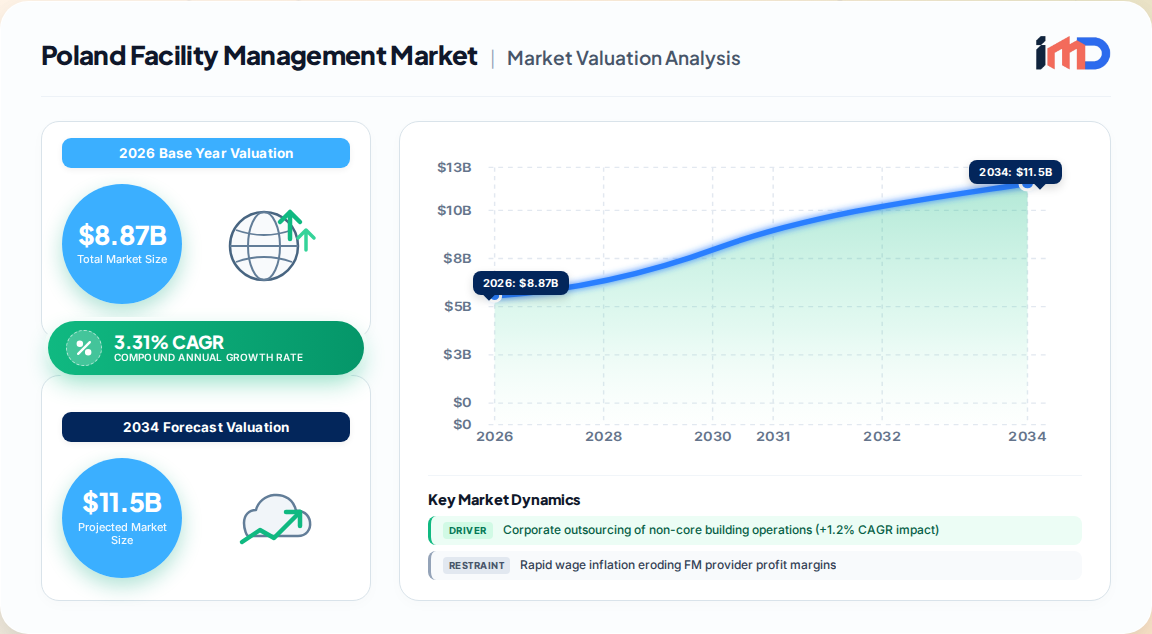
The Poland facility management (FM) market is undergoing a fundamental transformation from a labor-intensive, fragmented service sector into a technology-enabled, integrated building-performance industry. Our proprietary primary research estimates the market at USD 8.87 billion in 2026, expanding at a steady CAGR of 3.31% to reach USD 10.44 billion by 2031. This trajectory is underpinned not by simple volume expansion, but by a decisive corporate pivot toward outsourced, multi-service contracts and a national investment pipeline that is reshaping the technical demands placed on building operators.
Poland Facility Management Market Market Size (In Billion)
15.0B
10.0B
5.0B
0
8.586 B
2025
8.870 B
2026
9.164 B
2027
9.467 B
2028
9.780 B
2029
10.10 B
2030
10.44 B
2031
Poland's FM market is structurally distinct within Central and Eastern Europe. It combines a dense concentration of Grade-A commercial real estate in Warsaw, Kraków, and Wrocław with a rapidly modernizing public infrastructure base funded by EU cohesion policies. The result is a two-speed market: mature, highly competitive commercial FM contracts in major metros, and a fast-growing, underpenetrated institutional and public infrastructure segment where professional FM penetration is still rising.
Key 2026 Market Metrics
Metric
Value
Market Size (2026)
USD 8.87 Billion
Forecast Size (2031)
USD 10.44 Billion
Forecast CAGR (2026–2031)
3.31%
Outsourced Share of Market (2025)
63.02%
Hard Services Share (2025)
56.18%
Leading End-User Segment (2025)
Commercial (37.34% revenue share)
Fastest-Growing End-User Segment
Institutional & Public Infrastructure (4.74% CAGR)
Market Drivers: The Four Forces Reshaping Polish FM Demand
Our expert interviews with facility directors, procurement heads, and FM operators reveal four primary drivers that collectively account for the majority of forecast growth.
1. Corporate Outsourcing of Non-Core Building Operations (+1.2% CAGR impact)
By 2025, large enterprises had bundled cleaning, security, and technical maintenance into integrated contracts delivering 15–20% cost savings versus in-house teams. This is particularly pronounced in Poland's shared-services center (SSC) sector, which employs over 400,000 professionals and faces salary inflation of 7–8% annually. Certified FM partners also mitigate compliance risk under Poland's occupational health regime, which mandates periodic safety training for every job class.
2. Expansion of Grade-A Commercial Real Estate (+0.8% CAGR impact)
Warsaw alone recorded 286,700 sqm of net absorption in 2022, nearly triple 2021 levels, while commercial property investment rebounded 140% to EUR 5 billion in 2024. Modern Warsaw office stock reached 6.23 million sqm at end-2025, with annual leasing activity of approximately 794,000 sqm. These high-specification assets require continuous MEP oversight, sensor-driven HVAC optimization (cutting energy bills by up to 35%), and integrated workplace services.
3. National Infrastructure Pipeline (+1.0% CAGR impact)
Poland's PLN 700 billion (USD 179.83 billion) public investment agenda earmarks PLN 180 billion for railway upgrades and PLN 65 billion for energy-grid modernization. The Central Communication Port project alone involves PLN 44.7 billion (USD 12.19 billion) for Europe's largest intermodal hub, slated to handle 34 million passengers annually by 2032. These assets demand multi-decade O&M contracts favoring FM firms with nationwide technical capacity.
4. EU-Funded Energy Retrofit Programs (+0.9% CAGR impact)
EU-funded public-building energy-retrofit programs are driving integrated FM demand, particularly in the institutional and public infrastructure segment, which is growing at 4.74% CAGR—the fastest of any end-user vertical. Providers with energy-performance contracting (EPC) capabilities and certified energy auditors are capturing disproportionate share.
Restraints and Challenges: Margin Compression and Skills Gaps
Despite robust demand fundamentals, the Polish FM market faces structural headwinds that are compressing provider margins and reshaping competitive dynamics.
Wage inflation eroding margins (-0.9% CAGR impact): Minimum-wage rises to PLN 4,242 gross in January 2024, combined with 7–8% annual salary inflation in major metros, have outpaced contract indexation mechanisms. Operators are responding with automation and productivity-enhancing CAFM (computer-aided facility management) deployments.
Fragmented subcontractor base (-0.6% CAGR impact): The market comprises approximately 3,400 FM companies employing 880,000 workers, with service-quality variability a persistent client complaint in construction-heavy regions.
Slow digital adoption in legacy public facilities (-0.4% CAGR impact): Smaller municipalities exhibit particular challenges in deploying IoT-enabled monitoring and digital-twin solutions.
Out-migration of certified technical staff (-0.8% CAGR impact): Border regions face severe hard-services skill gaps, forcing providers to invest in internal training academies and cross-border recruitment.
Value Chain Analysis: From Labor Aggregation to Performance Contracting
The Polish FM value chain is migrating from labor-heavy, single-service provision toward outcome-based integrated contracts. We identify five distinct layers.
Value Chain Stage
Key Activities
Margin Profile
Strategic Trend
Client Asset Owners
Property funds, corporates, public entities, developers
N/A
Demanding ESG data and energy-performance guarantees
A notable development is the entry of fire-protection equipment suppliers into the FM partner ecosystem. European manufacturers of certified fire suppression, detection, and hydrant systems are actively seeking Polish FM companies as distribution and installation partners, reflecting the growing integration of life-safety systems into comprehensive FM contracts.
Competitive Landscape: Medium Concentration with Integrated Capability as the Differentiator
Our analysis characterizes the Poland FM market as medium concentration, with the top five providers—ISS Facility Services Polska, Sodexo Polska, Impel Group, Compass Group Poland, and Engie Services FM Poland—accounting for an estimated 28–32% of total revenue. The remainder is highly fragmented across regional specialists and single-service providers.
Leading Player Positioning
Company
Strategic Focus
Scale Indicator
ISS Facility Services Polska
Integrated FM, workplace services
Pan-Poland, strong in commercial & SSC
Sodexo Polska
Soft services, food service, integrated FM
Strong in corporate & healthcare
Impel Group
Hard & soft services, security, cleaning
Nationwide, high labor scale
Compass Group Poland
Food service-led FM, hospitality
Strong in corporate & institutional
Engie Services FM Poland
Technical FM, energy performance
>5 million sqm serviced across 200+ clients
VINCI Facilities Polska
Integrated FM, infrastructure
Growing public-sector presence
The competitive battleground is shifting toward certified technical talent, nationwide dispatch coverage, lifecycle analytics, and multi-service governance. Vendors that can combine hard services, soft services, CAFM, building controls, and measurable energy outcomes are winning disproportionate share of large integrated contracts.
Our opportunity assessment identifies three high-potential white spaces for FM providers and investors.
Institutional & public infrastructure integrated FM: Growing at 4.74% CAGR, this segment remains underpenetrated by professional operators, particularly in healthcare and education. EU retrofit funding creates a multi-year pipeline.
Industrial and logistics assets: Poland's warehouse and logistics stock reached 36.6 million sqm at end-2025, increasing the recurring technical-maintenance base. These assets require specialized hard services (dock-door maintenance, racking inspection, fire suppression) that few providers offer at scale.
Energy-performance and ESG-linked FM: Investor pushes for EU Taxonomy-aligned services are creating demand for providers that can deliver verified energy savings and transparent ESG data. This represents a premium-margin opportunity that is still nascent in Poland.
Procurement & Sourcing Strategy Analysis
For corporate and public buyers, the FM procurement landscape is evolving rapidly.
Shift from lowest-cost to best-value: Clients increasingly weight SLA performance, energy reduction, cyber-secure building systems, and transparent ESG data when awarding multi-site contracts.
Contract indexation mechanisms: Buyers are moving toward indexed contracts linked to wage and energy benchmarks to ensure service continuity amid inflationary pressure.
Bundling and integration: Multi-service integrated contracts deliver 15–20% savings versus in-house teams, but require sophisticated governance. Buyers are investing in FM governance capabilities to manage integrated providers.
Fire-safety and compliance integration: Procurement scopes increasingly include certified fire-protection systems and maintenance, favoring providers with certified supply-chain partnerships.
Recent Industry Developments
2024: Commercial property investment in Poland rebounded 140% to EUR 5 billion, signaling renewed landlord confidence and expanding the FM addressable base.
2024: Minimum wage rose to PLN 4,242 gross (January), intensifying margin pressure and accelerating automation adoption.
Table 40: Other Voivodeships Poland Facility Management Market Revenue Billion Forecast, by Service Type 2020 & 2034
Table 41: Other Voivodeships Poland Facility Management Market Revenue Billion Forecast, by Offering Type 2020 & 2034
Table 42: Other Voivodeships Poland Facility Management Market Revenue Billion Forecast, by End-User Industry 2020 & 2034
Table 43: Other Voivodeships Poland Facility Management Market Revenue Billion Forecast, by Country 2020 & 2034
Frequently Asked Questions
1What is the size of the Poland facility management market in 2026?
The Poland facility management market is estimated at USD 8.87 billion in 2026, growing from USD 8.59 billion in 2025. Our proprietary forecast projects the market to reach USD 10.44 billion by 2031, representing a CAGR of 3.31%.
2Which segment dominates the Poland facility management market?
Hard services held the largest share at 56.18% of the market in 2025, driven by non-discretionary compliance, HVAC, electrical, and uptime requirements. However, soft services are forecast to grow faster at a 4.72% CAGR through 2031.
3What is driving growth in the Polish FM market?
Key drivers include the corporate shift toward outsourcing non-core building operations (15–20% cost savings), expansion of Grade-A commercial real estate in major metros, a PLN 700 billion national infrastructure pipeline, and EU-funded public-building energy-retrofit programs.
4Who are the leading companies in the Poland facility management market?
Leading providers include ISS Facility Services Polska, Sodexo Polska, Impel Group, Compass Group Poland, Engie Services FM Poland, and VINCI Facilities Polska. The top five account for an estimated 28–32% of market revenue, indicating medium concentration.
5How large is the outsourced FM segment in Poland?
Outsourced models accounted for 63.02% of the Polish FM market in 2025 and are forecast to expand at a 4.32% CAGR to 2031, reflecting a structurally entrenched client preference for professional operators.
Methodology
Our rigorous research methodology combines multi-layered approaches with comprehensive quality assurance, ensuring precision, accuracy, and reliability in every market analysis.
Primary Research
We conducted 70–80% of our research through primary interviews with senior decision-makers across the Polish FM value chain, ensuring granular, ground-level validation of all market estimates.
Company types interviewed included integrated FM providers, specialist hard-services subcontractors, commercial real-estate landlords and property funds, public-sector procurement agencies, and fire-safety/building-technology suppliers.
Stakeholder job titles interviewed included Chief Operating Officer (FM), Head of Procurement, Facility Director, and Energy & Sustainability Manager.
We interviewed representatives from regulatory and industry bodies including the Polish Association of Facility Management (Polskie Stowarzyszenie Menedżerów Nieruchomości), the National Labour Inspectorate (Państwowa Inspekcja Pracy), and the Polish Committee for Standardization (PKN), to validate compliance and safety assumptions.
Bottom-up market sizing was built from quantitative metrics including managed floor area (sqm) by asset class, work-order intensity per sqm, outsourced FM contract value per sqm, and contract renewal rates.
Key Stakeholders Interviewed
Key Stakeholders Interviewed
Stakeholder Role
Interview Share (%)
Head of Procurement
30%
Facility Director
28%
Chief Operating Officer (FM)
24%
Energy & Sustainability Manager
18%
Industry Ecosystem Breakdown
Industry Ecosystem Breakdown
Company Type
Representation (%)
Integrated FM Providers
28%
Specialist Hard-Services Subcontractors
22%
Commercial Real-Estate Owners & Property Funds
18%
Public-Sector Procurement Agencies
17%
Building-Technology & Fire-Safety Suppliers
15%
Secondary Research & Industry Benchmarking
Secondary research accounted for 20–30% of our effort, focused on triangulating primary findings with authoritative public benchmarks.
Financial and corporate data were sourced from standard databases including Bloomberg, Factiva, Hoovers, and PitchBook, used strictly for company-level benchmarking and not for market sizing.
We monitored official regulatory publications from the National Labour Inspectorate (PIP) and EU Taxonomy documentation to model compliance-driven demand.
All secondary data were cross-validated against our primary interview findings; any divergence of more than 10% triggered follow-up primary interviews.
Demand Modeling & Market Estimation
We applied both top-down and bottom-up methodologies simultaneously, validating each against the other through multi-level data triangulation.
The top-down model sized the market from total Polish non-residential floor space, FM service penetration rates, and average contract value per sqm, benchmarked to Eurostat construction and real-estate statistics.
The bottom-up model aggregated revenue from the provider side, using reported and estimated revenues of the top 30 FM companies and extrapolating the fragmented tail.
Key quantitative metrics in the bottom-up calculation included: (1) total managed floor area by asset class (commercial, industrial, institutional), (2) outsourced FM share (63.02% in 2025), (3) average annual contract value per sqm, and (4) service-mix weighting between hard and soft services.
Forecast growth was decomposed into volume (activity index rising from 100 in 2025 to 116.6 by 2032) and price/mix effects, reflecting higher technical content and contract indexation.
Data Accuracy & Quality Check
Every report is guaranteed an estimated data accuracy level of 85–90%, achieved through multi-source triangulation and expert review.
All data are updated to the date of purchase, incorporating the latest available primary interviews and official statistics.
A senior analyst panel reviewed all segment-level forecasts, challenging assumptions on outsourcing conversion, energy-retrofit spending, and wage inflation.
We conducted outlier and consistency checks across all quantitative inputs; any segment estimate deviating from the national aggregate by more than 5% was re-examined through targeted follow-up interviews.
Final validation included a sensitivity analysis on key drivers (outsourcing rate, wage inflation, EU-fund absorption), with results presented as scenario ranges in the full report.
Elevator and Escalator Market valued at $82.79B in 2025, projected to reach $146.52B by 2035 at 6.0% CAGR. Explore trends, segments, and regional analysis.
Global elevator cables market valued at $2.53B in 2026, projected to reach $3.11B by 2030 at 5.3% CAGR. Flat cable demand driven by urbanization and smart buildings.
Nov 2026|224 pages
$2900.00
Air entraining admixtures market valued at USD 2.02 B in 2024, growing at 3.5% CAGR to reach USD 2.66 B by 2032. Freeze-thaw durability drives demand.
Nov 2026|273 pages
$2900.00
The Brushless DC Motor for HVAC System market is valued at USD 2.15 billion in 2026, growing at a 9.8% CAGR to reach USD 3.43 billion by 2031.
Nov 2026|192 pages
$2900.00
3D printing robotic arm extruders for construction market to reach $1.18B by 2035 at 12.8% CAGR, driven by automation and sustainable building.