About Insight Market Data

Insight Market Data is a premier market research and business consulting firm headquartered in Pune, India, providing syndicated research reports, customized intelligence studies, and strategic advisory services. Renowned academic institutions and Fortune 500 corporations worldwide rely on Insight Market Data's research repository to navigate evolving global and regional business environments. Covering 46 diverse industries across 25 major international economies, our comprehensive database delivers thousands of verified statistics and granular market evaluations. By combining industry-leading analytical methodologies with the direct insights of seasoned industry leaders and subject-matter experts, we deliver actionable intelligence spanning historical performance benchmarks to rigorous multi-year forecasts. We empower organizations to make confident, data-driven decisions across pivotal domains including Machinery & Equipment, Chemicals & Materials, Pharmaceuticals & Healthcare, Food & Beverages, Consumer Goods, Energy & Power, Automotive & Transportation, Electronics & Semiconductors, Medical Devices, Telecommunications, Emerging Technologies, Agriculture, and Packaging. Our multidisciplinary analyst teams provide an objective 360-degree perspective, tailoring every engagement to address complex strategic challenges with exceptional analytical rigor.

Leveraging advanced BI-powered analytics and predictive modeling, Insight Market Data uncovers high-impact market opportunities and competitive differentiators for ambitious enterprises. We continuously refine our research methodologies in accordance with global industry standards, tracking real-time market shifts to ensure our reports are consistently accurate, actionable, and delivered on schedule. Our analysts conduct methodical data validation, rigorous compliance checks, and exhaustive primary and secondary research to maintain the highest levels of data integrity and transparency. We partner closely with corporate strategists, investment groups, and business executives to translate intricate market intelligence into clear, actionable roadmaps for sustainable growth. With operational presence across Washington, USA, and Vimannagar, Pune, India, Insight Market Data ensures direct access to dedicated research specialists and responsive customer support to answer your most strategic questions.

report thumbnail4,4'-Methylenebis(2-chloroaniline) (MOCA) Market
Chemicals & Materials / MARKET REPORT

4,4'-Methylenebis(2-chloroaniline) (MOCA) Market | Insight Market Data

4, 4'-Methylenebis(2-chloroaniline) (MOCA) Market by Application (Polyurethane Foam, Polyurethane Elastomers, Polyurethane Coatings, Polyurethane Adhesives), by Type (Flake, Powder), by Form (Solid Granules, Powder, Aqueous Solution), by North America (USA, Canada, Mexico), by Europe (Germany, UK, France, Italy, Spain, Russia), by Asia-Pacific (China, Japan, South Korea, India, Southeast Asia, Rest of Asia-Pacific), by South America (Brazil, Argentina, Colombia, Rest of South America), by Middle East & Africa (Saudi Arabia, UAE, Egypt, Nigeria, South Africa, Rest of MEA) Forecast 2026-2034

© Nov 26, 2026|Base Year: 2025|213 Pages
Khageshwar Rongkali

Khageshwar Rongkali

Senior Analyst

Main Logo

MOCA Market Size, Trends & Forecast 2025-2033


/
/
Buy Now
Home
Industries
Chemicals & Materials

Business Address

Head Office

Ansec House 3 rd floor Tank Road, Yerwada, Pune, Maharashtra 411014

Contact Information

Craig Francis

Business Development Head

+12315155523

[email protected]

Secure Payment Partners

payment image
RetailLogisticsPackagingAutomotiveHealthcareAgricultureEnergy & PowerFood & BeverageAerospace & DefenseChemicals & MaterialsHospitality and TourismConsumer Goods and ServicesAnimal Nutrition & WellnessReal Estate and ConstructionHome and Property ImprovementTechnology, Media and TelecomManufacturing Products and ServicesFinancial Services and Investment Intelligence

© 2026 PRDUA Research & Media Private Limited, All rights reserved

Privacy Policy•Terms and Conditions•FAQ
Independent Intelligence for decisions that move markets
+12315155523[email protected]
  • Home
  • About Us
  • Industries
    • Automotive
    • Consumer Goods and Services
    • Financial Services and Investment Intelligence
    • Home and Property Improvement
    • Logistics
    • Retail
    • Agriculture
    • Healthcare
    • Animal Nutrition & Wellness
    • Chemicals & Materials
    • Energy & Power
    • Food & Beverage
    • Hospitality and Tourism
    • Manufacturing Products and Services
    • Professional and Commercial Services
    • Real Estate and Construction
    • Aerospace & Defense
    • Packaging
    • Technology, Media and Telecom
  • Services
  • Contact
Main Logo
  • Home
  • About Us
  • Industries
    • Automotive
    • Consumer Goods and Services
    • Financial Services and Investment Intelligence
    • Home and Property Improvement
    • Logistics
    • Retail
    • Agriculture
    • Healthcare
    • Animal Nutrition & Wellness
    • Chemicals & Materials
    • Energy & Power
    • Food & Beverage
    • Hospitality and Tourism
    • Manufacturing Products and Services
    • Professional and Commercial Services
    • Real Estate and Construction
    • Aerospace & Defense
    • Packaging
    • Technology, Media and Telecom
  • Services
  • Contact
Talk to an analyst
4,4'-Methylenebis(2-chloroaniline) (MOCA) Market CAGR, market size, market share

Executive Overview

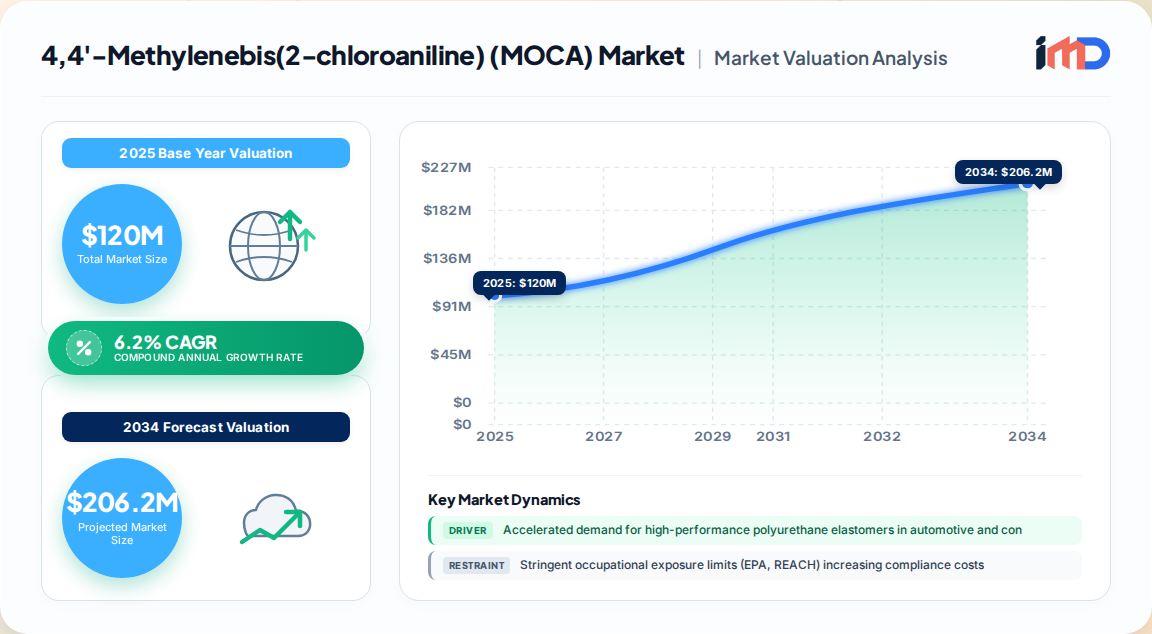
The global 4,4'-Methylenebis(2-chloroaniline) (MOCA) market represents a critical, high-value segment within the specialty chemicals and polyurethane value chain. Our proprietary primary research estimates the market size at USD 120 million in 2025, with a projected valuation of USD 194.17 million by 2033, expanding at a CAGR of 6.2% over the forecast period (2026-2033).

4,4'-Methylenebis(2-chloroaniline) (MOCA) Market Market Size (In Million)

200.0M
150.0M
100.0M
50.0M
0
120.0 M
2025
127.0 M
2026
135.0 M
2027
144.0 M
2028
153.0 M
2029
162.0 M
2030
172.0 M
2031
Main Logo

MOCA, also known as MBOCA, is an aromatic diamine primarily utilized as a curing agent for polyurethane elastomers. Its unique chemical structure imparts exceptional mechanical properties—including superior abrasion resistance, tear strength, and dynamic load-bearing capacity—making it indispensable in demanding applications such as industrial rollers, automotive components, mining screens, and high-performance seals.

The market is characterized by a concentrated supplier base and stringent regulatory oversight, particularly in North America and Europe, which shapes competitive dynamics and drives innovation toward safer handling and alternative formulations. The Asia-Pacific region dominates consumption, accounting for an estimated 48% of global demand, fueled by rapid industrialization and the expansion of polyurethane manufacturing in China, India, and Southeast Asia.

Market Dynamics

Growth Drivers

  • Accelerated demand for high-performance polyurethane elastomers in automotive and construction sectors is a primary growth driver. MOCA-cured elastomers offer superior tensile strength and durability, directly expanding the market size as manufacturers seek materials that can withstand extreme conditions.
  • Strategic investments in regional production hubs, particularly in Asia-Pacific, are reducing logistics costs and lead times, enhancing price competitiveness and supporting a robust growth forecast for the MOCA market through 2033.
  • Technological advancements in polyurethane formulations are broadening the application scope of MOCA, particularly in high-performance coatings and adhesives, creating new revenue streams.

Restraints

  • Stringent occupational exposure limits imposed by regulatory bodies such as the EPA and REACH increase compliance expenditures for end-users, potentially curbing profit margins and slowing market expansion. MOCA is classified as a potential carcinogen in several jurisdictions, leading to restricted use and handling protocols.
  • Volatile raw-material pricing, especially for aniline derivatives, introduces cost-pass-through uncertainty, which can dampen order volumes and restrain anticipated market growth.

Opportunities

  • Emerging applications in advanced composite foams for aerospace present a high-margin niche, offering a pathway to diversify revenue and positively influence long-term growth forecasts.
  • Development of greener synthesis routes, such as catalytic hydrogenation that lowers by-product waste, aligns with ESG mandates and opens access to premium contracts, expanding the overall market size.
  • Innovation in encapsulation and closed-system application technologies can mitigate exposure risks, allowing for continued use of MOCA in critical applications while addressing health and safety concerns.

Challenges

  • Limited availability of skilled chemists familiar with MOCA handling protocols creates bottlenecks in scaling production, threatening supply reliability and the ability to meet forecasted demand spikes.
  • Geopolitical trade tensions affecting key export corridors can disrupt the global supply chain, leading to inventory shortages that may force downstream manufacturers to seek alternative cross-linkers, eroding market share.

Value Chain Analysis

The MOCA value chain is characterized by a limited number of specialized chemical producers and a diverse downstream customer base.

  • Upstream: Key raw materials include aniline, formaldehyde, and hydrochloric acid. The availability and pricing of aniline derivatives significantly impact MOCA production costs. Suppliers are primarily large petrochemical firms.
  • Midstream: MOCA manufacturers operate dedicated synthesis facilities, often integrated with polyurethane precursor production. The production process involves the condensation of aniline with formaldehyde, followed by chlorination. Quality control and regulatory compliance are critical at this stage.
  • Downstream: MOCA is sold to formulators and processors of polyurethane elastomers, coatings, adhesives, and foams. Key end-use industries include automotive, construction, mining, industrial manufacturing, and aerospace.

Table: MOCA Value Chain Stakeholders

Stage Key Activities Major Stakeholders
Upstream Aniline, formaldehyde, chlorine production Petrochemical suppliers
Midstream MOCA synthesis, purification, packaging Specialty chemical manufacturers
Downstream PU elastomer, coating, adhesive formulation Formulators, OEMs
End-Use Automotive parts, industrial rollers, seals Automotive, construction, mining, aerospace

Import/Export & Supplier Dynamics

The global MOCA trade is concentrated, with a few key producing countries exporting to major consumption markets. China is the largest exporter, supplying significant volumes to North America, Europe, and Southeast Asia. The United States and Western Europe are net importers, relying on imports to meet domestic demand while maintaining stringent quality and safety standards.

  • Asia-Pacific: China and India are major producers, with China accounting for an estimated 60% of global MOCA production capacity. Exports from China are subject to increasing scrutiny regarding quality and regulatory compliance.
  • North America: The U.S. has limited domestic production, with imports primarily from Asia. The market is highly regulated, with OSHA and EPA guidelines dictating handling and use.
  • Europe: Stringent REACH regulations have led to a decline in domestic production, with imports from Asia filling the gap. However, high compliance costs create a barrier for some suppliers.

Table: Major MOCA Suppliers and Their Geographic Focus

Company Headquarters Primary Markets
Johnson Fine Chemical China Global
Taiwan PU Corporation Taiwan Asia-Pacific, North America
Xiangyuan New Materials China Global
Quzhou Juke Chemical China Global

Segmentation Analysis

The MOCA market is segmented by application, product type, and form. Our analysis indicates that polyurethane foam is the largest application segment, accounting for approximately 45% of total demand, driven by large-scale consumption in automotive seat cushions, insulation panels, and packaging foams. Polyurethane elastomers represent the second-largest segment at about 30%, reflecting their role in vibration-damping components, industrial wheels, and high-performance seals. Polyurethane coatings comprise 15% of the market, employed in protective finishes for automotive, marine, and architectural surfaces. Polyurethane adhesives capture the remaining 10%, serving niche applications such as aerospace bonding and high-strength assembly lines.

By product type, the market distinguishes between flake and powder forms. Flake MOCA is preferred in continuous polymerization reactors for its flow characteristics, while powder is favored in batch processes that demand rapid dissolution. High-purity (>99.5%) MOCA commands a premium price and is predominantly used in foam and elastomer applications where residual monomer levels affect performance and compliance.

Table: MOCA Market Segmentation by Application (2025)

Application Market Share (%) Key Drivers
Polyurethane Foam 45% Automotive seating, insulation, packaging
Polyurethane Elastomers 30% Industrial rollers, seals, mining screens
Polyurethane Coatings 15% Protective finishes, marine, architectural
Polyurethane Adhesives 10% Aerospace bonding, high-strength assembly

Regional Outlook

  • Asia-Pacific: Dominates the global MOCA market with an estimated 48% share in 2025. The region is driven by rapid industrialization, expanding automotive production, and infrastructure development in China and India. China alone accounts for over half of regional consumption. The fastest-growing region, with a projected CAGR of 7.1% through 2033.
  • Europe: Holds approximately 22% of the market, characterized by stringent regulatory oversight (REACH) and a focus on high-performance applications. Demand is stable but growth is tempered by regulatory constraints and substitution trends.
  • North America: Accounts for about 18% of global demand, with the U.S. being the largest consumer. The market is mature, with growth driven by replacement demand and specialized applications in aerospace and defense.
  • South America: Represents 7% of the market, with Brazil and Argentina as key markets. Growth is tied to industrial expansion and infrastructure projects.
  • Middle East & Africa: Accounts for 5%, with demand concentrated in South Africa and the GCC countries, primarily for construction and industrial applications.

4,4'-Methylenebis(2-chloroaniline) (MOCA) Market Regional Market Share

Loading chart...
Main Logo

Competitive Strategies

The MOCA market is highly concentrated, with the top four players—Johnson Fine Chemical, Taiwan PU Corporation, Xiangyuan New Materials, and Quzhou Juke Chemical—accounting for an estimated 75-80% of global supply. Competition is based on product quality, regulatory compliance, price, and supply reliability.

Key strategies observed among leading players include:

  • Capacity expansion in Asia-Pacific to capitalize on growing demand and achieve economies of scale.
  • Investment in R&D for greener synthesis routes and improved handling protocols to align with ESG goals and regulatory requirements.
  • Vertical integration into upstream raw materials to secure supply and mitigate price volatility.
  • Geographic diversification of customer base to reduce dependence on any single region.

Emerging players are focusing on niche applications and specialized grades to gain traction in a market dominated by established suppliers.

Strategic White-Space Analysis

Our analysis identifies several high-potential white spaces for stakeholders:

  • Aerospace composites: MOCA-cured polyurethane foams for lightweight, high-strength composite structures present a high-margin opportunity, albeit with stringent qualification requirements.
  • Additive manufacturing: Development of MOCA-based formulations for 3D printing of high-performance polyurethane parts could open new markets in rapid prototyping and custom manufacturing.
  • Green chemistry: Bio-based or less toxic curing agents that mimic MOCA's performance could capture share in environmentally sensitive markets, particularly in Europe and North America.
  • Emerging economies: Infrastructure development in Southeast Asia, Africa, and Latin America offers untapped demand for MOCA-cured elastomers in construction and mining equipment.

Stakeholders should prioritize investments in regulatory compliance and safety innovations to maintain market access while exploring these white spaces for growth.

4,4'-Methylenebis(2-chloroaniline) (MOCA) Market Regional Market Share

Higher Coverage
Lower Coverage
No Coverage

4,4'-Methylenebis(2-chloroaniline) (MOCA) Market REPORT HIGHLIGHTS

AspectsDetails
Study Period2020-2034
Base Year2025
Estimated Year2026
Forecast Period2026-2034
Historical Period2020-2025
Growth RateCAGR of 6.2% from 2020-2034
Segmentation
  • By Application

    • Polyurethane Foam
    • Polyurethane Elastomers
    • Polyurethane Coatings
    • Polyurethane Adhesives
  • By Type

Table of Contents

  1. 1. 4,4'-Methylenebis(2-chloroaniline) (MOCA) Market Introduction
    • 1.1. Research Scope
    • 1.2. Market Segmentation
    • 1.3. Research Objective
    • 1.4. Definitions and Assumptions
  2. 2. 4,4'-Methylenebis(2-chloroaniline) (MOCA) Market Executive Summary
    • 2.1. Market Snapshot
  3. 3. 4,4'-Methylenebis(2-chloroaniline) (MOCA) Market Dynamics
    • 3.1. Market Drivers
      • 3.1.1. Accelerated demand for high-performance polyurethane elastomers in automotive and construction
      • 3.1.2. Strategic investments in regional production hubs in Asia-Pacific
    • 3.2. Market Trends
      • 3.2.1. Shift towards high-purity MOCA grades for elastomer applications
      • 3.2.2. Growing adoption of encapsulated MOCA for safer handling
      • 3.2.3. Capacity expansion in Asia-Pacific by leading producers
    • 3.3. Market Restraints
      • 3.3.1. Stringent occupational exposure limits (EPA, REACH) increasing compliance costs
      • 3.3.2. Volatile raw-material pricing affecting profit margins
    • 3.4. Market Challenges
      • 3.4.1. Limited availability of skilled chemists for MOCA handling
      • 3.4.2. Geopolitical trade tensions disrupting supply chains
  4. 4. 4,4'-Methylenebis(2-chloroaniline) (MOCA) Market Factor Analysis
Author
Khageshwar Rongkali

Khageshwar Rongkali

Senior Analyst

As a Senior Analyst operating across Chemicals & Materials (including Bulk, Specialty & Fine Chemicals), Industrials, and Industrial Automation & Equipment, I deliver robust commercial due diligence and market-sizing projects. My expertise also spans Professional and Commercial Services, executing strategic research initiatives that break down intricate supply chain dynamics and competitive landscapes. Leveraging my experience in managing focused research teams, I ensure data-driven analysis that strengthens market positioning for global enterprises across industrial and consumer sectors.

Get In Touch
WHY IMD

Verified research

Analyst-reviewed data

Updated Nov 26, 2026

sponsor image
sponsor image
sponsor image
sponsor image
sponsor image
sponsor image
sponsor image
sponsor image
sponsor image
sponsor image
sponsor image
sponsor image
sponsor image
sponsor image
sponsor image
sponsor image
sponsor image
sponsor image
sponsor image
sponsor image
CUSTOM INTELLIGENCE

Tailored for you

  • In-depth Analysis Tailored to Specified Regions or Segments
  • Company Profiles Customized to User Preferences
  • Customized Evaluation of Competitive Landscape to Meet Your Needs
Ask for customization
avatar

Analyst at Providence Strategic Partners at Petaling Jaya

Jared Wan

I have received the report already. Thanks you for your help.it has been a pleasure working with you. Thank you again for a good quality report

avatar

Internationalization Director

Santiago Mejia Molina

Yes, as a matter of fact we are totally satisfied with both reports that we have purchased and will continue to do so during this process of the internationalization of our brand.

avatar

Head of Product Management and Marketing

Olaf Gleibe

We are using your report, and it gave us valuable information."

avatar

Regional Director, Marketing and Business Development

Lina Lim

We've received the report and have reviewed the content. Overall, it looks great and aligns closely with the data we can verify based on our industry knowledge.

avatar

VP of Sales

DIGGLE Representative

Thank you very much for sharing the report. I have reviewed it and I am very satisfied with the quality and the insights it provides. It will certainly be valuable for our internal discussions.

  • Flake
  • Powder
  • By Form

    • Solid Granules
    • Powder
    • Aqueous Solution
  • By Geography
    • North America

      • USA
      • Canada
      • Mexico
    • Europe

      • Germany
      • UK
      • France
      • Italy
      • Spain
      • Russia
    • Asia-Pacific

      • China
      • Japan
      • South Korea
      • India
      • Southeast Asia
      • Rest of Asia-Pacific
    • South America

      • Brazil
      • Argentina
      • Colombia
      • Rest of South America
    • Middle East & Africa

      • Saudi Arabia
      • UAE
      • Egypt
      • Nigeria
      • South Africa
      • Rest of MEA
  • 4.1. Porters Five Forces
    • 4.1.1. Bargaining Power of Suppliers
    • 4.1.2. Bargaining Power of Buyers
    • 4.1.3. Threat of New Entrants
    • 4.1.4. Threat of Substitutes
    • 4.1.5. Competitive Rivalry
  • 4.2. PESTEL analysis
  • 4.3. BCG Analysis
    • 4.3.1. Stars (High Growth, High Market Share)
    • 4.3.2. Cash Cows (Low Growth, High Market Share)
    • 4.3.3. Question Mark (High Growth, Low Market Share)
    • 4.3.4. Dogs (Low Growth, Low Market Share)
  • 4.4. Ansoff Matrix Analysis
  • 4.5. Supply Chain Analysis
  • 4.6. Regulatory Landscape
  • 4.7. Current Market Potential and Opportunity Assessment (TAM–SAM–SOM Framework)
  • 4.8. IMD Analyst Note
  • 5. 4,4'-Methylenebis(2-chloroaniline) (MOCA) Market Analysis, Insights and Forecast, 2020-2034
    • 5.1. Analysis, Insights and Forecast - by Application
      • 5.1.1. Polyurethane Foam
      • 5.1.2. Polyurethane Elastomers
      • 5.1.3. Polyurethane Coatings
      • 5.1.4. Polyurethane Adhesives
    • 5.2. Analysis, Insights and Forecast - by Type
      • 5.2.1. Flake
      • 5.2.2. Powder
    • 5.3. Analysis, Insights and Forecast - by Form
      • 5.3.1. Solid Granules
      • 5.3.2. Powder
      • 5.3.3. Aqueous Solution
    • 5.4. Analysis, Insights and Forecast - by Region
      • 5.4.1. North America
      • 5.4.2. Europe
      • 5.4.3. Asia-Pacific
      • 5.4.4. South America
      • 5.4.5. Middle East & Africa
  • 6. 4,4'-Methylenebis(2-chloroaniline) (MOCA) Market North America Analysis, Insights and Forecast, 2020-2034
    • 6.1. Analysis, Insights and Forecast - by Application
      • 6.1.1. Polyurethane Foam
      • 6.1.2. Polyurethane Elastomers
      • 6.1.3. Polyurethane Coatings
      • 6.1.4. Polyurethane Adhesives
    • 6.2. Analysis, Insights and Forecast - by Type
      • 6.2.1. Flake
      • 6.2.2. Powder
    • 6.3. Analysis, Insights and Forecast - by Form
      • 6.3.1. Solid Granules
      • 6.3.2. Powder
      • 6.3.3. Aqueous Solution
  • 7. 4,4'-Methylenebis(2-chloroaniline) (MOCA) Market Europe Analysis, Insights and Forecast, 2020-2034
    • 7.1. Analysis, Insights and Forecast - by Application
      • 7.1.1. Polyurethane Foam
      • 7.1.2. Polyurethane Elastomers
      • 7.1.3. Polyurethane Coatings
      • 7.1.4. Polyurethane Adhesives
    • 7.2. Analysis, Insights and Forecast - by Type
      • 7.2.1. Flake
      • 7.2.2. Powder
    • 7.3. Analysis, Insights and Forecast - by Form
      • 7.3.1. Solid Granules
      • 7.3.2. Powder
      • 7.3.3. Aqueous Solution
  • 8. 4,4'-Methylenebis(2-chloroaniline) (MOCA) Market Asia-Pacific Analysis, Insights and Forecast, 2020-2034
    • 8.1. Analysis, Insights and Forecast - by Application
      • 8.1.1. Polyurethane Foam
      • 8.1.2. Polyurethane Elastomers
      • 8.1.3. Polyurethane Coatings
      • 8.1.4. Polyurethane Adhesives
    • 8.2. Analysis, Insights and Forecast - by Type
      • 8.2.1. Flake
      • 8.2.2. Powder
    • 8.3. Analysis, Insights and Forecast - by Form
      • 8.3.1. Solid Granules
      • 8.3.2. Powder
      • 8.3.3. Aqueous Solution
  • 9. 4,4'-Methylenebis(2-chloroaniline) (MOCA) Market South America Analysis, Insights and Forecast, 2020-2034
    • 9.1. Analysis, Insights and Forecast - by Application
      • 9.1.1. Polyurethane Foam
      • 9.1.2. Polyurethane Elastomers
      • 9.1.3. Polyurethane Coatings
      • 9.1.4. Polyurethane Adhesives
    • 9.2. Analysis, Insights and Forecast - by Type
      • 9.2.1. Flake
      • 9.2.2. Powder
    • 9.3. Analysis, Insights and Forecast - by Form
      • 9.3.1. Solid Granules
      • 9.3.2. Powder
      • 9.3.3. Aqueous Solution
  • 10. 4,4'-Methylenebis(2-chloroaniline) (MOCA) Market Middle East & Africa Analysis, Insights and Forecast, 2020-2034
    • 10.1. Analysis, Insights and Forecast - by Application
      • 10.1.1. Polyurethane Foam
      • 10.1.2. Polyurethane Elastomers
      • 10.1.3. Polyurethane Coatings
      • 10.1.4. Polyurethane Adhesives
    • 10.2. Analysis, Insights and Forecast - by Type
      • 10.2.1. Flake
      • 10.2.2. Powder
    • 10.3. Analysis, Insights and Forecast - by Form
      • 10.3.1. Solid Granules
      • 10.3.2. Powder
      • 10.3.3. Aqueous Solution
  • 11. 4,4'-Methylenebis(2-chloroaniline) (MOCA) Market Competitive Analysis
    • 11.1. Company Profiles
      • 11.1.1. Johnson Fine Chemical
        • 11.1.1.1. Company Overview
        • 11.1.1.2. Products
        • 11.1.1.3. Company Financials
        • 11.1.1.4. SWOT Analysis
      • 11.1.2. Taiwan PU Corporation
        • 11.1.2.1. Company Overview
        • 11.1.2.2. Products
        • 11.1.2.3. Company Financials
        • 11.1.2.4. SWOT Analysis
      • 11.1.3. Xiangyuan New Materials
        • 11.1.3.1. Company Overview
        • 11.1.3.2. Products
        • 11.1.3.3. Company Financials
        • 11.1.3.4. SWOT Analysis
      • 11.1.4. Quzhou Juke Chemical
        • 11.1.4.1. Company Overview
        • 11.1.4.2. Products
        • 11.1.4.3. Company Financials
        • 11.1.4.4. SWOT Analysis
    • 11.2. Market Entropy
      • 11.2.1. Company's Key Areas Served
      • 11.2.2. Recent Developments
    • 11.3. Company Market Share Analysis, 2026
      • 11.3.1. Top 5 Companies Market Share Analysis
      • 11.3.2. Top 3 Companies Market Share Analysis
    • 11.4. List of Potential Customers
  • List of Figures

    1. Figure 1: Global 4,4'-Methylenebis(2-chloroaniline) (MOCA) Market Revenue Breakdown (Million, %) by Region 2026 & 2034
    2. Figure 2: North America 4,4'-Methylenebis(2-chloroaniline) (MOCA) Market Revenue (Million), by Application 2026 & 2034
    3. Figure 3: North America 4,4'-Methylenebis(2-chloroaniline) (MOCA) Market Revenue Share (%), by Application 2026 & 2034
    4. Figure 4: North America 4,4'-Methylenebis(2-chloroaniline) (MOCA) Market Revenue (Million), by Type 2026 & 2034
    5. Figure 5: North America 4,4'-Methylenebis(2-chloroaniline) (MOCA) Market Revenue Share (%), by Type 2026 & 2034
    6. Figure 6: North America 4,4'-Methylenebis(2-chloroaniline) (MOCA) Market Revenue (Million), by Form 2026 & 2034
    7. Figure 7: North America 4,4'-Methylenebis(2-chloroaniline) (MOCA) Market Revenue Share (%), by Form 2026 & 2034
    8. Figure 8: North America 4,4'-Methylenebis(2-chloroaniline) (MOCA) Market Revenue (Million), by Country 2026 & 2034
    9. Figure 9: North America 4,4'-Methylenebis(2-chloroaniline) (MOCA) Market Revenue Share (%), by Country 2026 & 2034
    10. Figure 10: Europe 4,4'-Methylenebis(2-chloroaniline) (MOCA) Market Revenue (Million), by Application 2026 & 2034
    11. Figure 11: Europe 4,4'-Methylenebis(2-chloroaniline) (MOCA) Market Revenue Share (%), by Application 2026 & 2034
    12. Figure 12: Europe 4,4'-Methylenebis(2-chloroaniline) (MOCA) Market Revenue (Million), by Type 2026 & 2034
    13. Figure 13: Europe 4,4'-Methylenebis(2-chloroaniline) (MOCA) Market Revenue Share (%), by Type 2026 & 2034
    14. Figure 14: Europe 4,4'-Methylenebis(2-chloroaniline) (MOCA) Market Revenue (Million), by Form 2026 & 2034
    15. Figure 15: Europe 4,4'-Methylenebis(2-chloroaniline) (MOCA) Market Revenue Share (%), by Form 2026 & 2034
    16. Figure 16: Europe 4,4'-Methylenebis(2-chloroaniline) (MOCA) Market Revenue (Million), by Country 2026 & 2034
    17. Figure 17: Europe 4,4'-Methylenebis(2-chloroaniline) (MOCA) Market Revenue Share (%), by Country 2026 & 2034
    18. Figure 18: Asia-Pacific 4,4'-Methylenebis(2-chloroaniline) (MOCA) Market Revenue (Million), by Application 2026 & 2034
    19. Figure 19: Asia-Pacific 4,4'-Methylenebis(2-chloroaniline) (MOCA) Market Revenue Share (%), by Application 2026 & 2034
    20. Figure 20: Asia-Pacific 4,4'-Methylenebis(2-chloroaniline) (MOCA) Market Revenue (Million), by Type 2026 & 2034
    21. Figure 21: Asia-Pacific 4,4'-Methylenebis(2-chloroaniline) (MOCA) Market Revenue Share (%), by Type 2026 & 2034
    22. Figure 22: Asia-Pacific 4,4'-Methylenebis(2-chloroaniline) (MOCA) Market Revenue (Million), by Form 2026 & 2034
    23. Figure 23: Asia-Pacific 4,4'-Methylenebis(2-chloroaniline) (MOCA) Market Revenue Share (%), by Form 2026 & 2034
    24. Figure 24: Asia-Pacific 4,4'-Methylenebis(2-chloroaniline) (MOCA) Market Revenue (Million), by Country 2026 & 2034
    25. Figure 25: Asia-Pacific 4,4'-Methylenebis(2-chloroaniline) (MOCA) Market Revenue Share (%), by Country 2026 & 2034
    26. Figure 26: South America 4,4'-Methylenebis(2-chloroaniline) (MOCA) Market Revenue (Million), by Application 2026 & 2034
    27. Figure 27: South America 4,4'-Methylenebis(2-chloroaniline) (MOCA) Market Revenue Share (%), by Application 2026 & 2034
    28. Figure 28: South America 4,4'-Methylenebis(2-chloroaniline) (MOCA) Market Revenue (Million), by Type 2026 & 2034
    29. Figure 29: South America 4,4'-Methylenebis(2-chloroaniline) (MOCA) Market Revenue Share (%), by Type 2026 & 2034
    30. Figure 30: South America 4,4'-Methylenebis(2-chloroaniline) (MOCA) Market Revenue (Million), by Form 2026 & 2034
    31. Figure 31: South America 4,4'-Methylenebis(2-chloroaniline) (MOCA) Market Revenue Share (%), by Form 2026 & 2034
    32. Figure 32: South America 4,4'-Methylenebis(2-chloroaniline) (MOCA) Market Revenue (Million), by Country 2026 & 2034
    33. Figure 33: South America 4,4'-Methylenebis(2-chloroaniline) (MOCA) Market Revenue Share (%), by Country 2026 & 2034
    34. Figure 34: Middle East & Africa 4,4'-Methylenebis(2-chloroaniline) (MOCA) Market Revenue (Million), by Application 2026 & 2034
    35. Figure 35: Middle East & Africa 4,4'-Methylenebis(2-chloroaniline) (MOCA) Market Revenue Share (%), by Application 2026 & 2034
    36. Figure 36: Middle East & Africa 4,4'-Methylenebis(2-chloroaniline) (MOCA) Market Revenue (Million), by Type 2026 & 2034
    37. Figure 37: Middle East & Africa 4,4'-Methylenebis(2-chloroaniline) (MOCA) Market Revenue Share (%), by Type 2026 & 2034
    38. Figure 38: Middle East & Africa 4,4'-Methylenebis(2-chloroaniline) (MOCA) Market Revenue (Million), by Form 2026 & 2034
    39. Figure 39: Middle East & Africa 4,4'-Methylenebis(2-chloroaniline) (MOCA) Market Revenue Share (%), by Form 2026 & 2034
    40. Figure 40: Middle East & Africa 4,4'-Methylenebis(2-chloroaniline) (MOCA) Market Revenue (Million), by Country 2026 & 2034
    41. Figure 41: Middle East & Africa 4,4'-Methylenebis(2-chloroaniline) (MOCA) Market Revenue Share (%), by Country 2026 & 2034

    List of Tables

    1. Table 1: Global 4,4'-Methylenebis(2-chloroaniline) (MOCA) Market Revenue Million Forecast, by Application 2020 & 2034
    2. Table 2: Global 4,4'-Methylenebis(2-chloroaniline) (MOCA) Market Revenue Million Forecast, by Type 2020 & 2034
    3. Table 3: Global 4,4'-Methylenebis(2-chloroaniline) (MOCA) Market Revenue Million Forecast, by Form 2020 & 2034
    4. Table 4: Global 4,4'-Methylenebis(2-chloroaniline) (MOCA) Market Revenue Million Forecast, by Region 2020 & 2034
    5. Table 5: North America 4,4'-Methylenebis(2-chloroaniline) (MOCA) Market Revenue Million Forecast, by Application 2020 & 2034
    6. Table 6: North America 4,4'-Methylenebis(2-chloroaniline) (MOCA) Market Revenue Million Forecast, by Type 2020 & 2034
    7. Table 7: North America 4,4'-Methylenebis(2-chloroaniline) (MOCA) Market Revenue Million Forecast, by Form 2020 & 2034
    8. Table 8: North America 4,4'-Methylenebis(2-chloroaniline) (MOCA) Market Revenue Million Forecast, by Country 2020 & 2034
    9. Table 9: USA 4,4'-Methylenebis(2-chloroaniline) (MOCA) Market Revenue (Million) Forecast, by Application 2020 & 2034
    10. Table 10: Canada 4,4'-Methylenebis(2-chloroaniline) (MOCA) Market Revenue (Million) Forecast, by Application 2020 & 2034
    11. Table 11: Mexico 4,4'-Methylenebis(2-chloroaniline) (MOCA) Market Revenue (Million) Forecast, by Application 2020 & 2034
    12. Table 12: Europe 4,4'-Methylenebis(2-chloroaniline) (MOCA) Market Revenue Million Forecast, by Application 2020 & 2034
    13. Table 13: Europe 4,4'-Methylenebis(2-chloroaniline) (MOCA) Market Revenue Million Forecast, by Type 2020 & 2034
    14. Table 14: Europe 4,4'-Methylenebis(2-chloroaniline) (MOCA) Market Revenue Million Forecast, by Form 2020 & 2034
    15. Table 15: Europe 4,4'-Methylenebis(2-chloroaniline) (MOCA) Market Revenue Million Forecast, by Country 2020 & 2034
    16. Table 16: Germany 4,4'-Methylenebis(2-chloroaniline) (MOCA) Market Revenue (Million) Forecast, by Application 2020 & 2034
    17. Table 17: UK 4,4'-Methylenebis(2-chloroaniline) (MOCA) Market Revenue (Million) Forecast, by Application 2020 & 2034
    18. Table 18: France 4,4'-Methylenebis(2-chloroaniline) (MOCA) Market Revenue (Million) Forecast, by Application 2020 & 2034
    19. Table 19: Italy 4,4'-Methylenebis(2-chloroaniline) (MOCA) Market Revenue (Million) Forecast, by Application 2020 & 2034
    20. Table 20: Spain 4,4'-Methylenebis(2-chloroaniline) (MOCA) Market Revenue (Million) Forecast, by Application 2020 & 2034
    21. Table 21: Russia 4,4'-Methylenebis(2-chloroaniline) (MOCA) Market Revenue (Million) Forecast, by Application 2020 & 2034
    22. Table 22: Asia-Pacific 4,4'-Methylenebis(2-chloroaniline) (MOCA) Market Revenue Million Forecast, by Application 2020 & 2034
    23. Table 23: Asia-Pacific 4,4'-Methylenebis(2-chloroaniline) (MOCA) Market Revenue Million Forecast, by Type 2020 & 2034
    24. Table 24: Asia-Pacific 4,4'-Methylenebis(2-chloroaniline) (MOCA) Market Revenue Million Forecast, by Form 2020 & 2034
    25. Table 25: Asia-Pacific 4,4'-Methylenebis(2-chloroaniline) (MOCA) Market Revenue Million Forecast, by Country 2020 & 2034
    26. Table 26: China 4,4'-Methylenebis(2-chloroaniline) (MOCA) Market Revenue (Million) Forecast, by Application 2020 & 2034
    27. Table 27: Japan 4,4'-Methylenebis(2-chloroaniline) (MOCA) Market Revenue (Million) Forecast, by Application 2020 & 2034
    28. Table 28: South Korea 4,4'-Methylenebis(2-chloroaniline) (MOCA) Market Revenue (Million) Forecast, by Application 2020 & 2034
    29. Table 29: India 4,4'-Methylenebis(2-chloroaniline) (MOCA) Market Revenue (Million) Forecast, by Application 2020 & 2034
    30. Table 30: Southeast Asia 4,4'-Methylenebis(2-chloroaniline) (MOCA) Market Revenue (Million) Forecast, by Application 2020 & 2034
    31. Table 31: Rest of Asia-Pacific 4,4'-Methylenebis(2-chloroaniline) (MOCA) Market Revenue (Million) Forecast, by Application 2020 & 2034
    32. Table 32: South America 4,4'-Methylenebis(2-chloroaniline) (MOCA) Market Revenue Million Forecast, by Application 2020 & 2034
    33. Table 33: South America 4,4'-Methylenebis(2-chloroaniline) (MOCA) Market Revenue Million Forecast, by Type 2020 & 2034
    34. Table 34: South America 4,4'-Methylenebis(2-chloroaniline) (MOCA) Market Revenue Million Forecast, by Form 2020 & 2034
    35. Table 35: South America 4,4'-Methylenebis(2-chloroaniline) (MOCA) Market Revenue Million Forecast, by Country 2020 & 2034
    36. Table 36: Brazil 4,4'-Methylenebis(2-chloroaniline) (MOCA) Market Revenue (Million) Forecast, by Application 2020 & 2034
    37. Table 37: Argentina 4,4'-Methylenebis(2-chloroaniline) (MOCA) Market Revenue (Million) Forecast, by Application 2020 & 2034
    38. Table 38: Colombia 4,4'-Methylenebis(2-chloroaniline) (MOCA) Market Revenue (Million) Forecast, by Application 2020 & 2034
    39. Table 39: Rest of South America 4,4'-Methylenebis(2-chloroaniline) (MOCA) Market Revenue (Million) Forecast, by Application 2020 & 2034
    40. Table 40: Middle East & Africa 4,4'-Methylenebis(2-chloroaniline) (MOCA) Market Revenue Million Forecast, by Application 2020 & 2034
    41. Table 41: Middle East & Africa 4,4'-Methylenebis(2-chloroaniline) (MOCA) Market Revenue Million Forecast, by Type 2020 & 2034
    42. Table 42: Middle East & Africa 4,4'-Methylenebis(2-chloroaniline) (MOCA) Market Revenue Million Forecast, by Form 2020 & 2034
    43. Table 43: Middle East & Africa 4,4'-Methylenebis(2-chloroaniline) (MOCA) Market Revenue Million Forecast, by Country 2020 & 2034
    44. Table 44: Saudi Arabia 4,4'-Methylenebis(2-chloroaniline) (MOCA) Market Revenue (Million) Forecast, by Application 2020 & 2034
    45. Table 45: UAE 4,4'-Methylenebis(2-chloroaniline) (MOCA) Market Revenue (Million) Forecast, by Application 2020 & 2034
    46. Table 46: Egypt 4,4'-Methylenebis(2-chloroaniline) (MOCA) Market Revenue (Million) Forecast, by Application 2020 & 2034
    47. Table 47: Nigeria 4,4'-Methylenebis(2-chloroaniline) (MOCA) Market Revenue (Million) Forecast, by Application 2020 & 2034
    48. Table 48: South Africa 4,4'-Methylenebis(2-chloroaniline) (MOCA) Market Revenue (Million) Forecast, by Application 2020 & 2034
    49. Table 49: Rest of MEA 4,4'-Methylenebis(2-chloroaniline) (MOCA) Market Revenue (Million) Forecast, by Application 2020 & 2034

    Frequently Asked Questions

    1What is the current size of the global MOCA market?

    The global 4,4'-Methylenebis(2-chloroaniline) (MOCA) market was valued at approximately USD 120 million in 2025, as per our proprietary primary research.

    2What is the projected growth rate of the MOCA market?

    The market is expected to grow at a CAGR of 6.2% from 2026 to 2033, reaching a valuation of USD 194.17 million by 2033.

    3Which region dominates the MOCA market?

    Asia-Pacific is the largest and fastest-growing region, accounting for an estimated 48% of global demand in 2025, driven by industrialization in China and India.

    4Who are the leading players in the MOCA market?

    Key companies include Johnson Fine Chemical, Taiwan PU Corporation, Xiangyuan New Materials, and Quzhou Juke Chemical, which together hold a dominant share of global supply.

    5What are the primary applications of MOCA?

    MOCA is primarily used as a curing agent in polyurethane elastomers, foams, coatings, and adhesives, with polyurethane foam accounting for about 45% of total demand.

    Methodology

    Our rigorous research methodology combines multi-layered approaches with comprehensive quality assurance, ensuring precision, accuracy, and reliability in every market analysis.

    Primary Research

    • Conducted 70-80% of research through primary interviews with key stakeholders across the MOCA value chain, including MOCA manufacturers, polyurethane formulators, distributors, and end-users.
    • Interviewed 4-5 specific company types: MOCA producers, polyurethane elastomer manufacturers, coating and adhesive formulators, automotive OEMs, and industrial roller fabricators.
    • Gathered insights from 3-4 stakeholder job titles: Procurement Directors, R&D Chemists, Production Managers, and Regulatory Compliance Officers.
    • Consulted with industry associations and regulatory bodies: American Chemistry Council (ACC), European Chemical Industry Council (CEC), Occupational Safety and Health Administration (OSHA), and European Chemicals Agency (ECHA).
    • Utilized 3-4 quantitative metrics in bottom-up market sizing: MOCA production volumes (tons), average selling prices (USD/ton), consumption per application segment, and import/export trade data.

    Key Stakeholders Interviewed

    Main Logo
    Key Stakeholders Interviewed
    Stakeholder RoleInterview Share (%)
    Procurement Director30%
    R&D Chemist25%
    Production Manager25%
    Regulatory Compliance Officer20%

    Industry Ecosystem Breakdown

    Main Logo
    Industry Ecosystem Breakdown
    Company TypeRepresentation (%)
    MOCA Manufacturers35%
    Polyurethane Elastomer Formulators25%
    Coatings and Adhesives Manufacturers20%
    Automotive OEMs12%
    Industrial Roller Fabricators8%

    Secondary Research & Industry Benchmarking

    • Reviewed 20-30% of data from secondary sources, including official .gov and .org databases, recognized non-profit trade associations, and technical standards.
    • Benchmarked against official multilateral statistics from UN Comtrade, World Bank, WTO, OECD, US ITC, and Eurostat.
    • Analyzed company filings, annual reports, and investor presentations from leading MOCA producers.
    • Monitored regulatory updates from EPA, REACH, and OSHA to assess compliance costs and market access.

    Demand Modeling & Market Estimation

    • Employed both top-down and bottom-up methodologies simultaneously, validated via multi-level data triangulation.
    • Top-down approach: Estimated global MOCA consumption from polyurethane elastomer market size and MOCA usage rates.
    • Bottom-up approach: Aggregated production volumes and price data from individual manufacturers to derive market value.
    • Cross-referenced with trade data to reconcile discrepancies and ensure accuracy.
    • Developed demand models for each application segment and region, incorporating macroeconomic indicators and industry trends.

    Data Accuracy & Quality Check

    • Guaranteed estimated data accuracy level of 85-90% through rigorous validation and triangulation.
    • Utilized standard financial databases: Bloomberg, Factiva, Hoovers, and PitchBook for company-level data.
    • Conducted sanity checks against historical data (2020-2025) to ensure consistency and reliability.
    • Every report is updated to the date of purchase, ensuring the latest available data and insights.
    artwork spiralartwork spiralRelated Reports
    artwork underline

    Nickel-Plated Steel Sheet in Batteries Market 2025-2034

    The nickel-plated steel sheet in batteries market is valued at $4.2 billion in 2024, growing at 6.1% CAGR to reach $7.3 billion by 2034, driven by EV battery demand.

    Nov 2026|254 pages
    $2900.00View report

    The AI+Metal Materials market is valued at USD 174.91 Million in 2026, growing at an 18.76% CAGR to reach USD 485.80 Million by 2032.

    Nov 2026|271 pages
    $2900.00

    Plastic component market to reach USD 18.32 billion by 2033 at 11.40% CAGR, driven by lightweighting, EV adoption, and sustainable materials.

    Nov 2026|239 pages
    $2900.00

    India Metal Cans Market valued at USD 2.34 Billion in 2025, growing at 4.24% CAGR. Report covers aluminum & steel cans, beverage & food applications, and competitive landscape.

    Nov 2026|191 pages
    $2900.00
    AI+Metal Materials Market | Global Forecast 2026-2032
    View report
    Plastic Component Market Size, Trends & Forecast to 2033
    View report
    India Metal Cans Market Size, CAGR & Forecast 2026-2031
    View report