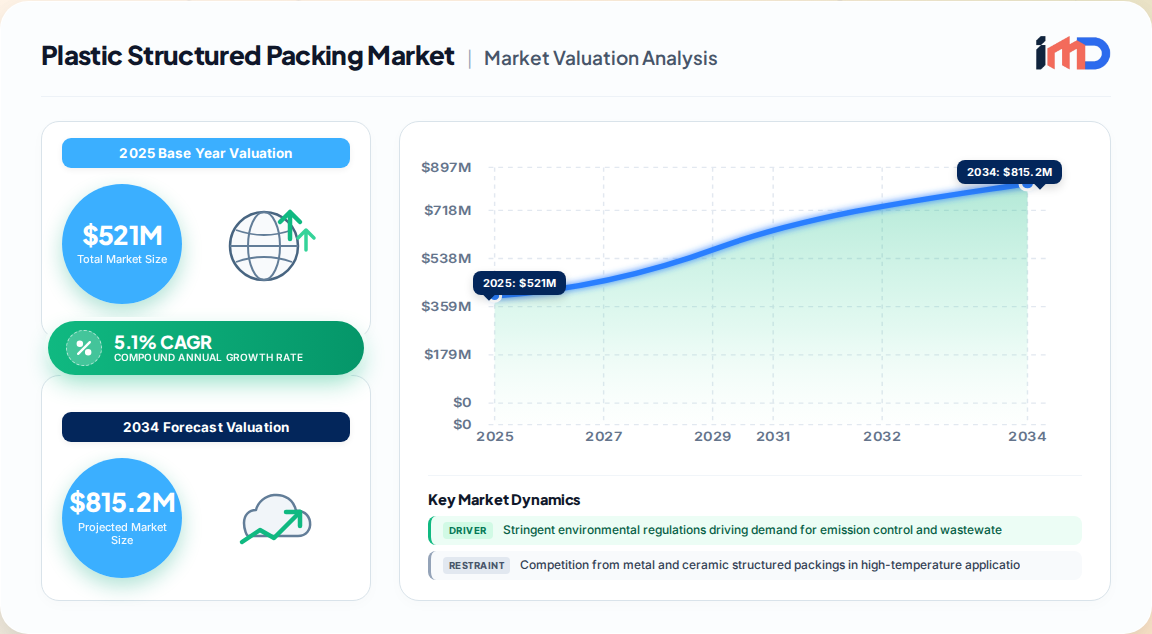
Executive Overview: A Resilient Market Anchored in Process Intensification\n\nThe global plastic structured packing market is valued at US$ 521 Million in 2025 and is forecast to reach US$ 733 Million by 2032, expanding at a 5.1% CAGR. Global production reached approximately 132 K MT in 2024, with an average market price of US$ 3,852 per MT. This sector is a critical enabler of mass transfer, separation, and purification across chemical, petrochemical, environmental, and food processing industries.\n\nPlastic structured packings—primarily constructed from polypropylene (PP), polyvinylidene fluoride (PVDF), polyvinyl chloride (PVC), polytetrafluoroethylene (PTFE), and polyphenylene sulfide (PPS)—offer distinct advantages: light weight, high corrosion resistance, ease of molding, high flux, low pressure drop, and large specific surface areas. These attributes position them as preferred solutions for low-temperature and highly corrosive environments where metal packings would fail.\n\nDespite a mature product lifecycle in traditional chemical stripping and absorption, the market is experiencing renewed momentum from environmental regulations, capacity expansions in Asia-Pacific, and the shift toward high-efficiency geometries. The competitive landscape remains fragmented, with key suppliers in Europe, North America, and Asia vying for share through material innovation and application engineering.\n\n> Market Size Snapshot (2025–2032)\n> - Base Year Value (2025): US$ 521 Million\n> - Forecast Value (2032): US$ 733 Million\n> - CAGR: 5.1%\n> - Production Volume (2024): 132 K MT\n> - Average Selling Price: US$ 3,852/MT\n\n## Market Drivers and Restraints\n\n### Growth Drivers\n\n- Environmental Regulations and Emission Control: Tightening emission standards, particularly in Asia-Pacific and Europe, are forcing upgrades to gas scrubbing, desulfurization, and CO2 capture systems. Plastic structured packings are integral to these installations due to their corrosion resistance and low pressure drop.\n- Capacity Expansions in Asia-Pacific: New chemical and petrochemical complexes, especially in China, India, and Southeast Asia, are driving demand for mass transfer equipment. The region is projected to grow at 6.2% CAGR, outpacing the global average.\n- Replacement Demand: Existing columns and towers require periodic replacement of packing elements due to fouling and degradation. Replacement cycles (typically 3–7 years in aggressive environments) provide a stable baseline demand of 35–45% of annual shipments.\n- Shift to High-Efficiency Packings: Users are moving toward specific surface areas of 300–500 m²/m³ and above to reduce energy consumption and column footprint, boosting unit value and margin.\n- Food and Pharmaceutical Industry Growth: Stringent hygiene and purification requirements in these sectors are creating demand for specialized plastic packings with FDA-compliant materials.\n\n### Restraints and Challenges\n\n- Competition from Metal and Ceramic Packings: In high-temperature or high-pressure applications, metal structured packings remain the default choice, limiting plastic packings to lower-temperature and corrosive niches.\n- Raw Material Price Volatility: Fluctuations in polymer prices (PP, PVDF, PTFE) directly impact production costs. PVDF and other fluoropolymers are subject to supply chain tightness, with lead times extending to 6–12 months.\n- Performance Limitations: Plastic packings suffer from poorer wetting characteristics compared to metal, which can reduce mass transfer efficiency in certain services.\n- Regulatory Compliance Costs: Meeting FDA 21 CFR, USP Class VI, and EU GMP Annex 1 standards requires substantial investment in material traceability and extractables/leachables testing, raising barriers for new entrants.\n\n## Value Chain Analysis\n\nThe plastic structured packing value chain is characterized by a diverse set of participants, from polymer suppliers to end-users.\n\n| Stage | Key Activities | Representative Participants |\n|-------|----------------|----------------------------|\n| Raw Material Supply | Production of PP, PVDF, PVC, PTFE, PPS resins | Petrochemical and specialty chemical companies |\n| Packing Manufacturing | Molding, corrugation, assembly of structured sheets | Specialized packing manufacturers (e.g., Sulzer, Koch-Glitsch, Matsui Machine) |\n| Distribution | Sales to OEMs, EPC contractors, and end-users | Regional distributors and direct sales forces |\n| Engineering & Design | Column internals design, simulation, and optimization | Engineering firms and licensors |\n| End-Use Industries | Chemical, petrochemical, environmental, food, and others | Plant operators and project owners |\n\nDirect material costs account for 60–75% of total production costs, with labor at 5–15% and manufacturing overhead at 15–25%. A single production line typically has a capacity of 1,000 tons per year, with gross margins around 40% for differentiated products.\n\n## Segmentation Analysis\n\nThe market is segmented by type, material, specific surface area, and application.\n\n### By Type\n\n- Honeycomb Inclined Tube (29% share): Primarily used in water purification, sand removal, and accelerated sedimentation. Its large void ratio and settling efficiency make it a staple in environmental protection.\n- Honeycomb Straight Tube (31%): Dominant in biological wastewater treatment as microbial carriers in contact oxidation tanks and biological filters. Also used in chemical towers and cooling towers.\n- Plastic Sheet Corrugated Packing (22%): The workhorse for gas purification, absorption, and stripping. Known for high capacity and low pressure drop.\n- Plastic Wire Mesh Corrugated Packing (18%): Offers higher specific surface area and mass transfer efficiency, suitable for fine separations.\n\n### By Material\n\n- Polypropylene (PP): The most widely used material due to its low cost and adequate temperature resistance (up to 100°C). Accounts for the majority of volume.\n- PVDF: Commands a premium for high-temperature (up to 150°C) and highly corrosive applications, particularly in pharmaceutical and fine chemical processing.\n- PVC: Offers good chemical resistance at low cost, often used in water treatment.\n- PTFE: Exceptional chemical inertness, used in extreme corrosive environments, but at a high price point.\n- PPS: High-temperature and chemical resistance, used in demanding applications such as flue gas desulfurization.\n\n### By Specific Surface Area\n\n- <300 m²/m³:** Used in applications requiring high capacity and low pressure drop, such as vacuum distillation.\n- **300–500 m²/m³:** The fastest-growing segment, driven by the need for higher efficiency and smaller column footprints.\n- **>500 m²/m³: Used in fine separations requiring high theoretical stage counts.\n\n### By Application\n\n- Chemical Industry (17%): Absorption, stripping, and distillation in organic and inorganic chemical production.\n- Petrochemical Industry (17%): Fractionation, gas treating, and dehydration.\n- Environmental Protection Industry (26%): The largest application segment, driven by wastewater treatment, flue gas desulfurization, and VOC abatement.\n- Food Industry (21%): Deodorization, degumming, and purification processes.\n- Others (19%): Includes pharmaceutical, mining, and power generation.\n\n## Regional Outlook\n\nAsia-Pacific dominates the market, accounting for approximately 40% of global demand, and is projected to grow at a 6.2% CAGR—the fastest among all regions. This growth is underpinned by rapid industrialization, urbanization, and stringent environmental policies in China and India.\n\nNorth America and Europe are mature markets, with growth driven by replacement demand and upgrades to existing facilities to meet tighter emission standards. North America is expected to grow at 3.8% CAGR, while Europe is forecast at 4.2% CAGR.\n\nLatin America and Middle East & Africa are smaller but growing markets, with Latin America at 5.4% CAGR and MEA at 4.7% CAGR. Investments in water treatment and oil & gas processing are key drivers in these regions.\n\n| Region | Market Share (2025) | CAGR (2025–2032) | Key Drivers |\n|--------|---------------------|------------------|-------------|\n| Asia-Pacific | 40% | 6.2% | Industrial expansion, environmental regulations |\n| North America | 24% | 3.8% | Replacement demand, emission control |\n| Europe | 20% | 4.2% | Green Deal, energy efficiency |\n| Latin America | 8% | 5.4% | Water treatment, petrochemicals |\n| Middle East & Africa | 8% | 4.7% | Oil & gas, desalination |\n\n## Competitive Landscape\n\nThe market is moderately consolidated, with a mix of global engineering firms and regional specialists. Key players include Matsui Machine, Sulzer, Koch-Glitsch, AWS Corporation, HAT International, MACH Engineering, RVT, Saiptech, Jiangxi Kailai Chemical Filler, Pingxiang Fxsino Petrochemical Packing, Jiangxi Aite Mass Transfer Technology, Rongjian Environmental Protection Chemical Filler, Helvo Chemical, Pingxiang Lihua Packing, and Nantong SuTong Separation Technology.\n\nCompetition is centered on:\n\n- Material Innovation: Development of high-performance polymers (e.g., PVDF, PPS) and surface treatments to improve wetting.\n- Application Engineering: Providing integrated column internals design and simulation services to optimize performance.\n- Regulatory Compliance: Suppliers with FDA and USP Class VI certifications gain preference in food and pharma applications.\n- Cost Leadership: Asian manufacturers leverage lower labor and material costs to compete on price, particularly for standard PP packings.\n\n## Strategic White-Space Analysis\n\nSeveral underpenetrated opportunities exist:\n\n- High-Potency API and Cell & Gene Therapy: The shift toward biologics and personalized medicines requires single-use and disposable packing solutions. Fluoropolymer packings (PVDF, ECTFE) are gaining traction, growing 2–3 percentage points faster than the overall market.\n- CO2 Capture and Carbon Utilization: Plastic structured packings are well-suited for amine-based CO2 capture due to their corrosion resistance and low pressure drop. This application is expected to grow significantly as carbon capture projects scale.\n- Modular and Pre-Packed Columns: The trend toward modular construction in chemical plants favors pre-packed column internals, reducing installation time and cost.\n- Digital Services: Offering predictive maintenance and performance monitoring through IoT sensors embedded in packings could create new revenue streams.\n\n## Import/Export & Supplier Dynamics\n\nGlobal trade in plastic structured packing is significant, with major manufacturing hubs in Asia (China, India, Japan) exporting to North America, Europe, and the Middle East. China is the largest exporter, benefiting from low production costs and a complete supply chain. However, trade tensions and anti-dumping duties in some markets pose risks.\n\nKey raw materials, particularly fluoropolymers like PVDF, are supplied by a limited number of global chemical companies, creating supply concentration. The lead time for PVDF grades can extend to 6–12 months, and price volatility is a major concern. Suppliers with long-term contracts and strategic partnerships with resin producers have a competitive advantage.\n\nDownstream, EPC contractors and OEMs often specify packings from approved vendors, creating a barrier to entry for new suppliers. Building a track record and obtaining certifications (e.g., ISO 9001, ASME) are essential for market access.\n\n## Strategic Recommendations\n\nFor stakeholders across the value chain, we recommend:\n\n- Invest in High-Performance Materials: Allocate R&D resources to PVDF, PPS, and other high-temperature, corrosion-resistant polymers to capture premium segments.\n- Expand in Asia-Pacific: Strengthen manufacturing and distribution presence in China and India to capitalize on regional growth.\n- Develop Integrated Offerings: Combine packing supply with design and simulation services to differentiate from commodity suppliers.\n- Secure Raw Material Supply: Establish strategic partnerships or backward integration for key polymers to mitigate price and supply risks.\n- Focus on Environmental Applications: Position products for carbon capture, wastewater treatment, and air pollution control, which are poised for strong growth.\n\nThe plastic structured packing market is set for steady expansion, driven by environmental imperatives and industrial growth. Companies that innovate in materials and applications, while ensuring supply chain resilience, will be best positioned to succeed.
Plastic Structured Packing Market Market Size (In Million)
Plastic Structured Packing Market Regional Market Share
 Plastic Structured Packing Market