1What is the personal lubricant market size in 2025?
The global personal lubricant market was valued at USD 1.8 billion in 2025 and is projected to reach USD 4.6 billion by 2035, growing at a 9.7% CAGR from 2026 to 2035.
Insight Market Data is a premier market research and business consulting firm headquartered in Pune, India, providing syndicated research reports, customized intelligence studies, and strategic advisory services. Renowned academic institutions and Fortune 500 corporations worldwide rely on Insight Market Data's research repository to navigate evolving global and regional business environments. Covering 46 diverse industries across 25 major international economies, our comprehensive database delivers thousands of verified statistics and granular market evaluations. By combining industry-leading analytical methodologies with the direct insights of seasoned industry leaders and subject-matter experts, we deliver actionable intelligence spanning historical performance benchmarks to rigorous multi-year forecasts. We empower organizations to make confident, data-driven decisions across pivotal domains including Machinery & Equipment, Chemicals & Materials, Pharmaceuticals & Healthcare, Food & Beverages, Consumer Goods, Energy & Power, Automotive & Transportation, Electronics & Semiconductors, Medical Devices, Telecommunications, Emerging Technologies, Agriculture, and Packaging. Our multidisciplinary analyst teams provide an objective 360-degree perspective, tailoring every engagement to address complex strategic challenges with exceptional analytical rigor.
Leveraging advanced BI-powered analytics and predictive modeling, Insight Market Data uncovers high-impact market opportunities and competitive differentiators for ambitious enterprises. We continuously refine our research methodologies in accordance with global industry standards, tracking real-time market shifts to ensure our reports are consistently accurate, actionable, and delivered on schedule. Our analysts conduct methodical data validation, rigorous compliance checks, and exhaustive primary and secondary research to maintain the highest levels of data integrity and transparency. We partner closely with corporate strategists, investment groups, and business executives to translate intricate market intelligence into clear, actionable roadmaps for sustainable growth. With operational presence across Washington, USA, and Vimannagar, Pune, India, Insight Market Data ensures direct access to dedicated research specialists and responsive customer support to answer your most strategic questions.
 Personal Lubricant Market
 by Product Type (Water-Based, Silicone-Based, Oil-Based, Hybrid/Specialty), by Distribution Channel (Drug Stores & Pharmacies, E-Commerce, Specialty Sexual-Wellness Stores, Supermarkets & Hypermarkets), by Application (Sexual Wellness, Therapeutic(Vaginal Dryness, Dyspareunia)), by End-User (Women, Men, Non-Binary/LGBTQ+), by North America (USA, Canada, Mexico), by Europe (Germany, UK, France, Italy, Spain), by Asia Pacific (China, Japan, India, Australia, South Korea), by Latin America (Brazil, Argentina), by Middle East & Africa (South Africa, UAE, Saudi Arabia) Forecast 2026-2034

Senior Analyst


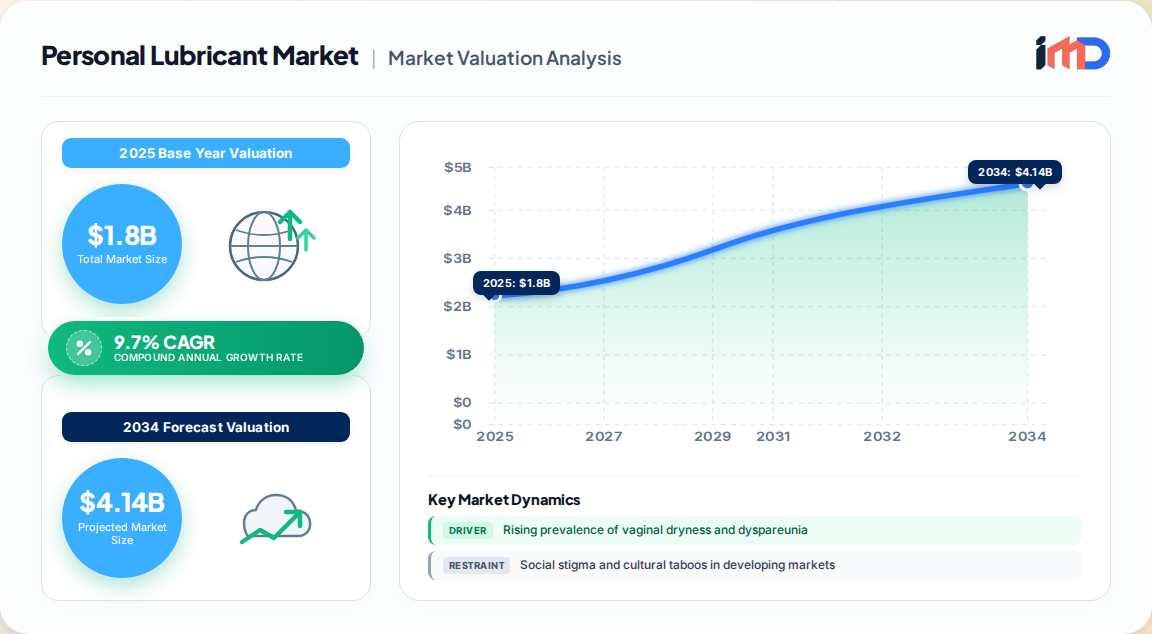
The global personal lubricant market is estimated at USD 1.8 billion in 2025 and is projected to reach USD 4.6 billion by 2035, expanding at a CAGR of 9.7% from 2026 to 2035. This growth is underpinned by two converging demand engines: chronic clinical need (vaginal dryness, dyspareunia, genitourinary syndrome of menopause) and a rapidly expanding discretionary sexual-wellness category.
Our first-party research indicates that the market is transitioning from a niche, stigma-adjacent purchase to a mainstream intimate-health product. Online channels now account for approximately 59.4% of global sales, or roughly USD 1.09 billion in 2025, as privacy and subscription models reduce purchase friction. North America remains the largest regional market at 37.45% share (USD 686.9 million), while Asia Pacific (17.78% share, USD 326.1 million) is the fastest-growing region.
1. Rising prevalence of vaginal dryness and dyspareunia
Dyspareunia affects 3%–18% of women globally, with lifetime prevalence estimates of 10%–28%. Genitourinary syndrome of menopause impacts 27%–84% of postmenopausal women, and vaginal dryness is reported by 60%–78% of affected women. Lubricants offer a non-prescription, accessible intervention, creating repeat-purchase demand independent of discretionary trends. Impact on CAGR: +1.5% to +1.8%.
2. Aging population and continued sexual activity in later life
U.S. data show 85% of men and 62% of women aged 57–65 reported sexual activity in the prior year; among those aged 75–85, 39% of men and 17% of women remain sexually active. Japan’s population aged 65+ crossed 29.1% in 2024, enlarging the clinical need base. This demographic is increasingly addressed through clinical, fragrance-free formulations rather than recreational messaging.
3. Destigmatization and sexual-wellness education
Pharmacy chains are repositioning lubricants alongside menstrual care. CVS moved sexual-wellness SKUs to front-of-store wellness bays across roughly 6,700 outlets in January 2025. WHO’s 2024 guidance recommends making lubricants available for optional use during sexual activity, reinforcing category legitimacy. Impact on CAGR: +1.8%.
4. Explosive e-commerce penetration
Digitally native brands are shaving geographic barriers and normalizing purchase in conservative markets. China’s top marketplaces reported double-digit growth in sexual-wellness GMV during the 2024 Double 11 festival. Subscription refills at 10–15% discounts amplify retention. Impact on CAGR: +2.1%.
5. Clean-label and plant-derived formulations
Consumers increasingly reject petrochemical carriers. Good Clean Love reformulated with organic aloe, agar, and xanthan gum, commanding 20–30% shelf premiums. BioFilm’s ASTROGLIDE Lube Plus (launched September 2023) incorporates watermelon extract, hemp, ashwagandha, and menthol. Impact on CAGR: +1.2%.
| Restraint | Impact on CAGR | Geographic Scope |
|---|---|---|
| Social stigma and limited awareness | -1.0% to -1.5% | Developing markets, MEA, parts of APAC |
| Allergic reaction and irritation concerns | -1.2% | Global, especially North America and EU |
| Regulatory compliance burden (Class II device pathway) | -0.8% | North America, Europe |
| Counterfeit products on online platforms | -0.6% | Asia-Pacific, global e-commerce |
By product type
| Segment | 2025 Share | Growth Outlook |
|---|---|---|
| Water-based | 52.5%–69.45% | Largest; broad compatibility, easy cleanup |
| Silicone-based | ~20% | Faster-growing; longer-lasting, toy-compatible |
| Oil-based | ~8% | Niche; not condom-compatible |
| Hybrid/specialty | ~10% | Fastest-growing at 11.67% CAGR |
By distribution channel
By application
By end-user
| Region | 2025 Share | Key Characteristics |
|---|---|---|
| North America | 37.45%–43.8% | Largest; U.S. ~USD 617M; FDA Class II framework |
| Europe | ~30% | Second-largest; strong clean-label adoption; NHS uptake |
| Asia Pacific | 17.78% | Fastest-growing (10.62% CAGR); Japan super-aging; China e-commerce |
| Latin America | ~7% | Emerging; stigma remains a barrier |
| Middle East & Africa | ~5% | Early-stage; cultural sensitivity limits penetration |
The top five players collectively held 55% share in 2025, indicating a medium-concentration market with room for niche disruptors.
The personal lubricant value chain comprises raw-material suppliers (glycerin, propylene glycol, silicone polymers, xanthan gum, aloe vera), formulation laboratories, contract manufacturers, brand owners, and distribution channels.
Supply chain risk is moderate: silicone and glycerin are commoditized, but organic-certified inputs and biocompatibility-tested formulations face longer lead times.
| Aspects | Details |
|---|---|
| Study Period | 2020-2034 |
| Base Year | 2025 |
| Estimated Year | 2026 |
| Forecast Period | 2026-2034 |
| Historical Period | 2020-2025 |
| Growth Rate | CAGR of 9.7% from 2020-2034 |
| Segmentation |
|
By Application
By End-User
| By Geography |
|
The global personal lubricant market was valued at USD 1.8 billion in 2025 and is projected to reach USD 4.6 billion by 2035, growing at a 9.7% CAGR from 2026 to 2035.
North America is the largest regional market, accounting for approximately 37.45% of global value in 2025, or about USD 686.9 million, with the United States contributing roughly USD 617 million.
Hybrid and specialty formulations are the fastest-growing product type at an 11.67% CAGR through 2031, while e-commerce is the fastest-growing distribution channel at 12.39% CAGR.
Reckitt leads with over 28% market share in 2025. The top five players—Reckitt, Church & Dwight, LifeStyles Healthcare, Good Clean Love, and Hello Cake—collectively held 55% share.
Growth is driven by rising prevalence of vaginal dryness and dyspareunia, aging populations maintaining sexual activity, destigmatization of sexual wellness, e-commerce penetration, and demand for clean-label plant-derived formulations.
Online stores account for approximately 59.4% of 2025 global sales, or about USD 1.09 billion, driven by privacy, discreet fulfillment, and broad product selection.
Our rigorous research methodology combines multi-layered approaches with comprehensive quality assurance, ensuring precision, accuracy, and reliability in every market analysis.
| Stakeholder Role | Interview Share (%) |
|---|---|
| Procurement Director | 30% |
| R&D/Formulation Lead | 25% |
| Regulatory Affairs Manager | 25% |
| Channel Category Manager | 20% |
| Company Type | Representation (%) |
|---|---|
| Raw-material suppliers | 25% |
| Contract manufacturers | 20% |
| Brand owners | 30% |
| E-commerce platforms | 15% |
| Pharmacy retail chains | 10% |
 Related Reports
