1What is the O-RAN operator market size in 2026?
Our proprietary estimates value the global O-RAN market at approximately USD 8.6 billion in 2026, up from USD 6.5 billion in 2025, on a trajectory to reach USD 45.1 billion by 2033.
Insight Market Data is a premier market research and business consulting firm headquartered in Pune, India, providing syndicated research reports, customized intelligence studies, and strategic advisory services. Renowned academic institutions and Fortune 500 corporations worldwide rely on Insight Market Data's research repository to navigate evolving global and regional business environments. Covering 46 diverse industries across 25 major international economies, our comprehensive database delivers thousands of verified statistics and granular market evaluations. By combining industry-leading analytical methodologies with the direct insights of seasoned industry leaders and subject-matter experts, we deliver actionable intelligence spanning historical performance benchmarks to rigorous multi-year forecasts. We empower organizations to make confident, data-driven decisions across pivotal domains including Machinery & Equipment, Chemicals & Materials, Pharmaceuticals & Healthcare, Food & Beverages, Consumer Goods, Energy & Power, Automotive & Transportation, Electronics & Semiconductors, Medical Devices, Telecommunications, Emerging Technologies, Agriculture, and Packaging. Our multidisciplinary analyst teams provide an objective 360-degree perspective, tailoring every engagement to address complex strategic challenges with exceptional analytical rigor.
Leveraging advanced BI-powered analytics and predictive modeling, Insight Market Data uncovers high-impact market opportunities and competitive differentiators for ambitious enterprises. We continuously refine our research methodologies in accordance with global industry standards, tracking real-time market shifts to ensure our reports are consistently accurate, actionable, and delivered on schedule. Our analysts conduct methodical data validation, rigorous compliance checks, and exhaustive primary and secondary research to maintain the highest levels of data integrity and transparency. We partner closely with corporate strategists, investment groups, and business executives to translate intricate market intelligence into clear, actionable roadmaps for sustainable growth. With operational presence across Washington, USA, and Vimannagar, Pune, India, Insight Market Data ensures direct access to dedicated research specialists and responsive customer support to answer your most strategic questions.
 O-RAN Operator Market
 by Component (Hardware, Software, Services), by Unit (Radio Unit, Distributed Unit, Centralized Unit, RAN Intelligent Controller), by Deployment (Hybrid Cloud, Public Macrocell, Private/Enterprise Network), by Network (5G, 4G, Other), by Frequency (Sub-6 GHz, mmWave), by End User (Mobile Network Operators, Neutral-Host Providers, Enterprise & Vertical), by North America (USA, Canada, Mexico), by Europe (Germany, UK, France), by Asia Pacific (China, Japan, India, South Korea), by Middle East & Africa, by South America Forecast 2026-2034

Senior Research Analyst


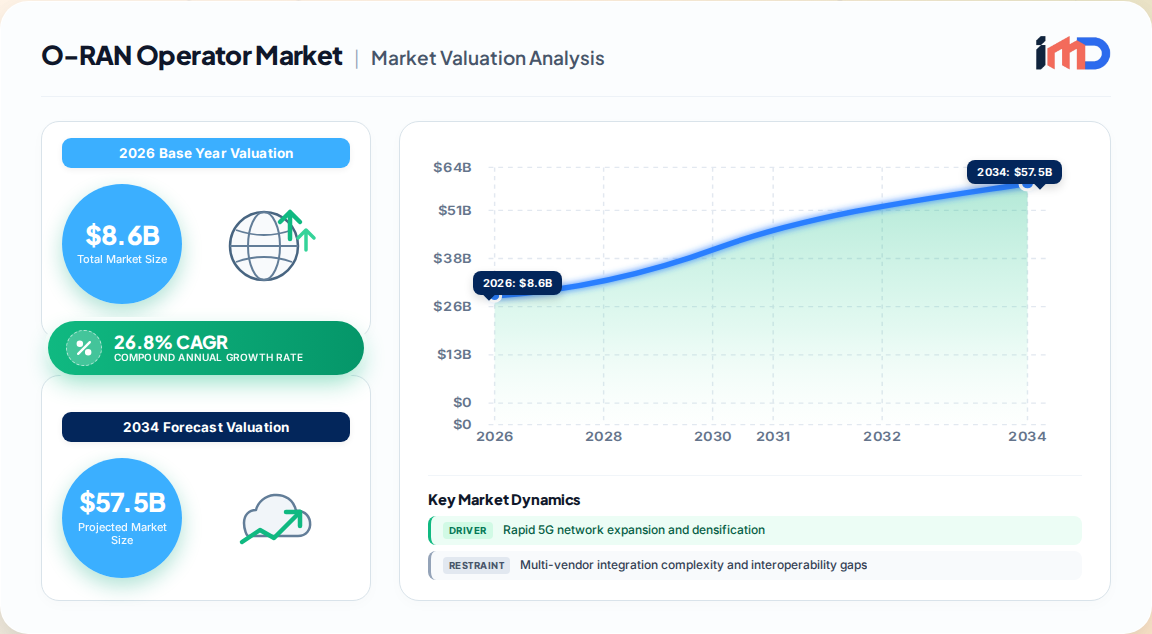
The O-RAN operator market represents the demand-side engine of the open radio access network revolution — the capital and operational spend that mobile network operators, neutral-host providers, and private network operators direct toward disaggregated, interoperable RAN architectures. Our proprietary primary research places global O-RAN operator-linked spend at USD 6.5 billion in 2025, rising to an estimated USD 8.6 billion in 2026, and scaling to USD 45.1 billion by 2033 at a 26.8% CAGR across the 2026–2033 window. Historical momentum confirms the trajectory: the market expanded at roughly 26.6% CAGR between 2020 and 2025.
The defining shift is structural rather than cyclical. Operators are moving from tightly integrated single-vendor radio stacks toward open interfaces — the O1, E2, A1, and Open Fronthaul specifications — that decouple radio units, distributed units, centralized units, and the RAN Intelligent Controller (RIC). This decoupling hands procurement teams unprecedented leverage: independent negotiation of RU, DU, CU, and software contracts, with documented total-cost-of-ownership reductions of 20–40% versus legacy stacks.
North America remains the anchor market at 41.1% revenue share in 2025, underpinned by early 5G standalone builds, federal supply-chain diversification funding, and tier-one operator commitments. Asia-Pacific is the fastest-growing region, propelled by aggressive 5G densification and state-directed vendor diversification.
Mobile data consumption continues to double within roughly four-year cycles. Densifying urban cores and extending rural broadband at legacy cost structures is not economically viable. Standardized open radio units can reduce deployment cost per site by as much as 30%, making rural coverage and small-cell infill bankable. Operator programs — such as multi-hundred-million-dollar 5G-Advanced expansions across hundreds of cities — are converting directly into modular, multi-vendor radio demand.
Policy is a genuine demand driver, not background noise. The U.S. Public Wireless Supply Chain Innovation Fund has allocated USD 1.5 billion, with initial tranches of roughly USD 273 million directed to open-radio prototyping and commercialization, alongside a USD 42.3 million award for open RAN compatibility and commercialization work. Defense and public-sector private 5G buildouts across hundreds of sites provide performance validation at scale. The EU channels research funding toward vendor-neutral platforms, and Japan offers tax incentives to carriers adopting multi-vendor architectures.
Operators report that component competition plus cloud-native automation trims capex and opex by 20–40%. Landmark tier-one frameworks — including multi-billion-dollar, multi-year open-interface commitments — lock in predictable unit pricing while preserving ecosystem optionality. Software-driven energy savings of approximately 15% across high-traffic clusters further strengthen the business case.
Cloud providers are pairing edge compute footprints with turnkey virtualized RAN stacks, enabling AI-infused network functions closer to end users. GPU-accelerated private 5G deployments and AI-RAN innovation centers co-developed with infrastructure vendors are accelerating the shift from proof-of-concept to commercial integration.
Adoption pace remains uneven because openness carries a real integration burden.
These factors do not suppress the market — they shape its sequencing, favoring greenfield builds and private networks where legacy constraints are absent.
| Segment Dimension | Leading Category (2025/2026) | Share | Fastest-Growing Category | Growth Signal |
|---|---|---|---|---|
| Component | Hardware | 46.2% | Software | ~28% CAGR |
| Unit / Architecture Layer | Distributed Unit / Radio Unit | >50% DU; 37.4% RU | RAN Intelligent Controller | ~39% CAGR |
| Deployment | Hybrid cloud; public macrocell | 56.6% public macro | Private/enterprise networks | ~33% CAGR |
| Network Generation | 5G | 77.2% | 5G | ~35% CAGR |
| Frequency | Sub-6 GHz | Dominant | mmWave (nascent) | Early stage |
| End User | Mobile network operators | 65.7% | Enterprise & vertical | ~26% CAGR |
Hardware dominance reflects the physical indispensability of remote radio units, baseband units, and antennas. But the software and RIC layers carry the highest growth multiples — the intelligence layer is where operator differentiation and AI-driven spectral efficiency gains will concentrate.
North America leads on revenue share (40–41%), driven by early 5G standalone deployment, federal funding, and tier-one scale commitments. Greenfield and brownfield hybrid models dominate.
Asia-Pacific is the volume growth engine, holding roughly 40% of global revenue by some measures and posting the highest forward CAGR. Rapid 5G densification, strong government industrial policy, and dense private-network demand in manufacturing and logistics underpin expansion.
Europe advances at a measured pace, shaped by vendor-neutral R&D funding and security-driven diversification policy, with brownfield integration complexity slowing nationwide rollouts.
Middle East & Africa and South America represent emerging greenfield opportunity — markets without entrenched legacy infrastructure can leapfrog directly to fully open, cloud-native architectures.
The supplier ecosystem spans incumbents extending open portfolios, challenger radio and software specialists, silicon vendors, and hyperscalers. Operators are deliberately cultivating dual-track supply bases: anchoring on one vendor for integration accountability while sourcing radios and RIC software competitively.
Key operator strategies observed in our interviews:
The highest-value white space sits at the intersection of three curves: AI-driven RAN optimization, energy-efficient radio silicon, and enterprise private 5G. Operators that build multi-vendor integration competence early will convert the "integration tax" into a durable margin advantage. Between 2026 and 2033, we expect the market to nearly quintuple, with software and services steadily eroding hardware's share as virtualization matures.
| Aspects | Details |
|---|---|
| Study Period | 2020-2034 |
| Base Year | 2026 |
| Estimated Year | 2026 |
| Forecast Period | 2026-2034 |
| Historical Period | 2020-2025 |
| Growth Rate | CAGR of 26.8% from 2020-2034 |
| Segmentation |
|
By Deployment
By Network
By Frequency
By End User
| By Geography |
|
Our proprietary estimates value the global O-RAN market at approximately USD 8.6 billion in 2026, up from USD 6.5 billion in 2025, on a trajectory to reach USD 45.1 billion by 2033.
The market is forecast to expand at a 26.8% CAGR from 2026 to 2033, with historical growth of roughly 26.6% between 2020 and 2025.
North America held about 41.1% of 2025 revenue, while Asia-Pacific is the fastest-growing region, driven by rapid 5G densification and government-backed vendor diversification.
Operators cite 20–40% total cost of ownership reductions from multi-vendor disaggregation, greater procurement flexibility, and alignment with cloud-native and AI-driven network automation.
Multi-vendor integration complexity, carrier-grade performance parity concerns, skills scarcity, and security assurance gaps continue to slow large-scale nationwide rollouts.
Our rigorous research methodology combines multi-layered approaches with comprehensive quality assurance, ensuring precision, accuracy, and reliability in every market analysis.
| Stakeholder Role | Interview Share (%) |
|---|---|
| RAN Planning Director | 30% |
| Network Strategy & Architecture Lead | 25% |
| Procurement & Vendor Management Head | 25% |
| Private 5G Solution Architect | 20% |
| Company Type | Representation (%) |
|---|---|
| Open Radio Unit & Baseband OEMs | 30% |
| vRAN & RIC Software Vendors | 22% |
| Silicon & Semiconductor Suppliers | 15% |
| Hyperscalers & Cloud Infrastructure Providers | 18% |
| System Integrators & Neutral-Host Operators | 15% |
 Related Reports
