1What is the market size of financial management and accounting software?
The market is projected to reach $23.68 billion by 2030, growing from $16.2 billion in 2026 at a CAGR of 10.0%.
Insight Market Data is a premier market research and business consulting firm headquartered in Pune, India, providing syndicated research reports, customized intelligence studies, and strategic advisory services. Renowned academic institutions and Fortune 500 corporations worldwide rely on Insight Market Data's research repository to navigate evolving global and regional business environments. Covering 46 diverse industries across 25 major international economies, our comprehensive database delivers thousands of verified statistics and granular market evaluations. By combining industry-leading analytical methodologies with the direct insights of seasoned industry leaders and subject-matter experts, we deliver actionable intelligence spanning historical performance benchmarks to rigorous multi-year forecasts. We empower organizations to make confident, data-driven decisions across pivotal domains including Machinery & Equipment, Chemicals & Materials, Pharmaceuticals & Healthcare, Food & Beverages, Consumer Goods, Energy & Power, Automotive & Transportation, Electronics & Semiconductors, Medical Devices, Telecommunications, Emerging Technologies, Agriculture, and Packaging. Our multidisciplinary analyst teams provide an objective 360-degree perspective, tailoring every engagement to address complex strategic challenges with exceptional analytical rigor.
Leveraging advanced BI-powered analytics and predictive modeling, Insight Market Data uncovers high-impact market opportunities and competitive differentiators for ambitious enterprises. We continuously refine our research methodologies in accordance with global industry standards, tracking real-time market shifts to ensure our reports are consistently accurate, actionable, and delivered on schedule. Our analysts conduct methodical data validation, rigorous compliance checks, and exhaustive primary and secondary research to maintain the highest levels of data integrity and transparency. We partner closely with corporate strategists, investment groups, and business executives to translate intricate market intelligence into clear, actionable roadmaps for sustainable growth. With operational presence across Washington, USA, and Vimannagar, Pune, India, Insight Market Data ensures direct access to dedicated research specialists and responsive customer support to answer your most strategic questions.
 Financial Management and Accounting Software
 by Deployment Type (Cloud-Based, On-Premise), by Organization Size (Large Enterprises, Small and Medium Enterprises (SMEs)), by End-User Industry (BFSI, Manufacturing, Retail and E-Commerce, Professional Services, IT and Telecom, Healthcare), by Application (Payroll Management, Billing and Invoicing, Others), by North America (USA, Canada, Mexico), by Europe (Germany, UK, France, Rest of Europe), by Asia-Pacific (China, Japan, South Korea, India, Rest of Asia-Pacific), by South America (Brazil, Argentina, Rest of South America), by Middle East & Africa (Saudi Arabia, UAE, South Africa, Rest of MEA) Forecast 2026-2034

Senior Research Analyst

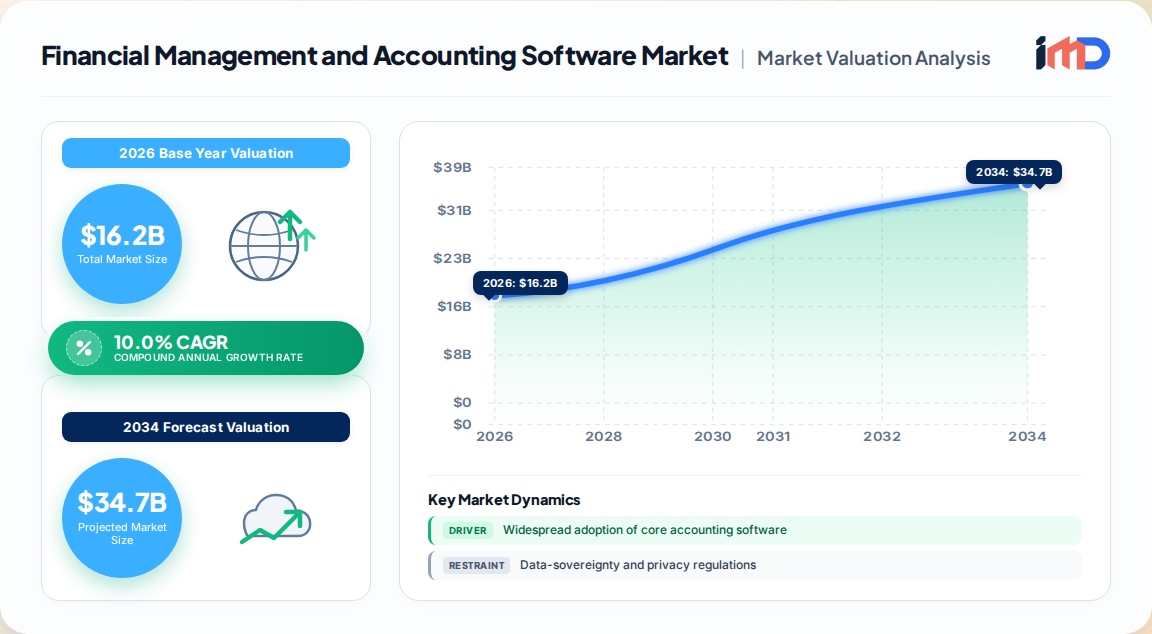
The global Financial Management and Accounting Software market is undergoing a structural transformation, moving from a system of record to a system of intelligence. Our proprietary primary research estimates the market will expand from $14.77 billion in 2025 to $23.68 billion by 2030, registering a robust CAGR of 10.0%. This acceleration, up from the historical 9.7% growth rate, is not merely a recovery trajectory but a fundamental re-rating of the sector's value proposition.
The narrative is no longer about digitizing ledgers; it is about autonomous finance. The convergence of AI-led anomaly detection, hyper-automation of bookkeeping workflows, and the imperative for real-time regulatory reporting is forcing a wholesale refresh of legacy architectures. The market's center of gravity has decisively shifted to the cloud, which accounted for 68.08% of revenue in 2025 and is growing at a 10.15% CAGR, signaling the end of the on-premise era for all but the most niche, latency-sensitive workloads.
Three primary forces are propelling the market forward, each with a quantifiable impact on our growth forecast.
The scarcity of AI-ready accounting talent is paradoxically the market's greatest tailwind. With a -0.8% drag on CAGR from talent shortages, organizations are aggressively substituting repetitive bookkeeping labor with machine learning extraction and robotic process automation (RPA). These systems now classify transactions and reconcile banks with 98% accuracy, allowing firms to absorb more clients without proportional head-count increases. This dynamic contributes a +1.8% uplift to CAGR, particularly in Asia-Pacific and the Middle East & Africa, where labor cost arbitrage is being replaced by technology arbitrage.
The migration to cloud architectures is the single largest driver, adding +2.1% to the CAGR in North America and Europe. CFOs are abandoning on-premise installations not merely for cost reduction but for the strategic imperative of real-time cash-flow visibility. The ability to synchronize accounting, treasury, and operational data unlocks seamless fintech integrations—payments, expense cards, and short-term liquidity—that were previously unattainable. This is not a lift-and-shift; it is a re-platforming of the finance function.
Stricter regulatory compliance demands, particularly around cross-border e-invoicing and ESG-grade audit trails, are forcing organizations to refresh legacy systems. The +0.7% CAGR impact from ESG-grade audit-trail requirements is set to double over the next five years as the EU's Corporate Sustainability Reporting Directive (CSRD) and similar mandates in North America take full effect. Real-time A/R-A/P financing via open banking adds a further +0.9% to the forecast, primarily in Europe and Asia-Pacific.
Despite the robust outlook, the market faces non-trivial headwinds that temper the growth trajectory.
Rules such as GDPR compel local data residency, forcing vendors to maintain multi-region clouds and inflating implementation budgets. This restraint exerts a -1.4% impact on CAGR in the EU and North America. Enterprises hesitate to migrate sensitive ledgers until contractual clauses guarantee encryption, access controls, and in-country storage options, delaying project timelines by an average of two quarters.
The -1.1% drag from legacy-system switching costs is most acute in the short term (≤2 years). Large enterprises wedded to customized ERPs face significant integration challenges, leading to hybrid strategies. However, the pay-as-you-grow pricing of cloud solutions and embedded automatic updates are rapidly eroding this barrier, particularly for mid-market firms.
The value chain for financial management software has evolved into a complex ecosystem of specialized layers.
The market's internal dynamics reveal clear leaders across deployment, organization size, end-user industry, and application.
| Segment | Dominant Sub-Segment | 2025 Share / Growth | Key Insight |
|---|---|---|---|
| Deployment | Cloud-Based | 68.08% share; 10.15% CAGR | Pay-as-you-grow pricing and automatic updates cement adoption. |
| Organization Size | Large Enterprises | 54.10% share; SMEs at 10.85% CAGR | SMEs are the fastest-growing cohort, driven by digital adoption. |
| End-User Industry | BFSI | 24.55% share; IT & Telecom at 10.35% CAGR | BFSI leads, but IT & Telecom is the growth engine. |
| Application | Payroll Management | 29.10% share; 10.40% CAGR | Payroll is the anchor application, integrating with core HR. |
North America remains the largest market, accounting for 38.35% of revenue in 2025, driven by early cloud adoption and a dense ecosystem of fintech integrations. However, Asia-Pacific is the fastest-growing region, projected to expand at a 10.45% CAGR through 2031. This is fueled by the explosive growth of SMEs—in South Korea alone, the number of SMEs rose to 8,299,000 in August 2025, a 3.2% increase from 2022—and mobile-first accounting experiences that cater to hybrid workforces.
Europe presents a more nuanced picture, with high cloud adoption tempered by data-sovereignty regulations. The region is a hotbed for open banking innovation, adding +0.9% to the CAGR through real-time A/R-A/P financing. South America and the Middle East & Africa are nascent but promising markets, where mobile-first experiences and hyper-automation are leapfrogging legacy infrastructure.
The competitive landscape is moderately concentrated, with incumbents facing pressure from agile, cloud-native challengers. The strategic imperatives are clear:
Our analysis identifies three under-served white spaces with high growth potential:
As a digital product, the financial management software market does not conform to traditional import/export trade statistics. However, the supply chain of the industry is reflected in the flow of digital services and the geographic distribution of data centers. According to UN Comtrade's EBOPS 2010 classification for services, cross-border trade in financial and digital services continues to grow, albeit at a slower pace than the software market itself. The key supplier dynamic is the concentration of cloud infrastructure providers, which dictates data residency options and latency. Vendors are increasingly dual-sourcing data centers across regions to mitigate data-sovereignty risks, a trend that is inflating capital expenditures but ensuring compliance in key markets. The 'import' of AI talent and the 'export' of compliance-ready software modules are the new trade flows of this market.
| Aspects | Details |
|---|---|
| Study Period | 2020-2034 |
| Base Year | 2026 |
| Estimated Year | 2026 |
| Forecast Period | 2026-2034 |
| Historical Period | 2020-2025 |
| Growth Rate | CAGR of 10.0% from 2020-2034 |
| Segmentation |
|
By End-User Industry
By Application
| By Geography |
|
The market is projected to reach $23.68 billion by 2030, growing from $16.2 billion in 2026 at a CAGR of 10.0%.
North America led with 38.35% revenue share in 2025, but Asia-Pacific is the fastest-growing region at a 10.45% CAGR through 2031.
Cloud-first finance-stack adoption (+2.1% CAGR impact), hyper-automation of bookkeeping (+1.8%), and AI-led anomaly detection (+1.5%) are the primary drivers.
Cloud-based solutions captured 68.08% of revenue in 2025 and are growing at a 10.15% CAGR, signaling a decisive shift away from on-premise systems.
Major players include Oracle Corporation, Microsoft Corporation, SAP SE, Xero Ltd, and Intuit Inc., competing on AI integration, cloud platforms, and API connectivity.
Our rigorous research methodology combines multi-layered approaches with comprehensive quality assurance, ensuring precision, accuracy, and reliability in every market analysis.
| Stakeholder Role | Interview Share (%) |
|---|---|
| Chief Financial Officer (CFO) | 30% |
| IT Procurement Director | 25% |
| Controller / Head of Accounting | 25% |
| Finance Systems Manager | 20% |
| Company Type | Representation (%) |
|---|---|
| Cloud Infrastructure Providers | 25% |
| ERP and Accounting Software Vendors | 35% |
| Fintech API and Integration Specialists | 20% |
| Managed Service Providers (MSPs) | 15% |
| Regulatory Compliance and Audit Firms | 5% |

 Related Reports
