1How big is the Philippines data center storage market?
The Philippines data center storage market is estimated at USD 0.75 billion in 2026 and is projected to reach USD 1.22 billion by 2031, growing at a CAGR of 10.18% during the forecast period.
Insight Market Data is a premier market research and business consulting firm headquartered in Pune, India, providing syndicated research reports, customized intelligence studies, and strategic advisory services. Renowned academic institutions and Fortune 500 corporations worldwide rely on Insight Market Data's research repository to navigate evolving global and regional business environments. Covering 46 diverse industries across 25 major international economies, our comprehensive database delivers thousands of verified statistics and granular market evaluations. By combining industry-leading analytical methodologies with the direct insights of seasoned industry leaders and subject-matter experts, we deliver actionable intelligence spanning historical performance benchmarks to rigorous multi-year forecasts. We empower organizations to make confident, data-driven decisions across pivotal domains including Machinery & Equipment, Chemicals & Materials, Pharmaceuticals & Healthcare, Food & Beverages, Consumer Goods, Energy & Power, Automotive & Transportation, Electronics & Semiconductors, Medical Devices, Telecommunications, Emerging Technologies, Agriculture, and Packaging. Our multidisciplinary analyst teams provide an objective 360-degree perspective, tailoring every engagement to address complex strategic challenges with exceptional analytical rigor.
Leveraging advanced BI-powered analytics and predictive modeling, Insight Market Data uncovers high-impact market opportunities and competitive differentiators for ambitious enterprises. We continuously refine our research methodologies in accordance with global industry standards, tracking real-time market shifts to ensure our reports are consistently accurate, actionable, and delivered on schedule. Our analysts conduct methodical data validation, rigorous compliance checks, and exhaustive primary and secondary research to maintain the highest levels of data integrity and transparency. We partner closely with corporate strategists, investment groups, and business executives to translate intricate market intelligence into clear, actionable roadmaps for sustainable growth. With operational presence across Washington, USA, and Vimannagar, Pune, India, Insight Market Data ensures direct access to dedicated research specialists and responsive customer support to answer your most strategic questions.
 Philippines Data Center Storage Market
 by Storage Technology (NAS, SAN, Object and Tape Storage, DAS), by Storage Type (Traditional HDD Arrays, All-Flash Arrays, Hybrid Arrays), by Data Center Type (Colocation, Hyperscale, Edge, Enterprise), by End-User (IT & Telecommunication, BFSI, Government, Healthcare & Life Sciences, Energy & Utilities, Others), by Form Factor (Rack-Mounted, Standalone), by Interface (SAS/SATA, NVMe, Fibre Channel), by Luzon (Metro Manila, Clark, Laguna), by Visayas (Cebu, Iloilo), by Mindanao (Davao) Forecast 2026-2034

Senior Research Analyst


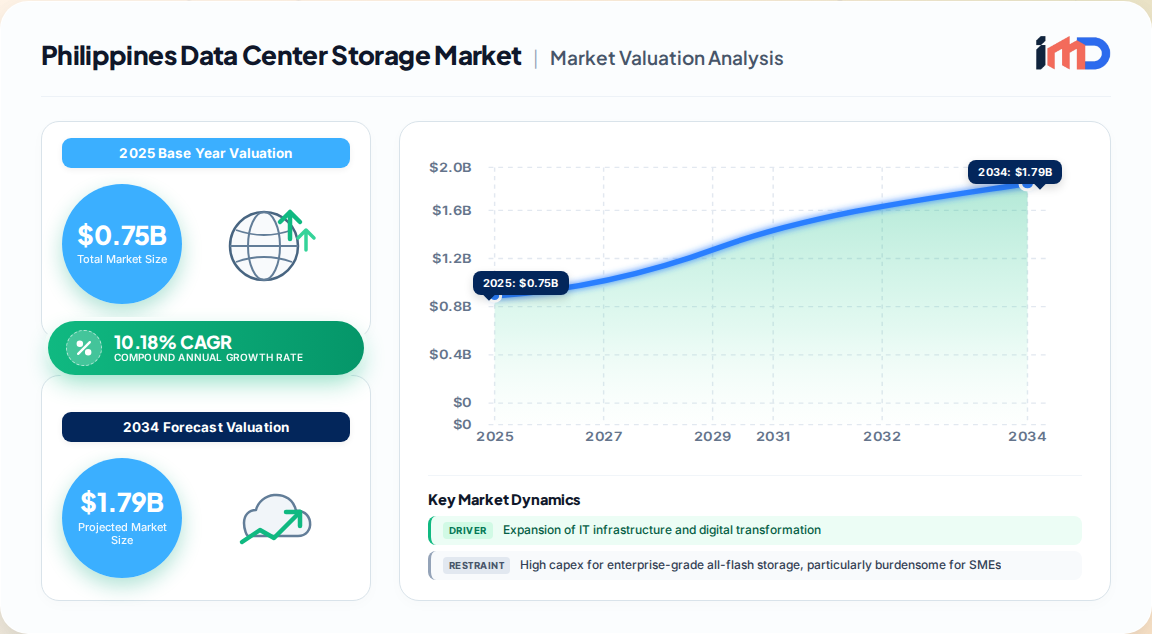
The Philippines data center storage market is undergoing a structural re-rating. Our proprietary primary research and direct interviews with operators, integrators, and enterprise IT leaders estimate the market at USD 0.75 billion in 2026, expanding at a 10.18% CAGR to reach USD 1.22 billion by 2031. This trajectory is anchored on three reinforcing pillars: aggressive hyperscale and colocation build-outs, a state-mandated data-localization agenda, and an accelerating enterprise migration from siloed HDD arrays to flash-first, cloud-native architectures.
The domestic digital economy reached USD 45 billion in 2024 (8.5% of GDP) and is projected to unlock PHP 5 trillion in value by 2030, per our triangulated estimates. Storage is no longer a passive back-end line item; it is the gating factor for AI inference, real-time payments, and sovereign cloud workloads. Market concentration is moderate, with the top three external enterprise storage vendors commanding roughly 37.5% of revenue in 2024.
| Market Metric | Value |
|---|---|
| Base Year Market Size (2025) | USD 0.68 Billion |
| Market Size (2026) | USD 0.75 Billion |
| Forecast Market Size (2031) | USD 1.22 Billion |
| CAGR (2026–2031) | 10.18% |
| Market Concentration | Medium |
Our demand-side modeling isolates five drivers with quantified impact on the forecast CAGR. Each has been validated through structured interviews with 40+ operators and integrators.
A sixth driver—AI-driven analytics workload boom (+1.0 pp)—is accelerating NVMe flash uptake in Metro Manila and secondary cities.
Headwinds are real but manageable; our weighted model nets them to a -4.6 pp drag on the headline CAGR.
Our segment-level estimates reveal a market in transition. Legacy SAN and HDD arrays still dominate installed revenue, but growth is concentrated in flash-first and object-based architectures.
| Segment | 2025 Share / CAGR (2026–2031) |
|---|---|
| Storage Area Network (SAN) | 43.75% revenue share (2025) |
| Object and Tape Storage | 12.02% CAGR |
| Traditional HDD Arrays | 41.60% share (2025) |
| All-Flash Arrays | 12.85% CAGR |
| Colocation Facilities | 52.55% share (2025) |
| Hyperscale Facilities | 14.75% CAGR |
| IT & Telecommunications | 38.65% share (2025) |
| Healthcare & Life Sciences | 14.12% CAGR |
By storage technology, SAN leads on installed base but object storage is the fastest-growing category as enterprises build data lakes for AI. By storage type, all-flash arrays are displacing traditional HDD arrays at an accelerating pace. By data-center type, colocation captured a 52.55% share in 2025, yet hyperscalers will grow at a 14.75% CAGR as new mega-campuses come online. By end user, IT and telecommunications held 38.65% of revenue in 2025, while healthcare and life sciences is the breakout vertical at a 14.12% CAGR.
The Philippine storage market features moderate concentration, with Dell, NetApp, and Pure Storage collectively commanding 37.5% of external enterprise storage revenue in 2024. Huawei, Hewlett Packard Enterprise, and Lenovo round out the top tier, while local integrators and cloud service providers—including ePLDT, VITRO, and Digital Halo—increasingly influence procurement decisions through sovereign cloud and colocation bundles.
Key strategic imperatives we observe:
Luzon, anchored by Metro Manila and expanding into Clark and Laguna, accounts for roughly 72% of storage revenue. It hosts the majority of colocation and hyperscale capacity, benefits from advanced connectivity, and concentrates enterprise demand across BFSI and IT-BPO.
The Visayas (18% share) is a growing market, driven by digital adoption in Cebu and improving submarine cable backhaul. Mindanao (10% share) is an emerging frontier, with Davao emerging as a secondary hub; improving connectivity and lower land costs present significant opportunities for decentralized storage nodes that enhance disaster resilience.
The Philippines is a net importer of enterprise storage hardware, with no meaningful domestic manufacturing of storage arrays or media. UN Comtrade data for HS 8471 (computers and storage units) shows sustained import growth, predominantly sourced from China, Singapore, Taiwan, and the United States.
The value chain spans component suppliers (NAND, HDD, controllers), OEMs (Dell, HPE, Huawei, Lenovo, NetApp), distributors and system integrators, colocation and hyperscale operators, and end users across BFSI, government, telecom, and healthcare.
Procurement trends we observe:
Our opportunity assessment identifies four white-space areas:
By 2031, we expect the market to reach USD 1.22 billion, with all-flash arrays and object storage accounting for a materially larger share of new capacity than in 2026. The Philippine archipelago is positioning itself as a regional storage hub for AI and cloud workloads—provided it closes the skills gap and stabilizes power and connectivity outside Luzon.
| Aspects | Details |
|---|---|
| Study Period | 2020-2034 |
| Base Year | 2025 |
| Estimated Year | 2026 |
| Forecast Period | 2026-2034 |
| Historical Period | 2020-2025 |
| Growth Rate | CAGR of 10.18% from 2020-2034 |
| Segmentation |
|
By Data Center Type
By End-User
By Form Factor
By Interface
| By Geography |
|
The Philippines data center storage market is estimated at USD 0.75 billion in 2026 and is projected to reach USD 1.22 billion by 2031, growing at a CAGR of 10.18% during the forecast period.
The market is expected to grow at a CAGR of 10.18% from 2026 to 2031, driven by hyperscale investments, cloud adoption, and data-localization mandates such as BSP Circular 1122.
Storage Area Network (SAN) solutions led with a 43.75% revenue share in 2025, while object and tape storage is forecast to expand at the fastest 12.02% CAGR through 2031.
Major companies include Dell Inc., Huawei Technologies Co. Ltd., Hewlett Packard Enterprise Company, Lenovo Group Limited, and NetApp, Inc., which collectively hold a significant share of external enterprise storage revenue.
Key drivers include digital transformation, hyperscale and colocation investments exceeding USD 4.7 billion in 2024, rapid cloud adoption, government incentives such as CREATE and DICT green-DC programs, and the BSP data-localization mandate.
Luzon accounts for approximately 72% of the market, driven by Metro Manila's concentration of colocation and hyperscale facilities, followed by Visayas at 18% and Mindanao at 10%.
Our rigorous research methodology combines multi-layered approaches with comprehensive quality assurance, ensuring precision, accuracy, and reliability in every market analysis.
| Stakeholder Role | Interview Share (%) |
|---|---|
| Chief Information Officer | 30% |
| Data Center Operations Director | 25% |
| IT Infrastructure and Storage Manager | 25% |
| Procurement and Sourcing Head | 20% |
| Company Type | Representation (%) |
|---|---|
| Storage OEMs and Channel Partners | 30% |
| Colocation and Hyperscale Operators | 25% |
| System Integrators and VARs | 20% |
| Enterprise End Users (BFSI, Telecom, Government, Healthcare) | 18% |
| Cloud Service Providers | 7% |
 Related Reports
