1What is the current size of the North America Commercial HVAC Equipment market?
The market is estimated at USD 11.41 billion in 2025, according to our proprietary primary research.
Insight Market Data is a premier market research and business consulting firm headquartered in Pune, India, providing syndicated research reports, customized intelligence studies, and strategic advisory services. Renowned academic institutions and Fortune 500 corporations worldwide rely on Insight Market Data's research repository to navigate evolving global and regional business environments. Covering 46 diverse industries across 25 major international economies, our comprehensive database delivers thousands of verified statistics and granular market evaluations. By combining industry-leading analytical methodologies with the direct insights of seasoned industry leaders and subject-matter experts, we deliver actionable intelligence spanning historical performance benchmarks to rigorous multi-year forecasts. We empower organizations to make confident, data-driven decisions across pivotal domains including Machinery & Equipment, Chemicals & Materials, Pharmaceuticals & Healthcare, Food & Beverages, Consumer Goods, Energy & Power, Automotive & Transportation, Electronics & Semiconductors, Medical Devices, Telecommunications, Emerging Technologies, Agriculture, and Packaging. Our multidisciplinary analyst teams provide an objective 360-degree perspective, tailoring every engagement to address complex strategic challenges with exceptional analytical rigor.
Leveraging advanced BI-powered analytics and predictive modeling, Insight Market Data uncovers high-impact market opportunities and competitive differentiators for ambitious enterprises. We continuously refine our research methodologies in accordance with global industry standards, tracking real-time market shifts to ensure our reports are consistently accurate, actionable, and delivered on schedule. Our analysts conduct methodical data validation, rigorous compliance checks, and exhaustive primary and secondary research to maintain the highest levels of data integrity and transparency. We partner closely with corporate strategists, investment groups, and business executives to translate intricate market intelligence into clear, actionable roadmaps for sustainable growth. With operational presence across Washington, USA, and Vimannagar, Pune, India, Insight Market Data ensures direct access to dedicated research specialists and responsive customer support to answer your most strategic questions.
 North America Commercial Heating, Ventilation, and Air Conditioning (HVAC) Equipment
 by Equipment (Air Conditioning/Ventilation Equipment, Heating Equipment), by End User (Public Utilities, Office Spaces, Retail Spaces, Education, Healthcare, Hospitality, Other End Users), by Installation Type (New Construction, Retrofit, Replacement), by Building Type (Office Buildings, Healthcare Facilities, Data Centers, Others), by North America (United States, Canada, Mexico) Forecast 2026-2034

Research Analyst


 Related Reports

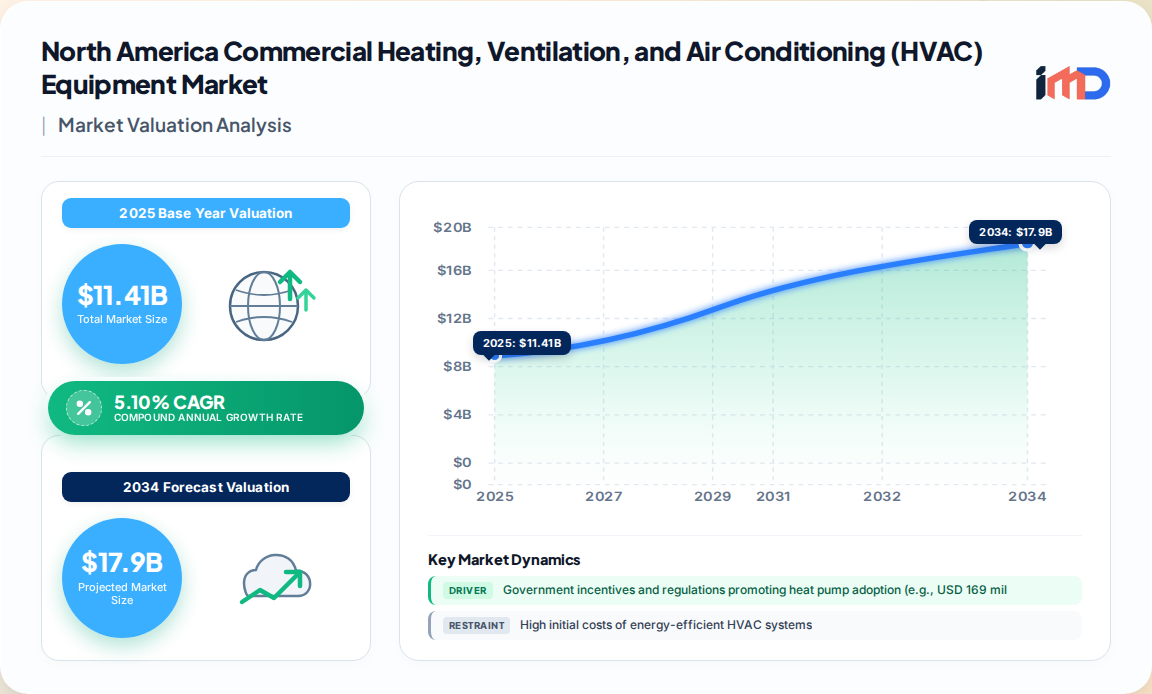
The North America Commercial Heating, Ventilation, and Air Conditioning (HVAC) Equipment market represents a critical infrastructure sector undergoing rapid transformation. Our proprietary primary research and expert interviews indicate that the market is valued at USD 11.41 billion in 2025 and is forecast to reach USD 14.64 billion by 2030, expanding at a CAGR of 5.10% during the forecast period. This growth is not merely a recovery from supply chain disruptions but a structural shift driven by regulatory mandates, technological convergence, and an urgent need for energy efficiency in commercial buildings.
The commercial HVAC equipment market is segmented by equipment type, end-user vertical, and installation type. Our analysis reveals that air conditioning equipment, including chillers, rooftop units, and ductless mini-splits, is expected to witness remarkable growth, driven by rising cooling degree days and the need for precision cooling in data centers.
| Segment | Sub-Segment | Market Share (2025) | Growth Outlook |
|---|---|---|---|
| By Equipment | Air Conditioning/Ventilation Equipment | 46.43% (AC) | Fastest growing (8.64% CAGR) |
| Heating Equipment (Heat Pumps, Boilers, Furnaces) | ~35% | High growth due to electrification | |
| By End User | Commercial (Office, Retail, Healthcare, Hospitality, Education) | 59.75% | 8.81% CAGR |
| Public Utilities, Others | ~40.25% | Moderate growth | |
| By Installation Type | Retrofit & Replacement | 60.84% | Dominant share, driven by regulations |
| New Construction | 39.16% | 8.29% CAGR |
Office spaces, retail, healthcare, education, and hospitality are the primary end users. Office buildings command the largest share (32.62% of commercial demand in 2025), while data centers are forecast to post the fastest CAGR (9.12% through 2031) due to exponential growth in server rack densities and AI-driven computing.
The North American commercial HVAC market is heavily regulated, with policy shifts creating both challenges and opportunities.
These regulations are compressing product development cycles and forcing manufacturers to redesign evaporator and condenser circuits for mildly flammable A2L refrigerants. Building owners are pre-emptively retiring 10- to 12-year-old systems, accelerating a replacement wave.
The North America Commercial HVAC Equipment market is moderately concentrated, with global players dominating through technological leadership and extensive distribution networks.
The United States holds the largest share of the North American market, accounting for 79.82% in 2025. The country's growth is driven by extreme weather events, government incentives, and a strong push toward energy efficiency. Heat pump adoption is particularly strong in the Northeast and Pacific Northwest.
Canada is the second-largest market, with cold-climate heat pumps gaining traction. Toronto and Montreal building codes now accept variable-refrigerant-flow (VRF) systems for sub-zero operation, opening replacement demand for aging boiler infrastructure. Government rebates of up to CAD 5,000 support adoption.
Mexico, while smaller, is projected to register the fastest CAGR of 8.78% through 2031, driven by nearshoring of manufacturing and commercial construction in its northern corridor. Mexico's manufacturing corridor is also narrowing the supply gap for commercial HVAC components serving U.S. installation demand.
The commercial HVAC value chain encompasses raw material suppliers, component manufacturers (compressors, coils, controls), OEMs, distributors, and contractors.
The North America Commercial HVAC Equipment market is poised for steady growth, with a CAGR of 5.10% from 2025 to 2030. The market is characterized by a shift toward electrification, digitalization, and sustainability. Stakeholders must monitor regulatory changes, particularly around refrigerants and efficiency standards, as these will define competitive table stakes.
In conclusion, the market offers significant opportunities, but success requires navigating a complex regulatory landscape and adapting to technological shifts.
| Aspects | Details |
|---|---|
| Study Period | 2020-2034 |
| Base Year | 2025 |
| Estimated Year | 2026 |
| Forecast Period | 2026-2034 |
| Historical Period | 2020-2025 |
| Growth Rate | CAGR of 5.10% from 2020-2034 |
| Segmentation |
|
By Installation Type
By Building Type
| By Geography |
|
The market is estimated at USD 11.41 billion in 2025, according to our proprietary primary research.
The market is expected to grow at a CAGR of 5.10% from 2025 to 2030, reaching USD 14.64 billion by 2030.
The United States dominates with approximately 79.82% market share in 2025, driven by government incentives and stringent energy regulations.
Key drivers include heat pump adoption, the AIM Act refrigerant transition, data center cooling demand, and smart building integration.
Major players include Daikin Industries, Ltd, Mitsubishi Electric Corporation, Johnson Controls, Carrier Global Corporation, and Trane Technologies Company, LLC.
The AIM Act mandates an 85% reduction in HFC consumption by 2036, accelerating the transition to low-GWP refrigerants like R-454B and R-32 and creating a replacement wave.
Our rigorous research methodology combines multi-layered approaches with comprehensive quality assurance, ensuring precision, accuracy, and reliability in every market analysis.
| Stakeholder Role | Interview Share (%) |
|---|---|
| Chief Engineers | 30% |
| Procurement Directors | 25% |
| Facility Managers | 25% |
| HVAC System Designers | 20% |
| Company Type | Representation (%) |
|---|---|
| OEMs & Component Manufacturers | 45% |
| Distributors & Wholesalers | 25% |
| HVAC Contractors & Installers | 20% |
| Building Automation & Controls Specialists | 10% |