1What is the Naval Vessel MRO market size in 2026?
The market is estimated at USD 63.27 billion in 2026 and is projected to reach USD 73.66 billion by 2031, growing at a CAGR of 3.09%.
Insight Market Data is a premier market research and business consulting firm headquartered in Pune, India, providing syndicated research reports, customized intelligence studies, and strategic advisory services. Renowned academic institutions and Fortune 500 corporations worldwide rely on Insight Market Data's research repository to navigate evolving global and regional business environments. Covering 46 diverse industries across 25 major international economies, our comprehensive database delivers thousands of verified statistics and granular market evaluations. By combining industry-leading analytical methodologies with the direct insights of seasoned industry leaders and subject-matter experts, we deliver actionable intelligence spanning historical performance benchmarks to rigorous multi-year forecasts. We empower organizations to make confident, data-driven decisions across pivotal domains including Machinery & Equipment, Chemicals & Materials, Pharmaceuticals & Healthcare, Food & Beverages, Consumer Goods, Energy & Power, Automotive & Transportation, Electronics & Semiconductors, Medical Devices, Telecommunications, Emerging Technologies, Agriculture, and Packaging. Our multidisciplinary analyst teams provide an objective 360-degree perspective, tailoring every engagement to address complex strategic challenges with exceptional analytical rigor.
Leveraging advanced BI-powered analytics and predictive modeling, Insight Market Data uncovers high-impact market opportunities and competitive differentiators for ambitious enterprises. We continuously refine our research methodologies in accordance with global industry standards, tracking real-time market shifts to ensure our reports are consistently accurate, actionable, and delivered on schedule. Our analysts conduct methodical data validation, rigorous compliance checks, and exhaustive primary and secondary research to maintain the highest levels of data integrity and transparency. We partner closely with corporate strategists, investment groups, and business executives to translate intricate market intelligence into clear, actionable roadmaps for sustainable growth. With operational presence across Washington, USA, and Vimannagar, Pune, India, Insight Market Data ensures direct access to dedicated research specialists and responsive customer support to answer your most strategic questions.
 Naval Vessel MRO Market
 by Vessel Type (Aircraft Carriers, Destroyers, Frigates, Corvettes, Submarines, Auxiliary Vessels), by MRO Type (Engine MRO, Dry-Dock MRO, Component MRO, Regular Maintenance MRO, Modification & Upgrade), by Maintenance Level (Organizational/Operational, Depot, Intermediate), by Propulsion Type (Nuclear-Powered, Conventional), by North America (USA, Canada, Mexico), by Europe (UK, France, Germany, Italy, Spain, Russia, Rest of Europe), by Asia Pacific (China, Japan, India, South Korea, Australia, Singapore, Rest of APAC), by South America (Brazil, Argentina, Colombia, Peru, Chile, Rest of South America), by Middle East (Saudi Arabia, Turkey, UAE, Egypt, Qatar, Rest of Middle East), by Africa (South Africa, Rest of Africa) Forecast 2026-2034

Research Associate


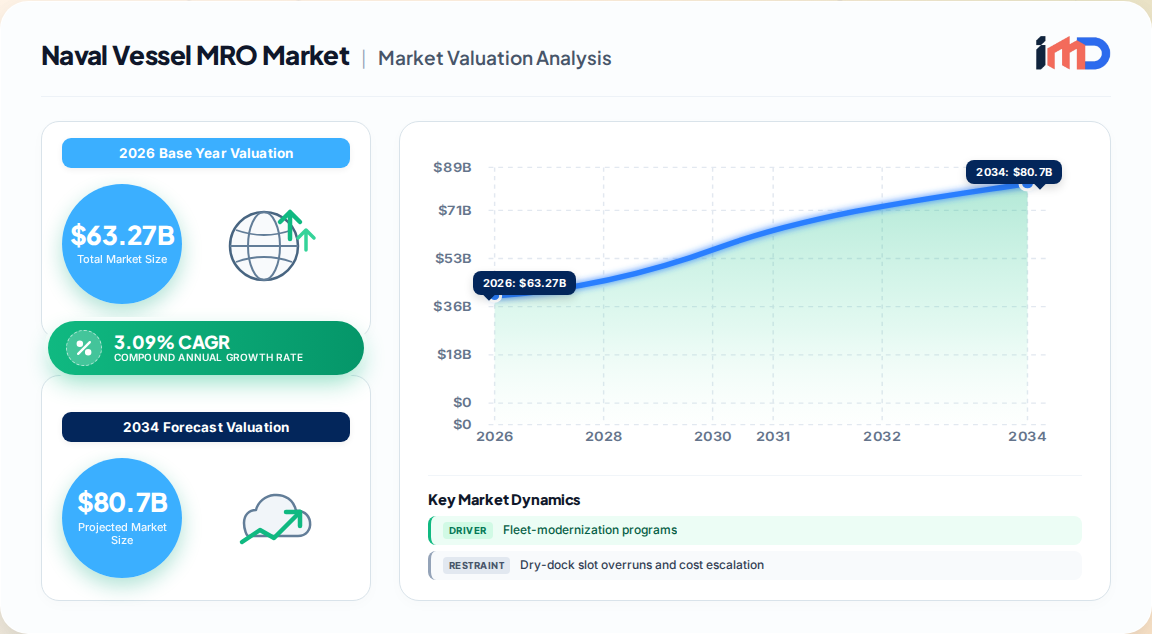
The Naval Vessel MRO (Maintenance, Repair, and Overhaul) market represents a critical pillar of global naval readiness, valued at USD 63.27 billion in 2026 and projected to reach USD 73.66 billion by 2031, expanding at a steady 3.09% CAGR. This market encompasses the full spectrum of sustainment services—from routine organizational-level maintenance to complex depot-level overhauls and dry-docking—essential for extending the service life of aging fleets and integrating advanced combat systems.
Our proprietary analysis indicates that the market’s trajectory is shaped by a confluence of persistent geopolitical tensions, the imperative to modernize legacy platforms, and the accelerating adoption of performance-based logistics (PBL) contracts. While new-build cycles fluctuate, the sustaining engineering and industrial base required to keep existing hulls mission-ready provides a resilient, long-term revenue stream. The market is characterized by medium concentration, with prime defense contractors and specialized shipyards dominating high-value segments such as nuclear propulsion maintenance and Aegis combat system upgrades.
The market is segmented by vessel type, MRO type, maintenance level, and propulsion type, each presenting distinct growth dynamics.
Submarines led the market with a 33.46% share in 2025, reflecting the complexity and cost of nuclear submarine refueling and hull maintenance. Frigates are forecast to expand at the fastest 5.05% CAGR through 2031, driven by widespread adoption and increasing operational demands. Destroyers, corvettes, aircraft carriers, and auxiliary vessels constitute the remainder, with destroyers and frigates together expected to account for over 50% of revenue in 2026 due to their extensive deployment across global fleets.
Dry-dock services accounted for 38.57% of the market in 2025, driven by mandatory inspections and major overhauls. Modification and upgrade services are advancing at a 3.60% CAGR, as navies integrate new combat systems, sensors, and propulsion technologies into existing platforms. Engine MRO and component MRO remain significant, with component MRO being the largest sub-segment in some analyses due to the constant need for spare parts and electronics repair.
Depot-level work controlled 37.05% of the market in 2025 and is rising at a 4.66% CAGR, as complex overhauls and nuclear refueling require specialized infrastructure and deep technical expertise. Organizational/operational-level maintenance, performed by naval personnel, represents a smaller but essential share.
Nuclear-powered vessels captured 53.21% of the market in 2025 and are projected to grow at a 4.12% CAGR through 2031. The high cost and complexity of nuclear refueling and reactor maintenance lock in premium pricing for specialized contractors. Conventional propulsion remains significant, particularly for surface combatants and submarines operated by many navies.
Asia-Pacific held the largest regional share at 37.14% in 2025, propelled by China’s rapid fleet expansion and allied counter-responses. The region is expected to maintain its dominance, with a leading share of 38% in 2026, driven by strong domestic shipbuilding capabilities and increasing investments in MRO infrastructure. Europe is the fastest-growing region, registering a 3.88% CAGR to 2031, fueled by renewed NATO commitments and aging fleets requiring life extensions. North America, while mature, remains a critical market with significant submarine and carrier maintenance requirements, though it is projected to grow at a slower pace. The Middle East and South America present emerging opportunities, with modest but steady growth driven by naval modernization efforts.
| Region | 2025 Share (%) | 2026 Share (%) | CAGR 2026-2031 (%) |
|---|---|---|---|
| Asia-Pacific | 37.14 | 38.0 | 3.0 |
| Europe | 23.0 | 23.5 | 3.88 |
| North America | 25.0 | 24.5 | 2.5 |
| Middle East & Africa | 8.0 | 8.0 | 2.2 |
| South America | 6.86 | 6.0 | 2.5 |
Note: Regional shares are based on proprietary estimation and may vary by segment.
The market is moderately concentrated, with prime contractors leveraging deep technical expertise and long-standing relationships with navies. Key players include General Dynamics Corporation, Lockheed Martin Corporation, BAE Systems plc, Huntington Ingalls Industries, Inc., and Naval Group. These companies dominate high-value segments such as nuclear submarine maintenance, Aegis system upgrades, and aircraft carrier refueling. Strategic developments in recent years include:
The naval MRO value chain is complex, spanning tiered suppliers, shipyards, and naval bases. Key activities include:
Supply chain fragility, exacerbated by geopolitical tensions and raw material shortages, poses measurable headwinds. The industry is responding through digital twin analytics, additive manufacturing for spare parts, and performance-based logistics to mitigate downtime and unlock incremental savings.
The naval MRO market is intrinsically linked to global defense trade, with the US, Europe, and Asia-Pacific being major exporters of naval systems and support services. While direct trade data for MRO services is not publicly disaggregated, official statistics from UN Comtrade and national defense export agencies indicate robust flows. For instance, US Foreign Military Sales (FMS) for sustainment and training often include MRO packages, with allies in Asia-Pacific and Europe being primary recipients. Similarly, European consortiums export naval vessels with multi-year maintenance contracts, creating follow-on MRO revenue. Key supplier countries include the US, UK, France, Germany, and increasingly South Korea and Japan, which are emerging as exporters of naval technology and services. Import-dependent nations, particularly in the Middle East and Southeast Asia, rely on OEMs and specialized contractors for depot-level maintenance, driving demand for on-site support and technology transfer agreements.
Our analysis identifies several underpenetrated opportunities:
| Existing Markets | New Markets | |
|---|---|---|
| Existing Products | Market Penetration: Expand long-term PBL contracts with existing navies; increase share of depot-level work. | Market Development: Enter emerging naval markets (e.g., India, Brazil) with tailored MRO packages. |
| New Products | Product Development: Introduce digital twin platforms, additive manufacturing services, and green retrofits to existing customers. | Diversification: Offer integrated sustainment solutions combining MRO with training and logistics for new customers. |
The Naval Vessel MRO market is poised for steady growth, underpinned by aging fleets, geopolitical tensions, and the continuous need for modernization. While challenges such as dry-dock capacity and skilled labor shortages persist, technological advancements and innovative contracting models offer pathways to efficiency and value creation. Stakeholders across the value chain must invest in digital capabilities, workforce development, and strategic partnerships to capitalize on emerging opportunities in this critical defense sector.
| Aspects | Details |
|---|---|
| Study Period | 2020-2034 |
| Base Year | 2026 |
| Estimated Year | 2026 |
| Forecast Period | 2026-2034 |
| Historical Period | 2020-2025 |
| Growth Rate | CAGR of 3.09% from 2020-2034 |
| Segmentation |
|
By MRO Type
By Maintenance Level
By Propulsion Type
| By Geography |
|
The market is estimated at USD 63.27 billion in 2026 and is projected to reach USD 73.66 billion by 2031, growing at a CAGR of 3.09%.
Asia-Pacific holds the largest share, accounting for approximately 37.14% of the market in 2025, driven by China’s fleet expansion and regional modernization programs.
Key drivers include fleet modernization programs, life-extension of legacy fleets, rising maritime-security tensions, and the adoption of performance-based logistics (PBL) contracts.
Frigates are forecast to expand at the fastest CAGR of 5.05% through 2031, while submarines currently hold the largest share at 33.46%.
Challenges include dry-dock slot overruns and costs, skilled-labor shortages, cyber-risk to connected shipyards, and green-compliance waste-disposal costs.
Our rigorous research methodology combines multi-layered approaches with comprehensive quality assurance, ensuring precision, accuracy, and reliability in every market analysis.
| Stakeholder Role | Interview Share (%) |
|---|---|
| Vice President of Naval Programs | 35% |
| Director of Shipyard Operations | 30% |
| Naval Fleet Maintenance Officer | 20% |
| Defense Procurement Analyst | 15% |
| Company Type | Representation (%) |
|---|---|
| Nuclear Submarine Maintenance Contractors | 30% |
| Dry-Dock Operators & Shipyards | 25% |
| Combat System Integrators | 20% |
| Propulsion System OEMs | 15% |
| Naval Logistics & Supply Chain Providers | 10% |

Analyst at Providence Strategic Partners at Petaling Jaya
I have received the report already. Thanks you for your help.it has been a pleasure working with you. Thank you again for a good quality report

Internationalization Director
Yes, as a matter of fact we are totally satisfied with both reports that we have purchased and will continue to do so during this process of the internationalization of our brand.

Head of Product Management and Marketing
We are using your report, and it gave us valuable information."

Regional Director, Marketing and Business Development
We've received the report and have reviewed the content. Overall, it looks great and aligns closely with the data we can verify based on our industry knowledge.

VP of Sales
Thank you very much for sharing the report. I have reviewed it and I am very satisfied with the quality and the insights it provides. It will certainly be valuable for our internal discussions.
 Related Reports
