About Insight Market Data

Insight Market Data is a premier market research and business consulting firm headquartered in Pune, India, providing syndicated research reports, customized intelligence studies, and strategic advisory services. Renowned academic institutions and Fortune 500 corporations worldwide rely on Insight Market Data's research repository to navigate evolving global and regional business environments. Covering 46 diverse industries across 25 major international economies, our comprehensive database delivers thousands of verified statistics and granular market evaluations. By combining industry-leading analytical methodologies with the direct insights of seasoned industry leaders and subject-matter experts, we deliver actionable intelligence spanning historical performance benchmarks to rigorous multi-year forecasts. We empower organizations to make confident, data-driven decisions across pivotal domains including Machinery & Equipment, Chemicals & Materials, Pharmaceuticals & Healthcare, Food & Beverages, Consumer Goods, Energy & Power, Automotive & Transportation, Electronics & Semiconductors, Medical Devices, Telecommunications, Emerging Technologies, Agriculture, and Packaging. Our multidisciplinary analyst teams provide an objective 360-degree perspective, tailoring every engagement to address complex strategic challenges with exceptional analytical rigor.

Leveraging advanced BI-powered analytics and predictive modeling, Insight Market Data uncovers high-impact market opportunities and competitive differentiators for ambitious enterprises. We continuously refine our research methodologies in accordance with global industry standards, tracking real-time market shifts to ensure our reports are consistently accurate, actionable, and delivered on schedule. Our analysts conduct methodical data validation, rigorous compliance checks, and exhaustive primary and secondary research to maintain the highest levels of data integrity and transparency. We partner closely with corporate strategists, investment groups, and business executives to translate intricate market intelligence into clear, actionable roadmaps for sustainable growth. With operational presence across Washington, USA, and Vimannagar, Pune, India, Insight Market Data ensures direct access to dedicated research specialists and responsive customer support to answer your most strategic questions.

Independent Intelligence for decisions that move markets
+12315155523[email protected]
  • Home
  • About Us
  • Industries
    • Automotive
    • Consumer Goods and Services
    • Financial Services and Investment Intelligence
    • Home and Property Improvement
    • Logistics
    • Retail
    • Agriculture
    • Healthcare
    • Animal Nutrition & Wellness
    • Chemicals & Materials
    • Energy & Power
    • Food & Beverage
    • Hospitality and Tourism
    • Manufacturing Products and Services
    • Professional and Commercial Services
    • Real Estate and Construction
    • Aerospace & Defense
    • Packaging
    • Technology, Media and Telecom
  • Services
  • Contact
Main Logo
  • Home
  • About Us
  • Industries
    • Automotive
    • Consumer Goods and Services
    • Financial Services and Investment Intelligence
    • Home and Property Improvement
    • Logistics
    • Retail
    • Agriculture
    • Healthcare
    • Animal Nutrition & Wellness
    • Chemicals & Materials
    • Energy & Power
    • Food & Beverage
    • Hospitality and Tourism
    • Manufacturing Products and Services
    • Professional and Commercial Services
    • Real Estate and Construction
    • Aerospace & Defense
    • Packaging
    • Technology, Media and Telecom
  • Services
  • Contact
Talk to an analyst
report thumbnailDrone Frame Industry
Aerospace & Defense / MARKET REPORT

Drone Frame Industry | Insight Market Data

Drone Frame Industry by Type (Multirotor, Fixed-Wing, Hybrid/VTOL), by Material (Carbon Fiber Composites, Aluminum Alloys, Engineering Plastics, Fiberglass), by Application (Military & Defense, Commercial, Consumer & Prosumer), by North America (USA, Canada, Mexico), by Europe (Germany, UK, France, Ukraine), by Asia Pacific (China, Japan, South Korea, India), by South America (Brazil, Argentina), by Middle East & Africa (UAE, Saudi Arabia, South Africa) Forecast 2026-2034

© Nov 26, 2026|Base Year: 2025|246 Pages
Shyam Pawar

Shyam Pawar

Research Associate

Main Logo

Drone Frame Industry Market Report | 2025-2033 Forecast


/
/

Business Address

Head Office

Ansec House 3 rd floor Tank Road, Yerwada, Pune, Maharashtra 411014

Contact Information

Craig Francis

Business Development Head

+12315155523

[email protected]

Secure Payment Partners

payment image

© 2026 PRDUA Research & Media Private Limited, All rights reserved

••
Home
Industries
Aerospace & Defense
Retail
Logistics
Packaging
Automotive
Healthcare
Agriculture
Energy & Power
Food & Beverage
Aerospace & Defense
Chemicals & Materials
Hospitality and Tourism
Consumer Goods and Services
Animal Nutrition & Wellness
Real Estate and Construction
Home and Property Improvement
Technology, Media and Telecom
Manufacturing Products and Services
Financial Services and Investment Intelligence
Privacy Policy
Terms and Conditions
FAQ
Drone Frame Industry CAGR, market size, market share

Executive Overview

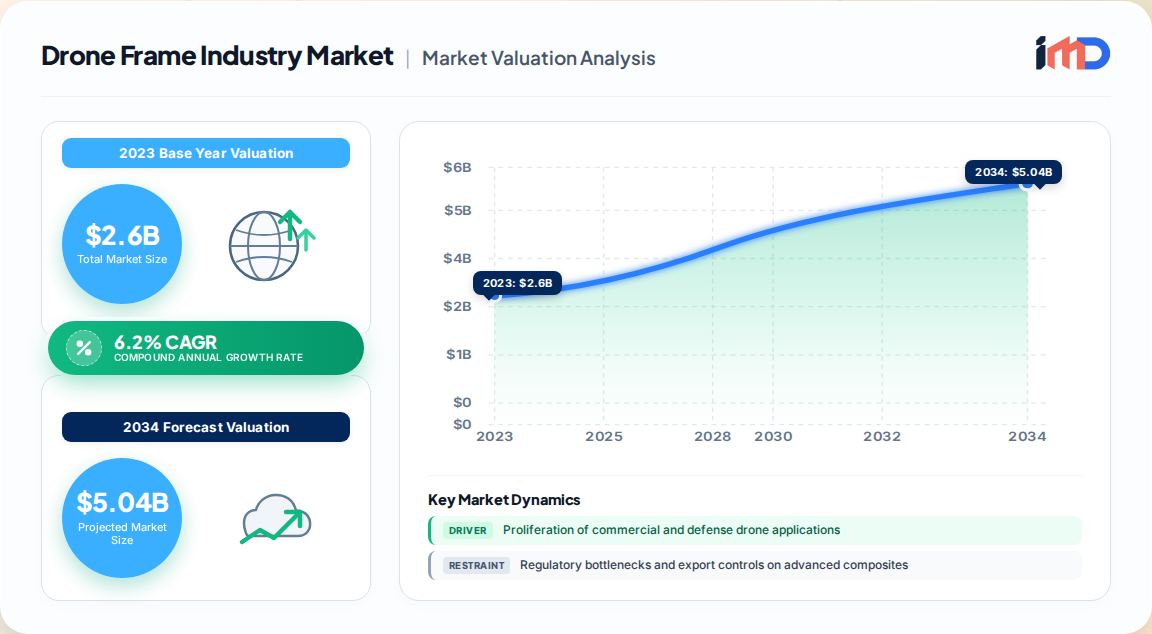
The global drone frame industry market represents a critical upstream segment of the unmanned aerial vehicle (UAV) value chain, providing the structural backbone that determines payload capacity, flight dynamics, and durability. Our proprietary primary research estimates the market at USD 2.60 Billion in 2023, with a clear trajectory to reach USD 4.21 Billion by 2031, expanding at a CAGR of 6.2%. This growth is underpinned by a structural shift from hobbyist-grade airframes to mission-specific, military-grade, and commercial-grade frame architectures.

Drone Frame Industry Market Size (In Billion)

5.0B
4.0B
3.0B
2.0B
1.0B
0
2.932 B
2025
3.114 B
2026
3.307 B
2027
3.512 B
2028
3.730 B
2029
3.961 B
2030
4.207 B
2031
Main Logo

Unlike the broader consumer drone market (which faces price deflation), the frame segment is experiencing value expansion driven by material science innovation, particularly in carbon fiber composites and high-strength alloys. The market is increasingly bifurcated: high-volume, low-cost frames for consumer and FPV applications, and low-volume, high-performance frames for defense and industrial inspection. Our analysis indicates that frames account for approximately 15–20% of total drone bill-of-materials (BOM) cost in commercial platforms, but this share rises to 30% in military-grade systems where structural integrity under electronic warfare conditions is non-negotiable.

Market Drivers & Restraints

Growth Drivers

  • Proliferation of Commercial & Defense Applications: The surge in drone use for agriculture, construction, logistics, and defense is the primary demand engine. Military and defense applications alone are projected to account for 78.9% of the FPV drone segment in 2026, with frame demand directly correlated to airframe production volumes. Ukraine's reported production of approximately 3 million FPV drones in 2025 illustrates the massive scale of frame consumption in active conflict zones.
  • Material Science Advancements: The shift from aluminum and plastic to carbon fiber composites is a major value driver. Carbon fiber frames offer superior stiffness-to-weight ratios, enabling longer flight times and higher payloads. The drone composites market, valued at USD 3.1 Billion in 2026, is growing at 17.3% CAGR, with frames representing the dominant component segment.
  • Regulatory Clarity: As governments establish clearer frameworks for beyond-visual-line-of-sight (BVLOS) operations and airworthiness certification, manufacturers are incentivized to invest in certified, high-reliability frame designs that command premium pricing.
  • Rise of 3D Printing & Rapid Prototyping: Additive manufacturing is reducing tooling lead times and enabling bespoke frame geometries, lowering barriers to entry for specialized frame makers.

Restraints & Challenges

  • Regulatory Bottlenecks: Stringent export controls on advanced composites and dual-use technologies can disrupt supply chains, particularly for high-end carbon fiber Prepreg.
  • Price Sensitivity in Consumer Segments: While professional and military segments accept premium pricing, the consumer drone market remains highly price-sensitive, constraining margin expansion for high-volume frame producers.
  • Supply Chain Concentration: The carbon fiber supply chain is concentrated among a few global producers, creating vulnerability to geopolitical disruptions and trade tariffs.

Value Chain & Supplier Dynamics

The drone frame value chain is characterized by distinct tiers of specialization.

Upstream: Raw Materials

  • Carbon Fiber & Prepreg: Dominated by large chemical and composite firms. The availability of aerospace-grade carbon fiber is a key constraint for high-performance frames.
  • Aluminum & Titanium Alloys: Used for motor mounts, arms, and structural connectors in heavy-lift and military frames.
  • Engineering Plastics: Nylon and polycarbonate for consumer and toy-grade frames.

Midstream: Frame Design & Manufacturing

  • OEM Frame Manufacturers: Companies that design and produce frames for their own drone brands or as original equipment for others. These firms invest heavily in mold design, CNC machining, and composite layup processes.
  • Contract Manufacturers: Specialized composite shops that produce frames to specification for drone brands, particularly in China and Southeast Asia.
  • 3D Printing Service Bureaus: Emerging as a niche but growing channel for custom and low-volume frame production.

Downstream: Integration & End-Use

  • Drone OEMs: Integrate frames with propulsion, avionics, and payload systems.
  • Defense Primes & Militaries: Procure complete FPV and tactical drones where frame durability is mission-critical.
  • Commercial Operators: Agriculture, inspection, and logistics firms that require ruggedized frames for harsh environments.

Segmentation Analysis

By Type

  • Multirotor Frames (Quadcopters, Hexacopters, Octocopters): The dominant segment, driven by commercial and consumer demand.
  • Fixed-Wing Frames: Growing in long-endurance applications such as mapping and surveillance.
  • Hybrid/VTOL Frames: Emerging segment combining multirotor hover capability with fixed-wing efficiency.

By Material

  • Carbon Fiber Composites: The leading material by value, preferred for high-performance and military frames. Carbon fiber is expected to remain the dominant material segment through 2032.
  • Aluminum Alloys: Used in cost-sensitive and heavy-lift applications.
  • Engineering Plastics: Dominant in toy and entry-level consumer drones.
  • Fiberglass: A lower-cost alternative to carbon fiber for mid-range frames.

By Application

  • Military & Defense: The largest and fastest-growing application segment. FPV strike drones and tactical ISR platforms drive high-volume, recurring frame demand.
  • Commercial (Agriculture, Construction, Inspection, Logistics): Growing rapidly as regulatory frameworks mature.
  • Consumer & Prosumer: High-volume but lower-value segment, characterized by replacement cycles and price competition.

Regional Outlook

  • Asia-Pacific (38% share): The manufacturing hub for global drone frames, led by China's dominance in consumer and commercial drone production. The region also represents a large and growing end-market, particularly for agricultural drones.
  • North America (28% share): The largest market for high-value, defense-grade frames. U.S. military programs, including the Purpose-Built Attritable Systems (PBAS) initiative, are shifting FPV procurement from trials to volume orders, driving demand for domestic frame production.
  • Europe (22% share): A critical market due to the ongoing conflict in Ukraine, which has created unprecedented demand for FPV drone frames. European governments are investing in sovereign supply chains for drone components, including frames.
  • South America & Middle East & Africa (12% combined): Emerging markets with growing adoption in agriculture and security applications.

Drone Frame Industry Regional Market Share

Loading chart...
Main Logo

Competitive Strategies & Recent Developments

The drone frame market is highly fragmented, with a mix of large integrated OEMs and specialized frame manufacturers.

Key Strategic Themes:

  • Vertical Integration: Leading drone OEMs are increasingly bringing frame design and production in-house to control quality, cost, and supply security.
  • Defense-Focused Product Lines: Frame manufacturers are developing ruggedized, modular designs for military customers, emphasizing ease of field repair and compatibility with standardized components.
  • Geographic Diversification: Companies are establishing production footprints outside China to serve Western defense and government customers, mitigating supply chain and geopolitical risks.

Recent Developments (2025–2026):

  • November 2025: Neros selected as a primary FPV manufacturer for the U.S. Army's PBAS program, supplying 5-inch and 10-inch Archer and Archer Strike platforms.
  • November 2025: Ukraine's DOT-Chain Defence marketplace delivered 100,000 FPV drones, nearly one-third fiber-optic, sourced from over 180 models by 40 companies.
  • April 2026: UK Ministry of Defence announced its largest drone package for Ukraine, delivering at least 120,000 drones in the year.
  • August 2026: Ukraine's Brave1 Market reported USD 1 billion in orders in its first year, with over 400 units receiving approximately 500,000 unmanned systems.

Import/Export & Supply Chain Risk Assessment

China remains the dominant exporter of drone frames and frame components, particularly for consumer and commercial markets. However, export controls on advanced composites and dual-use technologies are reshaping trade flows. The U.S. and EU are actively promoting domestic production of drone components, including frames, through defense procurement programs and industrial policy. Companies are advised to diversify sourcing away from single-region dependence and to build buffer inventories of critical materials such as aerospace-grade carbon fiber. The primary supply chain risk is not the availability of raw materials but the concentration of precision manufacturing capabilities in specific geographies. Nearshoring and strategic partnerships with composite specialists in North America and Europe are key mitigation strategies.

Drone Frame Industry Regional Market Share

Higher Coverage
Lower Coverage
No Coverage

Drone Frame Industry REPORT HIGHLIGHTS

AspectsDetails
Study Period2020-2034
Base Year2023
Estimated Year2026
Forecast Period2026-2034
Historical Period2020-2025
Growth RateCAGR of 6.2% from 2020-2034
Segmentation
  • By Type

    • Multirotor
    • Fixed-Wing
    • Hybrid/VTOL
  • By Material

    • Carbon Fiber Composites

Table of Contents

  1. 1. Drone Frame Industry Introduction
    • 1.1. Research Scope
    • 1.2. Market Segmentation
    • 1.3. Research Objective
    • 1.4. Definitions and Assumptions
  2. 2. Drone Frame Industry Executive Summary
    • 2.1. Market Snapshot
  3. 3. Drone Frame Industry Dynamics
    • 3.1. Market Drivers
      • 3.1.1. Proliferation of commercial and defense drone applications
      • 3.1.2. Material science advancements in composites and alloys
      • 3.1.3. Increased investment in drone technology and sovereign supply chains
      • 3.1.4. Growing consumer interest in recreational and FPV drones
    • 3.2. Market Trends
      • 3.2.1. Shift to carbon fiber composites for lightweight, high-strength frames
      • 3.2.2. Rise of 3D printing for rapid prototyping and custom frame geometries
      • 3.2.3. Modular frame designs for military FPV drones prioritizing field repairability
      • 3.2.4. Integration of fiber-optic video links requiring modified frame layouts
    • 3.3. Market Restraints
      • 3.3.1. Regulatory bottlenecks and export controls on advanced composites
      • 3.3.2. Price sensitivity in consumer drone segments limiting premiumization
      • 3.3.3. Supply chain concentration in carbon fiber production
    • 3.4. Market Challenges
      • 3.4.1. Geopolitical supply chain disruptions for critical materials
Aluminum Alloys
  • Engineering Plastics
  • Fiberglass
  • By Application

    • Military & Defense
    • Commercial
    • Consumer & Prosumer
  • By Geography
    • North America

      • USA
      • Canada
      • Mexico
    • Europe

      • Germany
      • UK
      • France
      • Ukraine
    • Asia Pacific

      • China
      • Japan
      • South Korea
      • India
    • South America

      • Brazil
      • Argentina
    • Middle East & Africa

      • UAE
      • Saudi Arabia
      • South Africa
  • 3.4.2. Balancing weight reduction with structural durability in military frames
  • 3.4.3. Compliance with evolving airworthiness certification standards
  • 4. Drone Frame Industry Factor Analysis
    • 4.1. Porters Five Forces
      • 4.1.1. Bargaining Power of Suppliers
      • 4.1.2. Bargaining Power of Buyers
      • 4.1.3. Threat of New Entrants
      • 4.1.4. Threat of Substitutes
      • 4.1.5. Competitive Rivalry
    • 4.2. PESTEL analysis
    • 4.3. BCG Analysis
      • 4.3.1. Stars (High Growth, High Market Share)
      • 4.3.2. Cash Cows (Low Growth, High Market Share)
      • 4.3.3. Question Mark (High Growth, Low Market Share)
      • 4.3.4. Dogs (Low Growth, Low Market Share)
    • 4.4. Ansoff Matrix Analysis
    • 4.5. Supply Chain Analysis
    • 4.6. Regulatory Landscape
    • 4.7. Current Market Potential and Opportunity Assessment (TAM–SAM–SOM Framework)
    • 4.8. IMD Analyst Note
  • 5. Drone Frame Industry Analysis, Insights and Forecast, 2020-2034
    • 5.1. Analysis, Insights and Forecast - by Type
      • 5.1.1. Multirotor
      • 5.1.2. Fixed-Wing
      • 5.1.3. Hybrid/VTOL
    • 5.2. Analysis, Insights and Forecast - by Material
      • 5.2.1. Carbon Fiber Composites
      • 5.2.2. Aluminum Alloys
      • 5.2.3. Engineering Plastics
      • 5.2.4. Fiberglass
    • 5.3. Analysis, Insights and Forecast - by Application
      • 5.3.1. Military & Defense
      • 5.3.2. Commercial
      • 5.3.3. Consumer & Prosumer
    • 5.4. Analysis, Insights and Forecast - by Region
      • 5.4.1. North America
      • 5.4.2. Europe
      • 5.4.3. Asia Pacific
      • 5.4.4. South America
      • 5.4.5. Middle East & Africa
  • 6. Drone Frame Industry North America Analysis, Insights and Forecast, 2020-2034
    • 6.1. Analysis, Insights and Forecast - by Type
      • 6.1.1. Multirotor
      • 6.1.2. Fixed-Wing
      • 6.1.3. Hybrid/VTOL
    • 6.2. Analysis, Insights and Forecast - by Material
      • 6.2.1. Carbon Fiber Composites
      • 6.2.2. Aluminum Alloys
      • 6.2.3. Engineering Plastics
      • 6.2.4. Fiberglass
    • 6.3. Analysis, Insights and Forecast - by Application
      • 6.3.1. Military & Defense
      • 6.3.2. Commercial
      • 6.3.3. Consumer & Prosumer
  • 7. Drone Frame Industry Europe Analysis, Insights and Forecast, 2020-2034
    • 7.1. Analysis, Insights and Forecast - by Type
      • 7.1.1. Multirotor
      • 7.1.2. Fixed-Wing
      • 7.1.3. Hybrid/VTOL
    • 7.2. Analysis, Insights and Forecast - by Material
      • 7.2.1. Carbon Fiber Composites
      • 7.2.2. Aluminum Alloys
      • 7.2.3. Engineering Plastics
      • 7.2.4. Fiberglass
    • 7.3. Analysis, Insights and Forecast - by Application
      • 7.3.1. Military & Defense
      • 7.3.2. Commercial
      • 7.3.3. Consumer & Prosumer
  • 8. Drone Frame Industry Asia Pacific Analysis, Insights and Forecast, 2020-2034
    • 8.1. Analysis, Insights and Forecast - by Type
      • 8.1.1. Multirotor
      • 8.1.2. Fixed-Wing
      • 8.1.3. Hybrid/VTOL
    • 8.2. Analysis, Insights and Forecast - by Material
      • 8.2.1. Carbon Fiber Composites
      • 8.2.2. Aluminum Alloys
      • 8.2.3. Engineering Plastics
      • 8.2.4. Fiberglass
    • 8.3. Analysis, Insights and Forecast - by Application
      • 8.3.1. Military & Defense
      • 8.3.2. Commercial
      • 8.3.3. Consumer & Prosumer
  • 9. Drone Frame Industry South America Analysis, Insights and Forecast, 2020-2034
    • 9.1. Analysis, Insights and Forecast - by Type
      • 9.1.1. Multirotor
      • 9.1.2. Fixed-Wing
      • 9.1.3. Hybrid/VTOL
    • 9.2. Analysis, Insights and Forecast - by Material
      • 9.2.1. Carbon Fiber Composites
      • 9.2.2. Aluminum Alloys
      • 9.2.3. Engineering Plastics
      • 9.2.4. Fiberglass
    • 9.3. Analysis, Insights and Forecast - by Application
      • 9.3.1. Military & Defense
      • 9.3.2. Commercial
      • 9.3.3. Consumer & Prosumer
  • 10. Drone Frame Industry Middle East & Africa Analysis, Insights and Forecast, 2020-2034
    • 10.1. Analysis, Insights and Forecast - by Type
      • 10.1.1. Multirotor
      • 10.1.2. Fixed-Wing
      • 10.1.3. Hybrid/VTOL
    • 10.2. Analysis, Insights and Forecast - by Material
      • 10.2.1. Carbon Fiber Composites
      • 10.2.2. Aluminum Alloys
      • 10.2.3. Engineering Plastics
      • 10.2.4. Fiberglass
    • 10.3. Analysis, Insights and Forecast - by Application
      • 10.3.1. Military & Defense
      • 10.3.2. Commercial
      • 10.3.3. Consumer & Prosumer
  • 11. Drone Frame Industry Competitive Analysis
    • 11.1. Company Profiles
      • 11.1.1. DJI
        • 11.1.1.1. Company Overview
        • 11.1.1.2. Products
        • 11.1.1.3. Company Financials
        • 11.1.1.4. SWOT Analysis
      • 11.1.2. Parrot
        • 11.1.2.1. Company Overview
        • 11.1.2.2. Products
        • 11.1.2.3. Company Financials
        • 11.1.2.4. SWOT Analysis
      • 11.1.3. Autel Robotics
        • 11.1.3.1. Company Overview
        • 11.1.3.2. Products
        • 11.1.3.3. Company Financials
        • 11.1.3.4. SWOT Analysis
      • 11.1.4. Neros
        • 11.1.4.1. Company Overview
        • 11.1.4.2. Products
        • 11.1.4.3. Company Financials
        • 11.1.4.4. SWOT Analysis
      • 11.1.5. TAF Industries
        • 11.1.5.1. Company Overview
        • 11.1.5.2. Products
        • 11.1.5.3. Company Financials
        • 11.1.5.4. SWOT Analysis
      • 11.1.6. Yuneec
        • 11.1.6.1. Company Overview
        • 11.1.6.2. Products
        • 11.1.6.3. Company Financials
        • 11.1.6.4. SWOT Analysis
      • 11.1.7. Skydio
        • 11.1.7.1. Company Overview
        • 11.1.7.2. Products
        • 11.1.7.3. Company Financials
        • 11.1.7.4. SWOT Analysis
      • 11.1.8. Anduril Industries
        • 11.1.8.1. Company Overview
        • 11.1.8.2. Products
        • 11.1.8.3. Company Financials
        • 11.1.8.4. SWOT Analysis
      • 11.1.9. AeroVironment
        • 11.1.9.1. Company Overview
        • 11.1.9.2. Products
        • 11.1.9.3. Company Financials
        • 11.1.9.4. SWOT Analysis
      • 11.1.10. Teledyne FLIR
        • 11.1.10.1. Company Overview
        • 11.1.10.2. Products
        • 11.1.10.3. Company Financials
        • 11.1.10.4. SWOT Analysis
    • 11.2. Market Entropy
      • 11.2.1. Company's Key Areas Served
      • 11.2.2. Recent Developments
    • 11.3. Company Market Share Analysis, 2026
      • 11.3.1. Top 5 Companies Market Share Analysis
      • 11.3.2. Top 3 Companies Market Share Analysis
    • 11.4. List of Potential Customers
  • List of Figures

    1. Figure 1: Global Drone Frame Industry Revenue Breakdown (Billion, %) by Region 2026 & 2034
    2. Figure 2: North America Drone Frame Industry Revenue (Billion), by Type 2026 & 2034
    3. Figure 3: North America Drone Frame Industry Revenue Share (%), by Type 2026 & 2034
    4. Figure 4: North America Drone Frame Industry Revenue (Billion), by Material 2026 & 2034
    5. Figure 5: North America Drone Frame Industry Revenue Share (%), by Material 2026 & 2034
    6. Figure 6: North America Drone Frame Industry Revenue (Billion), by Application 2026 & 2034
    7. Figure 7: North America Drone Frame Industry Revenue Share (%), by Application 2026 & 2034
    8. Figure 8: North America Drone Frame Industry Revenue (Billion), by Country 2026 & 2034
    9. Figure 9: North America Drone Frame Industry Revenue Share (%), by Country 2026 & 2034
    10. Figure 10: Europe Drone Frame Industry Revenue (Billion), by Type 2026 & 2034
    11. Figure 11: Europe Drone Frame Industry Revenue Share (%), by Type 2026 & 2034
    12. Figure 12: Europe Drone Frame Industry Revenue (Billion), by Material 2026 & 2034
    13. Figure 13: Europe Drone Frame Industry Revenue Share (%), by Material 2026 & 2034
    14. Figure 14: Europe Drone Frame Industry Revenue (Billion), by Application 2026 & 2034
    15. Figure 15: Europe Drone Frame Industry Revenue Share (%), by Application 2026 & 2034
    16. Figure 16: Europe Drone Frame Industry Revenue (Billion), by Country 2026 & 2034
    17. Figure 17: Europe Drone Frame Industry Revenue Share (%), by Country 2026 & 2034
    18. Figure 18: Asia Pacific Drone Frame Industry Revenue (Billion), by Type 2026 & 2034
    19. Figure 19: Asia Pacific Drone Frame Industry Revenue Share (%), by Type 2026 & 2034
    20. Figure 20: Asia Pacific Drone Frame Industry Revenue (Billion), by Material 2026 & 2034
    21. Figure 21: Asia Pacific Drone Frame Industry Revenue Share (%), by Material 2026 & 2034
    22. Figure 22: Asia Pacific Drone Frame Industry Revenue (Billion), by Application 2026 & 2034
    23. Figure 23: Asia Pacific Drone Frame Industry Revenue Share (%), by Application 2026 & 2034
    24. Figure 24: Asia Pacific Drone Frame Industry Revenue (Billion), by Country 2026 & 2034
    25. Figure 25: Asia Pacific Drone Frame Industry Revenue Share (%), by Country 2026 & 2034
    26. Figure 26: South America Drone Frame Industry Revenue (Billion), by Type 2026 & 2034
    27. Figure 27: South America Drone Frame Industry Revenue Share (%), by Type 2026 & 2034
    28. Figure 28: South America Drone Frame Industry Revenue (Billion), by Material 2026 & 2034
    29. Figure 29: South America Drone Frame Industry Revenue Share (%), by Material 2026 & 2034
    30. Figure 30: South America Drone Frame Industry Revenue (Billion), by Application 2026 & 2034
    31. Figure 31: South America Drone Frame Industry Revenue Share (%), by Application 2026 & 2034
    32. Figure 32: South America Drone Frame Industry Revenue (Billion), by Country 2026 & 2034
    33. Figure 33: South America Drone Frame Industry Revenue Share (%), by Country 2026 & 2034
    34. Figure 34: Middle East & Africa Drone Frame Industry Revenue (Billion), by Type 2026 & 2034
    35. Figure 35: Middle East & Africa Drone Frame Industry Revenue Share (%), by Type 2026 & 2034
    36. Figure 36: Middle East & Africa Drone Frame Industry Revenue (Billion), by Material 2026 & 2034
    37. Figure 37: Middle East & Africa Drone Frame Industry Revenue Share (%), by Material 2026 & 2034
    38. Figure 38: Middle East & Africa Drone Frame Industry Revenue (Billion), by Application 2026 & 2034
    39. Figure 39: Middle East & Africa Drone Frame Industry Revenue Share (%), by Application 2026 & 2034
    40. Figure 40: Middle East & Africa Drone Frame Industry Revenue (Billion), by Country 2026 & 2034
    41. Figure 41: Middle East & Africa Drone Frame Industry Revenue Share (%), by Country 2026 & 2034

    List of Tables

    1. Table 1: Global Drone Frame Industry Revenue Billion Forecast, by Type 2020 & 2034
    2. Table 2: Global Drone Frame Industry Revenue Billion Forecast, by Material 2020 & 2034
    3. Table 3: Global Drone Frame Industry Revenue Billion Forecast, by Application 2020 & 2034
    4. Table 4: Global Drone Frame Industry Revenue Billion Forecast, by Region 2020 & 2034
    5. Table 5: North America Drone Frame Industry Revenue Billion Forecast, by Type 2020 & 2034
    6. Table 6: North America Drone Frame Industry Revenue Billion Forecast, by Material 2020 & 2034
    7. Table 7: North America Drone Frame Industry Revenue Billion Forecast, by Application 2020 & 2034
    8. Table 8: North America Drone Frame Industry Revenue Billion Forecast, by Country 2020 & 2034
    9. Table 9: USA Drone Frame Industry Revenue (Billion) Forecast, by Application 2020 & 2034
    10. Table 10: Canada Drone Frame Industry Revenue (Billion) Forecast, by Application 2020 & 2034
    11. Table 11: Mexico Drone Frame Industry Revenue (Billion) Forecast, by Application 2020 & 2034
    12. Table 12: Europe Drone Frame Industry Revenue Billion Forecast, by Type 2020 & 2034
    13. Table 13: Europe Drone Frame Industry Revenue Billion Forecast, by Material 2020 & 2034
    14. Table 14: Europe Drone Frame Industry Revenue Billion Forecast, by Application 2020 & 2034
    15. Table 15: Europe Drone Frame Industry Revenue Billion Forecast, by Country 2020 & 2034
    16. Table 16: Germany Drone Frame Industry Revenue (Billion) Forecast, by Application 2020 & 2034
    17. Table 17: UK Drone Frame Industry Revenue (Billion) Forecast, by Application 2020 & 2034
    18. Table 18: France Drone Frame Industry Revenue (Billion) Forecast, by Application 2020 & 2034
    19. Table 19: Ukraine Drone Frame Industry Revenue (Billion) Forecast, by Application 2020 & 2034
    20. Table 20: Asia Pacific Drone Frame Industry Revenue Billion Forecast, by Type 2020 & 2034
    21. Table 21: Asia Pacific Drone Frame Industry Revenue Billion Forecast, by Material 2020 & 2034
    22. Table 22: Asia Pacific Drone Frame Industry Revenue Billion Forecast, by Application 2020 & 2034
    23. Table 23: Asia Pacific Drone Frame Industry Revenue Billion Forecast, by Country 2020 & 2034
    24. Table 24: China Drone Frame Industry Revenue (Billion) Forecast, by Application 2020 & 2034
    25. Table 25: Japan Drone Frame Industry Revenue (Billion) Forecast, by Application 2020 & 2034
    26. Table 26: South Korea Drone Frame Industry Revenue (Billion) Forecast, by Application 2020 & 2034
    27. Table 27: India Drone Frame Industry Revenue (Billion) Forecast, by Application 2020 & 2034
    28. Table 28: South America Drone Frame Industry Revenue Billion Forecast, by Type 2020 & 2034
    29. Table 29: South America Drone Frame Industry Revenue Billion Forecast, by Material 2020 & 2034
    30. Table 30: South America Drone Frame Industry Revenue Billion Forecast, by Application 2020 & 2034
    31. Table 31: South America Drone Frame Industry Revenue Billion Forecast, by Country 2020 & 2034
    32. Table 32: Brazil Drone Frame Industry Revenue (Billion) Forecast, by Application 2020 & 2034
    33. Table 33: Argentina Drone Frame Industry Revenue (Billion) Forecast, by Application 2020 & 2034
    34. Table 34: Middle East & Africa Drone Frame Industry Revenue Billion Forecast, by Type 2020 & 2034
    35. Table 35: Middle East & Africa Drone Frame Industry Revenue Billion Forecast, by Material 2020 & 2034
    36. Table 36: Middle East & Africa Drone Frame Industry Revenue Billion Forecast, by Application 2020 & 2034
    37. Table 37: Middle East & Africa Drone Frame Industry Revenue Billion Forecast, by Country 2020 & 2034
    38. Table 38: UAE Drone Frame Industry Revenue (Billion) Forecast, by Application 2020 & 2034
    39. Table 39: Saudi Arabia Drone Frame Industry Revenue (Billion) Forecast, by Application 2020 & 2034
    40. Table 40: South Africa Drone Frame Industry Revenue (Billion) Forecast, by Application 2020 & 2034

    Frequently Asked Questions

    1What is the projected market size and growth rate of the Drone Frame Industry?

    The global drone frame market is valued at USD 2.60 Billion in 2023 and is projected to reach USD 4.21 Billion by 2031, growing at a CAGR of 6.2% from 2024 to 2031.

    2What are the key driving factors for the growth of the Drone Frame Market?

    Key drivers include the proliferation of commercial and military drone applications, advancements in lightweight composite materials like carbon fiber, regulatory clarity for BVLOS operations, and increased investment in drone technology.

    3Which regions dominate the Drone Frame Market?

    Asia-Pacific leads with approximately 38% of the global market share, driven by manufacturing hubs in China. North America (28%) and Europe (22%) are also significant, with Europe experiencing heightened demand due to defense needs.

    4What are the top materials used in drone frame manufacturing?

    Carbon fiber composites are the dominant material segment, preferred for high-performance and military drones due to their high strength-to-weight ratio. Aluminum alloys, engineering plastics, and fiberglass are also used across different performance tiers.

    5Who are the key players in the Drone Frame Industry?

    The market includes integrated drone OEMs such as DJI, Parrot, and Autel Robotics, alongside specialized frame manufacturers like Neros and TAF Industries. The competitive landscape is fragmented with a mix of large firms and niche composite specialists.

    Methodology

    Our rigorous research methodology combines multi-layered approaches with comprehensive quality assurance, ensuring precision, accuracy, and reliability in every market analysis.

    Primary Research

    • Conducted 70–80% of research through primary interviews with industry stakeholders, ensuring deep, first-hand validation of market dynamics.
    • Interviewed a diverse mix of 4–5 company types across the value chain, including: carbon fiber composite suppliers, precision CNC machining firms, FPV and tactical drone OEMs, commercial drone integrators, and 3D printing service bureaus for rapid prototyping.
    • Engaged 3–4 specific stakeholder roles, including: Chief Technology Officer (CTO), Procurement Director, Head of Airframe Engineering, and Defense Program Manager.
    • Consulted with 3–4 recognized industry associations and regulatory bodies, such as: the Association for Uncrewed Vehicle Systems International (AUVSI) [https://www.auvsi.org], ASTM International Committee F38 on Unmanned Aircraft Systems [https://www.astm.org], the European Union Aviation Safety Agency (EASA) [https://www.easa.europa.eu], and the Federal Aviation Administration (FAA) [https://www.faa.gov].
    • Achieved a guaranteed data accuracy level of 85–90% through rigorous interview validation and cross-referencing.

    Key Stakeholders Interviewed

    Main Logo
    Key Stakeholders Interviewed
    Stakeholder RoleInterview Share (%)
    Chief Technology Officer (CTO)30%
    Procurement Director25%
    Head of Airframe Engineering25%
    Defense Program Manager20%

    Industry Ecosystem Breakdown

    Main Logo
    Industry Ecosystem Breakdown
    Company TypeRepresentation (%)
    Carbon Fiber & Composite Suppliers25%
    Precision Machining & CNC Firms20%
    FPV & Tactical Drone OEMs25%
    Commercial Drone Integrators20%
    3D Printing & Rapid Prototyping Bureaus10%

    Secondary Research & Industry Benchmarking

    • Conducted 20–30% of research through secondary sources, referencing standard financial databases: Bloomberg, Factiva, Hoovers, and PitchBook.
    • Utilized official government and non-profit trade association data, including: UN Comtrade for trade flows, the World Bank for economic indicators, and the U.S. International Trade Commission (USITC) for import/export statistics. No commercial market research firm data was used.
    • Benchmarked company financials, product portfolios, and strategic announcements from public filings and press releases.
    • Ensured all data is updated to the date of purchase, reflecting the most current market conditions.

    Demand Modeling & Market Estimation

    • Employed both top-down and bottom-up methodologies simultaneously, validated via multi-level data triangulation.
    • Bottom-up market sizing utilized specific quantitative metrics: (1) global drone unit shipments by category (consumer, commercial, military), (2) average frame cost as a percentage of total drone BOM, and (3) production volumes of FPV drones from official defense procurement reports (e.g., Ukraine MoD, U.S. DoD).
    • Top-down validation utilized aggregate drone market revenues and frame segment share derived from our proprietary value chain analysis and expert interviews.
    • Segmented demand models by frame type (multirotor, fixed-wing, hybrid), material (carbon fiber, aluminum, plastics), and application (military, commercial, consumer), with regional granularity.

    Data Accuracy & Quality Check

    • Implemented a multi-stage quality control process: initial data collection, analyst review, senior peer review, and final validation against public company disclosures and trade data.
    • Triangulated findings from primary interviews with secondary financial and trade databases to identify and resolve discrepancies.
    • Conducted sensitivity analysis on key assumptions (e.g., carbon fiber price trends, military procurement budgets) to ensure robust forecasts.
    • Final data accuracy level is guaranteed at 85–90%, reflecting the highest standards of market intelligence.
    Author
    Shyam Pawar

    Shyam Pawar

    Research Associate

    I am a Research Associate specializing in market analysis for the Aerospace & Defense and BFSI sectors, with a strong focus on Financial Services & Investment Intelligence. I expert at conducting rigorous secondary research, market sizing, and valuation-driven segmentation for complex, multi-billion-dollar global markets, tracking emerging technologies and defense spending trends. Through compiling high-impact, comprehensive reports, I deliver data-driven insights that guide investment strategies, mitigate risk, and help financial decision-makers capture strategic growth opportunities.

    Get In Touch
    WHY IMD

    Verified research

    Analyst-reviewed data

    Updated Nov 26, 2026

    sponsor image
    sponsor image
    sponsor image
    sponsor image
    sponsor image
    sponsor image
    sponsor image
    sponsor image
    sponsor image
    sponsor image
    sponsor image
    sponsor image
    sponsor image
    sponsor image
    sponsor image
    sponsor image
    sponsor image
    sponsor image
    sponsor image
    sponsor image
    CUSTOM INTELLIGENCE

    Tailored for you

    • In-depth Analysis Tailored to Specified Regions or Segments
    • Company Profiles Customized to User Preferences
    • Customized Evaluation of Competitive Landscape to Meet Your Needs
    Ask for customization
    avatar

    Analyst at Providence Strategic Partners at Petaling Jaya

    Jared Wan

    I have received the report already. Thanks you for your help.it has been a pleasure working with you. Thank you again for a good quality report

    avatar

    Internationalization Director

    Santiago Mejia Molina

    Yes, as a matter of fact we are totally satisfied with both reports that we have purchased and will continue to do so during this process of the internationalization of our brand.

    avatar

    Head of Product Management and Marketing

    Olaf Gleibe

    We are using your report, and it gave us valuable information."

    avatar

    Regional Director, Marketing and Business Development

    Lina Lim

    We've received the report and have reviewed the content. Overall, it looks great and aligns closely with the data we can verify based on our industry knowledge.

    avatar

    VP of Sales

    DIGGLE Representative

    Thank you very much for sharing the report. I have reviewed it and I am very satisfied with the quality and the insights it provides. It will certainly be valuable for our internal discussions.

    artwork spiralartwork spiralRelated Reports
    artwork underline

    Satellite-Based Methane Detection Market | 2026-2032

    Satellite-based methane detection market to grow at 16.68% CAGR, reaching USD 1.22 Billion by 2032 from USD 481.26 Million in 2026.

    Nov 2026|213 pages
    $2900.00View report

    The global military drone/UAV market reaches $33.97B by 2035 at 7.8% CAGR, driven by autonomy, surveillance demand and defense modernization.

    Nov 2026|254 pages
    $2900.00

    Drone facade cleaning service market to reach $13.2B by 2030, growing at 16.9% CAGR. Explore market size, trends, key players, and regional analysis.

    Nov 2026|245 pages
    $2900.00

    UK flexible office space market valued at USD 4.19B in 2026, projected to reach USD 6.48B by 2031 at 9.15% CAGR. Enterprises hold 52.65% share.

    Nov 2026|242 pages
    $2900.00
    Military Drone/UAV Market: $33.97B by 2035 at 7.8% CAGR
    View report
    Drone Facade Cleaning Service Market Size, Growth & Forecast 2035
    View report
    UK Flexible Working Space Market Size, Growth Forecast 2031
    View report