1What is the projected market size for satellite-based methane detection by 2032?
Our proprietary research projects the market to reach USD 1.22 Billion by 2032, growing at a CAGR of 16.68% from an estimated USD 481.26 Million in 2026.
Insight Market Data is a premier market research and business consulting firm headquartered in Pune, India, providing syndicated research reports, customized intelligence studies, and strategic advisory services. Renowned academic institutions and Fortune 500 corporations worldwide rely on Insight Market Data's research repository to navigate evolving global and regional business environments. Covering 46 diverse industries across 25 major international economies, our comprehensive database delivers thousands of verified statistics and granular market evaluations. By combining industry-leading analytical methodologies with the direct insights of seasoned industry leaders and subject-matter experts, we deliver actionable intelligence spanning historical performance benchmarks to rigorous multi-year forecasts. We empower organizations to make confident, data-driven decisions across pivotal domains including Machinery & Equipment, Chemicals & Materials, Pharmaceuticals & Healthcare, Food & Beverages, Consumer Goods, Energy & Power, Automotive & Transportation, Electronics & Semiconductors, Medical Devices, Telecommunications, Emerging Technologies, Agriculture, and Packaging. Our multidisciplinary analyst teams provide an objective 360-degree perspective, tailoring every engagement to address complex strategic challenges with exceptional analytical rigor.
Leveraging advanced BI-powered analytics and predictive modeling, Insight Market Data uncovers high-impact market opportunities and competitive differentiators for ambitious enterprises. We continuously refine our research methodologies in accordance with global industry standards, tracking real-time market shifts to ensure our reports are consistently accurate, actionable, and delivered on schedule. Our analysts conduct methodical data validation, rigorous compliance checks, and exhaustive primary and secondary research to maintain the highest levels of data integrity and transparency. We partner closely with corporate strategists, investment groups, and business executives to translate intricate market intelligence into clear, actionable roadmaps for sustainable growth. With operational presence across Washington, USA, and Vimannagar, Pune, India, Insight Market Data ensures direct access to dedicated research specialists and responsive customer support to answer your most strategic questions.
 Satellite-based Methane Detection Market
 by Sensor Type (Hyperspectral, Lidar, Synthetic Aperture Radar, Thermal Infrared), by Orbit Type (Geostationary Orbit, Low Earth Orbit, Medium Earth Orbit), by Deployment Mode (Commercial, Government), by Service Type (Detection, Quantification, Monitoring, Reporting, Others), by Application (Oil & Gas, Agriculture, Waste Management, Environmental Monitoring, Others), by End-User (Government, Private Companies, Research Institutes, Others), by North America (USA, Canada, Mexico), by Europe (Germany, UK, France, Italy, Spain), by Asia Pacific (China, Japan, India, South Korea, Australia), by Middle East & Africa (Saudi Arabia, UAE, South Africa), by South America (Brazil, Argentina, Colombia) Forecast 2026-2034

Research Associate


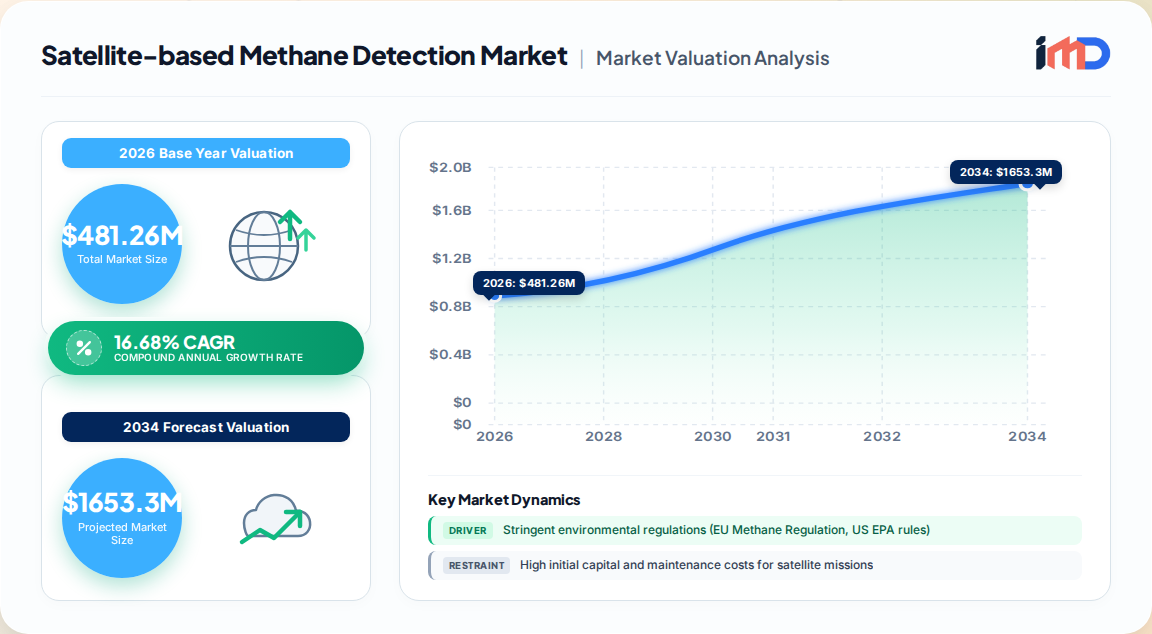
Satellite-based methane detection has transitioned from a niche scientific pursuit to a core operational layer of global emissions management. Our proprietary primary research estimates the market at USD 481.26 Million in 2026, expanding at a robust CAGR of 16.68% to reach USD 1.22 Billion by 2032. This acceleration is not merely a function of technology maturity; it is fundamentally driven by a structural shift from voluntary disclosure to mandatory, measurement-based verification regimes across major economies.
The value proposition is straightforward: orbital sensors provide independent, wide-area, and increasingly frequent observations that can identify super-emitters, attribute plumes to specific assets, and verify repair efficacy at a fraction of the cost of continuous ground-level monitoring across dispersed assets. The technology is now viewed less as a standalone procurement and more as the top tier of a multi-layered measurement, reporting, and verification (MRV) hierarchy that includes aircraft, drones, fixed sensors, and handheld devices.
The satellite-based methane detection value chain is characterized by distinct layers of specialization, each with different competitive dynamics and margin profiles.
This layer includes companies designing and manufacturing hyperspectral, LIDAR, synthetic aperture radar (SAR), and thermal infrared instruments. The trend is toward higher resolution, wider swath, and lower size, weight, and power (SWaP) to enable deployment on small satellite platforms. Key differentiators include sensor sensitivity, calibration stability, and spectral resolution.
This segment encompasses commercial satellite operators (e.g., GHGSat, Planet Labs, Orbital Sidekick) and government missions (e.g., Sentinel-5P, MethaneSAT). Operators manage constellations, downlink data, and perform initial radiometric and geometric corrections. The business model is shifting from raw data sales to subscription-based data-as-a-service (DaaS) offerings.
This is the fastest-growing and most value-accretive layer. Companies such as Kayrros, Bluefield Technologies, and Descartes Labs ingest satellite data and apply proprietary algorithms to detect, quantify, and attribute methane plumes. They integrate with operational data (production volumes, infrastructure maps) and deliver actionable alerts, dashboards, and verification reports. This layer is also where independent verification bodies and consultancies operate, providing third-party assurance for regulatory and voluntary reporting.
| Region | Market Share (2026) | Key Characteristics |
|---|---|---|
| North America | 38% | Mature oil and gas infrastructure, strong demand for compliance-grade data despite regulatory volatility, presence of major service providers. |
| Europe | 24% | Stringent climate policy, EU Methane Regulation driving harmonized MRV, cross-border reporting requirements. |
| Asia-Pacific | 22% | Fastest-growing region (CAGR 14.7%+), large industrial and agricultural sources, diverse regulatory environments, scalable monitoring needs. |
| Middle East & Africa | 9% | Concentrated hydrocarbon assets, remote operations, growing interest from GCC operators in linking satellite data to operational efficiency. |
| South America | 7% | Emerging demand linked to oil and gas, agriculture, and waste, supported by international climate finance and capacity-building initiatives. |
North America remains the largest market, driven by extensive energy assets and established monitoring programs. However, the Asia-Pacific region is poised for the highest growth, fueled by rapid industrialization, increasing environmental awareness, and supportive government initiatives. Europe's market is defined by regulatory compliance, with the EU Methane Regulation acting as a powerful demand catalyst.
The competitive landscape is characterized by a mix of vertically integrated satellite operators, pure-play analytics firms, and traditional environmental monitoring incumbents expanding into satellite services.
While satellite-based methane detection is a service-oriented market, the underlying hardware supply chain is global and subject to trade dynamics. Key components include:
The market is not heavily reliant on raw material imports, but the supply of advanced sensors and secure data transmission infrastructure is subject to geopolitical considerations. The US and EU have implemented export licensing requirements for certain remote sensing technologies, which can affect the availability of high-resolution data to non-allied nations.
Several underpenetrated opportunities exist for market participants:
The satellite-based methane detection market is on an irreversible growth trajectory, underpinned by regulatory mandates, technological maturity, and the urgent need to address short-lived climate pollutants. The next phase of market development will be defined by the integration of satellite data into operational workflows, the standardization of validation methodologies, and the expansion of demand beyond oil and gas into agriculture, waste, and carbon markets. Stakeholders who build robust evidence-to-action systems—combining satellite observations with ground-truth data and transparent analytics—will be best positioned to capitalize on this expanding market.
| Aspects | Details |
|---|---|
| Study Period | 2020-2034 |
| Base Year | 2026 |
| Estimated Year | 2026 |
| Forecast Period | 2026-2034 |
| Historical Period | 2020-2025 |
| Growth Rate | CAGR of 16.68% from 2020-2034 |
| Segmentation |
|
By Deployment Mode
By Service Type
By Application
By End-User
| By Geography |
|
Our proprietary research projects the market to reach USD 1.22 Billion by 2032, growing at a CAGR of 16.68% from an estimated USD 481.26 Million in 2026.
The EU Methane Regulation (2024/1787) mandates source-level measurement and independent verification for EU operators and, from January 2027, for importers of oil, gas, and coal. This creates a compliance-driven demand for satellite data across global supply chains, as exporters must demonstrate EU-equivalent MRV practices.
Asia-Pacific is the fastest-growing region, with a projected CAGR of over 14.7% through 2036, driven by rapid industrialization, increasing environmental awareness, and supportive government initiatives. North America currently holds the largest market share at approximately 38%.
The primary technologies include hyperspectral imaging, LIDAR, synthetic aperture radar (SAR), and thermal infrared sensors. These sensors are deployed on satellites in low Earth orbit (LEO), geostationary orbit (GEO), and medium Earth orbit (MEO), with LEO being the most common for high-resolution methane detection.
Key players include GHGSat, Planet Labs, Orbital Sidekick, Kayrros, Bluefield Technologies, Lockheed Martin, Satlantis, Maxar Technologies, SpaceKnow, and Descartes Labs. These companies offer a mix of satellite hardware, data analytics, and verification services.
Our rigorous research methodology combines multi-layered approaches with comprehensive quality assurance, ensuring precision, accuracy, and reliability in every market analysis.
| Stakeholder Role | Interview Share (%) |
|---|---|
| Chief Technology Officer | 25% |
| VP of Emissions Monitoring | 30% |
| Remote Sensing Scientist | 20% |
| Regulatory Affairs Director | 15% |
| Procurement Manager | 10% |
| Company Type | Representation (%) |
|---|---|
| Satellite Operators & Data Providers | 30% |
| Sensor & Payload Manufacturers | 20% |
| Analytics & Software Firms | 25% |
| Verification & Consulting Services | 15% |
| End-Users (Oil & Gas, Agriculture, Waste) | 10% |
 Related Reports
