1What is the myoelectric prosthetic hands market size in 2026?
The myoelectric prosthetic hands market is estimated at USD 2.1 billion in 2026, based on our proprietary primary research and expert interviews.
Insight Market Data is a premier market research and business consulting firm headquartered in Pune, India, providing syndicated research reports, customized intelligence studies, and strategic advisory services. Renowned academic institutions and Fortune 500 corporations worldwide rely on Insight Market Data's research repository to navigate evolving global and regional business environments. Covering 46 diverse industries across 25 major international economies, our comprehensive database delivers thousands of verified statistics and granular market evaluations. By combining industry-leading analytical methodologies with the direct insights of seasoned industry leaders and subject-matter experts, we deliver actionable intelligence spanning historical performance benchmarks to rigorous multi-year forecasts. We empower organizations to make confident, data-driven decisions across pivotal domains including Machinery & Equipment, Chemicals & Materials, Pharmaceuticals & Healthcare, Food & Beverages, Consumer Goods, Energy & Power, Automotive & Transportation, Electronics & Semiconductors, Medical Devices, Telecommunications, Emerging Technologies, Agriculture, and Packaging. Our multidisciplinary analyst teams provide an objective 360-degree perspective, tailoring every engagement to address complex strategic challenges with exceptional analytical rigor.
Leveraging advanced BI-powered analytics and predictive modeling, Insight Market Data uncovers high-impact market opportunities and competitive differentiators for ambitious enterprises. We continuously refine our research methodologies in accordance with global industry standards, tracking real-time market shifts to ensure our reports are consistently accurate, actionable, and delivered on schedule. Our analysts conduct methodical data validation, rigorous compliance checks, and exhaustive primary and secondary research to maintain the highest levels of data integrity and transparency. We partner closely with corporate strategists, investment groups, and business executives to translate intricate market intelligence into clear, actionable roadmaps for sustainable growth. With operational presence across Washington, USA, and Vimannagar, Pune, India, Insight Market Data ensures direct access to dedicated research specialists and responsive customer support to answer your most strategic questions.
 Myoelectric Prosthetic Hands Market
 by Product Type (Partial Hand Prosthesis, Multi-Articulating Hand Prosthesis), by Technology (Surface Electromyography (sEMG), Pattern Recognition, Real-time Control Systems), by Component (Sensors, Actuators, Control Algorithms), by End Use (Hospitals, Prosthetic Clinics, Rehabilitation Centers, Others), by North America (USA, Canada, Mexico), by Europe (Germany, UK, France, Rest of Europe), by Asia Pacific (China, Japan, India, Rest of APAC), by South America (Brazil, Rest of South America), by Middle East & Africa (GCC, South Africa, Rest of MEA) Forecast 2026-2034

Research Analyst


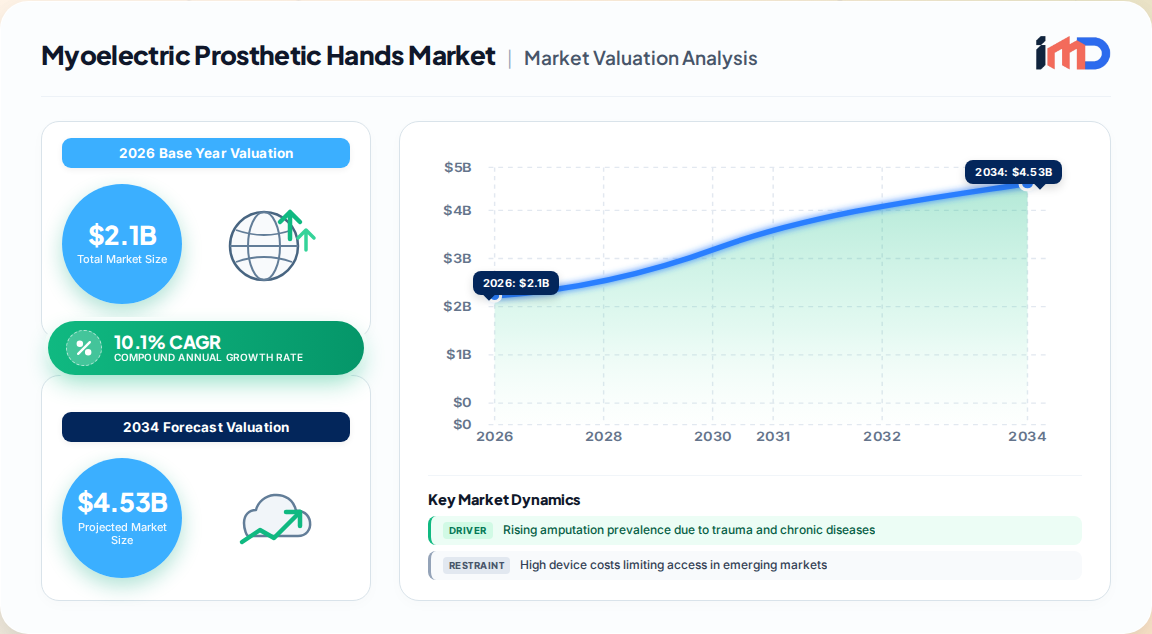
The global myoelectric prosthetic hands market represents one of the most technologically dynamic segments within the broader assistive technology and robotic prosthetics landscape. Our proprietary primary research, informed by extensive interviews with device manufacturers, clinicians, and procurement specialists, estimates the market at USD 2.1 billion in 2026, projected to reach USD 3.9 billion by 2033, expanding at a CAGR of 10.1%.
This growth trajectory outpaces the wider robotic prosthetics market (8.8% CAGR) and the general prosthetic arm segment, reflecting a structural shift toward externally powered, multi-articulating upper-limb solutions. The myoelectric hand segment alone accounts for an estimated 41.5% of the prosthetic arm device-type mix in 2026, underscoring its dominant role in advanced functional restoration.
Key demand signals include rising amputation incidence from trauma and chronic disease, expanding reimbursement coverage in developed economies, and rapid innovation in signal processing, AI-driven control, and lightweight materials. The market remains constrained by high device costs and limited access in lower-income regions, but falling sensor and actuator prices are progressively widening the addressable base.
Our segmentation analysis reveals that multi-articulating hand prostheses represent the fastest-growing product type, while partial hand prostheses maintain a steady share driven by affordability and simplicity. By technology, surface electromyography (sEMG) is the dominant control modality, but pattern recognition and real-time control systems are gaining traction, with pattern recognition expected to register the highest CAGR through 2033.
| Segment | Sub-segment | 2026 Share Estimate | Growth Outlook |
|---|---|---|---|
| By Product Type | Partial Hand Prosthesis | ~38% | Moderate |
| Multi-Articulating Hand Prosthesis | ~62% | High (fastest-growing) | |
| By Technology | Surface Electromyography (sEMG) | ~72% | Steady |
| Pattern Recognition | ~18% | Very High | |
| Real-time Control Systems | ~10% | High | |
| By Component | Sensors (EMG electrodes) | ~45% | High |
| Actuators | ~30% | High | |
| Control Algorithms | ~25% | Very High | |
| By End Use | Hospitals | ~48% | Steady |
| Prosthetic Clinics | ~30% | Moderate | |
| Rehabilitation Centers | ~15% | High | |
| Others (home care, research) | ~7% | Moderate |
Component-level dynamics highlight sensors as the largest revenue contributor, reflecting their criticality in signal acquisition. Actuators, particularly miniature brushless DC motors, are experiencing strong demand as multi-articulating designs proliferate. Control algorithms represent the highest-value intellectual property battleground, with AI-based adaptive control commanding premium pricing.
North America retains the largest regional share at approximately 39% in 2026, underpinned by high healthcare expenditure, favorable reimbursement, and the presence of leading manufacturers and research institutions. Europe follows with 28%, driven by robust public health systems and strong adoption in Germany, the UK, and France. Asia-Pacific is the fastest-growing region, expected to expand at a CAGR above 12% through 2033, fueled by rising healthcare investment, increasing awareness, and local manufacturing initiatives in China, India, and Japan.
Latin America and the Middle East & Africa collectively account for around 10% of global revenue, with growth constrained by affordability and infrastructure gaps, yet offering significant untapped potential as telehealth and low-cost device models gain traction.
| Region | 2026 Market Share | Key Growth Factors |
|---|---|---|
| North America | 39% | Reimbursement, veteran programs, innovation hubs |
| Europe | 28% | Public healthcare, aging population, strong clinical networks |
| Asia-Pacific | 23% | Healthcare investment, localization, rising amputation rates |
| South America | 5% | Expanding access, NGO partnerships |
| Middle East & Africa | 5% | Emerging demand, humanitarian programs |
The competitive landscape is moderately consolidated, with the top five players accounting for an estimated 55-60% of global revenue. Key players include Ottobock, Össur, Fillauer, Proteor, Motorica, Steeper Group, BrainRobotics, and Hanger Clinic. Ottobock leads with an estimated 25% share, leveraging its broad product portfolio and global distribution. Össur holds approximately 20%, known for its integrated bionic technologies. Fillauer, Proteor, and Motorica represent strong regional and niche competitors, while emerging players like BrainRobotics are gaining attention with AI-driven, affordable designs.
Recent strategic developments include:
These moves reflect a strategic focus on modularity, customization, and geographic expansion into high-growth markets. Companies that can balance advanced functionality with affordability and local manufacturing are poised to capture share in the next wave of adoption.
The myoelectric prosthetic hands value chain spans raw material suppliers (silicone, carbon fiber, rare-earth magnets), component manufacturers (EMG sensors, microcontrollers, actuators), device OEMs, and distribution channels (hospitals, clinics, and direct-to-patient fitting centers). Procurement is increasingly shifting toward strategic partnerships with component suppliers to secure supply and reduce costs, particularly for high-precision sensors and miniature actuators. Reimbursement authorities and procurement bodies in public health systems are placing greater emphasis on value-based pricing, driving OEMs to demonstrate functional outcomes and cost-effectiveness. Localization of manufacturing, exemplified by Motorica's India initiative, is a key strategy to overcome import barriers and reduce lead times, especially in Asia-Pacific and Latin America.
The myoelectric prosthetic hands market offers substantial white space in three areas: pediatric solutions, where customization and lightweight design are critical; affordable modular devices for emerging markets, enabled by 3D printing and simplified control systems; and AI-driven adaptive control that reduces the need for manual tuning and improves robustness. Companies investing in these areas, alongside those building strong clinical training and support networks, are likely to achieve sustainable differentiation. The market's 10.1% CAGR through 2033 signals robust long-term growth, with a total addressable market expanding to USD 3.9 billion. Strategic priorities should focus on cost reduction, interoperability with digital health platforms, and evidence generation to support reimbursement.
| Aspects | Details |
|---|---|
| Study Period | 2020-2034 |
| Base Year | 2026 |
| Estimated Year | 2026 |
| Forecast Period | 2026-2034 |
| Historical Period | 2020-2025 |
| Growth Rate | CAGR of 10.1% from 2020-2034 |
| Segmentation |
|
By Component
By End Use
| By Geography |
|
The myoelectric prosthetic hands market is estimated at USD 2.1 billion in 2026, based on our proprietary primary research and expert interviews.
The market is projected to grow at a compound annual growth rate of 10.1% from 2026 to 2033, reaching USD 3.9 billion by the end of the forecast period.
North America holds the largest regional share, accounting for approximately 39% of global revenue in 2026, driven by favorable reimbursement and high adoption of advanced prosthetics.
Key players include Ottobock, Össur, Fillauer, Proteor, Motorica, Steeper Group, BrainRobotics, and Hanger Clinic. Ottobock leads with an estimated 25% market share.
Myoelectric hands are primarily used in hospitals, prosthetic clinics, and rehabilitation centers, with multi-articulating hand prostheses being the fastest-growing product type.
Our rigorous research methodology combines multi-layered approaches with comprehensive quality assurance, ensuring precision, accuracy, and reliability in every market analysis.
| Stakeholder Role | Interview Share (%) |
|---|---|
| CEO/Managing Director | 25% |
| Procurement Director | 20% |
| Clinical Prosthetist | 30% |
| R&D/Product Manager | 15% |
| Regulatory Affairs Expert | 10% |
| Company Type | Representation (%) |
|---|---|
| Multi-articulating Hand OEMs | 35% |
| Partial Hand Prosthesis Manufacturers | 20% |
| EMG Sensor & Actuator Suppliers | 25% |
| Distribution & Fitting Clinics | 12% |
| Rehabilitation Centers | 8% |
 Related Reports
