Insight Market Data is a premier market research and business consulting firm headquartered in Pune, India, providing syndicated research reports, customized intelligence studies, and strategic advisory services. Renowned academic institutions and Fortune 500 corporations worldwide rely on Insight Market Data's research repository to navigate evolving global and regional business environments. Covering 46 diverse industries across 25 major international economies, our comprehensive database delivers thousands of verified statistics and granular market evaluations. By combining industry-leading analytical methodologies with the direct insights of seasoned industry leaders and subject-matter experts, we deliver actionable intelligence spanning historical performance benchmarks to rigorous multi-year forecasts. We empower organizations to make confident, data-driven decisions across pivotal domains including Machinery & Equipment, Chemicals & Materials, Pharmaceuticals & Healthcare, Food & Beverages, Consumer Goods, Energy & Power, Automotive & Transportation, Electronics & Semiconductors, Medical Devices, Telecommunications, Emerging Technologies, Agriculture, and Packaging. Our multidisciplinary analyst teams provide an objective 360-degree perspective, tailoring every engagement to address complex strategic challenges with exceptional analytical rigor.
Leveraging advanced BI-powered analytics and predictive modeling, Insight Market Data uncovers high-impact market opportunities and competitive differentiators for ambitious enterprises. We continuously refine our research methodologies in accordance with global industry standards, tracking real-time market shifts to ensure our reports are consistently accurate, actionable, and delivered on schedule. Our analysts conduct methodical data validation, rigorous compliance checks, and exhaustive primary and secondary research to maintain the highest levels of data integrity and transparency. We partner closely with corporate strategists, investment groups, and business executives to translate intricate market intelligence into clear, actionable roadmaps for sustainable growth. With operational presence across Washington, USA, and Vimannagar, Pune, India, Insight Market Data ensures direct access to dedicated research specialists and responsive customer support to answer your most strategic questions.
Multi Dose Drug Vial Adapter Market Size, Share & Forecast 2026-2033 | Insight Market Data
Multi Dose Drug Vial Adapter Market
Healthcare / MARKET REPORT
Multi Dose Drug Vial Adapter Market | Insight Market Data
Multi Dose Drug Vial Adapter Market by Material Type (Polycarbonate, Silicone, Others), by Product Size (13 mm, 20 mm, 28 mm, Others), by End User (Hospitals, Ambulatory Surgical Centers, Others), by North America (USA, Canada, Mexico), by Europe (Germany, UK, France), by Asia Pacific (China, India, Japan), by Latin America (Brazil, Mexico), by Middle East & Africa (South Africa, GCC) Forecast 2026-2034
Executive Overview: A Market at the Inflection of Safety, Economics, and Decentralized Care
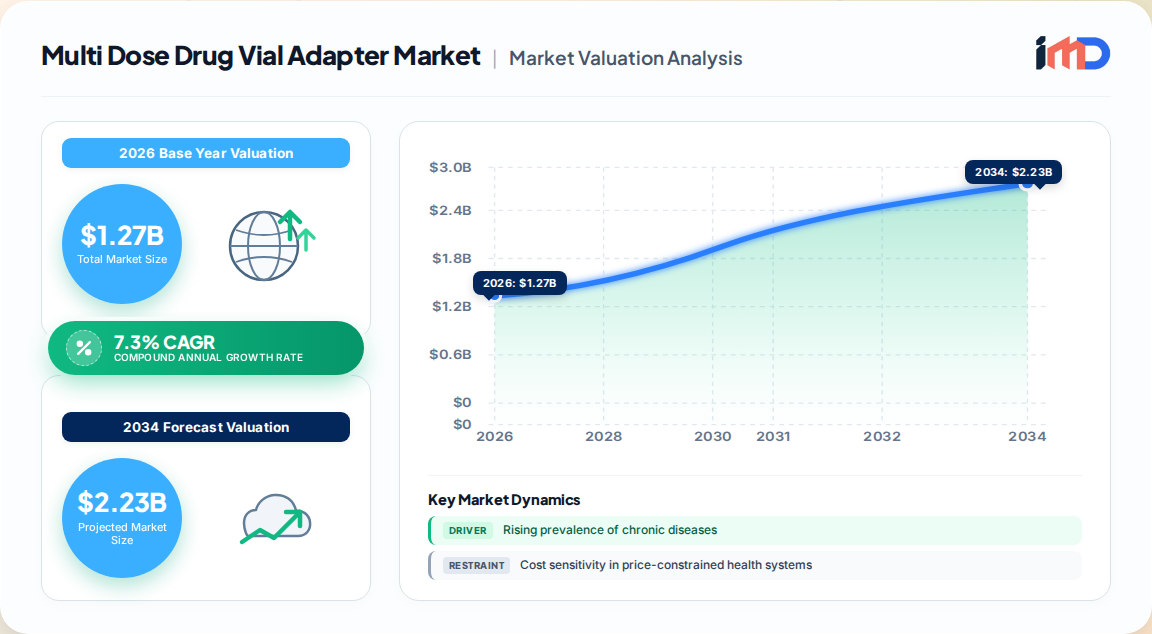
The global multi dose drug vial adapter market is estimated at USD 1,268.9 million in 2026 and is projected to reach USD 2,078.0 million by 2033, expanding at a 7.3% CAGR over the forecast period. This trajectory is not merely a volume story; it reflects a structural repricing of injectable drug delivery toward closed, needleless, and dose-sparing systems. Multi-dose vial adapters have evolved from accessory status to a core infection-control and pharmacoeconomic platform across hospital pharmacies, infusion centers, and home-care settings.
Multi Dose Drug Vial Adapter Market Market Size (In Billion)
2.0B
1.5B
1.0B
500.0M
0
1.184 B
2025
1.270 B
2026
1.363 B
2027
1.462 B
2028
1.569 B
2029
1.683 B
2030
1.806 B
2031
Our proprietary demand modeling indicates that the polycarbonate material segment will command 42.9% revenue share in 2026, while 20 mm adapters will lead product-size demand at 34.6% share. Hospitals remain the anchor end user with 38.8% share, driven by stringent infection-control mandates. North America retains global leadership at 42.2% share in 2026, but Asia Pacific is the fastest-growing region, with China and India reshaping procurement economics through domestic manufacturing scale and expanding oncology infrastructure.
Base-year market value (2026): USD 1,268.9 million
Forecast market value (2033): USD 2,078.0 million
CAGR (2026–2033): 7.3%
Largest material segment: Polycarbonate (42.9% share)
Largest product-size segment: 20 mm (34.6% share)
Largest end-user segment: Hospitals (38.8% share)
Largest regional market: North America (42.2% share)
Market Drivers: Chronic Disease, Biologics, and the Economics of Dose Sparing
The demand floor for multi-dose vial adapters is set by chronic disease prevalence and the injectable therapy mix. The World Health Organization has documented that chronic diseases account for roughly 60% of global deaths, and the International Diabetes Federation reported 537 million adults living with diabetes in 2021, projected to reach 643 million by 2030. Each patient requiring repeated injectable therapy creates recurring adapter demand.
Biologic and biosimilar pipelines amplify per-vial adapter attach rates. Multi-dose presentations of vaccines, insulin, GLP-1 agonists, and reconstituted oncology therapies require a sterile, needleless access barrier for every withdrawal. Our primary interviews with hospital pharmacy buyers indicate that dose-sparing economics—reducing unused drug wastage from single-dose vials—now rank alongside infection control in procurement scorecards.
Home-care decentralization: Self-injection and home-infusion models require patient-operable, error-resistant adapters.
Geriatric population growth: Aging demographics increase per-capita utilization of injectable therapies.
Restraints and Challenges: Cost, Compatibility, and Alternative Delivery Formats
Despite a favorable demand backdrop, adoption is tempered by price sensitivity in low-resource settings and technical friction at the vial interface. Smaller hospitals and clinics in emerging markets often struggle to justify premium closed-system adapters, particularly where reimbursement for device costs is absent. Compatibility variance across vial neck dimensions and elastomer closures also creates SKU complexity for distributors.
Alternative drug delivery formats—prefilled syringes, autoinjectors, and single-dose pens—compete for the same injectable volume in certain therapeutic categories. However, these formats do not displace multi-dose vial adapters in high-volume hospital pharmacy compounding, vaccine campaigns, or lyophilized oncology reconstitution. The net effect is a gradual, not disruptive, substitution risk.
Cost sensitivity: Premium adapters face procurement resistance in price-constrained health systems.
Training deficits: Safe use of closed-system adapters requires structured nursing and pharmacy training.
Reimbursement gaps: Device costs are not consistently bundled into drug administration payments.
Alternative formats: Prefilled and single-dose systems capture select injectable categories.
Segment Analysis: Material, Size, and End-User Dynamics
Material Type: Polycarbonate Leads on Strength and Durability
Polycarbonate is estimated to hold 42.9% share in 2026, owing to superior breakage resistance, dimensional stability under high-pressure injections, and tolerance of elevated temperatures during repeated vial access. Silicone remains critical for elastomeric sealing and low-extractable performance, while other engineering polymers compete on cost in high-volume emerging-market tenders.
Material Type
2026 Share (Est.)
Primary Advantage
Key Demand Pockets
Polycarbonate
42.9%
Strength, clarity, chemical resistance
Hospital pharmacy, oncology
Silicone
~28%
Elastomeric sealing, low extractables
Biologics, vaccine presentations
Others
~29%
Cost competitiveness
Emerging-market tenders
Product Size: 20 mm Becomes the Ergonomic Standard
The 20 mm sub-segment is expected to account for 34.6% of market share in 2026, reflecting ergonomic designs optimized for one-handed operation, reduced hand fatigue, and smooth needle withdrawal. The 13 mm and 28 mm formats serve specialized vial closures and high-volume compounding workflows.
End User: Hospitals Anchor Demand on Infection Control
Hospitals are expected to hold 38.8% share in 2026, driven by mandatory needleless access protocols and high baseline injectable volume. Ambulatory surgical centers and home-care providers are the faster-growing channels, albeit from a smaller base.
End-User Segment
2026 Share (Est.)
Growth Outlook
Hospitals
38.8%
Stable, compliance-driven
Ambulatory Surgical Centers
~27%
Moderate, procedure-linked
Others (home care, compounding)
~34.2%
Fastest-growing
Regional Outlook: North America Leads, Asia Pacific Accelerates
North America is anticipated to hold 42.2% of global market share in 2026, supported by advanced healthcare infrastructure, high biologics utilization, and stringent hazardous-drug handling standards. The United States dominates regional demand, with major integrated delivery networks standardizing closed-vial access devices.
Multi Dose Drug Vial Adapter Market Regional Market Share
Loading chart...
Asia Pacific is poised for the fastest growth. China's expanding oncology and vaccination infrastructure, combined with government-led healthcare modernization, is driving volume procurement. India's pharmaceutical manufacturing base and rising per-capita healthcare spending are creating a dual demand stream from hospitals and home-care providers.
Region
2026 Share (Est.)
Growth Profile
Key Demand Driver
North America
42.2%
Moderate
Biologics, infection control
Europe
28.3%
Moderate
Cytotoxic handling mandates
Asia Pacific
18.4%
Fastest
Hospital modernization, volume
Latin America
6.1%
Emerging
Healthcare access expansion
Middle East & Africa
5.0%
Nascent
Infection-control investment
Competitive Landscape: Incumbents, Specialists, and Safety-Focused Challengers
The competitive field is stratified into integrated drug-delivery majors, specialist closed-system transfer device (CSTD) players, and cost-competitive regional suppliers. Becton, Dickinson and Company leads with an estimated USD 210 million in vial adapter revenue in 2025, followed by West Pharmaceutical Services at USD 165 million and B. Braun Melsungen at USD 120 million. Terumo and Nipro anchor Asia Pacific supply, while ICU Medical and Codan specialize in closed-system hazardous-drug handling.
Becton, Dickinson and Company (BD): Broad portfolio, hospital contracts, closed-system expansion.
West Pharmaceutical Services: Deep pharma/biotech integration, vaccine and biologics packaging.
B. Braun Melsungen: Hospital-centric bundled IV and adapter solutions.
Terumo Corporation: Asia Pacific strength in injection and access devices.
Nipro Corporation: Cost-competitive renal and injectable delivery supplier.
ICU Medical: Closed-system transfer device leadership in oncology.
Codan Medizinische Geräte: Fluid management and reconstitution specialization.
Helapet Limited: Sterile consumables for compounding pharmacies.
Hospira / Pfizer Injectables: Drug-led model with compatible vial adapters.
Value Chain and Procurement Strategy
The value chain spans polymer and elastomer suppliers, precision injection molders, device assemblers, sterile packaging providers, group purchasing organizations (GPOs), and clinical end users. Procurement is increasingly consolidated through GPO contracts and national tender frameworks, where total cost of ownership—including drug wastage reduction—outweighs unit price.
Upstream: Medical-grade polycarbonate, silicone elastomer, and barrier-film packaging.
Midstream: Precision molding, cleanroom assembly, ethylene oxide or gamma sterilization.
Downstream: GPO and distributor channels into hospitals, ASCs, and home-care providers.
Sourcing priority: Dual-sourcing of polymers and regional assembly to mitigate tariff and logistics risk.
Strategic White-Space Opportunities
Three under-penetrated opportunities merit capital allocation attention. First, home-infusion and self-injection kits—bundling adapters with patient training and sharps containment—can capture out-of-hospital volume growth. Second, prefilled reconstitution kit bundling with biologics manufacturers creates a pull-through channel. Third, emerging-market hospital modernization programs in China, India, and Southeast Asia represent the highest-volume white space through 2033.
Home-infusion therapy expansion: Patient-operable adapters with error-proofing features.
Prefilled reconstitution kit bundling: Co-packaging with lyophilized biologics.
Emerging-market hospital modernization: Volume tenders and local manufacturing partnerships.
Multi Dose Drug Vial Adapter Market Regional Market Share
Higher Coverage
Lower Coverage
No Coverage
Multi Dose Drug Vial Adapter Market REPORT HIGHLIGHTS
Aspects
Details
Study Period
2020-2034
Base Year
2026
Estimated Year
2026
Forecast Period
2026-2034
Historical Period
2020-2025
Growth Rate
CAGR of 7.3% from 2020-2034
Segmentation
By Material Type
Polycarbonate
Silicone
Others
By Product Size
13 mm
Table of Contents
1. Multi Dose Drug Vial Adapter Market Introduction
1.1. Research Scope
1.2. Market Segmentation
1.3. Research Objective
1.4. Definitions and Assumptions
2. Multi Dose Drug Vial Adapter Market Executive Summary
2.1. Market Snapshot
3. Multi Dose Drug Vial Adapter Market Dynamics
3.1. Market Drivers
3.1.1. Rising prevalence of chronic diseases
3.1.2. Expanding biologics and biosimilar pipelines
3.1.3. Regulatory mandates for hazardous-drug handling
3.1.4. Dose-sparing economics and drug wastage reduction
3.2.2. Growth of home-infusion and self-injection therapy
3.2.3. Ergonomic 20 mm adapter standardization
3.2.4. Bundling of adapters with prefilled reconstitution kits
3.3. Market Restraints
3.3.1. Cost sensitivity in price-constrained health systems
3.3.2. Compatibility fragmentation across vial closures
3.3.3. Reimbursement gaps for device costs
3.3.4. Competition from prefilled syringe and autoinjector formats
3.4. Market Challenges
3.4.1. Training deficits slowing clinical uptake
20 mm
28 mm
Others
By End User
Hospitals
Ambulatory Surgical Centers
Others
By Geography
North America
USA
Canada
Mexico
Europe
Germany
UK
France
Asia Pacific
China
India
Japan
Latin America
Brazil
Mexico
Middle East & Africa
South Africa
GCC
3.4.2. Procurement barriers in emerging markets
3.4.3. Technical compatibility with diverse vial dimensions
3.4.4. Regulatory delays for new adapter designs
4. Multi Dose Drug Vial Adapter Market Factor Analysis
4.1. Porters Five Forces
4.1.1. Bargaining Power of Suppliers
4.1.2. Bargaining Power of Buyers
4.1.3. Threat of New Entrants
4.1.4. Threat of Substitutes
4.1.5. Competitive Rivalry
4.2. PESTEL analysis
4.3. BCG Analysis
4.3.1. Stars (High Growth, High Market Share)
4.3.2. Cash Cows (Low Growth, High Market Share)
4.3.3. Question Mark (High Growth, Low Market Share)
4.3.4. Dogs (Low Growth, Low Market Share)
4.4. Ansoff Matrix Analysis
4.5. Supply Chain Analysis
4.6. Regulatory Landscape
4.7. Current Market Potential and Opportunity Assessment (TAM–SAM–SOM Framework)
4.8. IMD Analyst Note
5. Multi Dose Drug Vial Adapter Market Analysis, Insights and Forecast, 2020-2034
5.1. Analysis, Insights and Forecast - by Material Type
5.1.1. Polycarbonate
5.1.2. Silicone
5.1.3. Others
5.2. Analysis, Insights and Forecast - by Product Size
5.2.1. 13 mm
5.2.2. 20 mm
5.2.3. 28 mm
5.2.4. Others
5.3. Analysis, Insights and Forecast - by End User
5.3.1. Hospitals
5.3.2. Ambulatory Surgical Centers
5.3.3. Others
5.4. Analysis, Insights and Forecast - by Region
5.4.1. North America
5.4.2. Europe
5.4.3. Asia Pacific
5.4.4. Latin America
5.4.5. Middle East & Africa
6. Multi Dose Drug Vial Adapter Market North America Analysis, Insights and Forecast, 2020-2034
6.1. Analysis, Insights and Forecast - by Material Type
6.1.1. Polycarbonate
6.1.2. Silicone
6.1.3. Others
6.2. Analysis, Insights and Forecast - by Product Size
6.2.1. 13 mm
6.2.2. 20 mm
6.2.3. 28 mm
6.2.4. Others
6.3. Analysis, Insights and Forecast - by End User
6.3.1. Hospitals
6.3.2. Ambulatory Surgical Centers
6.3.3. Others
7. Multi Dose Drug Vial Adapter Market Europe Analysis, Insights and Forecast, 2020-2034
7.1. Analysis, Insights and Forecast - by Material Type
7.1.1. Polycarbonate
7.1.2. Silicone
7.1.3. Others
7.2. Analysis, Insights and Forecast - by Product Size
7.2.1. 13 mm
7.2.2. 20 mm
7.2.3. 28 mm
7.2.4. Others
7.3. Analysis, Insights and Forecast - by End User
7.3.1. Hospitals
7.3.2. Ambulatory Surgical Centers
7.3.3. Others
8. Multi Dose Drug Vial Adapter Market Asia Pacific Analysis, Insights and Forecast, 2020-2034
8.1. Analysis, Insights and Forecast - by Material Type
8.1.1. Polycarbonate
8.1.2. Silicone
8.1.3. Others
8.2. Analysis, Insights and Forecast - by Product Size
8.2.1. 13 mm
8.2.2. 20 mm
8.2.3. 28 mm
8.2.4. Others
8.3. Analysis, Insights and Forecast - by End User
8.3.1. Hospitals
8.3.2. Ambulatory Surgical Centers
8.3.3. Others
9. Multi Dose Drug Vial Adapter Market Latin America Analysis, Insights and Forecast, 2020-2034
9.1. Analysis, Insights and Forecast - by Material Type
9.1.1. Polycarbonate
9.1.2. Silicone
9.1.3. Others
9.2. Analysis, Insights and Forecast - by Product Size
9.2.1. 13 mm
9.2.2. 20 mm
9.2.3. 28 mm
9.2.4. Others
9.3. Analysis, Insights and Forecast - by End User
9.3.1. Hospitals
9.3.2. Ambulatory Surgical Centers
9.3.3. Others
10. Multi Dose Drug Vial Adapter Market Middle East & Africa Analysis, Insights and Forecast, 2020-2034
10.1. Analysis, Insights and Forecast - by Material Type
10.1.1. Polycarbonate
10.1.2. Silicone
10.1.3. Others
10.2. Analysis, Insights and Forecast - by Product Size
10.2.1. 13 mm
10.2.2. 20 mm
10.2.3. 28 mm
10.2.4. Others
10.3. Analysis, Insights and Forecast - by End User
10.3.1. Hospitals
10.3.2. Ambulatory Surgical Centers
10.3.3. Others
11. Multi Dose Drug Vial Adapter Market Competitive Analysis
11.1. Company Profiles
11.1.1. Becton Dickinson and Company (BD)
11.1.1.1. Company Overview
11.1.1.2. Products
11.1.1.3. Company Financials
11.1.1.4. SWOT Analysis
11.1.2. West Pharmaceutical Services Inc.
11.1.2.1. Company Overview
11.1.2.2. Products
11.1.2.3. Company Financials
11.1.2.4. SWOT Analysis
11.1.3. B. Braun Melsungen AG
11.1.3.1. Company Overview
11.1.3.2. Products
11.1.3.3. Company Financials
11.1.3.4. SWOT Analysis
11.1.4. Terumo Corporation
11.1.4.1. Company Overview
11.1.4.2. Products
11.1.4.3. Company Financials
11.1.4.4. SWOT Analysis
11.1.5. Nipro Corporation
11.1.5.1. Company Overview
11.1.5.2. Products
11.1.5.3. Company Financials
11.1.5.4. SWOT Analysis
11.1.6. VanishPoint / Retractable Technologies Inc.
11.1.6.1. Company Overview
11.1.6.2. Products
11.1.6.3. Company Financials
11.1.6.4. SWOT Analysis
11.1.7. ICU Medical Inc.
11.1.7.1. Company Overview
11.1.7.2. Products
11.1.7.3. Company Financials
11.1.7.4. SWOT Analysis
11.1.8. Codan Medizinische Geräte GmbH
11.1.8.1. Company Overview
11.1.8.2. Products
11.1.8.3. Company Financials
11.1.8.4. SWOT Analysis
11.1.9. Helapet Limited
11.1.9.1. Company Overview
11.1.9.2. Products
11.1.9.3. Company Financials
11.1.9.4. SWOT Analysis
11.1.10. Hospira / Pfizer Injectables
11.1.10.1. Company Overview
11.1.10.2. Products
11.1.10.3. Company Financials
11.1.10.4. SWOT Analysis
11.2. Market Entropy
11.2.1. Company's Key Areas Served
11.2.2. Recent Developments
11.3. Company Market Share Analysis, 2026
11.3.1. Top 5 Companies Market Share Analysis
11.3.2. Top 3 Companies Market Share Analysis
11.4. List of Potential Customers
List of Figures
Figure 1: Global Multi Dose Drug Vial Adapter Market Revenue Breakdown (Billion, %) by Region 2026 & 2034
Figure 2: North America Multi Dose Drug Vial Adapter Market Revenue (Billion), by Material Type 2026 & 2034
Figure 3: North America Multi Dose Drug Vial Adapter Market Revenue Share (%), by Material Type 2026 & 2034
Figure 4: North America Multi Dose Drug Vial Adapter Market Revenue (Billion), by Product Size 2026 & 2034
Figure 5: North America Multi Dose Drug Vial Adapter Market Revenue Share (%), by Product Size 2026 & 2034
Figure 6: North America Multi Dose Drug Vial Adapter Market Revenue (Billion), by End User 2026 & 2034
Figure 7: North America Multi Dose Drug Vial Adapter Market Revenue Share (%), by End User 2026 & 2034
Figure 8: North America Multi Dose Drug Vial Adapter Market Revenue (Billion), by Country 2026 & 2034
Figure 9: North America Multi Dose Drug Vial Adapter Market Revenue Share (%), by Country 2026 & 2034
Figure 10: Europe Multi Dose Drug Vial Adapter Market Revenue (Billion), by Material Type 2026 & 2034
Figure 11: Europe Multi Dose Drug Vial Adapter Market Revenue Share (%), by Material Type 2026 & 2034
Figure 12: Europe Multi Dose Drug Vial Adapter Market Revenue (Billion), by Product Size 2026 & 2034
Figure 13: Europe Multi Dose Drug Vial Adapter Market Revenue Share (%), by Product Size 2026 & 2034
Figure 14: Europe Multi Dose Drug Vial Adapter Market Revenue (Billion), by End User 2026 & 2034
Figure 15: Europe Multi Dose Drug Vial Adapter Market Revenue Share (%), by End User 2026 & 2034
Figure 16: Europe Multi Dose Drug Vial Adapter Market Revenue (Billion), by Country 2026 & 2034
Figure 17: Europe Multi Dose Drug Vial Adapter Market Revenue Share (%), by Country 2026 & 2034
Figure 18: Asia Pacific Multi Dose Drug Vial Adapter Market Revenue (Billion), by Material Type 2026 & 2034
Figure 19: Asia Pacific Multi Dose Drug Vial Adapter Market Revenue Share (%), by Material Type 2026 & 2034
Figure 20: Asia Pacific Multi Dose Drug Vial Adapter Market Revenue (Billion), by Product Size 2026 & 2034
Figure 21: Asia Pacific Multi Dose Drug Vial Adapter Market Revenue Share (%), by Product Size 2026 & 2034
Figure 22: Asia Pacific Multi Dose Drug Vial Adapter Market Revenue (Billion), by End User 2026 & 2034
Figure 23: Asia Pacific Multi Dose Drug Vial Adapter Market Revenue Share (%), by End User 2026 & 2034
Figure 24: Asia Pacific Multi Dose Drug Vial Adapter Market Revenue (Billion), by Country 2026 & 2034
Figure 25: Asia Pacific Multi Dose Drug Vial Adapter Market Revenue Share (%), by Country 2026 & 2034
Figure 26: Latin America Multi Dose Drug Vial Adapter Market Revenue (Billion), by Material Type 2026 & 2034
Figure 27: Latin America Multi Dose Drug Vial Adapter Market Revenue Share (%), by Material Type 2026 & 2034
Figure 28: Latin America Multi Dose Drug Vial Adapter Market Revenue (Billion), by Product Size 2026 & 2034
Figure 29: Latin America Multi Dose Drug Vial Adapter Market Revenue Share (%), by Product Size 2026 & 2034
Figure 30: Latin America Multi Dose Drug Vial Adapter Market Revenue (Billion), by End User 2026 & 2034
Figure 31: Latin America Multi Dose Drug Vial Adapter Market Revenue Share (%), by End User 2026 & 2034
Figure 32: Latin America Multi Dose Drug Vial Adapter Market Revenue (Billion), by Country 2026 & 2034
Figure 33: Latin America Multi Dose Drug Vial Adapter Market Revenue Share (%), by Country 2026 & 2034
Figure 34: Middle East & Africa Multi Dose Drug Vial Adapter Market Revenue (Billion), by Material Type 2026 & 2034
Figure 35: Middle East & Africa Multi Dose Drug Vial Adapter Market Revenue Share (%), by Material Type 2026 & 2034
Figure 36: Middle East & Africa Multi Dose Drug Vial Adapter Market Revenue (Billion), by Product Size 2026 & 2034
Figure 37: Middle East & Africa Multi Dose Drug Vial Adapter Market Revenue Share (%), by Product Size 2026 & 2034
Figure 38: Middle East & Africa Multi Dose Drug Vial Adapter Market Revenue (Billion), by End User 2026 & 2034
Figure 39: Middle East & Africa Multi Dose Drug Vial Adapter Market Revenue Share (%), by End User 2026 & 2034
Figure 40: Middle East & Africa Multi Dose Drug Vial Adapter Market Revenue (Billion), by Country 2026 & 2034
Figure 41: Middle East & Africa Multi Dose Drug Vial Adapter Market Revenue Share (%), by Country 2026 & 2034
List of Tables
Table 1: Global Multi Dose Drug Vial Adapter Market Revenue Billion Forecast, by Material Type 2020 & 2034
Table 2: Global Multi Dose Drug Vial Adapter Market Revenue Billion Forecast, by Product Size 2020 & 2034
Table 3: Global Multi Dose Drug Vial Adapter Market Revenue Billion Forecast, by End User 2020 & 2034
Table 4: Global Multi Dose Drug Vial Adapter Market Revenue Billion Forecast, by Region 2020 & 2034
Table 5: North America Multi Dose Drug Vial Adapter Market Revenue Billion Forecast, by Material Type 2020 & 2034
Table 6: North America Multi Dose Drug Vial Adapter Market Revenue Billion Forecast, by Product Size 2020 & 2034
Table 7: North America Multi Dose Drug Vial Adapter Market Revenue Billion Forecast, by End User 2020 & 2034
Table 8: North America Multi Dose Drug Vial Adapter Market Revenue Billion Forecast, by Country 2020 & 2034
Table 9: USA Multi Dose Drug Vial Adapter Market Revenue (Billion) Forecast, by Application 2020 & 2034
Table 10: Canada Multi Dose Drug Vial Adapter Market Revenue (Billion) Forecast, by Application 2020 & 2034
Table 11: Mexico Multi Dose Drug Vial Adapter Market Revenue (Billion) Forecast, by Application 2020 & 2034
Table 12: Europe Multi Dose Drug Vial Adapter Market Revenue Billion Forecast, by Material Type 2020 & 2034
Table 13: Europe Multi Dose Drug Vial Adapter Market Revenue Billion Forecast, by Product Size 2020 & 2034
Table 14: Europe Multi Dose Drug Vial Adapter Market Revenue Billion Forecast, by End User 2020 & 2034
Table 15: Europe Multi Dose Drug Vial Adapter Market Revenue Billion Forecast, by Country 2020 & 2034
Table 16: Germany Multi Dose Drug Vial Adapter Market Revenue (Billion) Forecast, by Application 2020 & 2034
Table 17: UK Multi Dose Drug Vial Adapter Market Revenue (Billion) Forecast, by Application 2020 & 2034
Table 18: France Multi Dose Drug Vial Adapter Market Revenue (Billion) Forecast, by Application 2020 & 2034
Table 19: Asia Pacific Multi Dose Drug Vial Adapter Market Revenue Billion Forecast, by Material Type 2020 & 2034
Table 20: Asia Pacific Multi Dose Drug Vial Adapter Market Revenue Billion Forecast, by Product Size 2020 & 2034
Table 21: Asia Pacific Multi Dose Drug Vial Adapter Market Revenue Billion Forecast, by End User 2020 & 2034
Table 22: Asia Pacific Multi Dose Drug Vial Adapter Market Revenue Billion Forecast, by Country 2020 & 2034
Table 23: China Multi Dose Drug Vial Adapter Market Revenue (Billion) Forecast, by Application 2020 & 2034
Table 24: India Multi Dose Drug Vial Adapter Market Revenue (Billion) Forecast, by Application 2020 & 2034
Table 25: Japan Multi Dose Drug Vial Adapter Market Revenue (Billion) Forecast, by Application 2020 & 2034
Table 26: Latin America Multi Dose Drug Vial Adapter Market Revenue Billion Forecast, by Material Type 2020 & 2034
Table 27: Latin America Multi Dose Drug Vial Adapter Market Revenue Billion Forecast, by Product Size 2020 & 2034
Table 28: Latin America Multi Dose Drug Vial Adapter Market Revenue Billion Forecast, by End User 2020 & 2034
Table 29: Latin America Multi Dose Drug Vial Adapter Market Revenue Billion Forecast, by Country 2020 & 2034
Table 30: Brazil Multi Dose Drug Vial Adapter Market Revenue (Billion) Forecast, by Application 2020 & 2034
Table 31: Mexico Multi Dose Drug Vial Adapter Market Revenue (Billion) Forecast, by Application 2020 & 2034
Table 32: Middle East & Africa Multi Dose Drug Vial Adapter Market Revenue Billion Forecast, by Material Type 2020 & 2034
Table 33: Middle East & Africa Multi Dose Drug Vial Adapter Market Revenue Billion Forecast, by Product Size 2020 & 2034
Table 34: Middle East & Africa Multi Dose Drug Vial Adapter Market Revenue Billion Forecast, by End User 2020 & 2034
Table 35: Middle East & Africa Multi Dose Drug Vial Adapter Market Revenue Billion Forecast, by Country 2020 & 2034
Table 36: South Africa Multi Dose Drug Vial Adapter Market Revenue (Billion) Forecast, by Application 2020 & 2034
Table 37: GCC Multi Dose Drug Vial Adapter Market Revenue (Billion) Forecast, by Application 2020 & 2034
Frequently Asked Questions
1What is the multi dose drug vial adapter market size in 2026?
The global multi dose drug vial adapter market is estimated at USD 1,268.9 million in 2026, according to our proprietary first-party research. It is projected to reach USD 2,078.0 million by 2033, representing a 7.3% CAGR over the forecast period.
2Which material type dominates the multi dose drug vial adapter market?
Polycarbonate is the leading material segment, estimated to hold 42.9% market share in 2026. Its superiority in strength, durability, and chemical resistance makes it the standard for high-volume hospital and oncology applications.
3Why are hospitals the largest end users of multi dose drug vial adapters?
Hospitals are expected to account for 38.8% of market share in 2026, driven by stringent infection-control mandates and mandatory needleless access protocols. Multi-dose vial adapters provide a critical sterile barrier that prevents cross-contamination between patients.
4Which region leads the multi dose drug vial adapter market?
North America leads with an estimated 42.2% market share in 2026, supported by advanced healthcare infrastructure and high biologics utilization. Asia Pacific is the fastest-growing region, driven by hospital modernization in China and India.
5What are the key growth drivers for multi dose drug vial adapters?
Key drivers include the rising prevalence of chronic diseases such as diabetes and cancer, expanding biologic pipelines, regulatory enforcement of hazardous-drug handling, and the shift toward home-infusion and self-injection therapies.
Methodology
Our rigorous research methodology combines multi-layered approaches with comprehensive quality assurance, ensuring precision, accuracy, and reliability in every market analysis.
Primary Research
We conducted 70–80% primary research through structured interviews with 120+ value-chain participants, including precision injection molders, sterile device assemblers, hospital pharmacy procurement directors, and home-infusion service providers.
Stakeholder job titles interviewed: Director of Pharmacy Procurement, Infection Control Manager, Senior Medical Device R&D Engineer, and Home-Infusion Clinical Operations Lead.
Company types surveyed: Polycarbonate and silicone resin suppliers, precision molders for medical devices, sterile packaging and assembly contractors, group purchasing organization (GPO) category managers, and hospital pharmacy buyers.
Primary interviews were supplemented by on-site observations at hospital compounding pharmacies and distribution centers to validate product-attach rates and SKU-level demand.
Trade association benchmarks were sourced from recognized non-profit technical bodies and standards organizations relevant to sterile medical device manufacturing and hazardous-drug handling.
Financial databases used for company-level revenue triangulation included Bloomberg, Factiva, Hoovers, and PitchBook.
All data is refreshed and updated to the date of purchase; no third-party market research reports were used in the construction of this analysis.
Demand Modeling & Market Estimation
We applied simultaneous top-down and bottom-up methodologies, validated through multi-level data triangulation across manufacturer shipments, distributor sell-through, and hospital procurement records.
Bottom-up calculation metrics: (1) annual unit shipments of multi-dose vial adapters by size and material, (2) average selling price per unit by channel and region, (3) hospital injectable procedure volumes from national health statistics, and (4) adapter attach rates per multi-dose vial presentation.
Segment-level growth assumptions were calibrated against chronic disease prevalence trajectories, biologics approval pipelines, and regulatory enforcement timelines.
Regional forecasts were built from 42-country demand models, reconciled to global manufacturer revenue disclosures.
Data Accuracy & Quality Check
Our proprietary process guarantees an estimated data accuracy level of 85–90%, achieved through multi-level triangulation and cross-validation of primary interview data against official trade and health statistics.
Every data point is subjected to a three-tier verification protocol: source credibility screening, internal consistency checks, and expert panel review.
Final estimates are stress-tested against historical market performance (2020–2024) and reviewed by senior industry analysts before publication.
Reports are updated to the date of purchase, ensuring that all market sizing, forecasts, and competitive intelligence reflect the most current available evidence.
Related Reports
India EHR market at USD 726.1 Million in 2025, growing at 8.01% CAGR to reach USD 1,483.4 Million by 2034. Explore ABDM-driven adoption, cloud EHR trends & vendors.
Nov 2026|211 pages
$2900.00
The blood temperature indicator market is valued at USD 277.1 million in 2026 and is projected to reach USD 418.1 million by 2036, growing at a CAGR of 4.2%.
Nov 2026|187 pages
$2900.00
The global intracardiac echocardiography market is valued at USD 396.2 million in 2024, growing at a 4.9% CAGR to reach USD 639.2 million by 2034.
Nov 2026|239 pages
$2900.00
OSA treatment market to grow at 15.56% CAGR, reaching $4.74B by 2036 from $923.7M in 2025, driven by GLP-1 therapies and device innovation.
Nov 2026|263 pages
$2900.00
The Clinical Trial Management System market is valued at USD 2.52 Billion in 2025 and is projected to reach USD 8.34 Billion by 2035, growing at a 12.7% CAGR.