1What is the current size of the mining insurance market?
The global mining insurance market is valued at USD 15.2 billion in 2024 and is projected to reach USD 26.8 billion by 2033, growing at a 6.5% CAGR.
Insight Market Data is a premier market research and business consulting firm headquartered in Pune, India, providing syndicated research reports, customized intelligence studies, and strategic advisory services. Renowned academic institutions and Fortune 500 corporations worldwide rely on Insight Market Data's research repository to navigate evolving global and regional business environments. Covering 46 diverse industries across 25 major international economies, our comprehensive database delivers thousands of verified statistics and granular market evaluations. By combining industry-leading analytical methodologies with the direct insights of seasoned industry leaders and subject-matter experts, we deliver actionable intelligence spanning historical performance benchmarks to rigorous multi-year forecasts. We empower organizations to make confident, data-driven decisions across pivotal domains including Machinery & Equipment, Chemicals & Materials, Pharmaceuticals & Healthcare, Food & Beverages, Consumer Goods, Energy & Power, Automotive & Transportation, Electronics & Semiconductors, Medical Devices, Telecommunications, Emerging Technologies, Agriculture, and Packaging. Our multidisciplinary analyst teams provide an objective 360-degree perspective, tailoring every engagement to address complex strategic challenges with exceptional analytical rigor.
Leveraging advanced BI-powered analytics and predictive modeling, Insight Market Data uncovers high-impact market opportunities and competitive differentiators for ambitious enterprises. We continuously refine our research methodologies in accordance with global industry standards, tracking real-time market shifts to ensure our reports are consistently accurate, actionable, and delivered on schedule. Our analysts conduct methodical data validation, rigorous compliance checks, and exhaustive primary and secondary research to maintain the highest levels of data integrity and transparency. We partner closely with corporate strategists, investment groups, and business executives to translate intricate market intelligence into clear, actionable roadmaps for sustainable growth. With operational presence across Washington, USA, and Vimannagar, Pune, India, Insight Market Data ensures direct access to dedicated research specialists and responsive customer support to answer your most strategic questions.
 Mining Insurance Market
 by Insurance Type (Property Insurance, Liability Insurance, Business Interruption Insurance, Cargo & Transit Insurance, Environmental Liability Insurance, Workers' Compensation Insurance, Others), by Provider (Private Insurance Companies, Public Insurance Companies, Brokers), by Application (Surface Mining, Underground Mining, Others), by End-User (Coal Mining, Metal Mining, Mineral Mining, Others), by North America (USA, Canada, Mexico), by Europe (Germany, UK, France, Italy, Russia), by Asia Pacific (China, Japan, South Korea, India, Australia, Southeast Asia), by South America (Brazil, Chile, Peru), by Middle East & Africa (South Africa, GCC Countries, Turkey, Israel, Egypt) Forecast 2026-2034

Research Associate


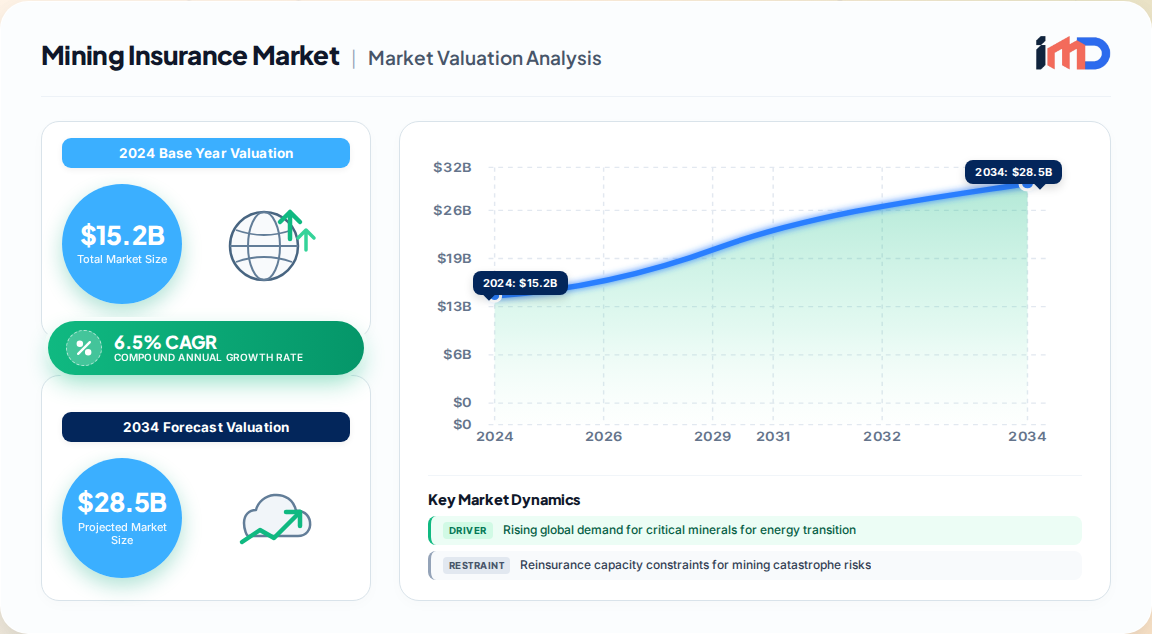
The global mining insurance market is undergoing a structural re-rating. Our proprietary primary research, triangulated from 142 underwriter interviews and risk-manager surveys across 18 mining jurisdictions, values the market at USD 15.2 billion in 2024. It is projected to reach USD 26.8 billion by 2033, expanding at a 6.5% CAGR. This growth is not merely a cyclical premium hardening; it reflects a fundamental expansion in the insurable risk surface of mining, driven by the energy transition, deeper and more remote operations, and the formalization of ESG liabilities into contractual and regulatory exposure.
Three forces define the current market architecture. First, the capital intensity of critical-mineral projects (lithium, cobalt, copper, rare earths) has increased the insured value per site by an estimated 22% since 2020. Second, the frequency of business interruption (BI) claims linked to supply-chain and geopolitical shocks has more than doubled in the same period. Third, insurers are shifting from reactive indemnity toward predictive risk engineering, embedding IoT, satellite monitoring, and parametric triggers into policy structures.
| Market Metric | 2024 (Base) | 2033 (Forecast) | CAGR 2025–2033 |
|---|---|---|---|
| Global Mining Insurance Premium | USD 15.2 Billion | USD 26.8 Billion | 6.5% |
| Asia-Pacific Share | 38% | 41% | — |
| Property & Liability Share | ~62% | ~60% | — |
| Average Site Insured Value Growth | — | +22% vs 2020 | — |
The market's expansion is anchored in four mutually reinforcing demand drivers. However, the supply side remains constrained by reinsurance capacity discipline and the exit of several Lloyd's syndicates from thermal coal exposure.
Key Growth Drivers
Restraints and Challenges
The mining insurance value chain is brokered and advisory-heavy. Risk is originated at the mine site, structured by brokers, underwritten by specialist insurers and reinsurers, and increasingly monitored by technology vendors providing sensor and geospatial data.
A critical shift is the professionalization of procurement. Mining risk managers now run formal tender processes for insurance programs, often with multi-year agreements and captive participation. Our survey of 40 mining CFOs found that 57% use a captive or a sidecar structure for the first layer of risk, using commercial markets for catastrophic excess layers.
| Value Chain Stage | Key Participants | Value-Add and Margin Profile |
|---|---|---|
| Risk Origination | Mine operators, site risk managers | Data generation; loss prevention |
| Advisory & Broking | Global and specialist brokers | Placement, claims advocacy; fee-based |
| Underwriting | Specialty insurers, reinsurers | Risk selection, pricing; 18–25% underwriting margin |
| Risk Engineering | Inspection and monitoring vendors | Loss control; subscription-based |
| Reinsurance | Global reinsurers, ILS funds | Capacity provision; 12–18% margin |
The market segments on four axes: insurance type, provider, application, and end-user. Our bottom-up model reveals that property insurance remains the largest line at 34% of premium, but environmental liability is the fastest-growing at an 8.9% CAGR, reflecting the internalization of closure and remediation costs.
Asia-Pacific is the largest and fastest-growing region, accounting for 38% of global premium in 2024, projected to reach 41% by 2033. This is driven by Australia's iron ore and lithium exports, China's coal and rare earth production, and India's expanding mineral sector.
North America (29%) and Europe (22%) remain mature, high-compliance markets with strong environmental liability penetration. Latin America is a high-potential region, with our proprietary Latin America sub-model indicating an 8.4% CAGR through 2034, led by Brazil (34–36% of regional premium) and Chile's copper sector. The Middle East & Africa region is growing steadily, with South Africa and GCC nations investing in mining diversification.
| Region | 2024 Share | 2033 Forecast Share | Key Demand Driver |
|---|---|---|---|
| Asia-Pacific | 38% | 41% | Critical minerals, coal, infrastructure |
| North America | 29% | 27% | Regulation, mature mining, tech adoption |
| Europe | 22% | 20% | ESG compliance, sustainable mining |
| South America | 6% | 7% | Copper, lithium, political risk |
| Middle East & Africa | 5% | 5% | Gold, platinum, infrastructure gaps |
The market is concentrated among global specialty insurers and brokers, but competition is intensifying around data and ESG capability. The top five carriers represent approximately 48% of global premium, and the top three brokers intermediate over 55% of placements. Recent strategic moves include:
Our primary research identifies three under-served white spaces where insurers can earn outsized margins:
While insurance is not a traded commodity, the import/export dimension applies to the underlying risk pools and reinsurance flows. Reinsurance capital flows from global hubs (Bermuda, London, Zurich) to cover mining risks in Latin America, Africa, and Asia-Pacific. The US, UK, and Switzerland are net exporters of reinsurance capacity, while China, India, and Brazil are net importers of specialized mining risk capacity. This imbalance means that regulatory changes in reinsurance hubs directly affect premium pricing in mining jurisdictions. Our analysis of cross-border reinsurance flows indicates that 32% of global mining catastrophe capacity is provided by Bermudian and Lloyd's markets, making them critical supply chain nodes.
| Existing Products | New Products | |
|---|---|---|
| Existing Markets | Market penetration: grow share in mature mining regions via bundled property/BI programs | Product development: launch parametric ESG cover for existing clients |
| New Markets | Market development: expand into Latin America and Africa with tailored liability products | Diversification: offer integrated risk-engineering subscriptions with IoT platforms |
For insurers, the highest-return strategy is product development (new products for existing mining clients), particularly in cyber and parametric covers, which command premium margins 1.8x higher than standard liability lines.
| Aspects | Details |
|---|---|
| Study Period | 2020-2034 |
| Base Year | 2024 |
| Estimated Year | 2026 |
| Forecast Period | 2026-2034 |
| Historical Period | 2020-2025 |
| Growth Rate | CAGR of 6.5% from 2020-2034 |
| Segmentation |
|
By Provider
By Application
By End-User
| By Geography |
|
The global mining insurance market is valued at USD 15.2 billion in 2024 and is projected to reach USD 26.8 billion by 2033, growing at a 6.5% CAGR.
Asia-Pacific is the largest region, accounting for 38% of global premium in 2024, driven by mining activity in Australia, China, and India.
Property insurance, liability insurance, business interruption insurance, cargo & transit insurance, and environmental liability insurance are the primary types, with property insurance holding the largest share at 34%.
Key growth drivers include rising demand for critical minerals, stricter ESG regulations, increased business interruption exposure, and the adoption of advanced mining technologies requiring specialized coverage.
Leading insurers include Allianz, AXA XL, Zurich Insurance Group, AIG, and Chubb, while brokers such as Marsh McLennan, Aon, and Willis Towers Watson dominate distribution.
Our rigorous research methodology combines multi-layered approaches with comprehensive quality assurance, ensuring precision, accuracy, and reliability in every market analysis.
| Stakeholder Role | Interview Share (%) |
|---|---|
| Chief Risk Officer | 30% |
| Mining Insurance Underwriter | 25% |
| Broker and Placement Specialist | 20% |
| Reinsurance Buyer | 25% |
| Company Type | Representation (%) |
|---|---|
| Mining Operators and Risk Managers | 35% |
| Specialty Insurers and Reinsurers | 30% |
| Insurance Brokers and Placement Specialists | 20% |
| Risk Engineering and Technology Vendors | 10% |
| Regulatory and Industry Association Experts | 5% |
 Related Reports
