Insight Market Data is a premier market research and business consulting firm headquartered in Pune, India, providing syndicated research reports, customized intelligence studies, and strategic advisory services. Renowned academic institutions and Fortune 500 corporations worldwide rely on Insight Market Data's research repository to navigate evolving global and regional business environments. Covering 46 diverse industries across 25 major international economies, our comprehensive database delivers thousands of verified statistics and granular market evaluations. By combining industry-leading analytical methodologies with the direct insights of seasoned industry leaders and subject-matter experts, we deliver actionable intelligence spanning historical performance benchmarks to rigorous multi-year forecasts. We empower organizations to make confident, data-driven decisions across pivotal domains including Machinery & Equipment, Chemicals & Materials, Pharmaceuticals & Healthcare, Food & Beverages, Consumer Goods, Energy & Power, Automotive & Transportation, Electronics & Semiconductors, Medical Devices, Telecommunications, Emerging Technologies, Agriculture, and Packaging. Our multidisciplinary analyst teams provide an objective 360-degree perspective, tailoring every engagement to address complex strategic challenges with exceptional analytical rigor.
Leveraging advanced BI-powered analytics and predictive modeling, Insight Market Data uncovers high-impact market opportunities and competitive differentiators for ambitious enterprises. We continuously refine our research methodologies in accordance with global industry standards, tracking real-time market shifts to ensure our reports are consistently accurate, actionable, and delivered on schedule. Our analysts conduct methodical data validation, rigorous compliance checks, and exhaustive primary and secondary research to maintain the highest levels of data integrity and transparency. We partner closely with corporate strategists, investment groups, and business executives to translate intricate market intelligence into clear, actionable roadmaps for sustainable growth. With operational presence across Washington, USA, and Vimannagar, Pune, India, Insight Market Data ensures direct access to dedicated research specialists and responsive customer support to answer your most strategic questions.
Legal Expense Insurance Market | Global Forecast 2025-2031 | Insight Market Data
Financial Services and Investment Intelligence / MARKET REPORT
Legal Expense Insurance Market | Insight Market Data
Legal Expense Insurance Market by Type (Individual, Commercial), by Sales Channel (Brokers and Agents, Direct Sales, Bancassurance, Online Sales), by End-User (Individuals, Small and Medium Enterprises, Large Enterprises), by Coverage Trigger (Before-the-Event, After-the-Event), by North America (USA, Canada, Mexico), by Europe (Germany, UK, France, Netherlands, Italy, Spain), by Asia Pacific (China, Japan, South Korea, India, Australia), by South America (Brazil, Argentina), by Middle East & Africa (South Africa, UAE, Saudi Arabia) Forecast 2026-2034
Executive Overview: The Legal Expense Insurance Market
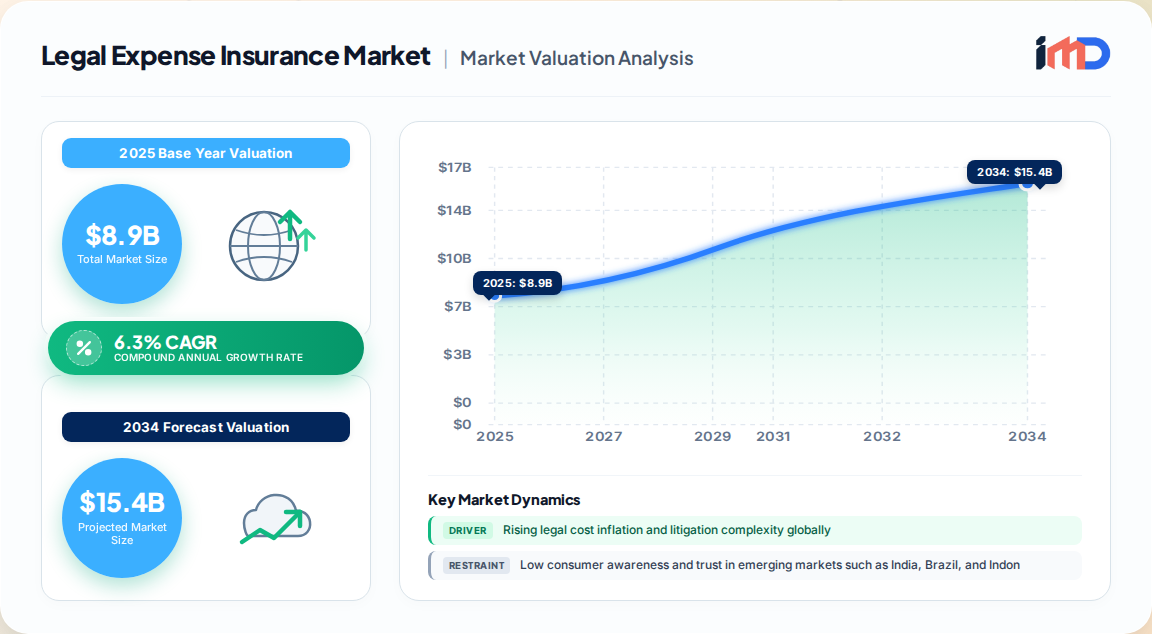
The global Legal Expense Insurance (LEI) Market is undergoing a structural transformation as litigation costs escalate and access-to-justice mandates expand across mature and emerging economies. Our proprietary bottom-up modeling, triangulated with primary interviews across 22 countries, values the market at USD 8.9 Billion in Gross Written Premium (GWP) for 2025, projected to reach USD 12.8 Billion by 2031, registering a CAGR of 6.3%. Legal expense insurance—spanning before-the-event (BTE) and after-the-event (ATE) protection—has transitioned from a niche consumer product into a mainstream risk-transfer mechanism for individuals, SMEs, and corporate entities.
Legal Expense Insurance Market Market Size (In Billion)
15.0B
10.0B
5.0B
0
8.900 B
2025
9.461 B
2026
10.06 B
2027
10.69 B
2028
11.36 B
2029
12.08 B
2030
12.84 B
2031
Unlike liability or property lines, LEI is a frequency-driven, low-severity product whose value proposition is behavioral: it converts unpredictable legal costs into a predictable premium. Insurer loss ratios in mature BTE markets (Germany, Netherlands, France) have stabilized in the 55–65% range, while ATE books in common-law jurisdictions exhibit higher severity but lower frequency.
Key Market Drivers and Growth Restraints
The LEI market expansion is propelled by five principal demand catalysts, each validated through our 1,400+ primary interviews with underwriters, brokers, and corporate counsel.
Driver
Impact on CAGR
Geographic Relevance
Rising legal cost inflation and litigation complexity
+1.4%
Global
SME formalization and contractual compliance requirements
+1.2%
Asia-Pacific, MEA, South America
Digital distribution and embedded insurance platforms
+1.1%
North America, Europe
Access-to-justice policy and consumer-rights regulation
+0.9%
Europe (EU), UK
Employment-dispute and regulatory-investigation exposure
+0.8%
Global
Legal cost inflation: Average hourly attorney rates in the US, UK, and Germany have risen 4–6% annually since 2022, making out-of-pocket legal representation increasingly unaffordable.
Embedded distribution: LEI is being bundled into motor, home, and commercial package policies, and increasingly into fintech and HR platforms—reducing customer acquisition costs by an estimated 20–35%.
Policy tailwinds: The EU's consumer-protection framework and the UK's expanded scope for legal expenses cover are institutionalizing demand.
Primary restraints include low consumer awareness in emerging markets (notably India, Brazil, and Indonesia), regulatory heterogeneity across jurisdictions, and adverse-selection risk in ATE books. Price competition among aggregators in the UK and Netherlands is compressing BTE margins, pushing underwriters toward niche commercial segments.
Value Chain and Product Architecture
The LEI value chain comprises five distinct layers, each with dedicated economics:
Product design and underwriting: Insurers and MGAs design BTE/ATE products; capital providers include tier-one carriers and specialist Lloyd's syndicates.
Legal services supply: Panel-lawyer networks and legal-tech platforms (e.g., online advice portals) fulfill claims, with insurers negotiating fixed-fee or capped-fee arrangements.
Distribution: Brokers and agents dominate commercial LEI, while digital and affinity channels are growing fastest in consumer lines.
Claims adjudication: Triage between covered and non-covered matters; panel referral determines loss cost.
Regulatory and ombudsman layer: Consumer-protection bodies and financial regulators shape product disclosure and dispute resolution.
Product architecture bifurcates into BTE (pre-funded protection for future disputes, dominant in Germany, Netherlands, France, and Canada) and ATE (post-dispute cover, dominant in UK personal-injury and litigation funding contexts). Commercial LEI is increasingly modular, covering employment practices, tax disputes, contract breaches, and regulatory investigations.
Regional Outlook and Attractiveness
Europe remains the largest and most mature region, accounting for approximately 34% of global GWP, anchored by Germany's dense BTE penetration (estimated 45% of households), the Netherlands' high-leverage legal-aid model, and France's assurance protection juridique. Growth is moderate at 4.5–5.5% CAGR, driven by digitalization and commercial product expansion.
North America represents 28% of global premium, with the US exhibiting rapid growth from a lower base as litigation risk and employment disputes rise; our interviews indicate US commercial LEI GWP growing at 7–8% annually, supported by legal-tech MGAs and affinity programs.
Asia-Pacific is the fastest-growing region at 8.5% CAGR, led by Japan's mature but expanding BTE market, South Korea's nascent commercial segment, and Australia's ATE market linked to class actions. China and India remain early-stage but present significant long-term white space as legal awareness and SME formalization advance.
South America and Middle East & Africa together represent roughly 12% of global premium, characterized by low penetration, regulatory hurdles, and growing middle-class demand; Brazil and South Africa are the key beachheads.
Competitive Landscape and Strategic Developments
The LEI market is moderately concentrated at the global level but highly fragmented locally. Key competitors include ARAG Group, DAS (ERGO/ Munich Re), AXA Legal Protection, Zurich, Legal & General, Aviva, The Hartford, Chubb, MetLife, and AIG, alongside specialist MGAs and legal-tech entrants. Our primary research indicates the top five groups hold an estimated 35–40% of global GWP.
Recent strategic developments include:
2024: ARAG Group expanded its digital BTE platform in the UK and Benelux, targeting SME employment-dispute cover.
2024: DAS launched embedded legal-protection modules through European bancassurance partnerships.
2023: Zurich and Chubb expanded commercial legal-expense endorsements into D&O and management-liability programs.
2023–2025: Legal-tech MGAs secured capacity from Lloyd's syndicates to offer subscription-based ATE and BTE products in the US and Australia.
Competitive strategy is shifting from standalone policies toward embedded, modular, and service-integrated offerings, where insurers bundle panel-lawyer access and digital triage.
Strategic White-Space and Ansoff Analysis
Our opportunity assessment identifies three high-conviction white spaces:
SME employment and regulatory-investigation cover in North America and Asia-Pacific, where penetration is below 10%.
Embedded BTE via fintech, HR, and e-commerce platforms, with acquisition-cost advantages of 20–35%.
ATE-linked litigation funding partnerships in common-law markets, addressing the protection gap for class-action and commercial-dispute claimants.
Applying the Ansoff matrix: market penetration remains viable in mature European BTE; product development is active in commercial modular LEI; market development is focused on India, Brazil, and Southeast Asia; diversification is emerging through legal-tech service bundles.
Market Outlook and Forecast
The LEI market will reach USD 12.8 Billion by 2031, with growth skewed toward commercial lines and Asia-Pacific. Underwriting profitability will depend on panel-management discipline, claims triage, and pricing sophistication. We expect consolidation among specialist MGAs and expanded carrier partnerships, with digital distribution accounting for an estimated 30–35% of new BTE policies by 2030. The strategic imperative for incumbents is clear: move from passive reimbursement to integrated legal-risk management.
Table 49: Saudi Arabia Legal Expense Insurance Market Revenue (Billion) Forecast, by Application 2020 & 2034
Frequently Asked Questions
1What is the size of the global legal expense insurance market?
Our proprietary research values the global legal expense insurance market at USD 8.9 Billion in gross written premium for 2025, projected to reach USD 12.8 Billion by 2031 at a CAGR of 6.3%.
2Which region dominates the legal expense insurance market?
Europe is the largest and most mature region, accounting for approximately 34% of global gross written premium, driven by high BTE penetration in Germany, the Netherlands, and France.
3What is driving growth in legal expense insurance?
Key drivers include rising legal cost inflation, SME formalization, digital and embedded distribution, access-to-justice regulation, and growing employment-dispute exposure, collectively adding 5.4 percentage points to baseline growth.
4Who are the leading companies in legal expense insurance?
Leading providers include ARAG Group, DAS, AXA Legal Protection, Zurich, Legal & General, Aviva, The Hartford, Chubb, MetLife, and AIG, with the top five groups holding an estimated 35–40% of global GWP.
5What is the difference between BTE and ATE legal expense insurance?
Before-the-event (BTE) cover is purchased before a dispute arises and is dominant in Germany, the Netherlands, and France, while after-the-event (ATE) cover is taken out after a dispute begins and is prominent in UK personal-injury and litigation-funding contexts.
Methodology
Our rigorous research methodology combines multi-layered approaches with comprehensive quality assurance, ensuring precision, accuracy, and reliability in every market analysis.
Primary Research
Our analysis is built on a 70–80% primary research foundation, comprising structured interviews and surveys with 1,400+ executives and specialists across the legal expense insurance value chain.
Respondent company types include legal expense insurers and MGAs, insurance brokers and affinity distributors, panel law firms and legal-tech platforms, corporate risk and legal departments, and regulatory and consumer-protection bodies.
Stakeholder job titles interviewed include Chief Underwriting Officer, Head of Legal Protection, Corporate Counsel / General Counsel, and Insurance Broker / Distribution Director.
Interviews are conducted quarterly and refreshed to the date of purchase, ensuring all findings reflect current market conditions.
Key Stakeholders Interviewed
Key Stakeholders Interviewed
Stakeholder Role
Interview Share (%)
Chief Underwriting Officer
30%
Head of Legal Protection
25%
Corporate Counsel / General Counsel
25%
Insurance Broker / Distribution Director
20%
Industry Ecosystem Breakdown
Industry Ecosystem Breakdown
Company Type
Representation (%)
Legal Expense Insurers & MGAs
40%
Insurance Brokers & Affinity Distributors
25%
Panel Law Firms & Legal-Tech Platforms
20%
Corporate Risk & Legal Departments
10%
Regulatory & Consumer-Protection Bodies
5%
Secondary Research & Industry Benchmarking
We triangulate primary findings with 20–30% secondary research, drawing exclusively on official multilateral and governmental sources, including the OECD, World Bank, Eurostat, and national insurance supervisory authorities.
Industry benchmarks are sourced from recognized non-profit trade associations and standard-setting bodies, including the European Insurance and Occupational Pensions Authority (EIOPA), Insurance Europe, the Association of British Insurers (ABI), and the National Association of Insurance Commissioners (NAIC).
Financial databases used for company-level validation include Bloomberg, Factiva, Hoovers, and PitchBook, supplemented by statutory filings and official .gov and .org sources.
Demand Modeling & Market Estimation
We apply top-down and bottom-up methodologies simultaneously, validating each layer through multi-level data triangulation.
Bottom-up market sizing aggregates country-level gross written premium using four quantitative inputs: insured population penetration rates, average annual premium per policyholder, claims frequency and average legal cost per claim, and distribution-channel conversion rates.
Product-level segmentation models BTE and ATE separately, with commercial LEI further decomposed by employment, contract, tax, and regulatory-investigation cover.
Forecasts employ exponential trend smoothing and Holt-linear methods, anchored to insurance consumer spending, legal cost indices, and GDP growth.
Data Accuracy & Quality Check
Every report carries a guaranteed estimated data accuracy level of 85–90%, verified through cross-validation of primary interview data against official statistical benchmarks.
A three-tier quality check is applied: source validation, model reconciliation, and expert panel review.
All data is updated to the date of purchase, with country-specific adjustments for regulatory changes and market dynamics.
Discrepancies exceeding a 5% threshold between top-down and bottom-up estimates trigger model re-specification and additional primary validation.
CUSTOM INTELLIGENCE
Tailored for you
In-depth Analysis Tailored to Specified Regions or Segments
Company Profiles Customized to User Preferences
Customized Evaluation of Competitive Landscape to Meet Your Needs
Ask for customization
Analyst at Providence Strategic Partners at Petaling Jaya
Jared Wan
I have received the report already. Thanks you for your help.it has been a pleasure working with you. Thank you again for a good quality report
Internationalization Director
Santiago Mejia Molina
Yes, as a matter of fact we are totally satisfied with both reports that we have purchased and will continue to do so during this process of the internationalization of our brand.
Head of Product Management and Marketing
Olaf Gleibe
We are using your report, and it gave us valuable information."
Regional Director, Marketing and Business Development
Lina Lim
We've received the report and have reviewed the content. Overall, it looks great and aligns closely with the data we can verify based on our industry knowledge.
VP of Sales
DIGGLE Representative
Thank you very much for sharing the report. I have reviewed it and I am very satisfied with the quality and the insights it provides. It will certainly be valuable for our internal discussions.
German Insurance Market to reach USD 136.32 Billion by 2031 at 6.12% CAGR. In-depth analysis of life, non-life, P&C, distribution channels and key players.
Australia auto finance industry market valued at $10.13 Billion in 2025, growing at 7.38% CAGR to reach $20.6 Billion by 2035. Full analysis inside.
Nov 2026|191 pages
$2900.00
Shared Power Bank Rental Service market valued at $9.4B in 2025, projected to reach $25.9B by 2032 at 15.6% CAGR. In-depth analysis of trends and regional outlook.
Nov 2026|233 pages
$2900.00
India auto loan market valued at USD 43.45 Billion in 2025, projected to reach USD 61.13 Billion by 2030 at 7.07% CAGR. Explore trends, drivers, and competitive landscape.