1What is the current size of the German insurance market?
Our proprietary research estimates the German insurance market at USD 96.79 Billion in 2024, projected to reach USD 101.25 Billion by 2026 and USD 136.32 Billion by 2031.
Insight Market Data is a premier market research and business consulting firm headquartered in Pune, India, providing syndicated research reports, customized intelligence studies, and strategic advisory services. Renowned academic institutions and Fortune 500 corporations worldwide rely on Insight Market Data's research repository to navigate evolving global and regional business environments. Covering 46 diverse industries across 25 major international economies, our comprehensive database delivers thousands of verified statistics and granular market evaluations. By combining industry-leading analytical methodologies with the direct insights of seasoned industry leaders and subject-matter experts, we deliver actionable intelligence spanning historical performance benchmarks to rigorous multi-year forecasts. We empower organizations to make confident, data-driven decisions across pivotal domains including Machinery & Equipment, Chemicals & Materials, Pharmaceuticals & Healthcare, Food & Beverages, Consumer Goods, Energy & Power, Automotive & Transportation, Electronics & Semiconductors, Medical Devices, Telecommunications, Emerging Technologies, Agriculture, and Packaging. Our multidisciplinary analyst teams provide an objective 360-degree perspective, tailoring every engagement to address complex strategic challenges with exceptional analytical rigor.
Leveraging advanced BI-powered analytics and predictive modeling, Insight Market Data uncovers high-impact market opportunities and competitive differentiators for ambitious enterprises. We continuously refine our research methodologies in accordance with global industry standards, tracking real-time market shifts to ensure our reports are consistently accurate, actionable, and delivered on schedule. Our analysts conduct methodical data validation, rigorous compliance checks, and exhaustive primary and secondary research to maintain the highest levels of data integrity and transparency. We partner closely with corporate strategists, investment groups, and business executives to translate intricate market intelligence into clear, actionable roadmaps for sustainable growth. With operational presence across Washington, USA, and Vimannagar, Pune, India, Insight Market Data ensures direct access to dedicated research specialists and responsive customer support to answer your most strategic questions.
 German Insurance Market
 by Life Insurance, by Non-Life Insurance (Health Insurance, Motor Vehicle Insurance, Property Insurance, General Liability Insurance, Legal Insurance), by Distribution Channel (Direct, Agency, Brokers, Banks), by Customer Type (Personal Lines, Commercial Lines), by End-User Industry (Manufacturing, Construction and Real Estate, Others), by Westdeutschland, by Süddeutschland, by Norddeutschland, by Ostdeutschland Forecast 2026-2034

Research Associate

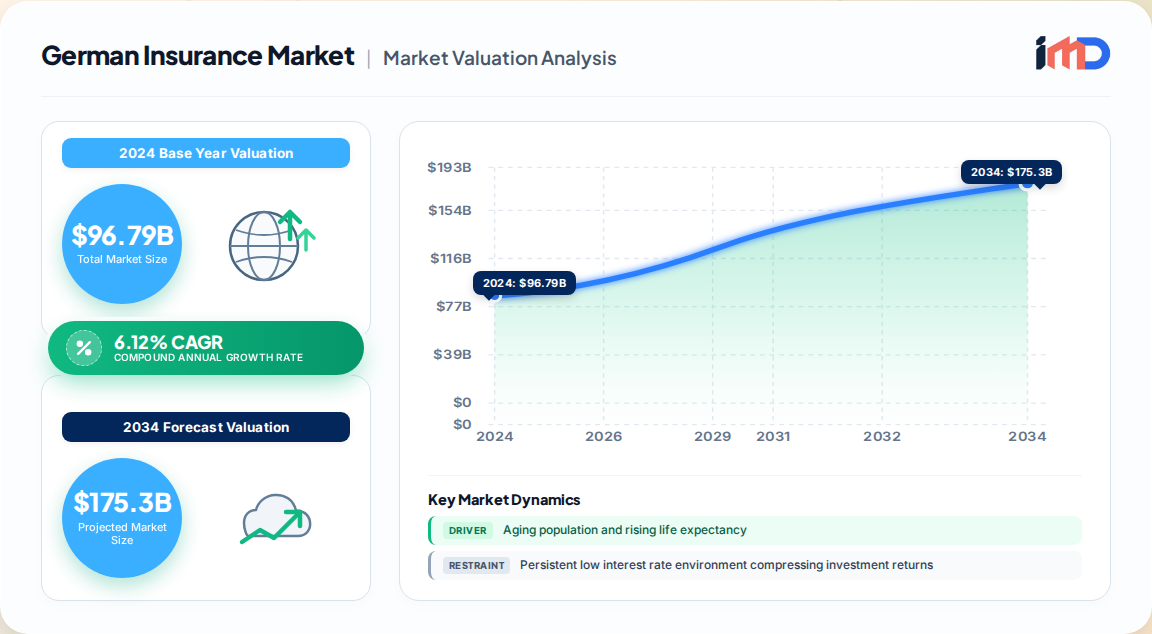
The German insurance market stands as one of the most mature, resilient, and sophisticated financial services sectors in Europe, representing a cornerstone of the country's economic architecture. Our proprietary primary research estimates the total German insurance market (gross written premium, GWP) at USD 96.79 Billion in 2024, with an anticipated expansion to USD 101.25 Billion in 2026. The market is projected to grow at a CAGR of 6.12% from 2026 to 2031, ultimately reaching USD 136.32 Billion by the end of the forecast period. This trajectory reflects a sector undergoing profound transformation, driven by digitalization, regulatory evolution, and the imperative to address climate-related risks.
The market comprises two primary pillars: life insurance and non-life insurance. Non-life insurance (including property & casualty, health, motor, and legal) dominates the landscape, accounting for an estimated 65-70% of total GWP, while life insurance continues to play a critical role in retirement planning and long-term savings. The German market is characterized by high insurance penetration, a dense competitive field of domestic and international carriers, and a customer base that increasingly demands personalized, digital-first services.
The German insurance market is propelled by a confluence of demographic, macroeconomic, and technological factors. Key drivers include:
However, the market faces significant restraints:
The German insurance value chain is highly structured, encompassing product design, underwriting, distribution, claims management, and asset management. Distribution channels are evolving rapidly, with a distinct shift toward direct and digital models.
The German insurance market is segmented by product type, customer type, and end-user industry.
By Insurance Type:
By Customer Type:
By End-User Industry:
Germany exhibits distinct regional insurance dynamics. Westdeutschland (including North Rhine-Westphalia, Hesse, and Rhineland-Palatinate) is the largest market, capturing 44.92% of the P&C insurance share in 2025, owing to its dense industrial base and high population density. Süddeutschland (Bavaria, Baden-Württemberg) follows with a significant share, home to major insurers like Allianz and Munich Re. Ostdeutschland (the former East Germany) is the fastest-growing region, with a projected CAGR of 6.52% to 2031, driven by economic convergence, infrastructure modernization, and increasing insurance penetration.
The German insurance market is moderately concentrated, with a mix of global giants and specialized regional players. Key competitors include Allianz Group, Munich Re Group (including ERGO), Talanx Group (HDI, Hannover Re), AXA Konzern AG, Generali Deutschland, R+V Versicherung, Debeka, and Signal Iduna. These players are aggressively investing in technology and strategic partnerships to defend market share.
Recent strategic developments underscore the industry's direction:
The competitive battlefield is shifting from traditional price competition to differentiation through customer experience, data analytics, and ecosystem integration. Insurers that successfully leverage AI for underwriting and claims, while navigating a complex regulatory environment, will be best positioned to capture growth.
Our analysis identifies several underpenetrated segments offering significant growth opportunities:
These segments require targeted product innovation and agile distribution partnerships to unlock their potential.
While insurance is not a tradable physical commodity, the German market is deeply integrated into the European and global reinsurance and capital markets. Reinsurance inflows are critical for managing catastrophe risk; German primary insurers cede a significant portion of risk to global reinsurers, including Munich Re, Swiss Re, and Hannover Re. In 2024, nat-cat reinsurance rates increased, impacting primary insurers' cost structures. Cross-border insurance services within the EU are facilitated by passporting rules, allowing German insurers to operate across the European Economic Area. Conversely, foreign insurers, particularly from the UK and Switzerland, maintain a strong presence in the German commercial lines market. The primary "import" is risk capacity (reinsurance and capital), while "export" is underwriting expertise and specialized products. Supply chain risk is minimal in terms of physical inputs, but dependence on global reinsurance capacity and capital market conditions remains a key operational consideration.
| Aspects | Details |
|---|---|
| Study Period | 2020-2034 |
| Base Year | 2024 |
| Estimated Year | 2026 |
| Forecast Period | 2026-2034 |
| Historical Period | 2020-2025 |
| Growth Rate | CAGR of 6.12% from 2020-2034 |
| Segmentation |
|
By Distribution Channel
By Customer Type
By End-User Industry
| By Geography |
|
Our proprietary research estimates the German insurance market at USD 96.79 Billion in 2024, projected to reach USD 101.25 Billion by 2026 and USD 136.32 Billion by 2031.
Non-life insurance, particularly motor and property lines, dominates the market. Motor insurance alone accounted for 35.54% of the property & casualty market share in 2025.
The aging population is a primary driver, fueling demand for retirement, health, and long-term care insurance products. Digitalization and embedded insurance models are also accelerating growth.
Leading companies include Allianz Group, Munich Re Group (ERGO), Talanx Group, AXA Konzern AG, Generali Deutschland, R+V Versicherung, Debeka, and Signal Iduna.
Insured NatCat claims reached USD 6.21 Billion in 2024, driving premium increases in property lines. The debate over mandatory flood insurance could further expand the market.
Direct and digital channels are the fastest-growing, with a projected CAGR of 10.88% through 2031, driven by insurtech platforms and embedded insurance partnerships.
Our rigorous research methodology combines multi-layered approaches with comprehensive quality assurance, ensuring precision, accuracy, and reliability in every market analysis.
| Stakeholder Role | Interview Share (%) |
|---|---|
| Chief Underwriting Officer | 30% |
| Chief Risk Officer | 25% |
| Head of Distribution | 25% |
| Digital Transformation Lead | 20% |
| Company Type | Representation (%) |
|---|---|
| Primary Insurers (Life & Non-Life) | 45% |
| Reinsurers | 15% |
| Insurance Brokers & Agents | 20% |
| Insurtech & Digital Platforms | 12% |
| Regulatory & Trade Bodies | 8% |
 Related Reports

