1What is the size of the military land tactical radios market?
Our proprietary research values the global military land tactical radios market at USD 8.60 billion in 2025, projected to reach USD 10.93 billion by 2030 at a CAGR of 4.86%.
Insight Market Data is a premier market research and business consulting firm headquartered in Pune, India, providing syndicated research reports, customized intelligence studies, and strategic advisory services. Renowned academic institutions and Fortune 500 corporations worldwide rely on Insight Market Data's research repository to navigate evolving global and regional business environments. Covering 46 diverse industries across 25 major international economies, our comprehensive database delivers thousands of verified statistics and granular market evaluations. By combining industry-leading analytical methodologies with the direct insights of seasoned industry leaders and subject-matter experts, we deliver actionable intelligence spanning historical performance benchmarks to rigorous multi-year forecasts. We empower organizations to make confident, data-driven decisions across pivotal domains including Machinery & Equipment, Chemicals & Materials, Pharmaceuticals & Healthcare, Food & Beverages, Consumer Goods, Energy & Power, Automotive & Transportation, Electronics & Semiconductors, Medical Devices, Telecommunications, Emerging Technologies, Agriculture, and Packaging. Our multidisciplinary analyst teams provide an objective 360-degree perspective, tailoring every engagement to address complex strategic challenges with exceptional analytical rigor.
Leveraging advanced BI-powered analytics and predictive modeling, Insight Market Data uncovers high-impact market opportunities and competitive differentiators for ambitious enterprises. We continuously refine our research methodologies in accordance with global industry standards, tracking real-time market shifts to ensure our reports are consistently accurate, actionable, and delivered on schedule. Our analysts conduct methodical data validation, rigorous compliance checks, and exhaustive primary and secondary research to maintain the highest levels of data integrity and transparency. We partner closely with corporate strategists, investment groups, and business executives to translate intricate market intelligence into clear, actionable roadmaps for sustainable growth. With operational presence across Washington, USA, and Vimannagar, Pune, India, Insight Market Data ensures direct access to dedicated research specialists and responsive customer support to answer your most strategic questions.
 Military Land Tactical Radios: Market
 by Radio Type (Analog Radios(Handheld, Vehicle-Mounted, Base Station), Digital Radios(Handheld, Vehicle-Mounted, Manpack, Base Station), Software-Defined Radios(Handheld, Vehicle-Mounted, Manpack, Base Station)), by Frequency Band (VHF, UHF, HF, 24 GHz and above), by Component (Transmitters, Receivers, Amplifiers, Antennas, Accessories), by Application (Combat Operations, Training and Simulation, Command and Control, Logistics and Supply Chain Management, Surveillance and Intelligence Gathering), by End User (Land Forces, Special Forces, Government and Defense Agencies, Private Security Contractors, Research and Development Institutions), by North America (USA, Canada, Mexico), by Europe (Germany, UK, France, Italy, Turkey, Rest of Europe), by Asia Pacific (China, Japan, India, South Korea, Australia, Rest of Asia-Pacific), by Middle East & Africa (Saudi Arabia, UAE, Israel, South Africa, Rest of MEA), by South America (Brazil, Argentina, Rest of South America) Forecast 2026-2034



Research Associate
 Related Reports

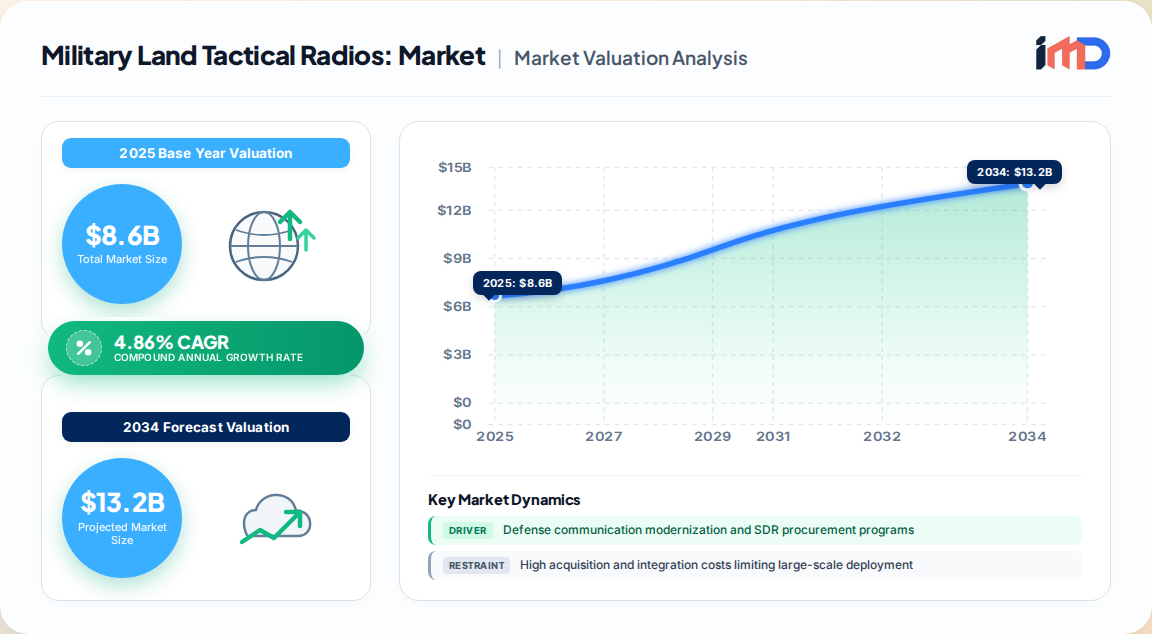
The global military land tactical radios market represents one of the most mission-critical segments of the defense communications value chain, enabling secure voice, data and video exchange for dismounted soldiers, armored formations and forward command posts. Our proprietary primary research and expert interview program values the market at USD 8.60 billion in 2025, advancing toward USD 10.93 billion by 2030 at a CAGR of 4.86%.
Growth is anchored in the structural replacement of legacy analog fleets with software-defined radios (SDRs), the diffusion of mesh networking architectures, and the integration of satellite-enabled beyond-line-of-sight (BLOS) connectivity into land force structures. Demand is further reinforced by elevated geopolitical risk, multinational interoperability mandates and soldier modernization programs that prioritize lightweight, power-efficient form factors.
| Metric | 2025 Baseline | 2030 Outlook |
|---|---|---|
| Market valuation | USD 8.60 billion | USD 10.93 billion |
| Compound annual growth | — | 4.86% |
| Largest regional market | North America (~38%) | North America (retained) |
| Fastest-growing region | Asia-Pacific | Asia-Pacific |
| Dominant technology | Conventional/digital radios | Software-defined radios |
The demand engine for land tactical radios is unusually resilient because procurement is tied to sovereign security obligations rather than commercial cycles. Our interviews with program officers and procurement directors consistently identify four primary growth drivers:
Against these drivers sit meaningful frictions. High acquisition and integration costs constrain large-scale deployment, particularly for tier-two militaries. Spectrum congestion and electronic warfare threats demand continuous anti-jam and frequency-hopping investment. Long procurement cycles and certification burdens slow fielding velocity, while battery and thermal constraints continue to shape dismounted soldier form factors.
Segmentation follows radio type, frequency band, component, application and end user. Our analysis indicates that software-defined radios are the fastest-compounding technology class, while digital radios continue to hold the largest installed base.
| Segment Axis | Leading Segment | Strategic Read |
|---|---|---|
| By radio type | Digital radios (installed base); SDRs (fastest growth) | SDR transition is the central procurement thesis |
| By frequency band | UHF and VHF dominate; HF for long-range | Wideband HF enables 10x data-rate uplift |
| By component | Antennas, amplifiers, transmitters, receivers | Antenna modernization often precedes radio refresh |
| By application | Command & control; combat operations | C2 remains the anchor use case |
| By end user | Land forces; special forces | Special forces prioritize manpack and wearable formats |
Frequency dynamics deserve particular attention. UHF remains the workhorse for line-of-sight tactical nets, VHF sustains combat-net radio usage, and wideband HF (3–30 MHz) is emerging as a hedge against satellite denial. Industry launches such as cognitive wideband HF families delivering up to tenfold data-rate improvement and autonomous jam avoidance illustrate the direction of travel.
The market is concentrated among a small cohort of transatlantic and allied prime contractors with deep waveform libraries, security accreditations and government relationships. Competitive advantage increasingly rests on waveform portability, cryptographic agility and coalition interoperability rather than raw hardware specification.
Key participants shaping the competitive field include RTX Corporation, Northrop Grumman Corporation, BAE Systems plc, Thales S.A., L3Harris Technologies Inc., Leonardo S.p.A., Motorola Solutions Inc., Elbit Systems Ltd., General Dynamics Mission Systems Inc., Rohde & Schwarz GmbH & Co. KG, ASELSAN A.S., Ultra Electronics Holdings Limited, Sepura Limited, Datron World Communications Inc., Codan Communications Pty Ltd, Hytera Communications Corporation Limited, TrellisWare Technologies Inc., Southwest Antennas Inc. and Spectra Group (UK) Limited.
Regional demand is shaped by threat perception, budget trajectory and domestic industrial policy. North America leads on absolute spend, while Asia-Pacific leads on growth rate.
| Region | Position | Primary Demand Signature |
|---|---|---|
| North America | Market leader (~38%) | SDR refresh, joint interoperability, soldier lethality programs |
| Europe | Mature, re-accelerating | Coalition interoperability, replenishment, EDF-backed R&D |
| Asia-Pacific | Fastest growth | Indigenous manufacturing, naval-land integration, border security |
| Middle East & Africa | Selective high-value procurement | Vehicle-mounted and base-station systems |
| South America | Emerging | Upgrades of legacy analog fleets |
European demand is increasingly shaped by multinational funding instruments and standardization agendas that reward interoperable, coalition-ready systems. Asia-Pacific growth is broad-based across China, India, Japan, South Korea and Australia, with local assembly requirements becoming a decisive award criterion.
Land tactical radios sit at the confluence of defense electronics, secure cryptography and ruggedized mechanical engineering. The value chain is vertically integrated at the prime level but highly dependent on specialized sub-tier suppliers.
| Value Chain Stage | Key Inputs | Risk Profile |
|---|---|---|
| R&D and waveform development | DSP/FPGA design, encryption algorithms | High — talent scarcity, export-controlled cryptography |
| Component supply | RF front-ends, GaN amplifiers, antennas, batteries | High — semiconductor allocation, rare-earth magnets |
| Assembly and ruggedization | MIL-STD environmental qualification | Moderate |
| Integration and certification | Waveform portability, Type-1 accreditation | High — certification bottlenecks |
| Sustainment | Software updates, spares, training | Low-moderate, high-margin |
Our scenario modeling identifies several under-served opportunity spaces where supplier positioning remains fluid:
Procurement strategy should prioritize vendors demonstrating cryptographic agility, certified waveform portability and credible sustainment pipelines, since lifecycle software support increasingly determines total cost of ownership over a 15–20 year platform horizon.
We assess the military land tactical radios market as a structurally resilient, moderately compounding sector with a 4.86% CAGR through 2030. The growth rate understates the value migration occurring within the market: the center of gravity is shifting from discrete hardware sales toward software-defined, networked and satellite-augmented communication ecosystems.
Primes that can deliver cognitive electronic protection, coalition-grade interoperability and power-efficient dismounted form factors will capture disproportionate share of value. Conversely, suppliers anchored in legacy analog portfolios face accelerating obsolescence risk. The strategic imperative for the decade is clear: invest in waveform software, secure sub-tier supply and localize presence in Asia-Pacific growth markets.
| Aspects | Details |
|---|---|
| Study Period | 2020-2034 |
| Base Year | 2025 |
| Estimated Year | 2026 |
| Forecast Period | 2026-2034 |
| Historical Period | 2020-2025 |
| Growth Rate | CAGR of 4.86% from 2020-2034 |
| Segmentation |
|
By Frequency Band
By Component
By Application
By End User
| By Geography |
|
Our proprietary research values the global military land tactical radios market at USD 8.60 billion in 2025, projected to reach USD 10.93 billion by 2030 at a CAGR of 4.86%.
North America leads with approximately 38% revenue share, driven by sustained defense modernization and network-centric warfare doctrine, while Asia-Pacific is the fastest-growing region.
Software-defined radios (SDRs) are the fastest-growing technology class, offering programmable waveforms, multi-band operation and in-field upgradability that extend platform lifecycle.
Key players include RTX Corporation, L3Harris Technologies, Thales S.A., BAE Systems plc, Northrop Grumman Corporation, Elbit Systems Ltd., Motorola Solutions Inc. and Rohde & Schwarz GmbH & Co. KG.
In August 2024, Motorola Solutions acquired Australia's Barrett Communications, adding HF and VHF radio technologies, Asia-Pacific reach and expanded mission-critical communications capability.
Our rigorous research methodology combines multi-layered approaches with comprehensive quality assurance, ensuring precision, accuracy, and reliability in every market analysis.
| Stakeholder Role | Interview Share (%) |
|---|---|
| Program Director (Tactical Communications) | 32% |
| Procurement Officer (Defense Acquisition) | 27% |
| Chief RF Systems Engineer | 24% |
| Capability Requirements Manager (Land Forces) | 17% |
| Company Type | Representation (%) |
|---|---|
| Tactical Radio OEMs & Prime Defense Contractors | 38% |
| RF Front-End, Antenna & Amplifier Suppliers | 22% |
| Ruggedized Electronics & MIL-STD Integrators | 16% |
| Waveform Software & Cryptographic Module Developers | 14% |
| Defense Procurement Agencies & Systems Integrators | 10% |