1What is the size of the metabolic disease drugs market?
The global metabolic disease drugs market was valued at USD 83.1 billion in 2025 and is projected to reach USD 149.2 billion by 2033, growing at a CAGR of 7.6% from 2026 to 2033.
Insight Market Data is a premier market research and business consulting firm headquartered in Pune, India, providing syndicated research reports, customized intelligence studies, and strategic advisory services. Renowned academic institutions and Fortune 500 corporations worldwide rely on Insight Market Data's research repository to navigate evolving global and regional business environments. Covering 46 diverse industries across 25 major international economies, our comprehensive database delivers thousands of verified statistics and granular market evaluations. By combining industry-leading analytical methodologies with the direct insights of seasoned industry leaders and subject-matter experts, we deliver actionable intelligence spanning historical performance benchmarks to rigorous multi-year forecasts. We empower organizations to make confident, data-driven decisions across pivotal domains including Machinery & Equipment, Chemicals & Materials, Pharmaceuticals & Healthcare, Food & Beverages, Consumer Goods, Energy & Power, Automotive & Transportation, Electronics & Semiconductors, Medical Devices, Telecommunications, Emerging Technologies, Agriculture, and Packaging. Our multidisciplinary analyst teams provide an objective 360-degree perspective, tailoring every engagement to address complex strategic challenges with exceptional analytical rigor.
Leveraging advanced BI-powered analytics and predictive modeling, Insight Market Data uncovers high-impact market opportunities and competitive differentiators for ambitious enterprises. We continuously refine our research methodologies in accordance with global industry standards, tracking real-time market shifts to ensure our reports are consistently accurate, actionable, and delivered on schedule. Our analysts conduct methodical data validation, rigorous compliance checks, and exhaustive primary and secondary research to maintain the highest levels of data integrity and transparency. We partner closely with corporate strategists, investment groups, and business executives to translate intricate market intelligence into clear, actionable roadmaps for sustainable growth. With operational presence across Washington, USA, and Vimannagar, Pune, India, Insight Market Data ensures direct access to dedicated research specialists and responsive customer support to answer your most strategic questions.
 metabolic disease drugs Market
 by Disease (Diabetes, Obesity, Lysosomal Storage Diseases, Hypercholesterolemia, Inherited Metabolic Disorders), by Therapy (Enzyme Replacement Therapy, Drug Therapy, Gene Therapy, Substrate Reduction Therapy, Small Molecule-Based Therapy, Cellular Transplantation), by Route of Administration (Oral, Parenteral), by Distribution Channel (Hospital Pharmacy, Retail Pharmacy, Online Pharmacy), by North America (USA, Canada, Mexico), by Europe (Germany, UK, France, Italy, Spain), by Asia Pacific (China, Japan, India, South Korea, Australia), by Latin America (Brazil, Argentina), by Middle East & Africa (South Africa, GCC) Forecast 2026-2034

Research Analyst


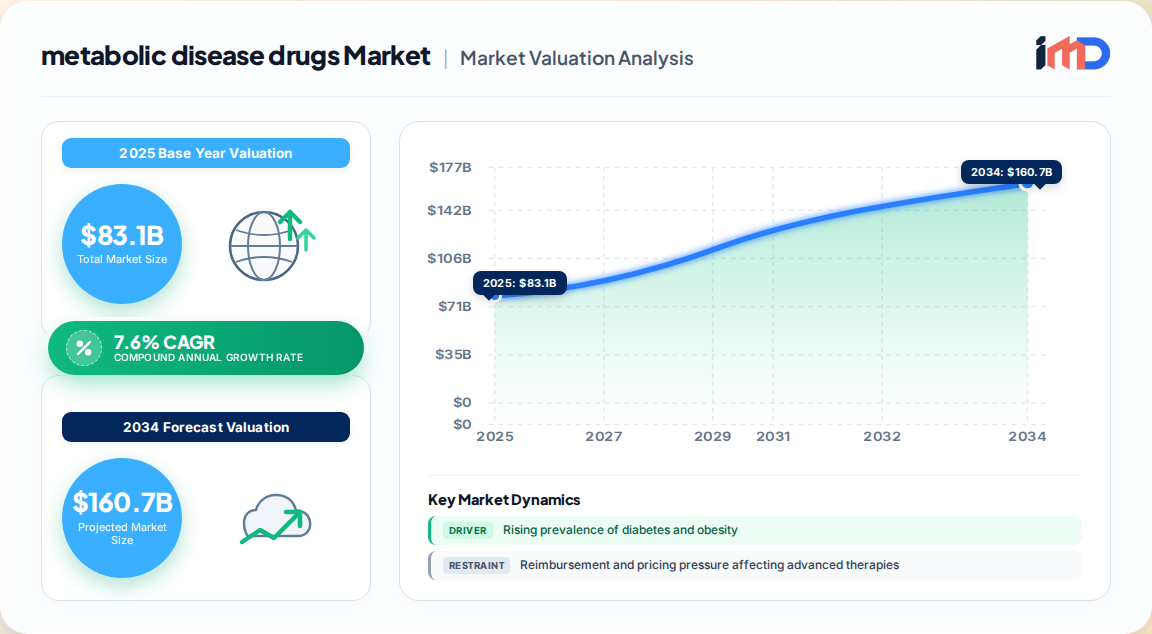
The global metabolic disease drugs market represents one of the most dynamic and rapidly expanding segments of the pharmaceutical industry. Our proprietary primary research estimates the market at USD 83.1 billion in 2025, projected to grow to USD 89.4 billion in 2026 and reach USD 149.2 billion by 2033, registering a robust CAGR of 7.6% over the forecast period (2026–2033). This expansion is underpinned by the escalating global burden of diabetes, obesity, dyslipidemia, and rare inherited metabolic disorders, coupled with unprecedented innovation in incretin-based therapies, enzyme replacement, and gene-based interventions.
North America remains the dominant regional market, accounting for 39.9% revenue share in 2025, driven by advanced healthcare infrastructure, high diagnosis rates, and strong adoption of premium-priced therapies. However, Asia-Pacific is emerging as the fastest-growing region, fueled by rising disease prevalence, growing healthcare expenditure, and expanding access to novel treatments in countries such as China, India, and Japan.
The competitive landscape is characterized by intense R&D activity, strategic collaborations, and a shift toward precision medicine. Key industry players are investing heavily in multi-agonist platforms, oral formulations, and long-acting injectables to improve patient adherence and outcomes.
North America held 39.9% revenue share in 2025, with the U.S. as the largest country market. High prevalence of metabolic syndrome (approximately 34% of U.S. adults, per the American Heart Association) and strong reimbursement for innovative therapies drive growth. The region is expected to maintain dominance, reaching USD 57.7 billion by 2032 at a 7.2% CAGR.
Europe represents a mature market with emphasis on cost-effectiveness and value-based pricing. The region is characterized by high awareness, organized screening programs, and robust regulatory frameworks. Germany, France, and the UK are key contributors.
Asia-Pacific is the fastest-growing region, propelled by rising lifestyle diseases, increasing healthcare expenditure, and expanding access in China, India, and Japan. Government initiatives, such as Japan's ten-year campaign to reduce metabolic syndrome prevalence launched in March 2023, are driving demand for both lifestyle interventions and pharmaceuticals.
Latin America faces a high burden of metabolic disorders, with Mexico reporting ~30% adult prevalence. Brazil and Argentina are key markets, though economic volatility and limited reimbursement pose challenges.
The region exhibits growing prevalence of obesity and diabetes, but healthcare infrastructure constraints and low diagnosis rates limit market expansion. However, increasing government focus on non-communicable diseases presents long-term opportunities.
The metabolic disease drugs market is highly competitive, with major pharmaceutical companies investing in pipeline diversification and strategic collaborations. Key players include Novo Nordisk, Eli Lilly, Merck & Co., Sanofi, AstraZeneca, Johnson & Johnson, Pfizer, Amgen, Boehringer Ingelheim, and others. These companies are focusing on:
Recent strategic moves include Ascendis Pharma and Novo Nordisk's collaboration (November 2024) to develop TransCon technology products for metabolic and cardiovascular diseases, and Novo Nordisk's partnership with Septerna (May 2025) for oral small molecule therapies.
Significant unmet needs and investment opportunities exist in:
The metabolic disease drugs value chain spans from raw material suppliers to end-users:
Supply chain risks include API shortages, geopolitical tensions, and regulatory compliance. Companies are increasingly diversifying sourcing and adopting digital supply chain solutions for resilience.
The metabolic disease drugs market is global, with significant cross-border trade in APIs and finished products. Major exporting countries include Switzerland, Germany, Ireland, and the United States, while emerging markets rely on imports for advanced therapies. For instance, India and China are key suppliers of generic APIs and biosimilars, though quality and regulatory compliance remain critical. Trade data from UN Comtrade and national customs agencies indicate a growing flow of biopharmaceuticals, with cold-chain logistics playing a vital role. Companies must navigate complex regulations, tariffs, and intellectual property regimes to optimize global supply chains.
| Aspects | Details |
|---|---|
| Study Period | 2020-2034 |
| Base Year | 2025 |
| Estimated Year | 2026 |
| Forecast Period | 2026-2034 |
| Historical Period | 2020-2025 |
| Growth Rate | CAGR of 7.6% from 2020-2034 |
| Segmentation |
|
By Therapy
By Route of Administration
By Distribution Channel
| By Geography |
|
The global metabolic disease drugs market was valued at USD 83.1 billion in 2025 and is projected to reach USD 149.2 billion by 2033, growing at a CAGR of 7.6% from 2026 to 2033.
North America dominates the market, accounting for a 39.9% revenue share in 2025, driven by advanced healthcare infrastructure and high adoption of innovative therapies.
Key drivers include the rising prevalence of diabetes and obesity, increasing investment in next-generation therapies such as oral small molecules and multi-agonists, and supportive regulatory pathways for orphan drugs.
Enzyme replacement therapy led the market with a 30.8% revenue share in 2025, essential for treating lysosomal storage diseases.
Major challenges include reimbursement and pricing pressure for advanced therapies, high treatment costs, and limited access in low- and middle-income countries.
Our rigorous research methodology combines multi-layered approaches with comprehensive quality assurance, ensuring precision, accuracy, and reliability in every market analysis.
| Stakeholder Role | Interview Share (%) |
|---|---|
| Chief Scientific Officer | 25% |
| Head of Metabolic Research | 30% |
| Clinical Development Director | 25% |
| Procurement Director | 20% |
| Company Type | Representation (%) |
|---|---|
| Pharmaceutical Manufacturers | 40% |
| Biotechnology Firms | 25% |
| Contract Development and Manufacturing Organizations (CDMOs) | 15% |
| Specialty Pharmacies | 10% |
| Hospital Procurement Departments | 10% |
 Related Reports
