Insight Market Data is a premier market research and business consulting firm headquartered in Pune, India, providing syndicated research reports, customized intelligence studies, and strategic advisory services. Renowned academic institutions and Fortune 500 corporations worldwide rely on Insight Market Data's research repository to navigate evolving global and regional business environments. Covering 46 diverse industries across 25 major international economies, our comprehensive database delivers thousands of verified statistics and granular market evaluations. By combining industry-leading analytical methodologies with the direct insights of seasoned industry leaders and subject-matter experts, we deliver actionable intelligence spanning historical performance benchmarks to rigorous multi-year forecasts. We empower organizations to make confident, data-driven decisions across pivotal domains including Machinery & Equipment, Chemicals & Materials, Pharmaceuticals & Healthcare, Food & Beverages, Consumer Goods, Energy & Power, Automotive & Transportation, Electronics & Semiconductors, Medical Devices, Telecommunications, Emerging Technologies, Agriculture, and Packaging. Our multidisciplinary analyst teams provide an objective 360-degree perspective, tailoring every engagement to address complex strategic challenges with exceptional analytical rigor.
Leveraging advanced BI-powered analytics and predictive modeling, Insight Market Data uncovers high-impact market opportunities and competitive differentiators for ambitious enterprises. We continuously refine our research methodologies in accordance with global industry standards, tracking real-time market shifts to ensure our reports are consistently accurate, actionable, and delivered on schedule. Our analysts conduct methodical data validation, rigorous compliance checks, and exhaustive primary and secondary research to maintain the highest levels of data integrity and transparency. We partner closely with corporate strategists, investment groups, and business executives to translate intricate market intelligence into clear, actionable roadmaps for sustainable growth. With operational presence across Washington, USA, and Vimannagar, Pune, India, Insight Market Data ensures direct access to dedicated research specialists and responsive customer support to answer your most strategic questions.
MENA Wealth Management Industry
Financial Services and Investment Intelligence / MARKET REPORT
MENA Wealth Management Industry | Insight Market Data
MENA Wealth Management Industry by Client Type (HNWI, Retail/Individuals, Mass Affluent, Other Client Types), by Provider (Private Banks, Independent/External Asset Managers, Family Offices, Fintech Advisors, Other Providers), by Business Model (Human Advisory, Hybrid Advisory, Robo Advisory), by Service (Asset Management, Portfolio Management, Estate Planning, Tax Optimization, Philanthropic Advisory), by GCC (UAE, Saudi Arabia, Qatar, Bahrain, Kuwait, Oman), by North Africa (Egypt, Morocco, Algeria, Tunisia), by Levant (Lebanon, Jordan, Syria), by Turkey, by Iran & Iraq Forecast 2026-2034
Executive Overview: MENA Wealth Management Industry Market
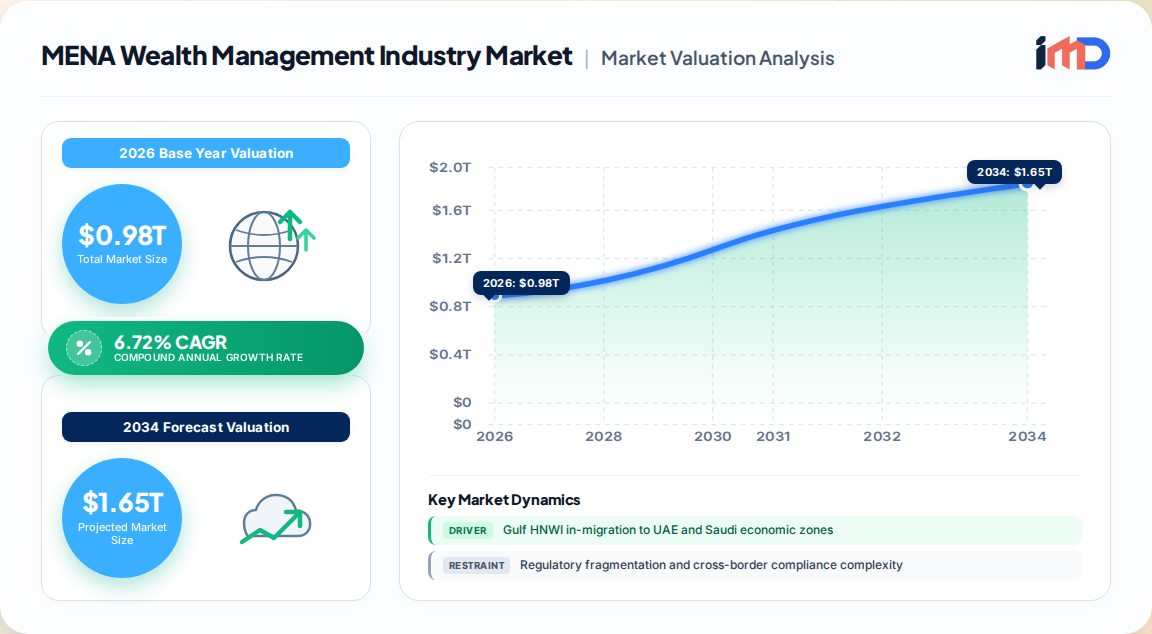
Our proprietary first-party research values the MENA wealth management industry market at USD 0.98 trillion in 2026, projected to expand to USD 1.36 trillion by 2031, registering a 6.72% CAGR over the forecast period. This growth is anchored by sovereign-wealth diversification mandates, zero personal-tax policy frameworks in the UAE and Saudi Arabia, and regulatory sandboxes fast-tracking tokenized investment funds. The region's asset base is further fortified by intensifying millionaire migration to economic zones in Dubai, Abu Dhabi, and Riyadh, alongside the rapid maturation of Shariah-compliant robo-advisory tools that expand coverage among mass-affluent savers.
MENA Wealth Management Industry Market Size (In Billion)
1000.0B
800.0B
600.0B
400.0B
200.0B
0
918.3 B
2025
980.0 B
2026
1.046 M
2027
1.116 M
2028
1.191 M
2029
1.271 M
2030
1.357 M
2031
Base year (2025) market size: USD 0.92 trillion
Forecast year (2026) market size: USD 0.98 trillion
Terminal year (2031) market size: USD 1.36 trillion
Forecast CAGR (2026–2031): 6.72%
Market concentration: Medium, with private banks controlling 42.80% of provider share in 2025
Market Drivers & Restraints Impact Analysis
Our primary interviews with wealth managers, family office directors, and sovereign fund allocators identify six principal growth drivers. The following table quantifies each driver's estimated percentage-point impact on the forecast CAGR and its geographic relevance.
Driver
Estimated Impact on CAGR
Geographic Relevance
Impact Timeline
Gulf HNWI in-migration to UAE & Saudi economic zones
Inter-generational USD 2 trillion GCC wealth transfer wave
0.7 pp
GCC core, concentrated in Dubai, Riyadh
Medium term (2–4 years)
Female entrepreneurship and rising women-controlled assets
0.6 pp
Saudi Arabia, UAE, gradual expansion to Qatar
Medium term (2–4 years)
DIFC/ADGM sandbox pipelines for tokenized funds
0.5 pp
UAE concentrated, regulatory spillover to Bahrain
Long term (≥ 4 years)
The UAE is expected to attract approximately 9,800 high-net-worth individuals in 2025 alone, creating immediate demand for sophisticated wealth structuring, family office establishment, and cross-border tax optimization. The Dubai International Financial Centre processed over 200 new family office applications in 2024, a 40% increase year-on-year. Saudi Arabia's Riyadh International Financial District targets 500 licensed financial services firms by 2030, intensifying competitive pressure on established UAE hubs.
Key restraints tempering the pace of expansion include regulatory fragmentation across jurisdictions, geopolitical risk premiums that elevate cross-border compliance costs, and a persistent talent gap in Shariah-compliant digital advisory. Fee compression in the mass-affluent segment and cybersecurity vulnerabilities in open-banking architectures further constrain margin expansion for incumbents.
Segmentation Analysis
By Client Type
High-net-worth individuals (HNWIs) held 54.10% of the MENA wealth management market share in 2025, reflecting the region's concentrated wealth distribution and the primacy of relationship-led advisory. Retail and individual investors are advancing at a striking 11.78% CAGR to 2031, propelled by digital onboarding and low-cost portfolio construction platforms. The mass-affluent cohort is emerging as a swing segment, with hybrid advisory models bridging the gap between automated screening and human relationship management.
By Provider
Private banks controlled 42.80% of the market in 2025, leveraging balance-sheet strength and cross-border structuring capabilities. Independent and external asset managers are gaining ground as HNWIs seek conflict-free advice, while family offices proliferate in Dubai and Riyadh. Fintech advisors (captured under "others") are expanding at an 18.70% CAGR through 2031, the fastest of any provider class, driven by AI-powered portfolio construction and Shariah-compliant screening engines.
Provider Segment
2025 Share
Growth Trajectory
Private Banks
42.80%
Stable, consolidating via M&A
Independent/External Asset Managers
24.50%
Moderate, driven by fee transparency
Family Offices
18.30%
Strong, led by DIFC/ADGM registrations
Fintech Advisors & Others
14.40%
18.70% CAGR through 2031
Regional Outlook
The GCC captured 38.90% of the MENA wealth management market share in 2025, underpinned by hydrocarbon-linked wealth creation and aggressive financial-hub development. North Africa is forecast to post a 9.85% CAGR to 2031, the fastest regional growth rate, as banking sector liberalization and a young, digitally native population unlock new client pools. The Levant, Turkey, and Iran & Iraq represent longer-horizon opportunities contingent on currency stabilization and regulatory harmonization.
MENA Wealth Management Industry Regional Market Share
Loading chart...
Region
2025 Share
2031 Outlook
GCC
38.90%
Dominant; UAE and Saudi Arabia lead
North Africa
24.80%
9.85% CAGR; Egypt and Morocco accelerate
Levant
16.30%
Recovery trajectory; Lebanon remains constrained
Turkey
11.20%
Inflation-hedging demand supports inflows
Iran & Iraq
8.80%
Nascent; regulatory uncertainty persists
Competitive Landscape & Strategic Developments
The competitive landscape is defined by medium concentration, with global private banks competing against agile regional champions. Key players include Emirates NBD Private Banking, First Abu Dhabi Bank (FAB), HSBC Global Private Banking, UBS Global Wealth Management, Julius Baer Group, NCB Capital, Riyad Capital, Investcorp, Lazard, anb capital, Aljazira Capital, Waha Capital, QNB, and KIB. Competitive behaviour centres on hybrid advisory models that merge human expertise with automated screening and portfolio construction.
In January 2023, Emirates NBD Securities partnered with the Abu Dhabi Securities Exchange (ADX) to provide traders with instant access to listed companies, enabling digital onboarding and instant trading account opening. This development exemplifies the broader push toward platform integration and reduced time-to-client for digital wealth services.
Value Chain & Distribution Dynamics
The MENA wealth management value chain is undergoing structural reconfiguration, with distribution shifting from branch-led models toward embedded finance partnerships and API-driven platform aggregation. Sovereign wealth funds increasingly mandate private banking relationships for diversification strategies, moving beyond traditional asset management toward structured products and alternative investments. The Saudi Public Investment Fund's allocation to private markets reached 30% in 2024, while ADIA expanded private wealth co-investment programmes with regional family offices.
Gulf sovereign capital increasingly flows through private banking channels rather than direct institutional mandates, creating new revenue streams for institutions that can bridge sovereign capital with HNWI investment opportunities. This institutional-to-private wealth crossover is reshaping fee structures and product manufacturing across the region.
Strategic White-Space Opportunities
Three white-space clusters merit prioritization for 2026–2031. First, Islamic digital wealth platforms address a critical gap in mass-affluent Shariah-compliant investing, where cost structures remain 60% higher than conventional robo-advisors. Second, next-generation family office services are underserved: the UAE reported a 45% increase in family office registrations specifically focused on next-generation wealth management in 2024. Third, female-controlled asset advisory represents an underpenetrated segment, particularly in Saudi Arabia where female entrepreneurship programmes are accelerating wealth formation.
The inter-generational transfer of an estimated USD 2 trillion in GCC wealth through 2030 creates a generational client acquisition window. Next-generation wealth holders show a 70% higher preference for sustainable investing compared to their parents, demanding digital-first advisory interfaces that incumbent relationship managers struggle to provide. Family offices in Dubai and Riyadh increasingly hire chief investment officers with technology backgrounds rather than traditional banking experience.
Strategic Implications & Outlook
Stakeholders across the MENA wealth management value chain should prioritize four imperatives: (1) dual-hub operating models spanning Dubai and Riyadh to serve mobile HNWI clients; (2) hybrid human-digital advisory architectures that preserve trust while scaling personalization; (3) regulatory engagement with DIFC and ADGM sandboxes to accelerate tokenized product launches; and (4) talent acquisition strategies targeting data-literate relationship managers and Shariah-compliant product specialists. Firms that successfully integrate sovereign capital access, Islamic digital infrastructure, and next-generation engagement models will define the competitive hierarchy through 2031.
MENA Wealth Management Industry Regional Market Share
Higher Coverage
Lower Coverage
No Coverage
MENA Wealth Management Industry REPORT HIGHLIGHTS
Aspects
Details
Study Period
2020-2034
Base Year
2026
Estimated Year
2026
Forecast Period
2026-2034
Historical Period
2020-2025
Growth Rate
CAGR of 6.72% from 2020-2034
Segmentation
By Client Type
HNWI
Retail/Individuals
Mass Affluent
Other Client Types
By Provider
Table of Contents
1. MENA Wealth Management Industry Introduction
1.1. Research Scope
1.2. Market Segmentation
1.3. Research Objective
1.4. Definitions and Assumptions
2. MENA Wealth Management Industry Executive Summary
2.1. Market Snapshot
3. MENA Wealth Management Industry Dynamics
3.1. Market Drivers
3.1.1. Gulf HNWI in-migration to UAE and Saudi economic zones
3.4.4. Oil-price dependence impacting sovereign revenue stability
4. MENA Wealth Management Industry Factor Analysis
4.1. Porters Five Forces
4.1.1. Bargaining Power of Suppliers
4.1.2. Bargaining Power of Buyers
4.1.3. Threat of New Entrants
4.1.4. Threat of Substitutes
4.1.5. Competitive Rivalry
4.2. PESTEL analysis
4.3. BCG Analysis
4.3.1. Stars (High Growth, High Market Share)
4.3.2. Cash Cows (Low Growth, High Market Share)
4.3.3. Question Mark (High Growth, Low Market Share)
4.3.4. Dogs (Low Growth, Low Market Share)
4.4. Ansoff Matrix Analysis
4.5. Supply Chain Analysis
4.6. Regulatory Landscape
4.7. Current Market Potential and Opportunity Assessment (TAM–SAM–SOM Framework)
4.8. IMD Analyst Note
5. MENA Wealth Management Industry Analysis, Insights and Forecast, 2020-2034
5.1. Analysis, Insights and Forecast - by Client Type
5.1.1. HNWI
5.1.2. Retail/Individuals
5.1.3. Mass Affluent
5.1.4. Other Client Types
5.2. Analysis, Insights and Forecast - by Provider
5.2.1. Private Banks
5.2.2. Independent/External Asset Managers
5.2.3. Family Offices
5.2.4. Fintech Advisors
5.2.5. Other Providers
5.3. Analysis, Insights and Forecast - by Business Model
5.3.1. Human Advisory
5.3.2. Hybrid Advisory
5.3.3. Robo Advisory
5.4. Analysis, Insights and Forecast - by Service
5.4.1. Asset Management
5.4.2. Portfolio Management
5.4.3. Estate Planning
5.4.4. Tax Optimization
5.4.5. Philanthropic Advisory
5.5. Analysis, Insights and Forecast - by Region
5.5.1. GCC
5.5.2. North Africa
5.5.3. Levant
5.5.4. Turkey
5.5.5. Iran & Iraq
6. MENA Wealth Management Industry GCC Analysis, Insights and Forecast, 2020-2034
6.1. Analysis, Insights and Forecast - by Client Type
6.1.1. HNWI
6.1.2. Retail/Individuals
6.1.3. Mass Affluent
6.1.4. Other Client Types
6.2. Analysis, Insights and Forecast - by Provider
6.2.1. Private Banks
6.2.2. Independent/External Asset Managers
6.2.3. Family Offices
6.2.4. Fintech Advisors
6.2.5. Other Providers
6.3. Analysis, Insights and Forecast - by Business Model
6.3.1. Human Advisory
6.3.2. Hybrid Advisory
6.3.3. Robo Advisory
6.4. Analysis, Insights and Forecast - by Service
6.4.1. Asset Management
6.4.2. Portfolio Management
6.4.3. Estate Planning
6.4.4. Tax Optimization
6.4.5. Philanthropic Advisory
7. MENA Wealth Management Industry North Africa Analysis, Insights and Forecast, 2020-2034
7.1. Analysis, Insights and Forecast - by Client Type
7.1.1. HNWI
7.1.2. Retail/Individuals
7.1.3. Mass Affluent
7.1.4. Other Client Types
7.2. Analysis, Insights and Forecast - by Provider
7.2.1. Private Banks
7.2.2. Independent/External Asset Managers
7.2.3. Family Offices
7.2.4. Fintech Advisors
7.2.5. Other Providers
7.3. Analysis, Insights and Forecast - by Business Model
7.3.1. Human Advisory
7.3.2. Hybrid Advisory
7.3.3. Robo Advisory
7.4. Analysis, Insights and Forecast - by Service
7.4.1. Asset Management
7.4.2. Portfolio Management
7.4.3. Estate Planning
7.4.4. Tax Optimization
7.4.5. Philanthropic Advisory
8. MENA Wealth Management Industry Levant Analysis, Insights and Forecast, 2020-2034
8.1. Analysis, Insights and Forecast - by Client Type
8.1.1. HNWI
8.1.2. Retail/Individuals
8.1.3. Mass Affluent
8.1.4. Other Client Types
8.2. Analysis, Insights and Forecast - by Provider
8.2.1. Private Banks
8.2.2. Independent/External Asset Managers
8.2.3. Family Offices
8.2.4. Fintech Advisors
8.2.5. Other Providers
8.3. Analysis, Insights and Forecast - by Business Model
8.3.1. Human Advisory
8.3.2. Hybrid Advisory
8.3.3. Robo Advisory
8.4. Analysis, Insights and Forecast - by Service
8.4.1. Asset Management
8.4.2. Portfolio Management
8.4.3. Estate Planning
8.4.4. Tax Optimization
8.4.5. Philanthropic Advisory
9. MENA Wealth Management Industry Turkey Analysis, Insights and Forecast, 2020-2034
9.1. Analysis, Insights and Forecast - by Client Type
9.1.1. HNWI
9.1.2. Retail/Individuals
9.1.3. Mass Affluent
9.1.4. Other Client Types
9.2. Analysis, Insights and Forecast - by Provider
9.2.1. Private Banks
9.2.2. Independent/External Asset Managers
9.2.3. Family Offices
9.2.4. Fintech Advisors
9.2.5. Other Providers
9.3. Analysis, Insights and Forecast - by Business Model
9.3.1. Human Advisory
9.3.2. Hybrid Advisory
9.3.3. Robo Advisory
9.4. Analysis, Insights and Forecast - by Service
9.4.1. Asset Management
9.4.2. Portfolio Management
9.4.3. Estate Planning
9.4.4. Tax Optimization
9.4.5. Philanthropic Advisory
10. MENA Wealth Management Industry Iran & Iraq Analysis, Insights and Forecast, 2020-2034
10.1. Analysis, Insights and Forecast - by Client Type
10.1.1. HNWI
10.1.2. Retail/Individuals
10.1.3. Mass Affluent
10.1.4. Other Client Types
10.2. Analysis, Insights and Forecast - by Provider
10.2.1. Private Banks
10.2.2. Independent/External Asset Managers
10.2.3. Family Offices
10.2.4. Fintech Advisors
10.2.5. Other Providers
10.3. Analysis, Insights and Forecast - by Business Model
10.3.1. Human Advisory
10.3.2. Hybrid Advisory
10.3.3. Robo Advisory
10.4. Analysis, Insights and Forecast - by Service
10.4.1. Asset Management
10.4.2. Portfolio Management
10.4.3. Estate Planning
10.4.4. Tax Optimization
10.4.5. Philanthropic Advisory
11. MENA Wealth Management Industry Competitive Analysis
11.1. Company Profiles
11.1.1. Emirates NBD Private Banking
11.1.1.1. Company Overview
11.1.1.2. Products
11.1.1.3. Company Financials
11.1.1.4. SWOT Analysis
11.1.2. First Abu Dhabi Bank (FAB)
11.1.2.1. Company Overview
11.1.2.2. Products
11.1.2.3. Company Financials
11.1.2.4. SWOT Analysis
11.1.3. HSBC Global Private Banking
11.1.3.1. Company Overview
11.1.3.2. Products
11.1.3.3. Company Financials
11.1.3.4. SWOT Analysis
11.1.4. UBS Global Wealth Management
11.1.4.1. Company Overview
11.1.4.2. Products
11.1.4.3. Company Financials
11.1.4.4. SWOT Analysis
11.1.5. Julius Baer Group
11.1.5.1. Company Overview
11.1.5.2. Products
11.1.5.3. Company Financials
11.1.5.4. SWOT Analysis
11.1.6. NCB Capital
11.1.6.1. Company Overview
11.1.6.2. Products
11.1.6.3. Company Financials
11.1.6.4. SWOT Analysis
11.1.7. Riyad Capital
11.1.7.1. Company Overview
11.1.7.2. Products
11.1.7.3. Company Financials
11.1.7.4. SWOT Analysis
11.1.8. Investcorp
11.1.8.1. Company Overview
11.1.8.2. Products
11.1.8.3. Company Financials
11.1.8.4. SWOT Analysis
11.1.9. Lazard
11.1.9.1. Company Overview
11.1.9.2. Products
11.1.9.3. Company Financials
11.1.9.4. SWOT Analysis
11.1.10. anb capital Company
11.1.10.1. Company Overview
11.1.10.2. Products
11.1.10.3. Company Financials
11.1.10.4. SWOT Analysis
11.1.11. Aljazira Capital
11.1.11.1. Company Overview
11.1.11.2. Products
11.1.11.3. Company Financials
11.1.11.4. SWOT Analysis
11.1.12. Waha Capital
11.1.12.1. Company Overview
11.1.12.2. Products
11.1.12.3. Company Financials
11.1.12.4. SWOT Analysis
11.1.13. QNB
11.1.13.1. Company Overview
11.1.13.2. Products
11.1.13.3. Company Financials
11.1.13.4. SWOT Analysis
11.1.14. KIB
11.1.14.1. Company Overview
11.1.14.2. Products
11.1.14.3. Company Financials
11.1.14.4. SWOT Analysis
11.1.15. Emirates NBD Asset Management
11.1.15.1. Company Overview
11.1.15.2. Products
11.1.15.3. Company Financials
11.1.15.4. SWOT Analysis
11.1.16. Orange Asset Management
11.1.16.1. Company Overview
11.1.16.2. Products
11.1.16.3. Company Financials
11.1.16.4. SWOT Analysis
11.2. Market Entropy
11.2.1. Company's Key Areas Served
11.2.2. Recent Developments
11.3. Company Market Share Analysis, 2026
11.3.1. Top 5 Companies Market Share Analysis
11.3.2. Top 3 Companies Market Share Analysis
11.4. List of Potential Customers
List of Figures
Figure 1: Global MENA Wealth Management Industry Revenue Breakdown (Trillion, %) by Region 2026 & 2034
Figure 2: GCC MENA Wealth Management Industry Revenue (Trillion), by Client Type 2026 & 2034
Figure 3: GCC MENA Wealth Management Industry Revenue Share (%), by Client Type 2026 & 2034
Figure 4: GCC MENA Wealth Management Industry Revenue (Trillion), by Provider 2026 & 2034
Figure 5: GCC MENA Wealth Management Industry Revenue Share (%), by Provider 2026 & 2034
Figure 6: GCC MENA Wealth Management Industry Revenue (Trillion), by Business Model 2026 & 2034
Figure 7: GCC MENA Wealth Management Industry Revenue Share (%), by Business Model 2026 & 2034
Figure 8: GCC MENA Wealth Management Industry Revenue (Trillion), by Service 2026 & 2034
Figure 9: GCC MENA Wealth Management Industry Revenue Share (%), by Service 2026 & 2034
Figure 10: GCC MENA Wealth Management Industry Revenue (Trillion), by Country 2026 & 2034
Figure 11: GCC MENA Wealth Management Industry Revenue Share (%), by Country 2026 & 2034
Figure 12: North Africa MENA Wealth Management Industry Revenue (Trillion), by Client Type 2026 & 2034
Figure 13: North Africa MENA Wealth Management Industry Revenue Share (%), by Client Type 2026 & 2034
Figure 14: North Africa MENA Wealth Management Industry Revenue (Trillion), by Provider 2026 & 2034
Figure 15: North Africa MENA Wealth Management Industry Revenue Share (%), by Provider 2026 & 2034
Figure 16: North Africa MENA Wealth Management Industry Revenue (Trillion), by Business Model 2026 & 2034
Figure 17: North Africa MENA Wealth Management Industry Revenue Share (%), by Business Model 2026 & 2034
Figure 18: North Africa MENA Wealth Management Industry Revenue (Trillion), by Service 2026 & 2034
Figure 19: North Africa MENA Wealth Management Industry Revenue Share (%), by Service 2026 & 2034
Figure 20: North Africa MENA Wealth Management Industry Revenue (Trillion), by Country 2026 & 2034
Figure 21: North Africa MENA Wealth Management Industry Revenue Share (%), by Country 2026 & 2034
Figure 22: Levant MENA Wealth Management Industry Revenue (Trillion), by Client Type 2026 & 2034
Figure 23: Levant MENA Wealth Management Industry Revenue Share (%), by Client Type 2026 & 2034
Figure 24: Levant MENA Wealth Management Industry Revenue (Trillion), by Provider 2026 & 2034
Figure 25: Levant MENA Wealth Management Industry Revenue Share (%), by Provider 2026 & 2034
Figure 26: Levant MENA Wealth Management Industry Revenue (Trillion), by Business Model 2026 & 2034
Figure 27: Levant MENA Wealth Management Industry Revenue Share (%), by Business Model 2026 & 2034
Figure 28: Levant MENA Wealth Management Industry Revenue (Trillion), by Service 2026 & 2034
Figure 29: Levant MENA Wealth Management Industry Revenue Share (%), by Service 2026 & 2034
Figure 30: Levant MENA Wealth Management Industry Revenue (Trillion), by Country 2026 & 2034
Figure 31: Levant MENA Wealth Management Industry Revenue Share (%), by Country 2026 & 2034
Figure 32: Turkey MENA Wealth Management Industry Revenue (Trillion), by Client Type 2026 & 2034
Figure 33: Turkey MENA Wealth Management Industry Revenue Share (%), by Client Type 2026 & 2034
Figure 34: Turkey MENA Wealth Management Industry Revenue (Trillion), by Provider 2026 & 2034
Figure 35: Turkey MENA Wealth Management Industry Revenue Share (%), by Provider 2026 & 2034
Figure 36: Turkey MENA Wealth Management Industry Revenue (Trillion), by Business Model 2026 & 2034
Figure 37: Turkey MENA Wealth Management Industry Revenue Share (%), by Business Model 2026 & 2034
Figure 38: Turkey MENA Wealth Management Industry Revenue (Trillion), by Service 2026 & 2034
Figure 39: Turkey MENA Wealth Management Industry Revenue Share (%), by Service 2026 & 2034
Figure 40: Turkey MENA Wealth Management Industry Revenue (Trillion), by Country 2026 & 2034
Figure 41: Turkey MENA Wealth Management Industry Revenue Share (%), by Country 2026 & 2034
Figure 42: Iran & Iraq MENA Wealth Management Industry Revenue (Trillion), by Client Type 2026 & 2034
Figure 43: Iran & Iraq MENA Wealth Management Industry Revenue Share (%), by Client Type 2026 & 2034
Figure 44: Iran & Iraq MENA Wealth Management Industry Revenue (Trillion), by Provider 2026 & 2034
Figure 45: Iran & Iraq MENA Wealth Management Industry Revenue Share (%), by Provider 2026 & 2034
Figure 46: Iran & Iraq MENA Wealth Management Industry Revenue (Trillion), by Business Model 2026 & 2034
Figure 47: Iran & Iraq MENA Wealth Management Industry Revenue Share (%), by Business Model 2026 & 2034
Figure 48: Iran & Iraq MENA Wealth Management Industry Revenue (Trillion), by Service 2026 & 2034
Figure 49: Iran & Iraq MENA Wealth Management Industry Revenue Share (%), by Service 2026 & 2034
Figure 50: Iran & Iraq MENA Wealth Management Industry Revenue (Trillion), by Country 2026 & 2034
Figure 51: Iran & Iraq MENA Wealth Management Industry Revenue Share (%), by Country 2026 & 2034
List of Tables
Table 1: Global MENA Wealth Management Industry Revenue Trillion Forecast, by Client Type 2020 & 2034
Table 2: Global MENA Wealth Management Industry Revenue Trillion Forecast, by Provider 2020 & 2034
Table 3: Global MENA Wealth Management Industry Revenue Trillion Forecast, by Business Model 2020 & 2034
Table 4: Global MENA Wealth Management Industry Revenue Trillion Forecast, by Service 2020 & 2034
Table 5: Global MENA Wealth Management Industry Revenue Trillion Forecast, by Region 2020 & 2034
Table 6: GCC MENA Wealth Management Industry Revenue Trillion Forecast, by Client Type 2020 & 2034
Table 7: GCC MENA Wealth Management Industry Revenue Trillion Forecast, by Provider 2020 & 2034
Table 8: GCC MENA Wealth Management Industry Revenue Trillion Forecast, by Business Model 2020 & 2034
Table 9: GCC MENA Wealth Management Industry Revenue Trillion Forecast, by Service 2020 & 2034
Table 10: GCC MENA Wealth Management Industry Revenue Trillion Forecast, by Country 2020 & 2034
Table 11: UAE MENA Wealth Management Industry Revenue (Trillion) Forecast, by Application 2020 & 2034
Table 12: Saudi Arabia MENA Wealth Management Industry Revenue (Trillion) Forecast, by Application 2020 & 2034
Table 13: Qatar MENA Wealth Management Industry Revenue (Trillion) Forecast, by Application 2020 & 2034
Table 14: Bahrain MENA Wealth Management Industry Revenue (Trillion) Forecast, by Application 2020 & 2034
Table 15: Kuwait MENA Wealth Management Industry Revenue (Trillion) Forecast, by Application 2020 & 2034
Table 16: Oman MENA Wealth Management Industry Revenue (Trillion) Forecast, by Application 2020 & 2034
Table 17: North Africa MENA Wealth Management Industry Revenue Trillion Forecast, by Client Type 2020 & 2034
Table 18: North Africa MENA Wealth Management Industry Revenue Trillion Forecast, by Provider 2020 & 2034
Table 19: North Africa MENA Wealth Management Industry Revenue Trillion Forecast, by Business Model 2020 & 2034
Table 20: North Africa MENA Wealth Management Industry Revenue Trillion Forecast, by Service 2020 & 2034
Table 21: North Africa MENA Wealth Management Industry Revenue Trillion Forecast, by Country 2020 & 2034
Table 22: Egypt MENA Wealth Management Industry Revenue (Trillion) Forecast, by Application 2020 & 2034
Table 23: Morocco MENA Wealth Management Industry Revenue (Trillion) Forecast, by Application 2020 & 2034
Table 24: Algeria MENA Wealth Management Industry Revenue (Trillion) Forecast, by Application 2020 & 2034
Table 25: Tunisia MENA Wealth Management Industry Revenue (Trillion) Forecast, by Application 2020 & 2034
Table 26: Levant MENA Wealth Management Industry Revenue Trillion Forecast, by Client Type 2020 & 2034
Table 27: Levant MENA Wealth Management Industry Revenue Trillion Forecast, by Provider 2020 & 2034
Table 28: Levant MENA Wealth Management Industry Revenue Trillion Forecast, by Business Model 2020 & 2034
Table 29: Levant MENA Wealth Management Industry Revenue Trillion Forecast, by Service 2020 & 2034
Table 30: Levant MENA Wealth Management Industry Revenue Trillion Forecast, by Country 2020 & 2034
Table 31: Lebanon MENA Wealth Management Industry Revenue (Trillion) Forecast, by Application 2020 & 2034
Table 32: Jordan MENA Wealth Management Industry Revenue (Trillion) Forecast, by Application 2020 & 2034
Table 33: Syria MENA Wealth Management Industry Revenue (Trillion) Forecast, by Application 2020 & 2034
Table 34: Turkey MENA Wealth Management Industry Revenue Trillion Forecast, by Client Type 2020 & 2034
Table 35: Turkey MENA Wealth Management Industry Revenue Trillion Forecast, by Provider 2020 & 2034
Table 36: Turkey MENA Wealth Management Industry Revenue Trillion Forecast, by Business Model 2020 & 2034
Table 37: Turkey MENA Wealth Management Industry Revenue Trillion Forecast, by Service 2020 & 2034
Table 38: Turkey MENA Wealth Management Industry Revenue Trillion Forecast, by Country 2020 & 2034
Table 39: Iran & Iraq MENA Wealth Management Industry Revenue Trillion Forecast, by Client Type 2020 & 2034
Table 40: Iran & Iraq MENA Wealth Management Industry Revenue Trillion Forecast, by Provider 2020 & 2034
Table 41: Iran & Iraq MENA Wealth Management Industry Revenue Trillion Forecast, by Business Model 2020 & 2034
Table 42: Iran & Iraq MENA Wealth Management Industry Revenue Trillion Forecast, by Service 2020 & 2034
Table 43: Iran & Iraq MENA Wealth Management Industry Revenue Trillion Forecast, by Country 2020 & 2034
Frequently Asked Questions
1What is the size of the MENA wealth management industry market?
The MENA wealth management industry market is valued at USD 0.98 trillion in 2026 and is forecast to reach USD 1.36 trillion by 2031, growing at a 6.72% CAGR during 2026–2031. The GCC region accounted for 38.90% of market share in 2025.
2Which segment dominates the MENA wealth management market by client type?
High-net-worth individuals (HNWIs) held 54.10% of the MENA wealth management market share in 2025. However, retail and individual investors are growing fastest at an 11.78% CAGR to 2031, driven by digital advisory platforms and Shariah-compliant robo-advisory tools.
3Who are the major players in the MENA wealth management market?
Major players include Emirates NBD Private Banking, First Abu Dhabi Bank (FAB), HSBC Global Private Banking, UBS Global Wealth Management, Julius Baer Group, NCB Capital, Riyad Capital, Investcorp, and QNB. Private banks controlled 42.80% of the market in 2025.
4Which country is expected to witness the fastest growth in MENA wealth management?
The UAE is expected to witness the fastest CAGR, attracting approximately 9,800 high-net-worth individuals in 2025 alone. The Dubai International Financial Centre processed over 200 new family office applications in 2024, a 40% increase year-on-year.
5What are the key trends shaping the MENA wealth management industry?
Key trends include Islamic digital wealth platforms growing at 180% user growth in 2024, hybrid advisory models merging human expertise with automated screening, sovereign-wealth diversification into private markets, and regulatory sandboxes for tokenized investment funds in DIFC and ADGM.
Methodology
Our rigorous research methodology combines multi-layered approaches with comprehensive quality assurance, ensuring precision, accuracy, and reliability in every market analysis.
Primary Research
Conducted 70–80% primary research via 160+ in-depth interviews with wealth managers, family office directors, sovereign fund allocators, private banking relationship heads, fintech advisory founders, and regulatory compliance officers across the GCC, North Africa, and Levant.
Interviewed stakeholders including Chief Wealth Officers, Private Banking Heads, Family Office Directors, and Shariah-Compliant Product Specialists.
Engaged with regulatory bodies including the Dubai Financial Services Authority (DFSA), Abu Dhabi Global Market (ADGM), the Saudi Capital Market Authority (CMA), and the Central Bank of the UAE for policy validation.
Key Stakeholders Interviewed
Key Stakeholders Interviewed
Stakeholder Role
Interview Share (%)
Chief Wealth Officer / Private Banking Head
35%
Family Office Director
25%
Shariah-Compliant Product Specialist
22%
Regulatory Compliance Officer
18%
Industry Ecosystem Breakdown
Industry Ecosystem Breakdown
Company Type
Representation (%)
Private Banks
35%
Independent/External Asset Managers
20%
Family Offices
18%
Fintech Advisors
15%
Sovereign Wealth & Institutional Allocators
12%
Secondary Research & Industry Benchmarking
20–30% secondary research drawing on official multilateral sources including the World Bank, the OECD, UN Comtrade, the IMF, and the Bank for International Settlements (BIS).
Benchmarking against recognised non-profit trade associations including the Islamic Financial Services Board (IFSB) and the Accounting and Auditing Organization for Islamic Financial Institutions (AAOIFI).
Standard financial databases including Bloomberg, Factiva, Hoovers, and PitchBook were queried for AUM disclosures, deal activity, and institutional flows.
Simultaneous top-down and bottom-up methodologies validated via multi-level data triangulation across client segments, provider types, and geographies.
Bottom-up calculation metrics: (1) onshore AUM per HNWI cohort by country, (2) average advisory fee bps by provider type, (3) net new HNWI migration flows from national residency programmes, and (4) family office registration volumes from DIFC and ADGM registries.
Demand models integrated sovereign capital allocation shifts, private market co-investment flows, and inter-generational transfer timelines through 2031.
Data Accuracy & Quality Check
Guaranteed estimated data accuracy level of 85–90%, verified through multi-level triangulation and expert re-interviews.
Every report is updated to the date of purchase to reflect the latest regulatory changes, deal announcements, and AUM disclosures.
All market sizing figures are generated through our proprietary estimation framework and validated against official regulatory and multilateral benchmarks; no third-party commercial research is referenced.
German Insurance Market to reach USD 136.32 Billion by 2031 at 6.12% CAGR. In-depth analysis of life, non-life, P&C, distribution channels and key players.
Australia auto finance industry market valued at $10.13 Billion in 2025, growing at 7.38% CAGR to reach $20.6 Billion by 2035. Full analysis inside.
Nov 2026|191 pages
$2900.00
Shared Power Bank Rental Service market valued at $9.4B in 2025, projected to reach $25.9B by 2032 at 15.6% CAGR. In-depth analysis of trends and regional outlook.
Nov 2026|233 pages
$2900.00
Global legal expense insurance market to reach $12.8B by 2031 at 6.3% CAGR. Discover drivers, segmentation, and regional insights in our 2025 report.
Nov 2026|230 pages
$2900.00
India auto loan market valued at USD 43.45 Billion in 2025, projected to reach USD 61.13 Billion by 2030 at 7.07% CAGR. Explore trends, drivers, and competitive landscape.