1What is the market size of the medical thawing system market in 2024?
The global medical thawing system market was valued at USD 221.9 million in 2024 and is projected to reach USD 355.9 million by 2030, growing at a CAGR of 8.3%.
Insight Market Data is a premier market research and business consulting firm headquartered in Pune, India, providing syndicated research reports, customized intelligence studies, and strategic advisory services. Renowned academic institutions and Fortune 500 corporations worldwide rely on Insight Market Data's research repository to navigate evolving global and regional business environments. Covering 46 diverse industries across 25 major international economies, our comprehensive database delivers thousands of verified statistics and granular market evaluations. By combining industry-leading analytical methodologies with the direct insights of seasoned industry leaders and subject-matter experts, we deliver actionable intelligence spanning historical performance benchmarks to rigorous multi-year forecasts. We empower organizations to make confident, data-driven decisions across pivotal domains including Machinery & Equipment, Chemicals & Materials, Pharmaceuticals & Healthcare, Food & Beverages, Consumer Goods, Energy & Power, Automotive & Transportation, Electronics & Semiconductors, Medical Devices, Telecommunications, Emerging Technologies, Agriculture, and Packaging. Our multidisciplinary analyst teams provide an objective 360-degree perspective, tailoring every engagement to address complex strategic challenges with exceptional analytical rigor.
Leveraging advanced BI-powered analytics and predictive modeling, Insight Market Data uncovers high-impact market opportunities and competitive differentiators for ambitious enterprises. We continuously refine our research methodologies in accordance with global industry standards, tracking real-time market shifts to ensure our reports are consistently accurate, actionable, and delivered on schedule. Our analysts conduct methodical data validation, rigorous compliance checks, and exhaustive primary and secondary research to maintain the highest levels of data integrity and transparency. We partner closely with corporate strategists, investment groups, and business executives to translate intricate market intelligence into clear, actionable roadmaps for sustainable growth. With operational presence across Washington, USA, and Vimannagar, Pune, India, Insight Market Data ensures direct access to dedicated research specialists and responsive customer support to answer your most strategic questions.
 Medical Thawing System
 by Type (Manual, Automated), by Sample (Blood, Embryo, Ovum, Semen), by End-use (Hospitals, Blood Banks & Transfusion Centers, Cord Blood & Stem Cell Banks, Research & Academic Institutes, Biotechnology & Pharmaceutical Companies, Tissue Banks), by North America (USA, Canada), by Europe (Germany, UK, France, Italy, Spain), by Asia Pacific (China, Japan, India, South Korea, Australia), by Latin America (Brazil, Mexico, Argentina), by Middle East & Africa (South Africa, Saudi Arabia, UAE) Forecast 2026-2034

Research Analyst


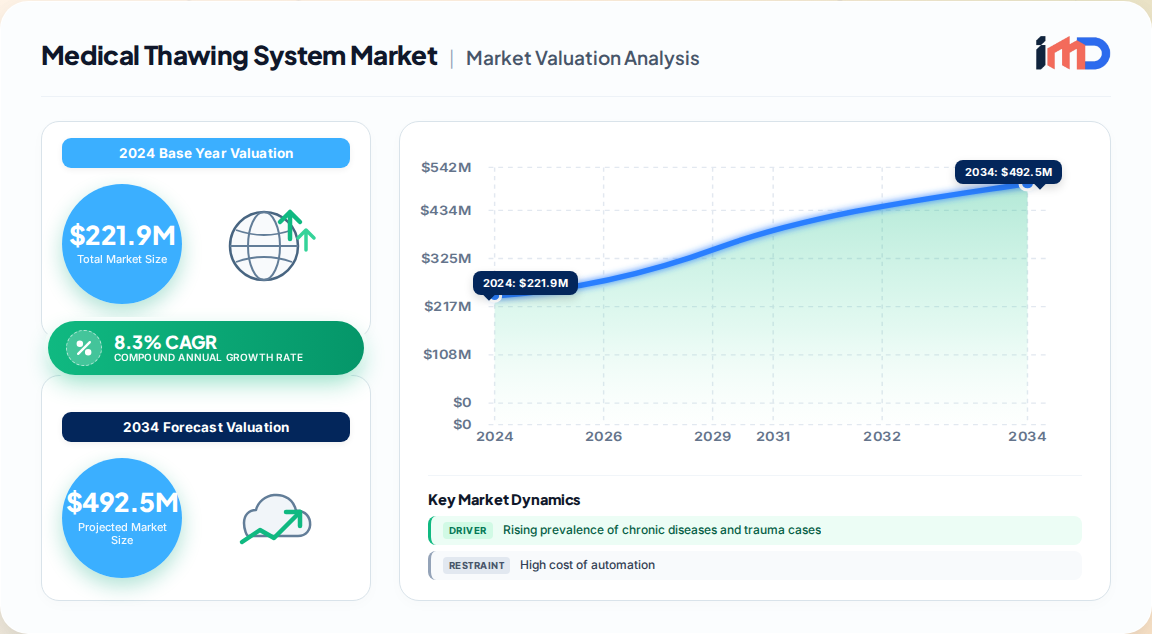
The global medical thawing system market is a critical component of the healthcare and life sciences equipment landscape, enabling the safe and controlled defrosting of biological samples for transfusion, transplantation, and advanced therapy applications. Our proprietary primary research and expert interviews indicate that the market was valued at USD 221.9 million in 2024 and is projected to grow to USD 355.9 million by 2030, registering a CAGR of 8.3% over the forecast period. This growth is underpinned by rising demand for blood component thawing, expanding frozen embryo transfer programs, and the scale-up of cell and gene therapy manufacturing.
North America remains the dominant regional market, accounting for the largest revenue share, driven by advanced healthcare infrastructure, high blood donation rates, and early adoption of automated technologies. Europe follows closely, with strong regulatory frameworks and growing ART (assisted reproductive technology) utilization. The Asia-Pacific region is identified as the fastest-growing market, fueled by increasing healthcare expenditure, expanding IVF networks, and improving blood banking infrastructure.
Key market participants are focusing on technological advancements, such as dry-heat thawing, closed-system platforms, and multi-bag thawing, to enhance efficiency, reduce contamination risks, and comply with stringent regulatory standards. The market is characterized by a mix of established players and emerging innovators, with a notable trend toward automated systems that offer precise temperature control and documentation capabilities.
The medical thawing system market is shaped by several robust drivers and persistent restraints that influence adoption and innovation.
Rising Prevalence of Chronic Diseases and Trauma Cases: The increasing incidence of chronic conditions such as cancer, cardiovascular diseases, and organ failures necessitates blood transfusions and organ transplants. According to the U.S. Government Information on Organ Donation and Transplantation, approximately 112,000 candidates were on the national transplant waiting list as of March 2020, underscoring the demand for reliable thawing solutions. Additionally, the Organ Procurement and Transplantation Network reported 46,632 organ transplant procedures in 2023, an 8.7% increase from the previous year, further driving the need for efficient thawing systems.
Expansion of Blood Transfusion Services: With approximately 120.4 million blood donations collected worldwide in 2023 (per WHO data), the volume of blood components requiring thawing continues to rise. This growth is particularly pronounced in emerging economies where blood banking infrastructure is being formalized and upgraded.
Accelerating Frozen Embryo Transfer (FET) Adoption: The shift toward vitrification and frozen embryo transfer in IVF cycles is a significant driver for specialized thawing systems. In the UK, the frozen embryo transfer share of IVF cycles rose from 24% in 2014 to 48% in 2024, while embryo-freezing cycles increased from roughly 1,900 to over 10,450 over the same period. This trend is mirrored globally, with over 401,483 FET cycles reported across 36 European countries in 2023, creating durable demand for ART warming workstations.
Cell and Gene Therapy Manufacturing Scale-Up: The commercialization of cell and gene therapies requires validated, closed-system thawing platforms that meet GMP requirements. Eight first-ever global CGT product approvals were recorded in 2025, signaling a growing need for qualified thawing systems that ensure product integrity and regulatory compliance.
High Cost of Automation: Automated thawing systems, while offering superior precision and efficiency, come with a higher price tag, limiting adoption in cost-sensitive healthcare settings, particularly in developing regions. The cost barrier is exacerbated by inadequate reimbursement policies in some markets.
Temperature Uniformity Challenges: Uneven heat distribution during thawing can compromise sample quality, leading to cautious adoption in applications requiring strict temperature control. This remains a technical challenge that vendors are addressing through advanced agitation and dry-heat technologies.
Extended Regulatory Timelines: Pre-market regulatory clearance, such as FDA 510(k) review, can be lengthy. For instance, the °M Warmer System required 322 days from submission to clearance in 2024. Such delays can hinder product launches and market entry, particularly for innovative technologies.
Infrastructure Limitations in Lower-Income Markets: In 119 of 168 WHO-reporting countries, all plasma-derived medicinal products are imported or none are used, reflecting limited blood establishment infrastructure. This constrains the addressable market for thawing systems in these regions.
The medical thawing system market is witnessing several transformative trends that are reshaping product development and end-user expectations.
Shift Toward Automated and Closed-System Platforms: Automated thawing systems are gaining traction due to their ability to deliver consistent, reproducible results while minimizing human error. The integration of closed-system thawing bags and controlled-temperature devices helps maintain sample integrity and reduces contamination risks, particularly for cryopreserved stem cells and CGT products.
Multi-Bag Thawing for Blood Components: The demand for rapid preparation of blood components has spurred the adoption of multi-bag thawing systems that can process several plasma units simultaneously. This improves workflow efficiency in blood banks and reduces turnaround times for transfusion services.
Dry-Heat Thawing Technology: Dry-heat thawing systems are increasingly preferred over traditional water baths due to their reduced risk of cross-contamination and easier compliance with quality management systems. These systems also support electronic data-logging, aligning with the documentation requirements of modern healthcare facilities.
Portable and Point-of-Care Devices: The trend toward decentralized healthcare delivery has led to the development of portable thawing devices suitable for ambulances, emergency rooms, and field hospitals. These devices enable rapid thawing of blood products in trauma cases where time is critical.
Integration with Digital Documentation: Automated systems are being equipped with software that records temperature profiles, batch records, and operator actions, facilitating regulatory compliance and quality assurance. This is particularly important for cell and gene therapy manufacturing, where traceability is paramount.
The medical thawing system market is segmented by type, sample, and end-use, each exhibiting distinct growth patterns and adoption drivers.
Manual Thawing Systems: Dominated the market with a revenue share of 56.6% in 2024, owing to their cost-effectiveness and simplicity. These systems are particularly appealing to budget-constrained facilities and remain prevalent in regions with limited automation budgets.
Automated Thawing Systems: Expected to grow at the fastest CAGR of 8.6% over the forecast period. Automated systems offer precise temperature control, reduced thaw times (often under three minutes), and compliance with stringent regulatory standards, making them indispensable for time-sensitive procedures such as organ transplantation and CGT manufacturing.
Blood: The largest sample segment, accounting for 52.6% share in 2024. The demand for rapid thawing of blood products in emergency and surgical settings is escalating, driven by increasing surgical volumes and trauma cases.
Embryo: Projected to register the fastest CAGR of 9.0% over the forecast period. The growing adoption of IVF and frozen embryo transfer cycles is a key driver. In 2023, India performed approximately 160,000 IVF cycles, reflecting the expanding fertility care market.
Ovum and Semen: These segments are also expected to contribute to growth, particularly with the expansion of ART services in Asia-Pacific and Latin America.
Blood Banks & Transfusion Centers: Held the largest share of 31.4% in 2024, driven by the need for rapid thawing of fresh frozen plasma and red blood cells for emergency transfusions. The expansion of blood banking infrastructure, especially in emerging markets, supports sustained demand.
Hospitals & Diagnostic Laboratories: A significant end-use segment, with hospitals increasingly adopting automated thawing systems for surgical and emergency departments. Diagnostic laboratories utilize thawing systems for processing frozen specimens.
Cord Blood & Stem Cell Banks: Expected to grow at a CAGR of 11.4% (2026-2034), fueled by the rising storage of cord blood and the expansion of stem cell therapies.
Research & Academic Institutes: These institutions drive demand for both manual and automated systems for research applications, including drug discovery and disease studies.
Biotechnology & Pharmaceutical Companies: The scale-up of biologics and CGT manufacturing requires qualified thawing platforms, presenting a high-value growth avenue.
North America leads the global medical thawing system market, supported by a well-established healthcare infrastructure, high healthcare expenditure, and the presence of key industry players. The U.S. alone performs a large number of organ transplants and blood transfusions, creating a substantial demand for thawing systems. The region is also at the forefront of adopting automated and closed-system technologies.
Europe is the second-largest market, with growth driven by increasing ART procedures, government initiatives to improve blood safety, and the presence of a robust regulatory framework. The region is expected to remain a key market for high-end thawing systems, particularly in Germany, the UK, and France.
Asia-Pacific is poised to be the fastest-growing region, with an estimated CAGR of over 10% during the forecast period. Factors such as rising healthcare expenditure, expanding medical tourism, and increasing awareness of blood donation are propelling market growth. Countries like China, India, and Japan are witnessing significant investments in healthcare infrastructure, including blood banks and IVF clinics.
Latin America and the Middle East & Africa are smaller but emerging markets, with growth driven by improving healthcare access and increasing focus on transfusion safety. However, infrastructure challenges and cost constraints may temper growth in these regions.
The medical thawing system market is moderately consolidated, with a mix of global players and regional specialists. Key companies are focusing on product innovation, strategic partnerships, and geographical expansion to strengthen their market position. The top five players collectively held a market share of approximately 52% in 2025, indicating a relatively concentrated competitive environment.
Leading companies include:
Recent developments in the market include product launches with enhanced automation and connectivity features, as well as strategic acquisitions to expand product portfolios and geographic reach. For instance, in 2024, a major player received FDA clearance for an advanced dry-heat thawing system, and in 2025, several companies announced partnerships with CGT manufacturers to develop validated thawing platforms.
Our analysis identifies several white-space opportunities for stakeholders in the medical thawing system market:
While thawing systems are not typically traded as commodities, the market is influenced by global supply chains for components such as heating elements, sensors, and control units. Key manufacturing hubs include North America, Europe, and Asia, with China and Germany being major exporters of laboratory and medical equipment. Trade data from UN Comtrade indicates that global exports of medical devices (HS code 9018) have been growing steadily, reflecting the overall expansion of the healthcare sector. However, specific trade data for thawing systems is not separately tracked. Suppliers are focusing on localized production to mitigate supply chain risks and reduce lead times. The COVID-19 pandemic highlighted the importance of resilient supply chains, prompting companies to diversify sourcing and increase inventory levels. Additionally, regulatory requirements such as the EU MDR and FDA 510(k) influence market access and require manufacturers to maintain robust quality management systems.
| Aspects | Details |
|---|---|
| Study Period | 2020-2034 |
| Base Year | 2024 |
| Estimated Year | 2026 |
| Forecast Period | 2026-2034 |
| Historical Period | 2020-2025 |
| Growth Rate | CAGR of 8.3% from 2020-2034 |
| Segmentation |
|
By End-use
| By Geography |
|
The global medical thawing system market was valued at USD 221.9 million in 2024 and is projected to reach USD 355.9 million by 2030, growing at a CAGR of 8.3%.
North America holds the largest share, accounting for 44.2% of the global market in 2024, driven by advanced healthcare infrastructure and high adoption of automated systems.
Key drivers include the increasing prevalence of chronic diseases, rising number of trauma cases, expansion of blood transfusion services, growth in frozen embryo transfer cycles, and the scale-up of cell and gene therapy manufacturing.
The embryo segment is projected to register the fastest CAGR of 9.0% over the forecast period, fueled by the rising adoption of IVF and frozen embryo transfer procedures.
Leading players include Thermo Fisher Scientific, Cytiva, Sartorius, Helmer Scientific, Barkey GmbH, BioLife Solutions, and Boekel Scientific, among others.
Our rigorous research methodology combines multi-layered approaches with comprehensive quality assurance, ensuring precision, accuracy, and reliability in every market analysis.
| Stakeholder Role | Interview Share (%) |
|---|---|
| Procurement Director | 30% |
| R&D Manager | 25% |
| Quality Assurance Head | 20% |
| Clinical Laboratory Manager | 15% |
| Regulatory Affairs Specialist | 10% |
| Company Type | Representation (%) |
|---|---|
| Hospitals & Blood Banks | 40% |
| Biopharmaceutical & CGT Companies | 25% |
| IVF Clinics | 15% |
| Research & Academic Institutes | 10% |
| Medical Device OEMs | 10% |
 Related Reports
