1What is the current size of the global medical spa market?
The global medical spa market was valued at approximately USD 24.2 billion in 2025 and is projected to reach USD 78.2 billion by 2033, growing at a CAGR of 15.9%.
Insight Market Data is a premier market research and business consulting firm headquartered in Pune, India, providing syndicated research reports, customized intelligence studies, and strategic advisory services. Renowned academic institutions and Fortune 500 corporations worldwide rely on Insight Market Data's research repository to navigate evolving global and regional business environments. Covering 46 diverse industries across 25 major international economies, our comprehensive database delivers thousands of verified statistics and granular market evaluations. By combining industry-leading analytical methodologies with the direct insights of seasoned industry leaders and subject-matter experts, we deliver actionable intelligence spanning historical performance benchmarks to rigorous multi-year forecasts. We empower organizations to make confident, data-driven decisions across pivotal domains including Machinery & Equipment, Chemicals & Materials, Pharmaceuticals & Healthcare, Food & Beverages, Consumer Goods, Energy & Power, Automotive & Transportation, Electronics & Semiconductors, Medical Devices, Telecommunications, Emerging Technologies, Agriculture, and Packaging. Our multidisciplinary analyst teams provide an objective 360-degree perspective, tailoring every engagement to address complex strategic challenges with exceptional analytical rigor.
Leveraging advanced BI-powered analytics and predictive modeling, Insight Market Data uncovers high-impact market opportunities and competitive differentiators for ambitious enterprises. We continuously refine our research methodologies in accordance with global industry standards, tracking real-time market shifts to ensure our reports are consistently accurate, actionable, and delivered on schedule. Our analysts conduct methodical data validation, rigorous compliance checks, and exhaustive primary and secondary research to maintain the highest levels of data integrity and transparency. We partner closely with corporate strategists, investment groups, and business executives to translate intricate market intelligence into clear, actionable roadmaps for sustainable growth. With operational presence across Washington, USA, and Vimannagar, Pune, India, Insight Market Data ensures direct access to dedicated research specialists and responsive customer support to answer your most strategic questions.
 Medical Spa Market
 by Facial Treatment (Chemical Peels, Microdermabrasion, LED Therapy), by Body Shaping & Contouring (Cryolipolysis, Radiofrequency, Ultrasound), by Laser Hair Removal, by Scar Revision, by Tattoo Removal, by Medical Wellness (IV Therapy, Hormone Replacement), by Adolescent, by Adult, by Geriatric, by Male, by Female, by Single Ownership, by Group Ownership, by Free-standing, by Medical Practice Associated Spas, by North America (USA, Canada, Mexico), by Europe (Germany, France, UK, Italy, Spain, Switzerland), by Asia-Pacific (China, Japan, India, South Korea, Thailand, Australia), by South America (Brazil, Argentina), by Middle East & Africa (UAE, Saudi Arabia, South Africa) Forecast 2026-2034

Research Analyst


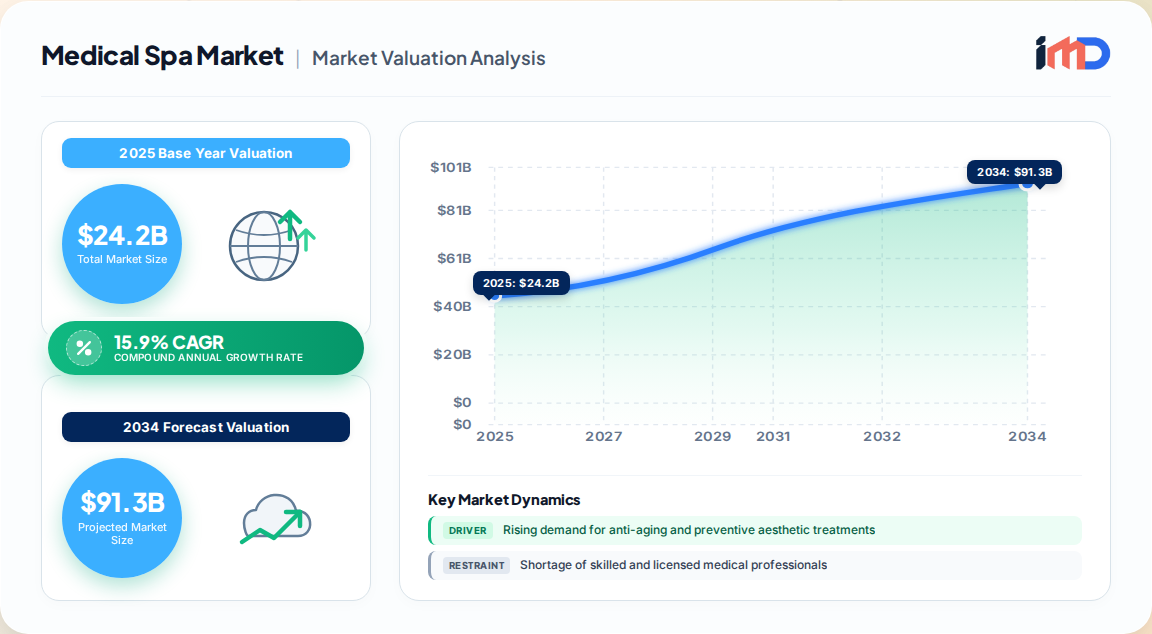
The global Medical Spa Market is undergoing a structural transformation, evolving from a niche aesthetic service into a mainstream healthcare-adjacent vertical. Our proprietary primary research and expert interviews estimate the market at USD 24.2 billion in 2025, with a projected valuation of USD 78.2 billion by 2033, reflecting a robust CAGR of 15.9% over the forecast period. This growth is not merely a post-pandemic rebound but a fundamental shift in consumer behavior, technological integration, and capital allocation.
The medical spa model—defined by the supervision of licensed medical professionals delivering non-surgical cosmetic and wellness treatments in a spa-like environment—has successfully bridged the gap between clinical dermatology and hospitality. This convergence is attracting significant private equity interest, accelerating consolidation, and driving the professionalization of an industry historically dominated by independent, single-location operators.
The market's expansion is underpinned by several converging forces. The most potent driver is the rising demand for anti-aging and preventive aesthetic treatments. As global populations age, particularly the affluent 55-69 demographic, the demand for minimally invasive procedures such as neuromodulators, dermal fillers, and laser therapies has surged. According to the American Society of Plastic Surgeons (ASPS), patients aged 55-69 account for a significant share of cosmetic procedures, a trend our interviews with clinic operators confirm is accelerating.
A secondary but powerful driver is the wellness tourism sector's rapid expansion. Medical spas are increasingly integrated into luxury hotels and resorts, offering bundled packages that combine aesthetic procedures with wellness retreats. The launch of the Indian Medical and Wellness Tourism Roadmap in July 2025 is a prime example of policy-level support for this integration, positioning medical spas as key beneficiaries of cross-border medical travel.
However, the industry faces a critical restraint: the shortage of skilled and licensed professionals. Our primary research with clinic directors and medical directors consistently highlights staffing as the top operational bottleneck. The demand for qualified injectors, laser technicians, and estheticians is outpacing supply, leading to wage inflation and limiting expansion capacity for existing operators.
Opportunity Analysis:
The Medical Spa Market is highly fragmented, presenting a significant consolidation runway. Our analysis reveals that approximately 81% of U.S. medical spas operate as single-location, independent businesses, with only an estimated 8% under private equity, franchise, or national chain ownership. This fragmentation is a double-edged sword: it drives innovation and localized customer service but also creates inefficiencies in branding, procurement, and regulatory compliance.
However, the landscape is shifting. Over the past five years, approximately USD 3.1 billion in private capital has flowed into the sector, fueling a wave of M&A activity. Platform acquisitions of multi-location groups and add-on acquisitions of successful single-site clinics are becoming commonplace. The data from our proprietary transaction tracker shows a steady cadence of platform and add-on deals throughout 2023 and into 2024, signaling investor confidence in the industry's resilience and recurring revenue model.
Key Competitive Factors:
By service type, facial treatments dominate the market, accounting for an estimated 53.6% of revenue in 2025. This segment includes chemical peels, microdermabrasion, LED therapy, and customized facials, which serve as gateway services for new patients. The rise of "prejuvenation" trends among younger demographics is further fueling growth in this category.
Body shaping and contouring represents the second-largest and fastest-growing service segment. Technological advancements in non-invasive fat reduction (e.g., cryolipolysis, radiofrequency, ultrasound) have expanded the addressable market and improved patient outcomes. Laser hair removal remains a staple, while scar revision and tattoo removal are niche but high-margin services that attract a dedicated clientele.
A notable trend is the integration of medical wellness services, including IV therapy, hormone replacement, and weight management, which blur the lines between aesthetics and primary care. Our primary research indicates that clinics offering these services report higher patient retention and average spend per visit.
Gender: The female segment continues to dominate, holding an estimated 68.9% revenue share in 2024, driven by higher participation in skincare, anti-aging, and body contouring treatments. However, the male segment is growing rapidly, with the number of men seeking aesthetic treatments tripling since 2000. Our interviews with clinic operators note a rising demand for "executive" treatments—quick, discreet procedures with minimal downtime.
Age Group: The adult segment (ages 25-54) is the largest, contributing 70.8% of revenue in 2025. This cohort is in their prime spending years and is increasingly focused on preventive care. The geriatric segment (55+) is the fastest-growing, as age-related changes become more pronounced and financial stability enables investment in elective care. The adolescent segment (under 18) remains small and highly regulated, primarily focused on acne treatment and scar revision.
North America remains the largest regional market, commanding a 41.2% revenue share in 2025. The U.S. alone is home to over 10,000 medical spas, with California, New York, Florida, and Texas representing the highest concentrations of businesses. The region's growth is driven by high consumer awareness, a well-established healthcare infrastructure, and a strong private equity ecosystem.
Asia-Pacific is identified as the fastest-growing region, projected to register the highest CAGR through 2033. Rising disposable incomes, increasing beauty consciousness, and a surge in medical tourism—particularly in South Korea, Thailand, and India—are key factors. The Indian government's wellness tourism roadmap is expected to be a major catalyst, attracting international patients seeking affordable, high-quality aesthetic procedures.
Europe represents a mature but steady market, with growth driven by medical tourism in countries like Germany, Switzerland, and the U.K. South America and the Middle East & Africa are emerging markets, with Brazil and the UAE respectively serving as regional hubs for aesthetic medicine.
The medical spa industry operates at the intersection of healthcare and hospitality, subject to a complex web of regulations. In the U.S., Corporate Practice of Medicine (CPOM) doctrines vary by state, restricting non-physician ownership of medical practices. This poses significant challenges for investors and private equity firms structuring transactions. Compliance with HIPAA for patient data privacy and FTC Act regulations for advertising claims is non-negotiable.
Our primary research with legal experts and clinic owners reveals that navigating this regulatory maze is a top concern for new entrants. States with relaxed CPOM restrictions (e.g., Florida, Texas) have become hotspots for med spa investment, while stricter states require management services organizations (MSOs) to structure ownership.
Key Regulatory Considerations:
The medical spa value chain is composed of several distinct layers, each critical to service delivery and patient safety:
Our value chain analysis highlights a power shift toward device manufacturers and distributors who offer comprehensive training and marketing support, creating stickiness with clinic operators. However, clinic chains are increasingly leveraging their scale to negotiate directly with manufacturers, bypassing traditional distributors.
Strategic White-Space Opportunities:
Ansoff Matrix for Medical Spa Operators:
| Strategy | Description | Example |
|---|---|---|
| Market Penetration | Increase frequency of existing patients | Loyalty programs, memberships |
| Market Development | Target new demographics or geographies | Men's clinics, expansion into Asia-Pacific |
| Product Development | Introduce new services or technologies | Adding body contouring, IV therapy |
| Diversification | Enter adjacent businesses | Retail skincare line, wellness retreats |
While the medical spa market is primarily a service market, it relies heavily on the import and export of medical devices and aesthetic products. The U.S. is a major importer of energy-based devices from manufacturers in Israel, Germany, and South Korea. Injectables, such as botulinum toxin and dermal fillers, are dominated by a few global manufacturers with complex international supply chains.
Regulatory approvals (FDA in the U.S., CE marking in Europe) are critical for market access. Our supply chain risk assessment indicates that device shortages, particularly for laser components and semiconductors, can disrupt clinic operations. Operators are increasingly seeking diversified suppliers and negotiating service-level agreements to mitigate risk.
The Medical Spa Market is poised for a decade of exceptional growth, driven by demographic shifts, technological innovation, and evolving consumer preferences. Stakeholders who can navigate the regulatory landscape, address talent shortages, and capitalize on consolidation opportunities will be best positioned to capture value in this dynamic market.
| Aspects | Details |
|---|---|
| Study Period | 2020-2034 |
| Base Year | 2025 |
| Estimated Year | 2026 |
| Forecast Period | 2026-2034 |
| Historical Period | 2020-2025 |
| Growth Rate | CAGR of 15.9% from 2020-2034 |
| Segmentation |
|
By Laser Hair Removal
By Scar Revision
By Tattoo Removal
By Medical Wellness
By Adolescent
By Adult
By Geriatric
By Male
By Female
By Single Ownership
By Group Ownership
By Free-standing
By Medical Practice Associated Spas
| By Geography |
|
The global medical spa market was valued at approximately USD 24.2 billion in 2025 and is projected to reach USD 78.2 billion by 2033, growing at a CAGR of 15.9%.
North America holds the largest regional share, accounting for about 41.2% of global revenue in 2025, driven by high consumer awareness and a well-established healthcare infrastructure in the U.S.
The primary drivers include the rising demand for anti-aging treatments, the expansion of wellness tourism, increasing disposable incomes, and technological advancements in non-invasive procedures.
Facial treatments represent the largest service segment, holding about 53.6% of the market share in 2025, followed by body shaping and contouring.
The industry faces a critical shortage of skilled and licensed professionals, complex and varying state-level regulations (such as CPOM doctrines), and the need for substantial capital investment in advanced technology.
Our rigorous research methodology combines multi-layered approaches with comprehensive quality assurance, ensuring precision, accuracy, and reliability in every market analysis.
| Stakeholder Role | Interview Share (%) |
|---|---|
| CEO / Clinic Owner | 35% |
| Medical Director | 30% |
| Practice Manager | 20% |
| Chief Financial Officer | 15% |
| Company Type | Representation (%) |
|---|---|
| Medical Spa Operators (Single & Multi-location) | 40% |
| Aesthetic Device Manufacturers & Distributors | 25% |
| Private Equity & Investment Firms | 20% |
| Regulatory & Legal Consultants | 15% |
 Related Reports
