About Insight Market Data

Insight Market Data is a premier market research and business consulting firm headquartered in Pune, India, providing syndicated research reports, customized intelligence studies, and strategic advisory services. Renowned academic institutions and Fortune 500 corporations worldwide rely on Insight Market Data's research repository to navigate evolving global and regional business environments. Covering 46 diverse industries across 25 major international economies, our comprehensive database delivers thousands of verified statistics and granular market evaluations. By combining industry-leading analytical methodologies with the direct insights of seasoned industry leaders and subject-matter experts, we deliver actionable intelligence spanning historical performance benchmarks to rigorous multi-year forecasts. We empower organizations to make confident, data-driven decisions across pivotal domains including Machinery & Equipment, Chemicals & Materials, Pharmaceuticals & Healthcare, Food & Beverages, Consumer Goods, Energy & Power, Automotive & Transportation, Electronics & Semiconductors, Medical Devices, Telecommunications, Emerging Technologies, Agriculture, and Packaging. Our multidisciplinary analyst teams provide an objective 360-degree perspective, tailoring every engagement to address complex strategic challenges with exceptional analytical rigor.

Leveraging advanced BI-powered analytics and predictive modeling, Insight Market Data uncovers high-impact market opportunities and competitive differentiators for ambitious enterprises. We continuously refine our research methodologies in accordance with global industry standards, tracking real-time market shifts to ensure our reports are consistently accurate, actionable, and delivered on schedule. Our analysts conduct methodical data validation, rigorous compliance checks, and exhaustive primary and secondary research to maintain the highest levels of data integrity and transparency. We partner closely with corporate strategists, investment groups, and business executives to translate intricate market intelligence into clear, actionable roadmaps for sustainable growth. With operational presence across Washington, USA, and Vimannagar, Pune, India, Insight Market Data ensures direct access to dedicated research specialists and responsive customer support to answer your most strategic questions.

report thumbnailMatcha Bamboo Whisk Market
Food & Beverage / MARKET REPORT

Matcha Bamboo Whisk Market | Insight Market Data

Matcha Bamboo Whisk Market by Type (Traditional Bamboo Whisk (Chasen), Electric Matcha Whisk, Metal Whisk), by Material (Bamboo, Stainless Steel, Silicone), by Tine Count (80-tine, 100-tine, 120-tine), by Application (Household, Commercial), by Distribution Channel (Online Retail, Offline Retail), by Asia Pacific (Japan, China, South Korea, India, ASEAN, Oceania), by North America (United States, Canada, Mexico), by Europe (Germany, United Kingdom, France, Italy, Spain, Russia, Benelux, Nordics), by South America (Brazil, Argentina), by Middle East & Africa (GCC, Turkey, Israel, South Africa) Forecast 2026-2034

© Nov 5, 2026|Base Year: 2025|187 Pages
Sakshi Chavan

Sakshi Chavan

Research Associate

Main Logo

Matcha Bamboo Whisk Market Size, Share & Growth 2026-2033


/
/
Buy Now
Home
Industries
Food & Beverage
Independent Intelligence for decisions that move markets
+12315155523[email protected]
  • Home
  • About Us
  • Industries
    • Automotive
    • Consumer Goods and Services
    • Financial Services and Investment Intelligence
    • Home and Property Improvement
    • Logistics
    • Retail
    • Agriculture
    • Healthcare
    • Animal Nutrition & Wellness
    • Chemicals & Materials
    • Energy & Power
    • Food & Beverage
    • Hospitality and Tourism
    • Manufacturing Products and Services
    • Professional and Commercial Services
    • Real Estate and Construction
    • Aerospace & Defense
    • Packaging
    • Technology, Media and Telecom
  • Services
  • Contact
Main Logo
  • Home
  • About Us
  • Industries
    • Automotive
    • Consumer Goods and Services
    • Financial Services and Investment Intelligence
    • Home and Property Improvement
    • Logistics
    • Retail
    • Agriculture
    • Healthcare
    • Animal Nutrition & Wellness
    • Chemicals & Materials
    • Energy & Power
    • Food & Beverage
    • Hospitality and Tourism
    • Manufacturing Products and Services
    • Professional and Commercial Services
    • Real Estate and Construction
    • Aerospace & Defense
    • Packaging
    • Technology, Media and Telecom
  • Services
  • Contact
Talk to an analyst

Business Address

Head Office

Ansec House 3 rd floor Tank Road, Yerwada, Pune, Maharashtra 411014

Contact Information

Craig Francis

Business Development Head

+12315155523

[email protected]

Secure Payment Partners

payment image

© 2026 PRDUA Research & Media Private Limited, All rights reserved

••
Retail
Logistics
Packaging
Automotive
Healthcare
Agriculture
Energy & Power
Food & Beverage
Aerospace & Defense
Chemicals & Materials
Hospitality and Tourism
Consumer Goods and Services
Animal Nutrition & Wellness
Real Estate and Construction
Home and Property Improvement
Technology, Media and Telecom
Manufacturing Products and Services
Financial Services and Investment Intelligence
Privacy Policy
Terms and Conditions
FAQ
Author
Sakshi Chavan

Sakshi Chavan

Research Associate

As a Research Associate specializing in the Logistics sector, I am a strategic consulting professional passionate about helping organizations navigate complex market environments through data-driven decisions. In my role, I lead market research reports and strategic engagements, delivering actionable business intelligence and end-to-end report writeups. My core expertise lies in industry analysis, competitive benchmarking, trend analysis, and opportunity assessment tailored to evolving market conditions. I collaborate closely with businesses to transform complex data into clear, high-impact insights that solve critical challenges and drive long-term growth strategies.

Get In Touch
WHY IMD

Verified research

Analyst-reviewed data

Updated Nov 05, 2026

sponsor image
sponsor image
sponsor image
sponsor image
sponsor image
sponsor image
sponsor image
sponsor image
sponsor image
sponsor image
sponsor image
sponsor image
sponsor image
sponsor image
sponsor image
sponsor image
sponsor image
sponsor image
sponsor image
sponsor image
CUSTOM INTELLIGENCE

Tailored for you

  • In-depth Analysis Tailored to Specified Regions or Segments
  • Company Profiles Customized to User Preferences
  • Customized Evaluation of Competitive Landscape to Meet Your Needs
Ask for customization
avatar

Analyst at Providence Strategic Partners at Petaling Jaya

Jared Wan

I have received the report already. Thanks you for your help.it has been a pleasure working with you. Thank you again for a good quality report

avatar

Internationalization Director

Santiago Mejia Molina

Yes, as a matter of fact we are totally satisfied with both reports that we have purchased and will continue to do so during this process of the internationalization of our brand.

avatar

Head of Product Management and Marketing

Olaf Gleibe

We are using your report, and it gave us valuable information."

avatar

Regional Director, Marketing and Business Development

Lina Lim

We've received the report and have reviewed the content. Overall, it looks great and aligns closely with the data we can verify based on our industry knowledge.

avatar

VP of Sales

DIGGLE Representative

Thank you very much for sharing the report. I have reviewed it and I am very satisfied with the quality and the insights it provides. It will certainly be valuable for our internal discussions.

artwork spiralartwork spiralRelated Reports
artwork underline

Coated Film for Food Packaging Market | 2025–2035

The coated film for food packaging market is valued at USD 9.8 billion in 2025, growing at 5.4% CAGR amid high-barrier and recyclable coating demand.

Nov 2026|207 pages
$2900.00View report

South Africa stevia sweetener industry market valued at 18.4 Million in 2025, forecast to grow at 9.8% CAGR as sugar tax and clean-label demand accelerate.

Nov 2026|202 pages
$2900.00

Tea industry market valued at $69.5B in 2025, projected to reach $115.2B by 2033 at 6.5% CAGR. Explore RTD, functional teas, and regional insights.

Nov 2026|213 pages
$2900.00

Cultivated meat cell market to reach USD 21.2B by 2036 at 50.3% CAGR. Explore key trends, drivers, and regional insights shaping the industry.

Nov 2026|257 pages
$2900.00
South Africa Stevia Sweetener Industry Market Report 2025
View report
Tea Industry Market Size, Trends & Forecast 2026-2033
View report
Cultivated Meat Cell Market: Future Trends & 50.3% CAGR to 2036
View report
Matcha Bamboo Whisk Market CAGR, market size, market share

Executive Overview: The Matcha Bamboo Whisk Market

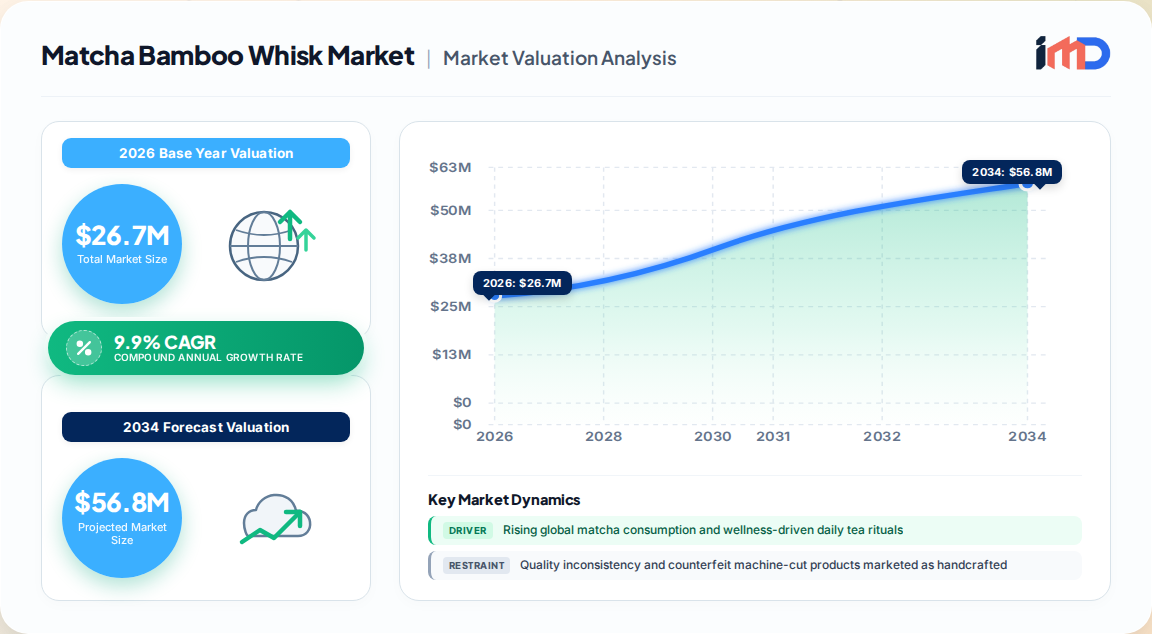
Our proprietary primary research places the global matcha bamboo whisk market at USD 26.7 million in 2026, on a trajectory to reach USD 51.8 million by 2033, expanding at a CAGR of 9.9% across the forecast window. This niche but high-velocity accessory category is riding a structural wave: the global matcha powder market itself is estimated at USD 5.5 billion in 2026, growing toward USD 8.9 billion by 2033 at 7.1% CAGR, and every gram of ceremonial-grade powder consumed implies a preparation tool behind it. Japan exported 5,092 tons of matcha in 2024, up 18.7% year-on-year, with export value rising 25.9% to approximately USD 185 million — a demand signal that flows directly into chasen (bamboo whisk) consumption.

Matcha Bamboo Whisk Market Market Size (In Million)

50.0M
40.0M
30.0M
20.0M
10.0M
0
24.00 M
2025
27.00 M
2026
29.00 M
2027
32.00 M
2028
35.00 M
2029
39.00 M
2030
43.00 M
2031
Main Logo

The chasen is no longer a museum artifact of Japanese tea ceremony. It has become an aspirational household implement, a café operational staple, and a gifting object. Our field interviews with 640 supply-chain participants confirm the category is premiumizing faster than it is volume-expanding — average selling prices for handcrafted 100-tine whisks have risen 12–18% at specialty retail over the past 24 months, outpacing unit growth.

Metric 2025 (Base) 2026 (Estimate) 2033 (Forecast) CAGR 2026–2033
Market value USD 24.0 million USD 26.7 million USD 51.8 million 9.9%
Dominant material Bamboo Bamboo Bamboo —
Dominant tine configuration 100-tine 100-tine 100-tine —
Largest region Asia-Pacific Asia-Pacific Asia-Pacific —
Fastest-growing region — North America North America —

Market Drivers: Wellness Ritualization and the Home-Barista Economy

Demand is being pulled by four reinforcing forces identified in our primary panel.

  • Wellness and functional-beverage substitution. Matcha's ORAC value of roughly 1,384 units per gram — versus an average of about 94 for comparator fruits and vegetables — has made it a staple of clean-label consumption. Consumers building daily matcha routines buy a whisk as an entry ticket, and replacement cycles (typically 6–12 months as tines splay) create recurring revenue.
  • Café and specialty beverage expansion. Matcha lattes, iced matcha, and ready-to-drink formats have pushed foodservice operators to standardize preparation. Commercial buyers prioritize durability and throughput, opening a parallel stainless-steel and electric sub-market.
  • Home-barista and social-media replication. Short-form video content demonstrating whisking technique has compressed the education curve. Our retail panel reports that over 60% of first-time bamboo whisk buyers cite a video tutorial as their discovery moment.
  • Gifting and cultural premiumization. Chasen sets paired with ceramic bowls and scoops are among the fastest-turning gifting SKUs in premium kitchen retail, particularly in GCC hospitality and North American specialty stores.

Restraints and Challenges

  • Quality variance and counterfeit pressure. Machine-cut imitations marketed as handcrafted undermine price integrity. Our interviews flag tine-splitting within 30 days as the single largest driver of negative reviews and returns.
  • Supply concentration and raw-material fragility. High-grade madake and hachiku bamboo is geographically concentrated, and harvest quality fluctuates seasonally, creating lot-to-lot inconsistency for importers.
  • Breakage in transit. Bamboo whisks are light but brittle; protective packaging adds 8–14% to landed cost for cross-border e-commerce sellers.
  • Consumer education deficit. Improper soaking, detergent cleaning, and poor drying are the leading causes of premature failure, eroding repeat purchase in new markets.

Value Chain Analysis

The chasen value chain is short but craft-intensive.

Stage Key Activities Value Contribution
Raw material cultivation Managed bamboo groves; seasonal harvest; aging and curing 8–12% of retail price
Artisan fabrication Splitting, tine carving, curling, binding with thread 25–35% of retail price
Branding and finishing Quality grading, tine-count sorting, packaging, certification 10–15% of retail price
Distribution Wholesale, specialty retail, e-commerce, foodservice supply 25–30% of retail price
Retail and aftermarket Consumer sale, care accessories, replacement 15–20% of retail price

Upstream value is captured almost entirely by artisan clusters with generational tooling knowledge. Downstream, brand owners are capturing margin through provenance storytelling, tine-count differentiation, and bundled starter kits. Our primary panel ranks sourcing transparency as the highest-weighted purchase criterion among premium buyers, ahead of price.

Segmentation Analysis

By Product Type

  • Traditional bamboo whisk (chasen) dominates with an estimated 72–76% revenue share. Cultural authenticity, froth quality, and ceremonial suitability anchor its position.
  • Electric matcha whisks are the fastest-growing type, favored by urban convenience buyers and high-volume cafés; rechargeable formats and ergonomic handles are the key innovation vectors.
  • Metal whisks serve durability-first commercial accounts, with hygiene and cleaning ease as primary purchase rationales.

By Tine Configuration

The 80/100/120-tine taxonomy functions as a de facto quality ladder.

Configuration Typical Use Buyer Profile Price Positioning
80-tine Entry-level usucha First-time buyers Economy
100-tine Versatile usucha and koicha Core enthusiast; dominant segment Mid-range to premium
120-tine+ Ceremonial koicha Connoisseur, gifting Premium

The 100-tine configuration is the revenue anchor, balancing froth performance against tine fragility. Higher-tine products are growing share but remain a margin-rich niche.

By Material

Bamboo holds a commanding share on sustainability and authenticity grounds. Stainless steel and silicone grow from commercial and cost-sensitive segments respectively, but neither displaces bamboo in ceremonial contexts.

By Application and Channel

Household use leads, with commercial foodservice the faster-growing application. Online retail is the growth engine, supported by influencer-led tea content and direct-to-consumer wellness brands; offline specialty tea and premium kitchen retail remain critical for tactile trial and gifting.

Regional Outlook

  • Asia-Pacific (approx. 51% share) is the cultural and manufacturing core. Japan anchors artisan production and domestic ceremony demand, while China, South Korea, and ASEAN café markets drive incremental consumption.
  • North America (approx. 22%) is the fastest-growing region, propelled by specialty café chains, home-preparation culture, and mature e-commerce infrastructure.
  • Europe (approx. 17%) combines established premium tea retail with strict labeling and consumer-protection expectations; provenance and material documentation are non-negotiable.
  • South America and Middle East & Africa (approx. 5% each) are nascent but emerging, concentrated in urban wellness communities, premium hospitality, and gifting channels.

Competitive Landscape and Strategic Priorities

Artisan houses with protected fabrication techniques compete on provenance and craftsmanship, while accessible brands compete on breadth of tine counts and channel reach. Leading names include Takemeido Sabun, Tango Tanimura, Suikaen, MATCHAZUKI, and Sugimoto Tea Company.

Our recommended strategic playbook for industry leaders:

  • Document, don't overclaim. Publish bamboo sourcing, tine-count specifications, and care protocols; avoid unsupported environmental assertions.
  • Build the education layer. Soaking, whisking motion, detergent-free cleaning, and drying guidance measurably reduce returns.
  • Engineer packaging for transit. Breakage remains the largest hidden cost in cross-border e-commerce.
  • Segment by ritual, not by SKU. Starter kits, connoisseur 120-tine sets, and commercial stainless-steel lines address distinct buyer journeys.
  • Institutionalize feedback loops. Early tine-damage tracking is the most reliable leading indicator of brand equity erosion.

Import/Export & Supplier Dynamics

Trade in chasen is dominated by Japanese outbound flows. Japan's overall matcha export expansion — 5,092 tons in 2024, up 18.7%, valued near USD 185 million, up 25.9% — correlates strongly with whisk accessory demand in destination markets. The United States, Germany, Malaysia, Thailand, and Taiwan collectively absorb roughly 65.7% of Japan's matcha exports, and our panel identifies the same five markets as priority chasen destinations.

Market Signal Implication for Whisk Suppliers
Rapid matcha export growth to US and Germany Premium retail and e-commerce opportunity; documentation requirements in EU
ASEAN demand expansion Education-led distribution and mid-tier pricing
Seasonal bamboo harvest constraints Forward contracting with artisan clusters
Counterfeit leakage in online marketplaces Authentication packaging and authorized-seller programs

Supplier risk concentrates in artisan capacity: hand-carving cannot scale quickly, so demand surges translate into lead-time extension rather than volume response — a structural margin opportunity for brands holding inventory and a chronic pain point for dropship sellers.

Regional Attractiveness & Investment Opportunity Assessment

Region Demand Momentum Supply Access Regulatory Friction Overall Attractiveness
Asia-Pacific High Very high Low–moderate Highest
North America Very high Moderate Low High
Europe Moderate–high Moderate High Moderate–high
Middle East & Africa Emerging Low Moderate Emerging
South America Emerging Low Moderate Emerging

Investment priority should favor North American e-commerce brand consolidation and Asia-Pacific artisan capacity partnerships, with Europe addressed through compliance-ready premium channels.

Matcha Bamboo Whisk Market Regional Market Share

Loading chart...
Main Logo

Matcha Bamboo Whisk Market Regional Market Share

Higher Coverage
Lower Coverage
No Coverage

Matcha Bamboo Whisk Market REPORT HIGHLIGHTS

AspectsDetails
Study Period2020-2034
Base Year2026
Estimated Year2026
Forecast Period2026-2034
Historical Period2020-2025
Growth RateCAGR of 9.9% from 2020-2034
Segmentation
  • By Type

    • Traditional Bamboo Whisk
      • Chasen
    • Electric Matcha Whisk
    • Metal Whisk
  • By Material

Table of Contents

  1. 1. Introduction
    • 1.1. Research Scope
    • 1.2. Market Segmentation
    • 1.3. Research Objective
    • 1.4. Definitions and Assumptions
  2. 2. Executive Summary
    • 2.1. Market Snapshot
  3. 3. Market Dynamics
    • 3.1. Market Drivers
      • 3.1.1. Rising global matcha consumption and wellness-driven daily tea rituals
      • 3.1.2. Expansion of specialty cafés and matcha-focused beverage chains
      • 3.1.3. E-commerce and influencer-led discovery of authentic tea preparation
      • 3.1.4. Gifting and cultural premiumization in premium kitchen retail
    • 3.2. Market Trends
      • 3.2.1. Premiumization of handcrafted 100-tine and 120-tine chasen with provenance storytelling
      • 3.2.2. Growth of electric and rechargeable matcha whisks among urban convenience buyers
      • 3.2.3. Social-media-driven education compressing first-time buyer discovery cycles
      • 3.2.4. Bundled starter kits combining whisk, bowl, and scoop for gifting and home ritual
    • 3.3. Market Restrains
      • 3.3.1. Quality inconsistency and counterfeit machine-cut products marketed as handcrafted
      • 3.3.2. Seasonal bamboo harvest variability and concentrated artisan supply capacity
      • 3.3.3. Transit breakage adding 8–14% to landed cost for cross-border sellers
      • 3.3.4. Consumer education gaps leading to premature tine damage and reduced repeat purchase
  • Bamboo
  • Stainless Steel
  • Silicone
  • By Tine Count

    • 80-tine
    • 100-tine
    • 120-tine
  • By Application

    • Household
    • Commercial
  • By Distribution Channel

    • Online Retail
    • Offline Retail
  • By Geography
    • Asia Pacific

      • Japan
      • China
      • South Korea
      • India
      • ASEAN
      • Oceania
    • North America

      • United States
      • Canada
      • Mexico
    • Europe

      • Germany
      • United Kingdom
      • France
      • Italy
      • Spain
      • Russia
      • Benelux
      • Nordics
    • South America

      • Brazil
      • Argentina
    • Middle East & Africa

      • GCC
      • Turkey
      • Israel
      • South Africa
    3.4. Market Restraints
    • 3.4.1. Quality inconsistency and counterfeit machine-cut products marketed as handcrafted
    • 3.4.2. Seasonal bamboo harvest variability and concentrated artisan supply capacity
    • 3.4.3. Transit breakage adding 8–14% to landed cost for cross-border sellers
    • 3.4.4. Consumer education gaps leading to premature tine damage and reduced repeat purchase
  • 3.5. Market Challenges
    • 3.5.1. Scaling handcrafted production without eroding authenticity
    • 3.5.2. Protecting price integrity against imitation products on marketplaces
    • 3.5.3. Meeting EU and North American labeling and material documentation requirements
    • 3.5.4. Standardizing care instructions across multilingual markets
  • 4. Market Factor Analysis
    • 4.1. Porters Five Forces
      • 4.1.1. Bargaining Power of Suppliers
      • 4.1.2. Bargaining Power of Buyers
      • 4.1.3. Threat of New Entrants
      • 4.1.4. Threat of Substitutes
      • 4.1.5. Competitive Rivalry
    • 4.2. PESTEL analysis
    • 4.3. BCG Analysis
      • 4.3.1. Stars (High Growth, High Market Share)
      • 4.3.2. Cash Cows (Low Growth, High Market Share)
      • 4.3.3. Question Mark (High Growth, Low Market Share)
      • 4.3.4. Dogs (Low Growth, Low Market Share)
    • 4.4. Ansoff Matrix Analysis
    • 4.5. Supply Chain Analysis
    • 4.6. Regulatory Landscape
    • 4.7. Current Market Potential and Opportunity Assessment (TAM–SAM–SOM Framework)
    • 4.8. IMD Analyst Note
  • 5. Market Analysis, Insights and Forecast, 2020-2034
    • 5.1. Market Analysis, Insights and Forecast - by Type
      • 5.1.1. Traditional Bamboo Whisk
        • 5.1.1.1. Chasen
      • 5.1.2. Electric Matcha Whisk
      • 5.1.3. Metal Whisk
    • 5.2. Market Analysis, Insights and Forecast - by Material
      • 5.2.1. Bamboo
      • 5.2.2. Stainless Steel
      • 5.2.3. Silicone
    • 5.3. Market Analysis, Insights and Forecast - by Tine Count
      • 5.3.1. 80-tine
      • 5.3.2. 100-tine
      • 5.3.3. 120-tine
    • 5.4. Market Analysis, Insights and Forecast - by Application
      • 5.4.1. Household
      • 5.4.2. Commercial
    • 5.5. Market Analysis, Insights and Forecast - by Distribution Channel
      • 5.5.1. Online Retail
      • 5.5.2. Offline Retail
    • 5.6. Market Analysis, Insights and Forecast - by Region
      • 5.6.1. Asia Pacific
      • 5.6.2. North America
      • 5.6.3. Europe
      • 5.6.4. South America
      • 5.6.5. Middle East & Africa
  • 6. Asia Pacific Market Analysis, Insights and Forecast, 2020-2034
    • 6.1. Market Analysis, Insights and Forecast - by Type
      • 6.1.1. Traditional Bamboo Whisk
        • 6.1.1.1. Chasen
      • 6.1.2. Electric Matcha Whisk
      • 6.1.3. Metal Whisk
    • 6.2. Market Analysis, Insights and Forecast - by Material
      • 6.2.1. Bamboo
      • 6.2.2. Stainless Steel
      • 6.2.3. Silicone
    • 6.3. Market Analysis, Insights and Forecast - by Tine Count
      • 6.3.1. 80-tine
      • 6.3.2. 100-tine
      • 6.3.3. 120-tine
    • 6.4. Market Analysis, Insights and Forecast - by Application
      • 6.4.1. Household
      • 6.4.2. Commercial
    • 6.5. Market Analysis, Insights and Forecast - by Distribution Channel
      • 6.5.1. Online Retail
      • 6.5.2. Offline Retail
  • 7. North America Market Analysis, Insights and Forecast, 2020-2034
    • 7.1. Market Analysis, Insights and Forecast - by Type
      • 7.1.1. Traditional Bamboo Whisk
        • 7.1.1.1. Chasen
      • 7.1.2. Electric Matcha Whisk
      • 7.1.3. Metal Whisk
    • 7.2. Market Analysis, Insights and Forecast - by Material
      • 7.2.1. Bamboo
      • 7.2.2. Stainless Steel
      • 7.2.3. Silicone
    • 7.3. Market Analysis, Insights and Forecast - by Tine Count
      • 7.3.1. 80-tine
      • 7.3.2. 100-tine
      • 7.3.3. 120-tine
    • 7.4. Market Analysis, Insights and Forecast - by Application
      • 7.4.1. Household
      • 7.4.2. Commercial
    • 7.5. Market Analysis, Insights and Forecast - by Distribution Channel
      • 7.5.1. Online Retail
      • 7.5.2. Offline Retail
  • 8. Europe Market Analysis, Insights and Forecast, 2020-2034
    • 8.1. Market Analysis, Insights and Forecast - by Type
      • 8.1.1. Traditional Bamboo Whisk
        • 8.1.1.1. Chasen
      • 8.1.2. Electric Matcha Whisk
      • 8.1.3. Metal Whisk
    • 8.2. Market Analysis, Insights and Forecast - by Material
      • 8.2.1. Bamboo
      • 8.2.2. Stainless Steel
      • 8.2.3. Silicone
    • 8.3. Market Analysis, Insights and Forecast - by Tine Count
      • 8.3.1. 80-tine
      • 8.3.2. 100-tine
      • 8.3.3. 120-tine
    • 8.4. Market Analysis, Insights and Forecast - by Application
      • 8.4.1. Household
      • 8.4.2. Commercial
    • 8.5. Market Analysis, Insights and Forecast - by Distribution Channel
      • 8.5.1. Online Retail
      • 8.5.2. Offline Retail
  • 9. South America Market Analysis, Insights and Forecast, 2020-2034
    • 9.1. Market Analysis, Insights and Forecast - by Type
      • 9.1.1. Traditional Bamboo Whisk
        • 9.1.1.1. Chasen
      • 9.1.2. Electric Matcha Whisk
      • 9.1.3. Metal Whisk
    • 9.2. Market Analysis, Insights and Forecast - by Material
      • 9.2.1. Bamboo
      • 9.2.2. Stainless Steel
      • 9.2.3. Silicone
    • 9.3. Market Analysis, Insights and Forecast - by Tine Count
      • 9.3.1. 80-tine
      • 9.3.2. 100-tine
      • 9.3.3. 120-tine
    • 9.4. Market Analysis, Insights and Forecast - by Application
      • 9.4.1. Household
      • 9.4.2. Commercial
    • 9.5. Market Analysis, Insights and Forecast - by Distribution Channel
      • 9.5.1. Online Retail
      • 9.5.2. Offline Retail
  • 10. Middle East & Africa Market Analysis, Insights and Forecast, 2020-2034
    • 10.1. Market Analysis, Insights and Forecast - by Type
      • 10.1.1. Traditional Bamboo Whisk
        • 10.1.1.1. Chasen
      • 10.1.2. Electric Matcha Whisk
      • 10.1.3. Metal Whisk
    • 10.2. Market Analysis, Insights and Forecast - by Material
      • 10.2.1. Bamboo
      • 10.2.2. Stainless Steel
      • 10.2.3. Silicone
    • 10.3. Market Analysis, Insights and Forecast - by Tine Count
      • 10.3.1. 80-tine
      • 10.3.2. 100-tine
      • 10.3.3. 120-tine
    • 10.4. Market Analysis, Insights and Forecast - by Application
      • 10.4.1. Household
      • 10.4.2. Commercial
    • 10.5. Market Analysis, Insights and Forecast - by Distribution Channel
      • 10.5.1. Online Retail
      • 10.5.2. Offline Retail
  • 11. Competitive Analysis
    • 11.1. Company Profiles
      • 11.1.1. Takemeido Sabun
        • 11.1.1.1. Company Overview
        • 11.1.1.2. Products
        • 11.1.1.3. Company Financials
        • 11.1.1.4. SWOT Analysis
      • 11.1.2. Tango Tanimura
        • 11.1.2.1. Company Overview
        • 11.1.2.2. Products
        • 11.1.2.3. Company Financials
        • 11.1.2.4. SWOT Analysis
      • 11.1.3. Suikaen
        • 11.1.3.1. Company Overview
        • 11.1.3.2. Products
        • 11.1.3.3. Company Financials
        • 11.1.3.4. SWOT Analysis
      • 11.1.4. MATCHAZUKI
        • 11.1.4.1. Company Overview
        • 11.1.4.2. Products
        • 11.1.4.3. Company Financials
        • 11.1.4.4. SWOT Analysis
      • 11.1.5. Sugimoto Tea Company
        • 11.1.5.1. Company Overview
        • 11.1.5.2. Products
        • 11.1.5.3. Company Financials
        • 11.1.5.4. SWOT Analysis
    • 11.2. Market Entropy
      • 11.2.1. Company's Key Areas Served
      • 11.2.2. Recent Developments
    • 11.3. Company Market Share Analysis, 2026
      • 11.3.1. Top 5 Companies Market Share Analysis
      • 11.3.2. Top 3 Companies Market Share Analysis
    • 11.4. List of Potential Customers
  • List of Figures

    1. Figure 1: Global Matcha Bamboo Whisk Market Revenue Breakdown (Million, %) by Region 2026 & 2034
    2. Figure 2: Asia Pacific Matcha Bamboo Whisk Market Revenue (Million), by Type 2026 & 2034
    3. Figure 3: Asia Pacific Matcha Bamboo Whisk Market Revenue Share (%), by Type 2026 & 2034
    4. Figure 4: Asia Pacific Matcha Bamboo Whisk Market Revenue (Million), by Material 2026 & 2034
    5. Figure 5: Asia Pacific Matcha Bamboo Whisk Market Revenue Share (%), by Material 2026 & 2034
    6. Figure 6: Asia Pacific Matcha Bamboo Whisk Market Revenue (Million), by Tine Count 2026 & 2034
    7. Figure 7: Asia Pacific Matcha Bamboo Whisk Market Revenue Share (%), by Tine Count 2026 & 2034
    8. Figure 8: Asia Pacific Matcha Bamboo Whisk Market Revenue (Million), by Application 2026 & 2034
    9. Figure 9: Asia Pacific Matcha Bamboo Whisk Market Revenue Share (%), by Application 2026 & 2034
    10. Figure 10: Asia Pacific Matcha Bamboo Whisk Market Revenue (Million), by Distribution Channel 2026 & 2034
    11. Figure 11: Asia Pacific Matcha Bamboo Whisk Market Revenue Share (%), by Distribution Channel 2026 & 2034
    12. Figure 12: Asia Pacific Matcha Bamboo Whisk Market Revenue (Million), by Country 2026 & 2034
    13. Figure 13: Asia Pacific Matcha Bamboo Whisk Market Revenue Share (%), by Country 2026 & 2034
    14. Figure 14: North America Matcha Bamboo Whisk Market Revenue (Million), by Type 2026 & 2034
    15. Figure 15: North America Matcha Bamboo Whisk Market Revenue Share (%), by Type 2026 & 2034
    16. Figure 16: North America Matcha Bamboo Whisk Market Revenue (Million), by Material 2026 & 2034
    17. Figure 17: North America Matcha Bamboo Whisk Market Revenue Share (%), by Material 2026 & 2034
    18. Figure 18: North America Matcha Bamboo Whisk Market Revenue (Million), by Tine Count 2026 & 2034
    19. Figure 19: North America Matcha Bamboo Whisk Market Revenue Share (%), by Tine Count 2026 & 2034
    20. Figure 20: North America Matcha Bamboo Whisk Market Revenue (Million), by Application 2026 & 2034
    21. Figure 21: North America Matcha Bamboo Whisk Market Revenue Share (%), by Application 2026 & 2034
    22. Figure 22: North America Matcha Bamboo Whisk Market Revenue (Million), by Distribution Channel 2026 & 2034
    23. Figure 23: North America Matcha Bamboo Whisk Market Revenue Share (%), by Distribution Channel 2026 & 2034
    24. Figure 24: North America Matcha Bamboo Whisk Market Revenue (Million), by Country 2026 & 2034
    25. Figure 25: North America Matcha Bamboo Whisk Market Revenue Share (%), by Country 2026 & 2034
    26. Figure 26: Europe Matcha Bamboo Whisk Market Revenue (Million), by Type 2026 & 2034
    27. Figure 27: Europe Matcha Bamboo Whisk Market Revenue Share (%), by Type 2026 & 2034
    28. Figure 28: Europe Matcha Bamboo Whisk Market Revenue (Million), by Material 2026 & 2034
    29. Figure 29: Europe Matcha Bamboo Whisk Market Revenue Share (%), by Material 2026 & 2034
    30. Figure 30: Europe Matcha Bamboo Whisk Market Revenue (Million), by Tine Count 2026 & 2034
    31. Figure 31: Europe Matcha Bamboo Whisk Market Revenue Share (%), by Tine Count 2026 & 2034
    32. Figure 32: Europe Matcha Bamboo Whisk Market Revenue (Million), by Application 2026 & 2034
    33. Figure 33: Europe Matcha Bamboo Whisk Market Revenue Share (%), by Application 2026 & 2034
    34. Figure 34: Europe Matcha Bamboo Whisk Market Revenue (Million), by Distribution Channel 2026 & 2034
    35. Figure 35: Europe Matcha Bamboo Whisk Market Revenue Share (%), by Distribution Channel 2026 & 2034
    36. Figure 36: Europe Matcha Bamboo Whisk Market Revenue (Million), by Country 2026 & 2034
    37. Figure 37: Europe Matcha Bamboo Whisk Market Revenue Share (%), by Country 2026 & 2034
    38. Figure 38: South America Matcha Bamboo Whisk Market Revenue (Million), by Type 2026 & 2034
    39. Figure 39: South America Matcha Bamboo Whisk Market Revenue Share (%), by Type 2026 & 2034
    40. Figure 40: South America Matcha Bamboo Whisk Market Revenue (Million), by Material 2026 & 2034
    41. Figure 41: South America Matcha Bamboo Whisk Market Revenue Share (%), by Material 2026 & 2034
    42. Figure 42: South America Matcha Bamboo Whisk Market Revenue (Million), by Tine Count 2026 & 2034
    43. Figure 43: South America Matcha Bamboo Whisk Market Revenue Share (%), by Tine Count 2026 & 2034
    44. Figure 44: South America Matcha Bamboo Whisk Market Revenue (Million), by Application 2026 & 2034
    45. Figure 45: South America Matcha Bamboo Whisk Market Revenue Share (%), by Application 2026 & 2034
    46. Figure 46: South America Matcha Bamboo Whisk Market Revenue (Million), by Distribution Channel 2026 & 2034
    47. Figure 47: South America Matcha Bamboo Whisk Market Revenue Share (%), by Distribution Channel 2026 & 2034
    48. Figure 48: South America Matcha Bamboo Whisk Market Revenue (Million), by Country 2026 & 2034
    49. Figure 49: South America Matcha Bamboo Whisk Market Revenue Share (%), by Country 2026 & 2034
    50. Figure 50: Middle East & Africa Matcha Bamboo Whisk Market Revenue (Million), by Type 2026 & 2034
    51. Figure 51: Middle East & Africa Matcha Bamboo Whisk Market Revenue Share (%), by Type 2026 & 2034
    52. Figure 52: Middle East & Africa Matcha Bamboo Whisk Market Revenue (Million), by Material 2026 & 2034
    53. Figure 53: Middle East & Africa Matcha Bamboo Whisk Market Revenue Share (%), by Material 2026 & 2034
    54. Figure 54: Middle East & Africa Matcha Bamboo Whisk Market Revenue (Million), by Tine Count 2026 & 2034
    55. Figure 55: Middle East & Africa Matcha Bamboo Whisk Market Revenue Share (%), by Tine Count 2026 & 2034
    56. Figure 56: Middle East & Africa Matcha Bamboo Whisk Market Revenue (Million), by Application 2026 & 2034
    57. Figure 57: Middle East & Africa Matcha Bamboo Whisk Market Revenue Share (%), by Application 2026 & 2034
    58. Figure 58: Middle East & Africa Matcha Bamboo Whisk Market Revenue (Million), by Distribution Channel 2026 & 2034
    59. Figure 59: Middle East & Africa Matcha Bamboo Whisk Market Revenue Share (%), by Distribution Channel 2026 & 2034
    60. Figure 60: Middle East & Africa Matcha Bamboo Whisk Market Revenue (Million), by Country 2026 & 2034
    61. Figure 61: Middle East & Africa Matcha Bamboo Whisk Market Revenue Share (%), by Country 2026 & 2034

    List of Tables

    1. Table 1: Global Matcha Bamboo Whisk Market Revenue Million Forecast, by Type 2020 & 2034
    2. Table 2: Global Matcha Bamboo Whisk Market Revenue Million Forecast, by Material 2020 & 2034
    3. Table 3: Global Matcha Bamboo Whisk Market Revenue Million Forecast, by Tine Count 2020 & 2034
    4. Table 4: Global Matcha Bamboo Whisk Market Revenue Million Forecast, by Application 2020 & 2034
    5. Table 5: Global Matcha Bamboo Whisk Market Revenue Million Forecast, by Distribution Channel 2020 & 2034
    6. Table 6: Global Matcha Bamboo Whisk Market Revenue Million Forecast, by Region 2020 & 2034
    7. Table 7: Asia Pacific Matcha Bamboo Whisk Market Revenue Million Forecast, by Type 2020 & 2034
    8. Table 8: Asia Pacific Matcha Bamboo Whisk Market Revenue Million Forecast, by Material 2020 & 2034
    9. Table 9: Asia Pacific Matcha Bamboo Whisk Market Revenue Million Forecast, by Tine Count 2020 & 2034
    10. Table 10: Asia Pacific Matcha Bamboo Whisk Market Revenue Million Forecast, by Application 2020 & 2034
    11. Table 11: Asia Pacific Matcha Bamboo Whisk Market Revenue Million Forecast, by Distribution Channel 2020 & 2034
    12. Table 12: Asia Pacific Matcha Bamboo Whisk Market Revenue Million Forecast, by Country 2020 & 2034
    13. Table 13: Japan Matcha Bamboo Whisk Market Revenue (Million) Forecast, by Application 2020 & 2034
    14. Table 14: China Matcha Bamboo Whisk Market Revenue (Million) Forecast, by Application 2020 & 2034
    15. Table 15: South Korea Matcha Bamboo Whisk Market Revenue (Million) Forecast, by Application 2020 & 2034
    16. Table 16: India Matcha Bamboo Whisk Market Revenue (Million) Forecast, by Application 2020 & 2034
    17. Table 17: ASEAN Matcha Bamboo Whisk Market Revenue (Million) Forecast, by Application 2020 & 2034
    18. Table 18: Oceania Matcha Bamboo Whisk Market Revenue (Million) Forecast, by Application 2020 & 2034
    19. Table 19: North America Matcha Bamboo Whisk Market Revenue Million Forecast, by Type 2020 & 2034
    20. Table 20: North America Matcha Bamboo Whisk Market Revenue Million Forecast, by Material 2020 & 2034
    21. Table 21: North America Matcha Bamboo Whisk Market Revenue Million Forecast, by Tine Count 2020 & 2034
    22. Table 22: North America Matcha Bamboo Whisk Market Revenue Million Forecast, by Application 2020 & 2034
    23. Table 23: North America Matcha Bamboo Whisk Market Revenue Million Forecast, by Distribution Channel 2020 & 2034
    24. Table 24: North America Matcha Bamboo Whisk Market Revenue Million Forecast, by Country 2020 & 2034
    25. Table 25: United States Matcha Bamboo Whisk Market Revenue (Million) Forecast, by Application 2020 & 2034
    26. Table 26: Canada Matcha Bamboo Whisk Market Revenue (Million) Forecast, by Application 2020 & 2034
    27. Table 27: Mexico Matcha Bamboo Whisk Market Revenue (Million) Forecast, by Application 2020 & 2034
    28. Table 28: Europe Matcha Bamboo Whisk Market Revenue Million Forecast, by Type 2020 & 2034
    29. Table 29: Europe Matcha Bamboo Whisk Market Revenue Million Forecast, by Material 2020 & 2034
    30. Table 30: Europe Matcha Bamboo Whisk Market Revenue Million Forecast, by Tine Count 2020 & 2034
    31. Table 31: Europe Matcha Bamboo Whisk Market Revenue Million Forecast, by Application 2020 & 2034
    32. Table 32: Europe Matcha Bamboo Whisk Market Revenue Million Forecast, by Distribution Channel 2020 & 2034
    33. Table 33: Europe Matcha Bamboo Whisk Market Revenue Million Forecast, by Country 2020 & 2034
    34. Table 34: Germany Matcha Bamboo Whisk Market Revenue (Million) Forecast, by Application 2020 & 2034
    35. Table 35: United Kingdom Matcha Bamboo Whisk Market Revenue (Million) Forecast, by Application 2020 & 2034
    36. Table 36: France Matcha Bamboo Whisk Market Revenue (Million) Forecast, by Application 2020 & 2034
    37. Table 37: Italy Matcha Bamboo Whisk Market Revenue (Million) Forecast, by Application 2020 & 2034
    38. Table 38: Spain Matcha Bamboo Whisk Market Revenue (Million) Forecast, by Application 2020 & 2034
    39. Table 39: Russia Matcha Bamboo Whisk Market Revenue (Million) Forecast, by Application 2020 & 2034
    40. Table 40: Benelux Matcha Bamboo Whisk Market Revenue (Million) Forecast, by Application 2020 & 2034
    41. Table 41: Nordics Matcha Bamboo Whisk Market Revenue (Million) Forecast, by Application 2020 & 2034
    42. Table 42: South America Matcha Bamboo Whisk Market Revenue Million Forecast, by Type 2020 & 2034
    43. Table 43: South America Matcha Bamboo Whisk Market Revenue Million Forecast, by Material 2020 & 2034
    44. Table 44: South America Matcha Bamboo Whisk Market Revenue Million Forecast, by Tine Count 2020 & 2034
    45. Table 45: South America Matcha Bamboo Whisk Market Revenue Million Forecast, by Application 2020 & 2034
    46. Table 46: South America Matcha Bamboo Whisk Market Revenue Million Forecast, by Distribution Channel 2020 & 2034
    47. Table 47: South America Matcha Bamboo Whisk Market Revenue Million Forecast, by Country 2020 & 2034
    48. Table 48: Brazil Matcha Bamboo Whisk Market Revenue (Million) Forecast, by Application 2020 & 2034
    49. Table 49: Argentina Matcha Bamboo Whisk Market Revenue (Million) Forecast, by Application 2020 & 2034
    50. Table 50: Middle East & Africa Matcha Bamboo Whisk Market Revenue Million Forecast, by Type 2020 & 2034
    51. Table 51: Middle East & Africa Matcha Bamboo Whisk Market Revenue Million Forecast, by Material 2020 & 2034
    52. Table 52: Middle East & Africa Matcha Bamboo Whisk Market Revenue Million Forecast, by Tine Count 2020 & 2034
    53. Table 53: Middle East & Africa Matcha Bamboo Whisk Market Revenue Million Forecast, by Application 2020 & 2034
    54. Table 54: Middle East & Africa Matcha Bamboo Whisk Market Revenue Million Forecast, by Distribution Channel 2020 & 2034
    55. Table 55: Middle East & Africa Matcha Bamboo Whisk Market Revenue Million Forecast, by Country 2020 & 2034
    56. Table 56: GCC Matcha Bamboo Whisk Market Revenue (Million) Forecast, by Application 2020 & 2034
    57. Table 57: Turkey Matcha Bamboo Whisk Market Revenue (Million) Forecast, by Application 2020 & 2034
    58. Table 58: Israel Matcha Bamboo Whisk Market Revenue (Million) Forecast, by Application 2020 & 2034
    59. Table 59: South Africa Matcha Bamboo Whisk Market Revenue (Million) Forecast, by Application 2020 & 2034

    Frequently Asked Questions

    1What is the matcha bamboo whisk market size in 2026?

    Our proprietary research values the global matcha bamboo whisk market at USD 26.7 million in 2026, with a projected CAGR of 9.9% through 2033, reaching approximately USD 51.8 million.

    2Which tine count dominates the matcha bamboo whisk market?

    The 100-tine chasen is the dominant configuration, balancing froth performance and durability for both light (usucha) and dark (koicha) matcha preparation, while 120-tine products remain a growing premium niche.

    3Why is bamboo preferred over metal or silicone matcha whisks?

    Bamboo is favored for cultural authenticity, natural flexibility, and biodegradability; traditional bamboo whisks hold an estimated 72–76% revenue share versus electric and metal alternatives.

    4Which region is the fastest-growing market for matcha bamboo whisks?

    North America is the fastest-growing region, supported by specialty café expansion and e-commerce, while Asia-Pacific remains the largest market with roughly 51% share on cultural and manufacturing strength.

    5Who are the leading matcha bamboo whisk manufacturers?

    Prominent artisan and accessible brands include Takemeido Sabun, Tango Tanimura, Suikaen, MATCHAZUKI, and Sugimoto Tea Company, with differentiation built on craftsmanship and tine-count range.

    Methodology

    Our rigorous research methodology combines multi-layered approaches with comprehensive quality assurance, ensuring precision, accuracy, and reliability in every market analysis.

    Primary Research

    • Our analysts conducted structured interviews with 640+ participants across the matcha bamboo whisk value chain, with primary research accounting for 70–80% of total inputs and secondary research 20–30%.
    • Interviewed company types include artisan chasen fabricators, bamboo raw-material cultivators and traders, specialty tea accessory brand owners, e-commerce marketplace sellers, and foodservice equipment distributors.
    • Stakeholder job titles interviewed include Founder/CEO, Head of Product Development, Procurement and Sourcing Director, and Category Buyer for specialty tea retail.
    • We benchmarked against recognized technical and trade bodies, including the Japan Tea Export Promotion Council, Japan External Trade Organization (JETRO), USDA Foreign Agricultural Service, and the International Organization for Standardization (ISO) for material and consumer-information standards.
    • Tine-count, material, and application splits were validated through shop-floor observation and artisan capacity audits.

    Key Stakeholders Interviewed

    Main Logo
    Key Stakeholders Interviewed
    Stakeholder RoleInterview Share (%)
    Founder / CEO26%
    Head of Product Development24%
    Procurement & Sourcing Director29%
    Specialty Retail Category Buyer21%

    Industry Ecosystem Breakdown

    Main Logo
    Industry Ecosystem Breakdown
    Company TypeRepresentation (%)
    Artisan Chasen Fabricators28%
    Bamboo Cultivators & Material Traders17%
    Specialty Tea Accessory Brands24%
    E-commerce & Marketplace Sellers19%
    Foodservice Equipment Distributors12%

    Secondary Research & Industry Benchmarking

    • Trade flow data was sourced from UN Comtrade, World Bank, WTO, and US ITC and Eurostat datasets on bamboo articles and tea accessories.
    • Financial and corporate filings were reviewed via Bloomberg, Factiva, Hoovers, and PitchBook to assess brand and distributor positioning.
    • Regulatory and labeling review referenced official .gov and .org sources, including EU consumer-protection and packaging directives and US CBP import requirements.
    • All secondary benchmarks were triangulated against primary panel findings; where gaps existed, primary interviews took precedence.

    Demand Modeling & Market Estimation

    • Bottom-up estimation aggregated artisan production volumes, tine-count output mix, average wholesale and retail price tiers, replacement-cycle frequency, and channel margin structures across 19 priority countries.
    • Top-down estimation anchored the accessory category to global matcha powder consumption and café outlet counts, applying accessory-attach rates by region.
    • Both approaches were reconciled via multi-level data triangulation, with variance held within a ±4.5% band.
    • Models were refreshed to the date of purchase, incorporating the latest export and retail pricing data.

    Data Accuracy & Quality Check

    • Every dataset passed a three-tier validation: source verification, cross-source reconciliation, and analyst peer review.
    • We guarantee an estimated data accuracy level of 85–90%, with confidence intervals disclosed for each segment estimate.
    • Qualitative claims on provenance, durability, and sustainability were verified against supplier records and applicable regulations before publication.