1What is the size of the Maldives hospitality market?
The Maldives hospitality market was valued at USD 3.13 billion in 2026 and is projected to reach USD 5.12 billion by 2032, growing at a CAGR of 8.45% between 2027 and 2032.
Insight Market Data is a premier market research and business consulting firm headquartered in Pune, India, providing syndicated research reports, customized intelligence studies, and strategic advisory services. Renowned academic institutions and Fortune 500 corporations worldwide rely on Insight Market Data's research repository to navigate evolving global and regional business environments. Covering 46 diverse industries across 25 major international economies, our comprehensive database delivers thousands of verified statistics and granular market evaluations. By combining industry-leading analytical methodologies with the direct insights of seasoned industry leaders and subject-matter experts, we deliver actionable intelligence spanning historical performance benchmarks to rigorous multi-year forecasts. We empower organizations to make confident, data-driven decisions across pivotal domains including Machinery & Equipment, Chemicals & Materials, Pharmaceuticals & Healthcare, Food & Beverages, Consumer Goods, Energy & Power, Automotive & Transportation, Electronics & Semiconductors, Medical Devices, Telecommunications, Emerging Technologies, Agriculture, and Packaging. Our multidisciplinary analyst teams provide an objective 360-degree perspective, tailoring every engagement to address complex strategic challenges with exceptional analytical rigor.
Leveraging advanced BI-powered analytics and predictive modeling, Insight Market Data uncovers high-impact market opportunities and competitive differentiators for ambitious enterprises. We continuously refine our research methodologies in accordance with global industry standards, tracking real-time market shifts to ensure our reports are consistently accurate, actionable, and delivered on schedule. Our analysts conduct methodical data validation, rigorous compliance checks, and exhaustive primary and secondary research to maintain the highest levels of data integrity and transparency. We partner closely with corporate strategists, investment groups, and business executives to translate intricate market intelligence into clear, actionable roadmaps for sustainable growth. With operational presence across Washington, USA, and Vimannagar, Pune, India, Insight Market Data ensures direct access to dedicated research specialists and responsive customer support to answer your most strategic questions.
 Maldives Hospitality Industry
 by Type (Chain Hotels, Independent Hotels), by Accommodation Class (Luxury, Mid & Upper-Mid-scale, Budget & Economy, Service Apartments), by Booking Channel (Direct Digital, OTAs, Corporate / MICE, Wholesale & Traditional Agents), by Greater Malé Region, by Central Atolls, by Northern Atolls, by Southern Atolls Forecast 2026-2034

Research Associate


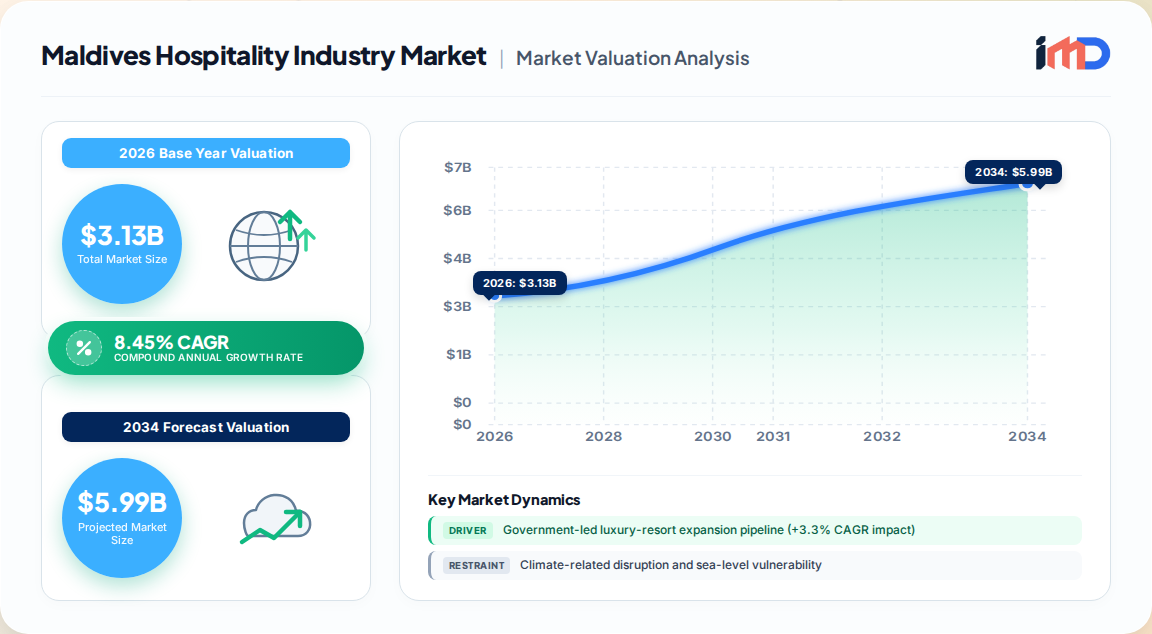
The Maldives hospitality industry market stood at USD 3.13 billion in 2026 and is projected to reach USD 5.12 billion by 2032, expanding at a CAGR of 8.45% over the 2027–2032 forecast period. This growth is anchored in a durable luxury-travel proposition, aggressive government-led resort development, and widening air access from Asia-Pacific source markets.
The industry remains structurally medium-concentrated, with independent hotels holding 57.69% of market value in 2026, while chain-affiliated properties are forecast to grow faster at 8.9% CAGR through 2032. Luxury accommodation commands a 52.43% revenue share and is the fastest-growing class at 10.95% CAGR, underscoring the destination's premium positioning.
| Metric | 2026 Value | 2027 Value | 2032 Forecast | CAGR (2027–2032) |
|---|---|---|---|---|
| Market Size (USD) | 3.13 Billion | 3.41 Billion | 5.12 Billion | 8.45% |
| Luxury Accommodation Share | 52.43% | — | — | 10.95% |
| OTA Booking Share | 61.04% | — | — | — |
| Chain Hotel Growth | 57.69% indep. share | — | — | 8.9% |
| Greater Malé Region Share | 36.83% | — | — | — |
| Southern Atolls Growth | — | — | — | 13.1% |
Government-led luxury-resort expansion pipeline contributes an estimated +3.3% to forecast CAGR. The January 2026 groundbreaking of Project Ayla in Noonu Atoll—an ultra-luxury resort with marina, residences, healthcare, and hospitality education facilities targeted for 2028 completion—exemplifies the integrated township model that broadens the commercial proposition beyond standalone accommodation.
Growth in direct air connectivity adds +2.9% to CAGR. The May 2026 launch of Maldivian's direct Melbourne–Malé route creates a new gateway for Australian travelers, though weekly frequency requires operators to align stay durations with flight schedules to avoid unsold room-nights.
Rising affluent Asia-Pacific arrivals contribute +2.4% to CAGR. Visit Maldives Corporation reported 706,033 Asia-Pacific tourist arrivals in 2025, representing roughly 31% of total arrivals and 12.1% year-over-year growth, driven by China, India, Southeast Asia, and Korea.
Additional tailwinds include integrated seaplane-scheduling technology (+1.0% CAGR impact) that lifts occupancy yields by confirming transfer availability before booking, green-finance incentives for solar-powered over-water villas (+0.6%), and experiential wellness positioning of lagoon-based retreats (+0.4%).
By Type. Independent hotels generated 57.69% of 2026 market size, exemplified by properties such as The Nautilus Maldives—a 26-key, privately owned retreat in Baa Atoll with private pools and dedicated House Master service. Chain hotels are the fastest-growing segment at 8.9% CAGR; Barceló Hotel Group's April 2025 opening of Barceló Nasandhura Malé (136 rooms plus 116 designer apartments) demonstrates how urban dual-format properties extend brand reach beyond island resorts.
By Accommodation Class. Luxury dominates at 52.43% of 2026 value and grows fastest at 10.95% CAGR, followed by mid & upper-mid-scale, budget & economy, and service apartments.
By Booking Channel. OTAs led with 61.04% of 2026 revenue, while direct digital is forecast to record the fastest CAGR at 12.3% as brands invest in first-party guest engagement.
The Greater Malé Region accounted for 36.83% of 2026 hospitality revenue, benefiting from airport proximity and urban hotel-apartment hybrids. The Southern Atolls are projected to expand fastest at a 13.1% CAGR, supported by new resort openings and undeveloped atoll white space. The Central Atolls (including Baa and Ari) remain the luxury over-water heartland, while the Northern Atolls gain momentum from the Noonu Atoll Project Ayla pipeline.
| Region | 2026 Revenue Share | Growth Outlook |
|---|---|---|
| Greater Malé Region | 36.83% | Moderate; urban hybrid model |
| Central Atolls | ~24.5% | Luxury over-water concentration |
| Northern Atolls | ~19.6% | Project Ayla upside (2028) |
| Southern Atolls | ~19.1% | Fastest at 13.1% CAGR |
The market is medium-concentrated, with global brands and Maldivian specialists competing on distinct propositions. Key operators include Accor S.A., Hilton Worldwide, Marriott International, InterContinental Hotels Group, Four Seasons Hotels & Resorts, Minor Hotels (Anantara), Soneva, Crown & Champa Resorts, VERSA Hospitality, Atmosphere Hotels & Resorts, LUX* Resorts & Hotels, Sun Siyam Resorts, Banyan Tree Holdings, Outrigger Hospitality, Hard Rock International, Club Med, Centara Hotels & Resorts, Jumeirah Group, Barceló Hotel Group, and Radisson Hotel Group.
Strategic priorities center on brand development, direct guest engagement, multi-format urban properties, and resilience investment to protect access and service continuity.
The value chain spans resort ownership and lease structures, brand management and franchising, tour-operator and OTA distribution, seaplane and speedboat transfer providers, and import-dependent food & beverage and fuel supply. Import intensity is a defining cost feature: with trade at 150.03% of GDP (World Bank, 2023), the economy is extraordinarily open and correspondingly exposed to landed-cost inflation. Integrated seaplane scheduling and green-finance-funded solar installations are the two most commercially material efficiency levers identified in our primary interviews.
Our assessment identifies three priority white spaces: (1) upper-mid-scale and service-apartment supply in the Greater Malé Region to serve the urbanizing hybrid demand; (2) wellness-and-marina integrated resorts in the Northern Atolls ahead of Project Ayla's 2028 completion; and (3) direct-digital booking infrastructure, the fastest-growing channel at 12.3% CAGR, where independent operators remain underpenetrated. Climate-resilience capex will increasingly function as a license-to-operate threshold rather than a differentiator, and operators that pair resilience investment with fuel-cost hedging and seaplane integration are best positioned to convert the 8.45% CAGR demand expansion into margin-accretive growth.
| Aspects | Details |
|---|---|
| Study Period | 2020-2034 |
| Base Year | 2026 |
| Estimated Year | 2026 |
| Forecast Period | 2026-2034 |
| Historical Period | 2020-2025 |
| Growth Rate | CAGR of 8.45% from 2020-2034 |
| Segmentation |
|
By Booking Channel
| By Geography |
|
The Maldives hospitality market was valued at USD 3.13 billion in 2026 and is projected to reach USD 5.12 billion by 2032, growing at a CAGR of 8.45% between 2027 and 2032.
Luxury accommodation is the fastest-growing class at a 10.95% CAGR and held a 52.43% revenue share in 2026. Chain hotels are also growing faster than independents at 8.9% CAGR.
Key drivers include the government-led luxury-resort expansion pipeline (+3.3% CAGR impact), growth in direct air connectivity (+2.9%), rising Asia-Pacific arrivals (+2.4%), and integrated seaplane-scheduling technology (+1.0%).
The Greater Malé Region held 36.83% of 2026 hospitality revenue, while the Southern Atolls are projected to expand fastest at a 13.1% CAGR through 2032.
Climate-related disruption and sea-level vulnerability (−0.9% CAGR impact), import-driven high operating costs (−0.7%), skilled-labor quota tightening, and currency-exchange volatility are the principal restraints.
Our rigorous research methodology combines multi-layered approaches with comprehensive quality assurance, ensuring precision, accuracy, and reliability in every market analysis.
| Stakeholder Role | Interview Share (%) |
|---|---|
| General Manager / Resort Director | 32% |
| Director of Revenue Management | 26% |
| Chief Financial Officer | 22% |
| Head of Development / Asset Management | 20% |
| Company Type | Representation (%) |
|---|---|
| Resort and Hotel Ownership Groups | 30% |
| Hotel Brand and Management Companies | 22% |
| OTA and Distribution Platforms | 16% |
| Seaplane and Transfer Operators | 14% |
| F&B and Import Supply Providers | 10% |
| Hospitality Real Estate and Finance Firms | 8% |
 Related Reports
