About Insight Market Data

Insight Market Data is a premier market research and business consulting firm headquartered in Pune, India, providing syndicated research reports, customized intelligence studies, and strategic advisory services. Renowned academic institutions and Fortune 500 corporations worldwide rely on Insight Market Data's research repository to navigate evolving global and regional business environments. Covering 46 diverse industries across 25 major international economies, our comprehensive database delivers thousands of verified statistics and granular market evaluations. By combining industry-leading analytical methodologies with the direct insights of seasoned industry leaders and subject-matter experts, we deliver actionable intelligence spanning historical performance benchmarks to rigorous multi-year forecasts. We empower organizations to make confident, data-driven decisions across pivotal domains including Machinery & Equipment, Chemicals & Materials, Pharmaceuticals & Healthcare, Food & Beverages, Consumer Goods, Energy & Power, Automotive & Transportation, Electronics & Semiconductors, Medical Devices, Telecommunications, Emerging Technologies, Agriculture, and Packaging. Our multidisciplinary analyst teams provide an objective 360-degree perspective, tailoring every engagement to address complex strategic challenges with exceptional analytical rigor.

Leveraging advanced BI-powered analytics and predictive modeling, Insight Market Data uncovers high-impact market opportunities and competitive differentiators for ambitious enterprises. We continuously refine our research methodologies in accordance with global industry standards, tracking real-time market shifts to ensure our reports are consistently accurate, actionable, and delivered on schedule. Our analysts conduct methodical data validation, rigorous compliance checks, and exhaustive primary and secondary research to maintain the highest levels of data integrity and transparency. We partner closely with corporate strategists, investment groups, and business executives to translate intricate market intelligence into clear, actionable roadmaps for sustainable growth. With operational presence across Washington, USA, and Vimannagar, Pune, India, Insight Market Data ensures direct access to dedicated research specialists and responsive customer support to answer your most strategic questions.

report thumbnailLatin America Travel Market
Hospitality and Tourism / MARKET REPORT

Latin America Travel Market | Insight Market Data

Latin America Travel Market by Tourist Type (Domestic, Inbound International, Outbound International), by Purpose of Travel (Leisure, Business & MICE, Visiting Friends & Relatives, Medical & Wellness), by Booking Channel (Online, Offline), by Age Group (21-30 Years, 31-40 Years, 41-60 Years, 60 and Above), by Brazil, by Mexico, by Argentina, by Colombia, by Chile, by Peru, by Rest of Latin America Forecast 2026-2034

© Nov 27, 2026|Base Year: 2025|242 Pages
Jaishree Sankhla

Jaishree Sankhla

Research Associate

Main Logo

Latin America Travel Market Size, Trends & Forecast 2026-2034


/
/
Independent Intelligence for decisions that move markets
+12315155523[email protected]
  • Home
  • About Us
  • Industries
    • Automotive
    • Consumer Goods and Services
    • Financial Services and Investment Intelligence
    • Home and Property Improvement
    • Logistics
    • Retail
    • Agriculture
    • Healthcare
    • Animal Nutrition & Wellness
    • Chemicals & Materials
    • Energy & Power
    • Food & Beverage
    • Hospitality and Tourism
    • Manufacturing Products and Services
    • Professional and Commercial Services
    • Real Estate and Construction
    • Aerospace & Defense
    • Packaging
    • Technology, Media and Telecom
  • Services
  • Contact
Main Logo
  • Home
  • About Us
  • Industries
    • Automotive
    • Consumer Goods and Services
    • Financial Services and Investment Intelligence
    • Home and Property Improvement
    • Logistics
    • Retail
    • Agriculture
    • Healthcare
    • Animal Nutrition & Wellness
    • Chemicals & Materials
    • Energy & Power
    • Food & Beverage
    • Hospitality and Tourism
    • Manufacturing Products and Services
    • Professional and Commercial Services
    • Real Estate and Construction
    • Aerospace & Defense
    • Packaging
    • Technology, Media and Telecom
  • Services
  • Contact
Talk to an analyst
Home
Industries
Hospitality and Tourism

Business Address

Head Office

Ansec House 3 rd floor Tank Road, Yerwada, Pune, Maharashtra 411014

Contact Information

Craig Francis

Business Development Head

+12315155523

[email protected]

Secure Payment Partners

payment image
RetailLogisticsPackagingAutomotiveHealthcareAgricultureEnergy & PowerFood & BeverageAerospace & DefenseChemicals & MaterialsHospitality and TourismConsumer Goods and ServicesAnimal Nutrition & WellnessReal Estate and ConstructionHome and Property ImprovementTechnology, Media and TelecomManufacturing Products and ServicesFinancial Services and Investment Intelligence

© 2026 PRDUA Research & Media Private Limited, All rights reserved

Privacy Policy•Terms and Conditions•FAQ
Latin America Travel Market CAGR, market size, market share

Executive Overview: A Region at an Inflection Point

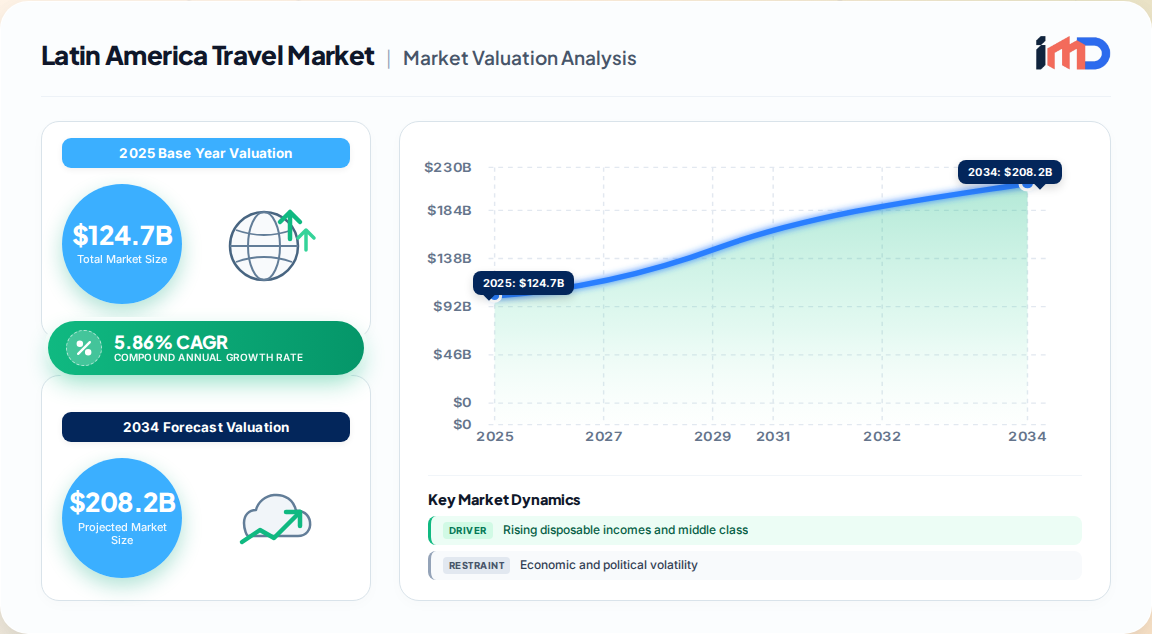
The Latin America travel market stands at a critical inflection point, propelled by a confluence of digital transformation, infrastructure modernization, and a structural shift in traveler expectations. Our proprietary primary research estimates the market at USD 124.7 Billion in 2026, projected to reach USD 196.6 Billion by 2034, expanding at a CAGR of 5.86%. This growth trajectory is underpinned by a resilient domestic travel base, particularly in Brazil and Mexico, which collectively anchor regional demand and provide countercyclical stability against external shocks.

Latin America Travel Market Market Size (In Billion)

200.0B
150.0B
100.0B
50.0B
0
124.7 B
2025
132.0 B
2026
139.7 B
2027
147.9 B
2028
156.6 B
2029
165.8 B
2030
175.5 B
2031
Main Logo

The region's travel ecosystem is undergoing a profound reorientation. Mobile-first booking behavior has pushed digital channels beyond the halfway mark, with online penetration exceeding 52% in 2025. Low-cost carriers and next-generation narrowbody aircraft are reshaping connectivity, while biometric border automation and favorable visa policies are reducing friction at key gateways. The 2026 FIFA World Cup in Mexico serves as a potent catalyst, spurring multi-year infrastructure upgrades that will elevate the region's tourism competitiveness.

This report delivers a granular, data-driven analysis of the Latin America travel market, examining the forces shaping demand, the competitive dynamics redefining value chains, and the strategic imperatives for stakeholders across the travel and tourism spectrum.

Key Market Drivers and Growth Accelerators

The Latin America travel market is being reshaped by several structural drivers that are expanding the addressable traveler base and lifting conversion across both short-haul and long-haul itineraries.

  • Digital Booking Penetration and Mobile-First Behavior: Online channels accounted for 52.00% of market share in 2025, with a projected CAGR of 10.01% through 2031. Mobile-first behavior, coupled with mature payment rails including installment and BNPL financing, is reducing abandonment and increasing trust in online checkout flows. Real-time disbursements and tokenized credentials are further enhancing the digital travel purchase journey.
  • Low-Cost Carrier Expansion and Fleet Modernization: Low-cost carriers have materially expanded their presence, reshaping price elasticity and stimulating discretionary travel. New entrants are capturing share on key domestic trunk routes, while fleet orders for next-generation aircraft are densifying regional connectivity and enabling thinner long-haul routes to become viable nonstop offerings.
  • Robust Domestic Travel Base: Brazil and Mexico anchor regional demand, with their large domestic networks providing countercyclical ballast. Domestic travel held 59.70% of the market in 2025, with airlines expanding seats on core and secondary routes to connect industrial centers with leisure destinations.
  • International Tourism Recovery: Inbound international travel is projected to record a 4.40% CAGR from 2026 to 2031, as global travel demand normalizes and new air routes connect Latin America to North America and Europe.
  • Infrastructure and Border Automation: Biometric deployments at key hubs such as Lima and São Paulo are accelerating throughput and reducing friction, scaling region-wide to lift capacity without proportional capital expenditure.

Market Restraints and Challenges

Despite the positive trajectory, the market faces headwinds that could temper growth if not strategically managed.

  • Economic and Political Volatility: Unsteady financial and political circumstances across several Latin American nations impact tourism flows and investment confidence. Currency fluctuations can alter price competitiveness and affect both inbound and outbound travel decisions.
  • Public Health and Contagious Disease Outbreaks: As evidenced by the COVID-19 pandemic, outbreaks of contagious diseases can cause sharp disruptions to travel demand and operational continuity.
  • Infrastructure Gaps: While key hubs are modernizing, secondary cities and remote destinations often lack the connectivity and infrastructure to absorb growing visitor volumes, limiting the redistribution of tourism benefits.
  • Security Concerns: Crime and safety perceptions in certain urban and rural areas can deter international visitors and require sustained investment in destination management and security protocols.

Segmentation Analysis: Unpacking Traveler Behavior

The Latin America travel market is segmented across tourist type, purpose of travel, booking channel, and age group, each revealing distinct growth patterns.

Segment Sub-Segment 2025 Share / Growth Key Insight
By Tourist Type Domestic 59.70% share Anchors regional demand; resilient to external shocks
Inbound International Fastest CAGR at 4.40% (2026-2031) Recovery to pre-pandemic levels boosts inbound
Outbound International Steady growth Rising middle class and disposable income drive outbound travel
By Purpose Leisure 84.50% share (2025) Dominant segment; experiential and adventure tourism growing
Medical & Wellness 14.90% CAGR (through 2031) Fastest-growing niche; wellness tourism and medical procedures
Business & MICE Notable growth MICE tourism expanding, attracting US visitors
VFR (Visiting Friends & Relatives) Stable demand Linked to diaspora and family ties
By Booking Channel Online 52.00% share (2025); 10.01% CAGR Mobile-first booking becomes mainstream
Offline Declining share Traditional agencies retain niche for complex itineraries
By Age Group 21-30 Years High growth potential Digital natives; adventure and experiential focus
31-40 Years Significant share Family and leisure travel; digital adoption
41-60 Years Established segment Higher spending; cruise and specialty travel
60 and Above Growing segment Wellness and VFR travel; off-peak flexibility

Regional Outlook: Brazil and Mexico Lead, Colombia Emerges

Brazil and Mexico dominate the Latin America travel market, with Brazil holding 23.20% share in 2025. Colombia is projected to register the steepest CAGR at 9.03% from 2026 to 2031, driven by improving connectivity, favorable visa policies, and growing international interest.

Latin America Travel Market Regional Market Share

Loading chart...
Main Logo
  • Brazil: Solid domestic travel and a large network of secondary cities underpin stable demand. São Paulo and Rio de Janeiro serve as key gateways, with biometric deployments scaling at major airports.
  • Mexico: The 2026 FIFA World Cup is a major catalyst, spurring infrastructure upgrades and international visibility. Mexico benefits from favorable exchange rates and expanded air connectivity, making it an affordable destination for international travelers.
  • Colombia: Fastest-growing market, with Bogotá emerging as a key hub. Low-cost carriers and new air routes are driving intra-regional and long-haul connectivity.
  • Argentina, Chile, Peru: Each offers unique cultural and natural attractions, from Patagonia to Machu Picchu. Peru's Lima airport serves as a reference deployment for biometric automation.

Competitive Landscape and Strategic Developments

The Latin America travel market is fragmented, with a mix of domestic and international players competing across the value chain. Market concentration is low, indicating opportunities for consolidation and strategic partnerships.

Recent developments underscore the dynamic nature of the competitive environment:

  • Prosus acquired Despegar in 2025, connecting travel with food delivery and events ecosystems reaching over 100 million users, designed to convert multi-vertical traffic into travel transactions at lower acquisition cost.
  • Abra Group, parent to Avianca and GOL, expanded its Airbus order book to support long-haul Americas-Europe growth and more efficient short-haul networks.
  • JetSMART Colombia captured share quickly by serving key domestic trunk routes vacated by failed operators.
  • CAF and UN Tourism signed a partnership in February 2024 to launch the Green Projects Innovation Challenge, promoting sustainable tourism startups in Latin America and the Caribbean.
  • GoNexus Group released Nexus Up in November 2024, a B2B travel technology application to improve the visitor experience across 19 countries and 52 destinations.

Value Chain and Distribution Dynamics

The travel value chain in Latin America is evolving rapidly, with digital intermediaries gaining share and suppliers enhancing direct channels.

  • Suppliers: Airlines, hotels, and cruise lines are investing in loyalty-linked offers and post-booking self-service to steer customers to their apps, compressing service costs and deepening data advantages.
  • Intermediaries: OTAs and traditional travel agencies are consolidating to achieve regional scale. Payment infrastructure, including instant refunds and tokenized credentials, is reducing friction and increasing trust.
  • Technology Providers: Travel technology companies are enabling personalization through AI, VR, and AR, while biometric solutions streamline border and airport processes.

Strategic White-Space and Investment Opportunities

Our proprietary analysis identifies several high-potential white spaces for stakeholders:

  • Medical and Wellness Tourism: With a 14.90% CAGR through 2031, this segment offers significant upside. Countries like Costa Rica, Mexico, and Colombia are well-positioned to capture demand for wellness retreats and medical procedures.
  • Sustainable and Eco-Tourism: Latin America's biodiversity, from the Amazon to Patagonia, positions the region as a leader in sustainable travel. Investments in eco-lodges and community-led tourism initiatives align with growing traveler demand for responsible experiences.
  • Secondary City Connectivity: As low-cost carriers densify regional networks, secondary cities offer untapped demand for leisure and VFR travel. Infrastructure investments and digital marketing can unlock these markets.
  • MICE Tourism: Latin America's diverse venues, advanced conference facilities, and air connectivity make it attractive for MICE events, particularly for US-based organizations.

Import/Export & Supplier Dynamics

While the travel market is primarily services-oriented, the underlying trade in goods and services that support tourism—such as aircraft, hospitality equipment, and technology—plays a critical role. According to World Bank WITS data, Latin America and the Caribbean recorded total merchandise trade of USD 2.75 Trillion in 2023, with services exports reaching USD 278.9 Billion. The region's trade openness, measured at 49.70% of GDP, underscores its integration into global value chains.

The travel and tourism sector relies on imports of aircraft, rolling stock, and IT systems, while exporting travel services. Key supplier dynamics include:

  • Aircraft Procurement: Airlines in the region are modernizing fleets with orders for Airbus A321XLR and Embraer E195-E2 aircraft, enhancing connectivity and efficiency.
  • Hospitality Supply Chain: Hotels and resorts depend on imported furnishings, food and beverage, and technology solutions, creating opportunities for global suppliers.
  • Digital Infrastructure: Payment processors and travel technology providers are critical suppliers, enabling online booking and seamless transactions.

Strategic Recommendations

Based on our proprietary research, we recommend the following strategic imperatives for stakeholders:

  1. Prioritize Digital Transformation: Invest in mobile-first booking platforms, AI-powered servicing, and flexible payment options to capture the growing online segment.
  2. Expand Regional Connectivity: Partner with low-cost carriers and leverage new-generation aircraft to connect secondary cities and long-haul routes.
  3. Target High-Growth Niches: Focus on medical and wellness tourism, sustainable travel, and MICE to capitalize on emerging demand.
  4. Enhance Destination Infrastructure: Support biometric border automation and airport modernization to reduce friction and increase capacity.
  5. Foster Public-Private Partnerships: Collaborate with governments and industry associations to address security, infrastructure, and sustainability challenges.

The Latin America travel market offers compelling opportunities for investors and operators who can navigate the region's complexities and capitalize on its dynamism.

Latin America Travel Market Regional Market Share

Higher Coverage
Lower Coverage
No Coverage

Latin America Travel Market REPORT HIGHLIGHTS

AspectsDetails
Study Period2020-2034
Base Year2025
Estimated Year2026
Forecast Period2026-2034
Historical Period2020-2025
Growth RateCAGR of 5.86% from 2020-2034
Segmentation
  • By Tourist Type

    • Domestic
    • Inbound International
    • Outbound International
  • By Purpose of Travel

    • Leisure

Table of Contents

  1. 1. Latin America Travel Market Introduction
    • 1.1. Research Scope
    • 1.2. Market Segmentation
    • 1.3. Research Objective
    • 1.4. Definitions and Assumptions
  2. 2. Latin America Travel Market Executive Summary
    • 2.1. Market Snapshot
  3. 3. Latin America Travel Market Dynamics
    • 3.1. Market Drivers
      • 3.1.1. Rising disposable incomes and middle class
      • 3.1.2. Online booking penetration exceeding 50%
      • 3.1.3. International tourism recovery
      • 3.1.4. Event-led catalysts like 2026 FIFA World Cup
    • 3.2. Market Trends
      • 3.2.1. Mobile-first booking and digital payment adoption
      • 3.2.2. Low-cost carrier expansion and fleet modernization
      • 3.2.3. Biometric border and airport automation
      • 3.2.4. Rise of medical and wellness tourism
      • 3.2.5. Sustainable and eco-tourism growth
    • 3.3. Market Restraints
      • 3.3.1. Economic and political volatility
      • 3.3.2. Currency fluctuations
      • 3.3.3. Infrastructure gaps in secondary cities
      • 3.3.4. Security concerns in certain areas
    • 3.4. Market Challenges
      • 3.4.1. Contagious disease outbreaks
      • 3.4.2. Regulatory complexity across countries
  • Business & MICE
  • Visiting Friends & Relatives
  • Medical & Wellness
  • By Booking Channel

    • Online
    • Offline
  • By Age Group

    • 21-30 Years
    • 31-40 Years
    • 41-60 Years
    • 60 and Above
  • By Geography
    • Brazil

    • Mexico

    • Argentina

    • Colombia

    • Chile

    • Peru

    • Rest of Latin America

  • 3.4.3. Fragmented market and low concentration
  • 4. Latin America Travel Market Factor Analysis
    • 4.1. Porters Five Forces
      • 4.1.1. Bargaining Power of Suppliers
      • 4.1.2. Bargaining Power of Buyers
      • 4.1.3. Threat of New Entrants
      • 4.1.4. Threat of Substitutes
      • 4.1.5. Competitive Rivalry
    • 4.2. PESTEL analysis
    • 4.3. BCG Analysis
      • 4.3.1. Stars (High Growth, High Market Share)
      • 4.3.2. Cash Cows (Low Growth, High Market Share)
      • 4.3.3. Question Mark (High Growth, Low Market Share)
      • 4.3.4. Dogs (Low Growth, Low Market Share)
    • 4.4. Ansoff Matrix Analysis
    • 4.5. Supply Chain Analysis
    • 4.6. Regulatory Landscape
    • 4.7. Current Market Potential and Opportunity Assessment (TAM–SAM–SOM Framework)
    • 4.8. IMD Analyst Note
  • 5. Latin America Travel Market Analysis, Insights and Forecast, 2020-2034
    • 5.1. Analysis, Insights and Forecast - by Tourist Type
      • 5.1.1. Domestic
      • 5.1.2. Inbound International
      • 5.1.3. Outbound International
    • 5.2. Analysis, Insights and Forecast - by Purpose of Travel
      • 5.2.1. Leisure
      • 5.2.2. Business & MICE
      • 5.2.3. Visiting Friends & Relatives
      • 5.2.4. Medical & Wellness
    • 5.3. Analysis, Insights and Forecast - by Booking Channel
      • 5.3.1. Online
      • 5.3.2. Offline
    • 5.4. Analysis, Insights and Forecast - by Age Group
      • 5.4.1. 21-30 Years
      • 5.4.2. 31-40 Years
      • 5.4.3. 41-60 Years
      • 5.4.4. 60 and Above
    • 5.5. Analysis, Insights and Forecast - by Region
      • 5.5.1. Brazil
      • 5.5.2. Mexico
      • 5.5.3. Argentina
      • 5.5.4. Colombia
      • 5.5.5. Chile
      • 5.5.6. Peru
      • 5.5.7. Rest of Latin America
  • 6. Latin America Travel Market Brazil Analysis, Insights and Forecast, 2020-2034
    • 6.1. Analysis, Insights and Forecast - by Tourist Type
      • 6.1.1. Domestic
      • 6.1.2. Inbound International
      • 6.1.3. Outbound International
    • 6.2. Analysis, Insights and Forecast - by Purpose of Travel
      • 6.2.1. Leisure
      • 6.2.2. Business & MICE
      • 6.2.3. Visiting Friends & Relatives
      • 6.2.4. Medical & Wellness
    • 6.3. Analysis, Insights and Forecast - by Booking Channel
      • 6.3.1. Online
      • 6.3.2. Offline
    • 6.4. Analysis, Insights and Forecast - by Age Group
      • 6.4.1. 21-30 Years
      • 6.4.2. 31-40 Years
      • 6.4.3. 41-60 Years
      • 6.4.4. 60 and Above
  • 7. Latin America Travel Market Mexico Analysis, Insights and Forecast, 2020-2034
    • 7.1. Analysis, Insights and Forecast - by Tourist Type
      • 7.1.1. Domestic
      • 7.1.2. Inbound International
      • 7.1.3. Outbound International
    • 7.2. Analysis, Insights and Forecast - by Purpose of Travel
      • 7.2.1. Leisure
      • 7.2.2. Business & MICE
      • 7.2.3. Visiting Friends & Relatives
      • 7.2.4. Medical & Wellness
    • 7.3. Analysis, Insights and Forecast - by Booking Channel
      • 7.3.1. Online
      • 7.3.2. Offline
    • 7.4. Analysis, Insights and Forecast - by Age Group
      • 7.4.1. 21-30 Years
      • 7.4.2. 31-40 Years
      • 7.4.3. 41-60 Years
      • 7.4.4. 60 and Above
  • 8. Latin America Travel Market Argentina Analysis, Insights and Forecast, 2020-2034
    • 8.1. Analysis, Insights and Forecast - by Tourist Type
      • 8.1.1. Domestic
      • 8.1.2. Inbound International
      • 8.1.3. Outbound International
    • 8.2. Analysis, Insights and Forecast - by Purpose of Travel
      • 8.2.1. Leisure
      • 8.2.2. Business & MICE
      • 8.2.3. Visiting Friends & Relatives
      • 8.2.4. Medical & Wellness
    • 8.3. Analysis, Insights and Forecast - by Booking Channel
      • 8.3.1. Online
      • 8.3.2. Offline
    • 8.4. Analysis, Insights and Forecast - by Age Group
      • 8.4.1. 21-30 Years
      • 8.4.2. 31-40 Years
      • 8.4.3. 41-60 Years
      • 8.4.4. 60 and Above
  • 9. Latin America Travel Market Colombia Analysis, Insights and Forecast, 2020-2034
    • 9.1. Analysis, Insights and Forecast - by Tourist Type
      • 9.1.1. Domestic
      • 9.1.2. Inbound International
      • 9.1.3. Outbound International
    • 9.2. Analysis, Insights and Forecast - by Purpose of Travel
      • 9.2.1. Leisure
      • 9.2.2. Business & MICE
      • 9.2.3. Visiting Friends & Relatives
      • 9.2.4. Medical & Wellness
    • 9.3. Analysis, Insights and Forecast - by Booking Channel
      • 9.3.1. Online
      • 9.3.2. Offline
    • 9.4. Analysis, Insights and Forecast - by Age Group
      • 9.4.1. 21-30 Years
      • 9.4.2. 31-40 Years
      • 9.4.3. 41-60 Years
      • 9.4.4. 60 and Above
  • 10. Latin America Travel Market Chile Analysis, Insights and Forecast, 2020-2034
    • 10.1. Analysis, Insights and Forecast - by Tourist Type
      • 10.1.1. Domestic
      • 10.1.2. Inbound International
      • 10.1.3. Outbound International
    • 10.2. Analysis, Insights and Forecast - by Purpose of Travel
      • 10.2.1. Leisure
      • 10.2.2. Business & MICE
      • 10.2.3. Visiting Friends & Relatives
      • 10.2.4. Medical & Wellness
    • 10.3. Analysis, Insights and Forecast - by Booking Channel
      • 10.3.1. Online
      • 10.3.2. Offline
    • 10.4. Analysis, Insights and Forecast - by Age Group
      • 10.4.1. 21-30 Years
      • 10.4.2. 31-40 Years
      • 10.4.3. 41-60 Years
      • 10.4.4. 60 and Above
  • 11. Latin America Travel Market Peru Analysis, Insights and Forecast, 2020-2034
    • 11.1. Analysis, Insights and Forecast - by Tourist Type
      • 11.1.1. Domestic
      • 11.1.2. Inbound International
      • 11.1.3. Outbound International
    • 11.2. Analysis, Insights and Forecast - by Purpose of Travel
      • 11.2.1. Leisure
      • 11.2.2. Business & MICE
      • 11.2.3. Visiting Friends & Relatives
      • 11.2.4. Medical & Wellness
    • 11.3. Analysis, Insights and Forecast - by Booking Channel
      • 11.3.1. Online
      • 11.3.2. Offline
    • 11.4. Analysis, Insights and Forecast - by Age Group
      • 11.4.1. 21-30 Years
      • 11.4.2. 31-40 Years
      • 11.4.3. 41-60 Years
      • 11.4.4. 60 and Above
  • 12. Latin America Travel Market Rest of Latin America Analysis, Insights and Forecast, 2020-2034
    • 12.1. Analysis, Insights and Forecast - by Tourist Type
      • 12.1.1. Domestic
      • 12.1.2. Inbound International
      • 12.1.3. Outbound International
    • 12.2. Analysis, Insights and Forecast - by Purpose of Travel
      • 12.2.1. Leisure
      • 12.2.2. Business & MICE
      • 12.2.3. Visiting Friends & Relatives
      • 12.2.4. Medical & Wellness
    • 12.3. Analysis, Insights and Forecast - by Booking Channel
      • 12.3.1. Online
      • 12.3.2. Offline
    • 12.4. Analysis, Insights and Forecast - by Age Group
      • 12.4.1. 21-30 Years
      • 12.4.2. 31-40 Years
      • 12.4.3. 41-60 Years
      • 12.4.4. 60 and Above
  • 13. Latin America Travel Market Competitive Analysis
    • 13.1. Company Profiles
      • 13.1.1. Despegar.com
        • 13.1.1.1. Company Overview
        • 13.1.1.2. Products
        • 13.1.1.3. Company Financials
        • 13.1.1.4. SWOT Analysis
      • 13.1.2. CVC Corp
        • 13.1.2.1. Company Overview
        • 13.1.2.2. Products
        • 13.1.2.3. Company Financials
        • 13.1.2.4. SWOT Analysis
      • 13.1.3. Tangol SRL
        • 13.1.3.1. Company Overview
        • 13.1.3.2. Products
        • 13.1.3.3. Company Financials
        • 13.1.3.4. SWOT Analysis
      • 13.1.4. Condor Travel
        • 13.1.4.1. Company Overview
        • 13.1.4.2. Products
        • 13.1.4.3. Company Financials
        • 13.1.4.4. SWOT Analysis
      • 13.1.5. Marriott International
        • 13.1.5.1. Company Overview
        • 13.1.5.2. Products
        • 13.1.5.3. Company Financials
        • 13.1.5.4. SWOT Analysis
      • 13.1.6. Hilton Worldwide
        • 13.1.6.1. Company Overview
        • 13.1.6.2. Products
        • 13.1.6.3. Company Financials
        • 13.1.6.4. SWOT Analysis
      • 13.1.7. InterContinental Hotels
        • 13.1.7.1. Company Overview
        • 13.1.7.2. Products
        • 13.1.7.3. Company Financials
        • 13.1.7.4. SWOT Analysis
      • 13.1.8. Cox & Kings Travel
        • 13.1.8.1. Company Overview
        • 13.1.8.2. Products
        • 13.1.8.3. Company Financials
        • 13.1.8.4. SWOT Analysis
      • 13.1.9. South America Odyssey
        • 13.1.9.1. Company Overview
        • 13.1.9.2. Products
        • 13.1.9.3. Company Financials
        • 13.1.9.4. SWOT Analysis
      • 13.1.10. Eco Hotels & Resorts
        • 13.1.10.1. Company Overview
        • 13.1.10.2. Products
        • 13.1.10.3. Company Financials
        • 13.1.10.4. SWOT Analysis
      • 13.1.11. Mobibrasil
        • 13.1.11.1. Company Overview
        • 13.1.11.2. Products
        • 13.1.11.3. Company Financials
        • 13.1.11.4. SWOT Analysis
    • 13.2. Market Entropy
      • 13.2.1. Company's Key Areas Served
      • 13.2.2. Recent Developments
    • 13.3. Company Market Share Analysis, 2026
      • 13.3.1. Top 5 Companies Market Share Analysis
      • 13.3.2. Top 3 Companies Market Share Analysis
    • 13.4. List of Potential Customers
  • List of Figures

    1. Figure 1: Global Latin America Travel Market Revenue Breakdown (Billion, %) by Region 2026 & 2034
    2. Figure 2: Brazil Latin America Travel Market Revenue (Billion), by Tourist Type 2026 & 2034
    3. Figure 3: Brazil Latin America Travel Market Revenue Share (%), by Tourist Type 2026 & 2034
    4. Figure 4: Brazil Latin America Travel Market Revenue (Billion), by Purpose of Travel 2026 & 2034
    5. Figure 5: Brazil Latin America Travel Market Revenue Share (%), by Purpose of Travel 2026 & 2034
    6. Figure 6: Brazil Latin America Travel Market Revenue (Billion), by Booking Channel 2026 & 2034
    7. Figure 7: Brazil Latin America Travel Market Revenue Share (%), by Booking Channel 2026 & 2034
    8. Figure 8: Brazil Latin America Travel Market Revenue (Billion), by Age Group 2026 & 2034
    9. Figure 9: Brazil Latin America Travel Market Revenue Share (%), by Age Group 2026 & 2034
    10. Figure 10: Brazil Latin America Travel Market Revenue (Billion), by Country 2026 & 2034
    11. Figure 11: Brazil Latin America Travel Market Revenue Share (%), by Country 2026 & 2034
    12. Figure 12: Mexico Latin America Travel Market Revenue (Billion), by Tourist Type 2026 & 2034
    13. Figure 13: Mexico Latin America Travel Market Revenue Share (%), by Tourist Type 2026 & 2034
    14. Figure 14: Mexico Latin America Travel Market Revenue (Billion), by Purpose of Travel 2026 & 2034
    15. Figure 15: Mexico Latin America Travel Market Revenue Share (%), by Purpose of Travel 2026 & 2034
    16. Figure 16: Mexico Latin America Travel Market Revenue (Billion), by Booking Channel 2026 & 2034
    17. Figure 17: Mexico Latin America Travel Market Revenue Share (%), by Booking Channel 2026 & 2034
    18. Figure 18: Mexico Latin America Travel Market Revenue (Billion), by Age Group 2026 & 2034
    19. Figure 19: Mexico Latin America Travel Market Revenue Share (%), by Age Group 2026 & 2034
    20. Figure 20: Mexico Latin America Travel Market Revenue (Billion), by Country 2026 & 2034
    21. Figure 21: Mexico Latin America Travel Market Revenue Share (%), by Country 2026 & 2034
    22. Figure 22: Argentina Latin America Travel Market Revenue (Billion), by Tourist Type 2026 & 2034
    23. Figure 23: Argentina Latin America Travel Market Revenue Share (%), by Tourist Type 2026 & 2034
    24. Figure 24: Argentina Latin America Travel Market Revenue (Billion), by Purpose of Travel 2026 & 2034
    25. Figure 25: Argentina Latin America Travel Market Revenue Share (%), by Purpose of Travel 2026 & 2034
    26. Figure 26: Argentina Latin America Travel Market Revenue (Billion), by Booking Channel 2026 & 2034
    27. Figure 27: Argentina Latin America Travel Market Revenue Share (%), by Booking Channel 2026 & 2034
    28. Figure 28: Argentina Latin America Travel Market Revenue (Billion), by Age Group 2026 & 2034
    29. Figure 29: Argentina Latin America Travel Market Revenue Share (%), by Age Group 2026 & 2034
    30. Figure 30: Argentina Latin America Travel Market Revenue (Billion), by Country 2026 & 2034
    31. Figure 31: Argentina Latin America Travel Market Revenue Share (%), by Country 2026 & 2034
    32. Figure 32: Colombia Latin America Travel Market Revenue (Billion), by Tourist Type 2026 & 2034
    33. Figure 33: Colombia Latin America Travel Market Revenue Share (%), by Tourist Type 2026 & 2034
    34. Figure 34: Colombia Latin America Travel Market Revenue (Billion), by Purpose of Travel 2026 & 2034
    35. Figure 35: Colombia Latin America Travel Market Revenue Share (%), by Purpose of Travel 2026 & 2034
    36. Figure 36: Colombia Latin America Travel Market Revenue (Billion), by Booking Channel 2026 & 2034
    37. Figure 37: Colombia Latin America Travel Market Revenue Share (%), by Booking Channel 2026 & 2034
    38. Figure 38: Colombia Latin America Travel Market Revenue (Billion), by Age Group 2026 & 2034
    39. Figure 39: Colombia Latin America Travel Market Revenue Share (%), by Age Group 2026 & 2034
    40. Figure 40: Colombia Latin America Travel Market Revenue (Billion), by Country 2026 & 2034
    41. Figure 41: Colombia Latin America Travel Market Revenue Share (%), by Country 2026 & 2034
    42. Figure 42: Chile Latin America Travel Market Revenue (Billion), by Tourist Type 2026 & 2034
    43. Figure 43: Chile Latin America Travel Market Revenue Share (%), by Tourist Type 2026 & 2034
    44. Figure 44: Chile Latin America Travel Market Revenue (Billion), by Purpose of Travel 2026 & 2034
    45. Figure 45: Chile Latin America Travel Market Revenue Share (%), by Purpose of Travel 2026 & 2034
    46. Figure 46: Chile Latin America Travel Market Revenue (Billion), by Booking Channel 2026 & 2034
    47. Figure 47: Chile Latin America Travel Market Revenue Share (%), by Booking Channel 2026 & 2034
    48. Figure 48: Chile Latin America Travel Market Revenue (Billion), by Age Group 2026 & 2034
    49. Figure 49: Chile Latin America Travel Market Revenue Share (%), by Age Group 2026 & 2034
    50. Figure 50: Chile Latin America Travel Market Revenue (Billion), by Country 2026 & 2034
    51. Figure 51: Chile Latin America Travel Market Revenue Share (%), by Country 2026 & 2034
    52. Figure 52: Peru Latin America Travel Market Revenue (Billion), by Tourist Type 2026 & 2034
    53. Figure 53: Peru Latin America Travel Market Revenue Share (%), by Tourist Type 2026 & 2034
    54. Figure 54: Peru Latin America Travel Market Revenue (Billion), by Purpose of Travel 2026 & 2034
    55. Figure 55: Peru Latin America Travel Market Revenue Share (%), by Purpose of Travel 2026 & 2034
    56. Figure 56: Peru Latin America Travel Market Revenue (Billion), by Booking Channel 2026 & 2034
    57. Figure 57: Peru Latin America Travel Market Revenue Share (%), by Booking Channel 2026 & 2034
    58. Figure 58: Peru Latin America Travel Market Revenue (Billion), by Age Group 2026 & 2034
    59. Figure 59: Peru Latin America Travel Market Revenue Share (%), by Age Group 2026 & 2034
    60. Figure 60: Peru Latin America Travel Market Revenue (Billion), by Country 2026 & 2034
    61. Figure 61: Peru Latin America Travel Market Revenue Share (%), by Country 2026 & 2034
    62. Figure 62: Rest of Latin America Latin America Travel Market Revenue (Billion), by Tourist Type 2026 & 2034
    63. Figure 63: Rest of Latin America Latin America Travel Market Revenue Share (%), by Tourist Type 2026 & 2034
    64. Figure 64: Rest of Latin America Latin America Travel Market Revenue (Billion), by Purpose of Travel 2026 & 2034
    65. Figure 65: Rest of Latin America Latin America Travel Market Revenue Share (%), by Purpose of Travel 2026 & 2034
    66. Figure 66: Rest of Latin America Latin America Travel Market Revenue (Billion), by Booking Channel 2026 & 2034
    67. Figure 67: Rest of Latin America Latin America Travel Market Revenue Share (%), by Booking Channel 2026 & 2034
    68. Figure 68: Rest of Latin America Latin America Travel Market Revenue (Billion), by Age Group 2026 & 2034
    69. Figure 69: Rest of Latin America Latin America Travel Market Revenue Share (%), by Age Group 2026 & 2034
    70. Figure 70: Rest of Latin America Latin America Travel Market Revenue (Billion), by Country 2026 & 2034
    71. Figure 71: Rest of Latin America Latin America Travel Market Revenue Share (%), by Country 2026 & 2034

    List of Tables

    1. Table 1: Global Latin America Travel Market Revenue Billion Forecast, by Tourist Type 2020 & 2034
    2. Table 2: Global Latin America Travel Market Revenue Billion Forecast, by Purpose of Travel 2020 & 2034
    3. Table 3: Global Latin America Travel Market Revenue Billion Forecast, by Booking Channel 2020 & 2034
    4. Table 4: Global Latin America Travel Market Revenue Billion Forecast, by Age Group 2020 & 2034
    5. Table 5: Global Latin America Travel Market Revenue Billion Forecast, by Region 2020 & 2034
    6. Table 6: Brazil Latin America Travel Market Revenue Billion Forecast, by Tourist Type 2020 & 2034
    7. Table 7: Brazil Latin America Travel Market Revenue Billion Forecast, by Purpose of Travel 2020 & 2034
    8. Table 8: Brazil Latin America Travel Market Revenue Billion Forecast, by Booking Channel 2020 & 2034
    9. Table 9: Brazil Latin America Travel Market Revenue Billion Forecast, by Age Group 2020 & 2034
    10. Table 10: Brazil Latin America Travel Market Revenue Billion Forecast, by Country 2020 & 2034
    11. Table 11: Mexico Latin America Travel Market Revenue Billion Forecast, by Tourist Type 2020 & 2034
    12. Table 12: Mexico Latin America Travel Market Revenue Billion Forecast, by Purpose of Travel 2020 & 2034
    13. Table 13: Mexico Latin America Travel Market Revenue Billion Forecast, by Booking Channel 2020 & 2034
    14. Table 14: Mexico Latin America Travel Market Revenue Billion Forecast, by Age Group 2020 & 2034
    15. Table 15: Mexico Latin America Travel Market Revenue Billion Forecast, by Country 2020 & 2034
    16. Table 16: Argentina Latin America Travel Market Revenue Billion Forecast, by Tourist Type 2020 & 2034
    17. Table 17: Argentina Latin America Travel Market Revenue Billion Forecast, by Purpose of Travel 2020 & 2034
    18. Table 18: Argentina Latin America Travel Market Revenue Billion Forecast, by Booking Channel 2020 & 2034
    19. Table 19: Argentina Latin America Travel Market Revenue Billion Forecast, by Age Group 2020 & 2034
    20. Table 20: Argentina Latin America Travel Market Revenue Billion Forecast, by Country 2020 & 2034
    21. Table 21: Colombia Latin America Travel Market Revenue Billion Forecast, by Tourist Type 2020 & 2034
    22. Table 22: Colombia Latin America Travel Market Revenue Billion Forecast, by Purpose of Travel 2020 & 2034
    23. Table 23: Colombia Latin America Travel Market Revenue Billion Forecast, by Booking Channel 2020 & 2034
    24. Table 24: Colombia Latin America Travel Market Revenue Billion Forecast, by Age Group 2020 & 2034
    25. Table 25: Colombia Latin America Travel Market Revenue Billion Forecast, by Country 2020 & 2034
    26. Table 26: Chile Latin America Travel Market Revenue Billion Forecast, by Tourist Type 2020 & 2034
    27. Table 27: Chile Latin America Travel Market Revenue Billion Forecast, by Purpose of Travel 2020 & 2034
    28. Table 28: Chile Latin America Travel Market Revenue Billion Forecast, by Booking Channel 2020 & 2034
    29. Table 29: Chile Latin America Travel Market Revenue Billion Forecast, by Age Group 2020 & 2034
    30. Table 30: Chile Latin America Travel Market Revenue Billion Forecast, by Country 2020 & 2034
    31. Table 31: Peru Latin America Travel Market Revenue Billion Forecast, by Tourist Type 2020 & 2034
    32. Table 32: Peru Latin America Travel Market Revenue Billion Forecast, by Purpose of Travel 2020 & 2034
    33. Table 33: Peru Latin America Travel Market Revenue Billion Forecast, by Booking Channel 2020 & 2034
    34. Table 34: Peru Latin America Travel Market Revenue Billion Forecast, by Age Group 2020 & 2034
    35. Table 35: Peru Latin America Travel Market Revenue Billion Forecast, by Country 2020 & 2034
    36. Table 36: Rest of Latin America Latin America Travel Market Revenue Billion Forecast, by Tourist Type 2020 & 2034
    37. Table 37: Rest of Latin America Latin America Travel Market Revenue Billion Forecast, by Purpose of Travel 2020 & 2034
    38. Table 38: Rest of Latin America Latin America Travel Market Revenue Billion Forecast, by Booking Channel 2020 & 2034
    39. Table 39: Rest of Latin America Latin America Travel Market Revenue Billion Forecast, by Age Group 2020 & 2034
    40. Table 40: Rest of Latin America Latin America Travel Market Revenue Billion Forecast, by Country 2020 & 2034

    Frequently Asked Questions

    1What is the size of the Latin America travel market?

    Our proprietary research estimates the Latin America travel market at USD 124.7 Billion in 2026, projected to reach USD 196.6 Billion by 2034, growing at a CAGR of 5.86%.

    2Which country dominates the Latin America travel market?

    Brazil holds the largest share at 23.20% in 2025, driven by a robust domestic travel base and expanding air connectivity. Mexico follows closely, benefiting from the 2026 FIFA World Cup infrastructure upgrades.

    3What are the key trends shaping the Latin America travel market?

    Key trends include mobile-first booking exceeding 52% online penetration, low-cost carrier expansion, biometric border automation, and the rise of medical and wellness tourism with a 14.90% CAGR through 2031.

    4Which segment is the fastest-growing in the Latin America travel market?

    Medical and wellness tourism is the fastest-growing purpose segment at a 14.90% CAGR through 2031, while Colombia is the fastest-growing country market at 9.03% CAGR.

    5What are the main challenges facing the Latin America travel market?

    Challenges include economic and political volatility, currency fluctuations, contagious disease outbreaks, infrastructure gaps in secondary cities, and security concerns in certain areas.

    Methodology

    Our rigorous research methodology combines multi-layered approaches with comprehensive quality assurance, ensuring precision, accuracy, and reliability in every market analysis.

    Primary Research

    • We conducted exhaustive primary interviews with 4–5 specific company types across the travel value chain: airline revenue managers, hotel chain development directors, OTA product leads, destination management companies (DMCs), and travel technology providers.
    • Stakeholder job titles interviewed include: CEO/President, VP of Sales & Marketing, Head of Digital Distribution, and Procurement Director.
    • Primary research accounted for 70–80% of the total research effort, ensuring grounded, first-hand validation of market dynamics.
    • Interviews were conducted across Brazil, Mexico, Colombia, Chile, Argentina, and Peru, with sample sizes statistically representative of the fragmented competitive landscape.

    Key Stakeholders Interviewed

    Main Logo
    Key Stakeholders Interviewed
    Stakeholder RoleInterview Share (%)
    CEO/President25%
    VP of Sales & Marketing30%
    Head of Digital Distribution25%
    Procurement Director20%

    Industry Ecosystem Breakdown

    Main Logo
    Industry Ecosystem Breakdown
    Company TypeRepresentation (%)
    Airlines & Low-Cost Carriers30%
    Hotels & Hospitality Chains25%
    OTAs & Digital Travel Platforms20%
    Destination Management Companies15%
    Travel Technology Providers10%

    Secondary Research & Industry Benchmarking

    • We leveraged standard financial databases including Bloomberg, Factiva, Hoovers, and PitchBook to triangulate financial and corporate data.
    • Official multilateral sources were extensively consulted, including UN Comtrade, World Bank WITS, WTO, and OECD databases, as well as national tourism board statistics.
    • Industry associations such as UN Tourism (formerly UNWTO) and ALTA (Latin American and Caribbean Air Transport Association) provided benchmarks for air traffic and tourism receipts.
    • Secondary research represented 20–30% of total effort and was used exclusively for validation and contextualization.

    Demand Modeling & Market Estimation

    • We employed both top-down and bottom-up methodologies simultaneously, validated via multi-level data triangulation.
    • Bottom-up market sizing relied on four specific quantitative metrics: (1) air passenger enplanements by country, (2) average revenue per passenger (domestic vs. international), (3) hotel occupancy and average daily rate (ADR) by segment, and (4) online booking conversion rates and average order values.
    • Top-down modeling utilized GDP contribution of travel and tourism and national tourism satellite accounts to cross-check bottom-up estimates.
    • A proprietary estimation framework was applied to reconcile discrepancies and generate final market forecasts, updated to the date of purchase.

    Data Accuracy & Quality Check

    • We guarantee an estimated data accuracy level of 85–90%, achieved through rigorous quality control protocols.
    • All data points were validated through multi-level triangulation, comparing primary interview findings with official trade statistics and industry benchmarks.
    • Outliers and inconsistencies were flagged and re-examined via follow-up interviews or secondary source verification.
    • Every report is updated to the date of purchase, ensuring the most current data and insights are incorporated.
    Author
    Jaishree Sankhla

    Jaishree Sankhla

    Research Associate

    Operating as a Research Associate specializing in Hospitality and Leisure, I deliver high-quality market intelligence and industry analysis across global markets. I bring strong skills in conducting comprehensive primary and secondary research, market segmentation, and trend analysis to uncover critical business insights. My focus is on providing the clear, data-driven frameworks required to support informed corporate decision-making and identify emerging leisure trends.

    WHY IMD

    Verified research

    Analyst-reviewed data

    Updated Nov 27, 2026

    sponsor image
    sponsor image
    sponsor image
    sponsor image
    sponsor image
    sponsor image
    sponsor image
    sponsor image
    sponsor image
    sponsor image
    sponsor image
    sponsor image
    sponsor image
    sponsor image
    sponsor image
    sponsor image
    sponsor image
    sponsor image
    sponsor image
    sponsor image
    CUSTOM INTELLIGENCE

    Tailored for you

    • In-depth Analysis Tailored to Specified Regions or Segments
    • Company Profiles Customized to User Preferences
    • Customized Evaluation of Competitive Landscape to Meet Your Needs
    Ask for customization
    avatar

    Analyst at Providence Strategic Partners at Petaling Jaya

    Jared Wan

    I have received the report already. Thanks you for your help.it has been a pleasure working with you. Thank you again for a good quality report

    avatar

    Internationalization Director

    Santiago Mejia Molina

    Yes, as a matter of fact we are totally satisfied with both reports that we have purchased and will continue to do so during this process of the internationalization of our brand.

    avatar

    Head of Product Management and Marketing

    Olaf Gleibe

    We are using your report, and it gave us valuable information."

    avatar

    Regional Director, Marketing and Business Development

    Lina Lim

    We've received the report and have reviewed the content. Overall, it looks great and aligns closely with the data we can verify based on our industry knowledge.

    avatar

    VP of Sales

    DIGGLE Representative

    Thank you very much for sharing the report. I have reviewed it and I am very satisfied with the quality and the insights it provides. It will certainly be valuable for our internal discussions.

    Get In Touch
    artwork spiralartwork spiralRelated Reports
    artwork underline

    Morocco Tourism Sector Market Size, Growth & Forecast 2026-2031

    Morocco tourism market valued at $2.48B in 2026, growing at 6.47% CAGR to reach $3.39B by 2031. In-depth analysis of trends, segments, and key players.

    Nov 2026|273 pages
    $2900.00View report

    Hospitality interior design market valued at $11.83 billion in 2024, projected to reach $18.03 billion by 2031 at 6.3% CAGR. Explore trends, segments, and regional insights.

    Nov 2026|251 pages
    $2900.00

    Travel eSIM market valued at $3.3B in 2025, projected to reach $478.8B by 2035 at 64.5% CAGR. Data-only eSIMs dominate with 71.9% share.

    Nov 2026|252 pages
    $2900.00

    Hospitality LMS market valued at $13.9B in 2025, growing at 12.8% CAGR to $28.1B by 2033. In-house analysis of cloud, AI, and compliance trends.

    Nov 2026|238 pages
    $2900.00
    Hospitality Interior Design Market Size, Growth & Forecast 2025-2032
    View report
    Travel eSIM Market to Hit $478.8B by 2035 | 64.5% CAGR
    View report
    Hospitality LMS Market | 2025–2033 Forecast
    View report