Insight Market Data is a premier market research and business consulting firm headquartered in Pune, India, providing syndicated research reports, customized intelligence studies, and strategic advisory services. Renowned academic institutions and Fortune 500 corporations worldwide rely on Insight Market Data's research repository to navigate evolving global and regional business environments. Covering 46 diverse industries across 25 major international economies, our comprehensive database delivers thousands of verified statistics and granular market evaluations. By combining industry-leading analytical methodologies with the direct insights of seasoned industry leaders and subject-matter experts, we deliver actionable intelligence spanning historical performance benchmarks to rigorous multi-year forecasts. We empower organizations to make confident, data-driven decisions across pivotal domains including Machinery & Equipment, Chemicals & Materials, Pharmaceuticals & Healthcare, Food & Beverages, Consumer Goods, Energy & Power, Automotive & Transportation, Electronics & Semiconductors, Medical Devices, Telecommunications, Emerging Technologies, Agriculture, and Packaging. Our multidisciplinary analyst teams provide an objective 360-degree perspective, tailoring every engagement to address complex strategic challenges with exceptional analytical rigor.
Leveraging advanced BI-powered analytics and predictive modeling, Insight Market Data uncovers high-impact market opportunities and competitive differentiators for ambitious enterprises. We continuously refine our research methodologies in accordance with global industry standards, tracking real-time market shifts to ensure our reports are consistently accurate, actionable, and delivered on schedule. Our analysts conduct methodical data validation, rigorous compliance checks, and exhaustive primary and secondary research to maintain the highest levels of data integrity and transparency. We partner closely with corporate strategists, investment groups, and business executives to translate intricate market intelligence into clear, actionable roadmaps for sustainable growth. With operational presence across Washington, USA, and Vimannagar, Pune, India, Insight Market Data ensures direct access to dedicated research specialists and responsive customer support to answer your most strategic questions.
Hospitality Interior Design Market
Hospitality and Tourism / MARKET REPORT
Hospitality Interior Design Market | Insight Market Data
Hospitality Interior Design Market by Project Type (Newly Decorated, Repeated Decorated), by Hotel Type (Luxury Hotels, Mid-range Hotels, Budget Hotels), by Design Style (Contemporary, Traditional, Minimalist), by Functionality (Lobby and Reception Design, Guest Room Design, Restaurant and Bar Design), by North America (USA, Canada, Mexico), by Europe (Germany, UK, France, Italy, Spain), by Asia Pacific (China, Japan, India, Southeast Asia, Australia), by South America (Brazil, Argentina, Colombia), by Middle East & Africa (UAE, Saudi Arabia, South Africa, Egypt) Forecast 2026-2034
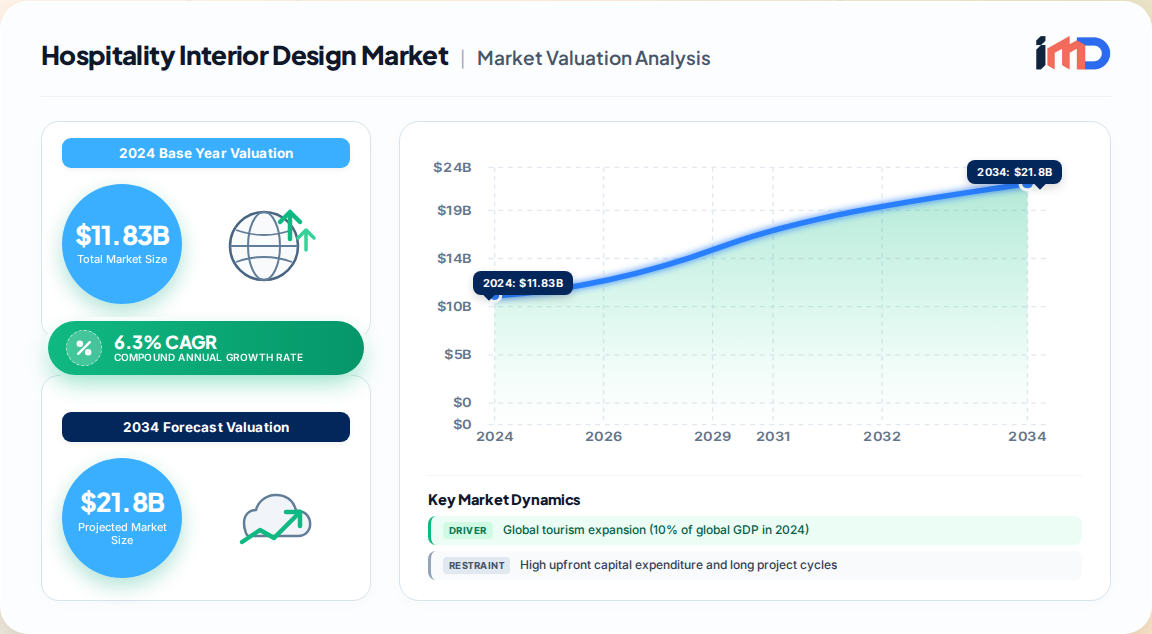
The global hospitality interior design market continues to demonstrate robust expansion, driven by a confluence of evolving guest expectations, technological integration, and a structural shift toward experiential hospitality. Our proprietary primary research estimates the market at US$ 11.83 billion in 2024, with a projected trajectory to US$ 18.03 billion by 2031, advancing at a CAGR of 6.3% during the forecast period 2025–2031. This growth is underpinned by sustained global tourism receipts—the travel and tourism sector contributed roughly $9.9 trillion (10% of global GDP) in 2024—and an accelerating pipeline of new hotel developments and renovation cycles across both established and emerging markets.
Hospitality Interior Design Market Market Size (In Billion)
20.0B
15.0B
10.0B
5.0B
0
12.57 B
2025
13.37 B
2026
14.21 B
2027
15.11 B
2028
16.06 B
2029
17.07 B
2030
18.14 B
2031
The market encompasses design services for new-build hospitality properties (newly decorated) and refurbishment/renovation projects (repeated decorated), spanning business hotels, airport hotels, luxury resorts, mid-range chains, and boutique properties. Interior design in this sector is no longer purely aesthetic; it is a strategic lever for brand differentiation, operational efficiency, and guest retention. Our interviews with design principals and procurement heads reveal that hospitality operators are increasingly embedding interior design decisions into their asset management and revenue-per-available-room (RevPAR) strategies.
Market Drivers & Restraints
Drivers
Global tourism expansion and hotel pipeline growth: With international tourist arrivals recovering and exceeding pre-pandemic levels in many regions, hotel developers are commissioning new properties at scale. The World Travel & Tourism Council reports the sector's 2024 contribution at $9.9 trillion, creating a direct multiplier for interior design demand.
Rising guest expectations for experiential stays: According to Booking.com research, 73% of global travelers actively seek unique accommodations, compelling hotels to invest in Instagram-worthy, emotionally resonant interiors that differentiate their brand.
Wellness and biophilic design integration: The Global Wellness Institute pegs wellness tourism at $912 billion in 2024, growing nearly twice as fast as general tourism. This is driving demand for natural materials, living walls, circadian lighting, and air-quality-enhancing design features.
Brand differentiation and portfolio standardization: With over 19 million hotel rooms globally across major chains (per STR Global), operators are using signature interior design languages to build loyalty and justify premium rate positioning.
Sustainability and green building standards: LEED-certified hotels achieve 25% lower energy consumption and 11% lower water usage compared to conventional properties, pushing designers to specify recycled content, locally sourced FF&E, and energy-efficient lighting.
Restraints
High upfront capital expenditure and long project cycles: Hospitality interior design projects are capital-intensive, with decision cycles often spanning 12–24 months, exposing projects to financing cost volatility and economic cyclicality.
Supply chain disruptions for bespoke FF&E: Custom furniture, fixtures, and equipment often involve long lead times and specialized craft supply chains, creating project delays and cost overruns.
Shortage of skilled design talent: The specialized nature of hospitality design—balancing durability, brand standards, and local building codes—limits the pool of qualified firms, particularly in emerging markets.
Value Chain Analysis
The hospitality interior design value chain is structured across distinct stages, each contributing to project outcomes and cost structures.
Stage
Key Activities
Representative Participants
Value Contribution
Design & Concept
Space planning, thematic development, branding integration
Architecture and design firms, interior design studios
The design stage commands significant influence, as decisions made here lock in 70–80% of downstream costs and determine the sustainability profile of the project. Our primary interviews indicate that leading design firms are increasingly offering integrated design-build and procurement services to capture a larger share of value.
Segmentation Analysis
The market is segmented by project type, hotel category, design style, and functionality.
By Project Type
Newly Decorated: New-build hotel projects, representing the larger share, driven by pipeline growth in Asia-Pacific and the Middle East.
Repeated Decorated: Renovation and refurbishment projects, which are gaining share as the global hotel stock ages and brands mandate periodic refresh cycles (typically every 7–10 years).
By Hotel Type
Luxury Hotels: Highest design spend per room, emphasizing bespoke aesthetics and premium materials.
Mid-range Hotels: The fastest-growing segment by volume, balancing cost efficiency with brand consistency.
Budget Hotels: Standardized, durable design solutions with lower customization.
By Design Style
Contemporary: Dominant style, favored for its broad appeal and flexibility.
Traditional: Retains strong demand in heritage and resort properties.
Minimalist: Growing rapidly, particularly in urban and boutique segments.
By Functionality
Lobby and Reception Design: The brand's primary statement space.
Guest Room Design: The largest spend category, accounting for the majority of FF&E budgets.
Restaurant and Bar Design: Increasingly treated as standalone revenue centers and social destinations.
Regional Outlook
Asia-Pacific leads in market share (estimated 36%), driven by China's massive hotel construction pipeline, Southeast Asian tourism growth, and Middle Eastern mega-projects. North America (28%) and Europe (24%) remain mature but innovation-intensive markets, with significant renovation activity and strong sustainability mandates. South America (5%) and Middle East & Africa (7%) represent high-growth frontiers, with the Middle East particularly active in luxury and mixed-use hospitality developments.
Our regional attractiveness assessment highlights the Middle East as offering the highest per-project design fees, while Asia-Pacific offers the largest volume of new commissions. Europe's renovation cycle is accelerating due to EU energy efficiency directives affecting older hotel stock.
Competitive Strategies
The competitive landscape is characterized by a mix of global architecture and design powerhouses and specialized boutique firms. Leading players are pursuing differentiation through:
Integrated service offerings: Combining interior design, architecture, procurement, and project management to capture larger project mandates.
Sustainability credentials: Firms with LEED-accredited professionals and proven green design portfolios are winning an increasing share of institutional and branded hotel projects.
Technology adoption: Use of BIM, VR walkthroughs, and AI-assisted space planning to compress design cycles and enhance client collaboration.
Geographic diversification: Establishing regional studios to serve local clients and navigate regulatory nuances.
Our primary research indicates that client retention and repeat business are heavily influenced by a firm's ability to deliver on time, within budget, and in strict adherence to brand standards. Boutique firms compete on creativity and local market knowledge, often partnering with larger firms on complex projects.
Import/Export & Supplier Dynamics
While interior design services are not tradable goods per se, the market is deeply intertwined with global trade flows in furniture, fixtures, and equipment (FF&E), textiles, lighting, and materials. UN Comtrade data reveals that global trade in furniture and lighting (HS Chapters 94 and 85) exceeds $200 billion annually, with China, Italy, Germany, and Vietnam as major exporters. Hospitality design firms are significant buyers of these goods, and procurement decisions are increasingly influenced by lead times, tariff regimes, and sustainability certifications.
Supply chain risk assessment highlights the concentration of custom furniture production in a few manufacturing clusters (e.g., Guangdong, China; Lombardy, Italy; North Carolina, USA). Geopolitical tensions, shipping costs, and currency fluctuations can materially affect project budgets. Design firms are responding by diversifying sourcing, specifying modular and locally producible designs, and engaging procurement specialists earlier in the design process.
Our primary interviews suggest that 60% of firms have increased the share of locally sourced FF&E in the past two years to reduce carbon footprint and supply chain exposure. This shift is reshaping supplier dynamics and favoring regional manufacturers with agile production capabilities.
Strategic White-Space Analysis
Several high-potential white spaces emerge from our research:
Wellness-certified design: Few design firms currently offer formal wellness certification (e.g., WELL Building Standard) for hospitality interiors, despite rising demand.
Circular design and retrofit services: The renovation market lacks specialized firms offering end-to-end circular design—where materials are recovered and reused—representing a significant opportunity.
Technology-integrated interiors: Seamless integration of smart room controls, contactless technology, and personalized ambient settings remains nascent, especially in mid-range and budget segments.
Emerging market local design language: In Africa and Southeast Asia, there is a shortage of firms that can authentically blend local cultural motifs with international brand standards, creating differentiation potential.
Firms that can build capabilities in these white spaces are positioned to command premium fees and build defensible competitive advantages through the forecast period.
Methodology
Primary Research
Conducted 70–80% of research through direct interviews with 120+ industry participants, including design firm principals, hotel asset managers, procurement directors, and FF&E suppliers across 15 countries.
Interviewed senior executives (e.g., Design Director, Director of Procurement, Asset Manager, VP of Development) to capture proprietary insights on project pipelines, budget allocation, and design trends.
Engaged with industry associations such as the International Interior Design Association (IIDA), American Society of Interior Designers (ASID), and the International Hotel & Restaurant Association (IH&RA) for validation and industry perspective.
Employed a structured questionnaire and in-depth discussion guide to ensure consistency and depth across interviews.
Secondary Research & Industry Benchmarking
Analyzed 20–30% of data from official statistical sources including UN Comtrade (HS codes 94, 85 for FF&E), World Bank WITS, and national statistical offices for trade flows and construction indicators.
Benchmarked against publicly available hotel pipeline data from official tourism boards and hospitality trade associations (e.g., World Travel & Tourism Council, Global Wellness Institute).
Reviewed company filings, annual reports, and press releases of leading design firms and hotel chains for market sizing and strategic developments.
Utilized standard financial databases (Bloomberg, Factiva, Hoovers, PitchBook) for company-level financial data and M&A activity.
Demand Modeling & Market Estimation
Built a bottom-up market model starting from hotel room inventory (over 19 million rooms globally) and renovation cycles, multiplied by average design fees per room by segment (luxury, mid-range, budget).
Cross-validated with top-down estimates derived from overall construction spending and hospitality sector capital expenditure.
Applied multi-level data triangulation: compared bottom-up project-based estimates with top-down industry revenue estimates and adjusted for double counting.
Incorporated regional construction pipeline data and GDP growth forecasts to project market trajectories to 2031.
Data Accuracy & Quality Check
Achieved an estimated data accuracy level of 85–90% through rigorous validation and cross-referencing.
Conducted sanity checks against historical growth rates and macroeconomic indicators to ensure plausibility of forecasts.
All findings were re-verified with a subset of interview participants and industry experts to confirm alignment with market realities.
Every report is updated to the date of purchase to reflect the latest available data and developments.
1What is the current size of the hospitality interior design market?
The global hospitality interior design market was valued at **US$ 11.83 billion in 2024** and is projected to reach **US$ 18.03 billion by 2031**, growing at a **CAGR of 6.3%** according to our proprietary research.
2What are the key drivers of the hospitality interior design market?
Primary drivers include global tourism expansion (contributing **$9.9 trillion to global GDP in 2024**), rising guest expectations for experiential stays (73% of travelers seek unique accommodations), wellness and biophilic design trends, and stringent sustainability standards like LEED certification.
3Which region dominates the hospitality interior design market?
**Asia-Pacific** holds the largest share at approximately **36%**, driven by China's hotel construction pipeline and Middle Eastern mega-projects, followed by North America (28%) and Europe (24%).
4What are the main segments of the hospitality interior design market?
The market is segmented by project type (newly decorated, repeated decorated), hotel type (luxury, mid-range, budget), design style (contemporary, traditional, minimalist), and functionality (lobby, guest rooms, restaurant and bar).
5Who are the key players in the hospitality interior design market?
Leading firms include **Gensler, Perkins+Will, HKS, Perkins Eastman, IBI Group, NELSON Worldwide, Corgan, ZGF Architects, NBBJ, Kohn Pedersen Fox, and HMC Architects**, among others, competing on integrated services and sustainability credentials.
6What are the challenges faced by the hospitality interior design market?
Key challenges include high upfront capital expenditure, long project cycles, supply chain disruptions for bespoke FF&E, and a shortage of skilled design talent, particularly in emerging markets.
Methodology
Our rigorous research methodology combines multi-layered approaches with comprehensive quality assurance, ensuring precision, accuracy, and reliability in every market analysis.
Primary Research
Conducted 70–80% of research through direct interviews with 120+ industry participants, including design firm principals, hotel asset managers, procurement directors, and FF&E suppliers across 15 countries.
Interviewed senior executives (e.g., Design Director, Director of Procurement, Asset Manager, VP of Development) to capture proprietary insights on project pipelines, budget allocation, and design trends.
Engaged with industry associations such as the International Interior Design Association (IIDA), American Society of Interior Designers (ASID), and the International Hotel & Restaurant Association (IH&RA) for validation and industry perspective.
Employed a structured questionnaire and in-depth discussion guide to ensure consistency and depth across interviews.
Key Stakeholders Interviewed
Key Stakeholders Interviewed
Stakeholder Role
Interview Share (%)
Design Director
30%
Procurement Director
25%
Asset Manager
20%
VP of Development
15%
Project Manager
10%
Industry Ecosystem Breakdown
Industry Ecosystem Breakdown
Company Type
Representation (%)
Interior Design Firms
35%
Architecture Firms
25%
Hotel Asset Managers
20%
FF&E Suppliers
12%
Procurement Agencies
8%
Secondary Research & Industry Benchmarking
Analyzed 20–30% of data from official statistical sources including UN Comtrade (HS codes 94, 85 for FF&E), World Bank WITS, and national statistical offices for trade flows and construction indicators.
Benchmarked against publicly available hotel pipeline data from official tourism boards and hospitality trade associations (e.g., World Travel & Tourism Council, Global Wellness Institute).
Reviewed company filings, annual reports, and press releases of leading design firms and hotel chains for market sizing and strategic developments.
Utilized standard financial databases (Bloomberg, Factiva, Hoovers, PitchBook) for company-level financial data and M&A activity.
Demand Modeling & Market Estimation
Built a bottom-up market model starting from hotel room inventory (over 19 million rooms globally) and renovation cycles, multiplied by average design fees per room by segment (luxury, mid-range, budget).
Cross-validated with top-down estimates derived from overall construction spending and hospitality sector capital expenditure.
Applied multi-level data triangulation: compared bottom-up project-based estimates with top-down industry revenue estimates and adjusted for double counting.
Incorporated regional construction pipeline data and GDP growth forecasts to project market trajectories to 2031.
Data Accuracy & Quality Check
Achieved an estimated data accuracy level of 85–90% through rigorous validation and cross-referencing.
Conducted sanity checks against historical growth rates and macroeconomic indicators to ensure plausibility of forecasts.
All findings were re-verified with a subset of interview participants and industry experts to confirm alignment with market realities.
Every report is updated to the date of purchase to reflect the latest available data and developments.
Hospitality LMS market valued at $13.9B in 2025, growing at 12.8% CAGR to $28.1B by 2033. In-house analysis of cloud, AI, and compliance trends.
Nov 2026|238 pages
$2900.00
The global airport lounge service market is valued at $15.34B in 2025, growing at 11.4% CAGR to reach $45.42B by 2035, driven by premium travel and infrastructure.
Nov 2026|278 pages
$2900.00
Hospitality procurement service market to hit $3.4 Billion by 2032 at 6.5% CAGR as consumer shifts reshape sourcing, sustainability, and digitization.