1What is the current size of the intraoral dental sensors market?
The global intraoral dental sensors market is valued at approximately USD 451.8 million in 2026 and is projected to reach USD 821.3 million by 2034, expanding at a CAGR of 7.8%.
Insight Market Data is a premier market research and business consulting firm headquartered in Pune, India, providing syndicated research reports, customized intelligence studies, and strategic advisory services. Renowned academic institutions and Fortune 500 corporations worldwide rely on Insight Market Data's research repository to navigate evolving global and regional business environments. Covering 46 diverse industries across 25 major international economies, our comprehensive database delivers thousands of verified statistics and granular market evaluations. By combining industry-leading analytical methodologies with the direct insights of seasoned industry leaders and subject-matter experts, we deliver actionable intelligence spanning historical performance benchmarks to rigorous multi-year forecasts. We empower organizations to make confident, data-driven decisions across pivotal domains including Machinery & Equipment, Chemicals & Materials, Pharmaceuticals & Healthcare, Food & Beverages, Consumer Goods, Energy & Power, Automotive & Transportation, Electronics & Semiconductors, Medical Devices, Telecommunications, Emerging Technologies, Agriculture, and Packaging. Our multidisciplinary analyst teams provide an objective 360-degree perspective, tailoring every engagement to address complex strategic challenges with exceptional analytical rigor.
Leveraging advanced BI-powered analytics and predictive modeling, Insight Market Data uncovers high-impact market opportunities and competitive differentiators for ambitious enterprises. We continuously refine our research methodologies in accordance with global industry standards, tracking real-time market shifts to ensure our reports are consistently accurate, actionable, and delivered on schedule. Our analysts conduct methodical data validation, rigorous compliance checks, and exhaustive primary and secondary research to maintain the highest levels of data integrity and transparency. We partner closely with corporate strategists, investment groups, and business executives to translate intricate market intelligence into clear, actionable roadmaps for sustainable growth. With operational presence across Washington, USA, and Vimannagar, Pune, India, Insight Market Data ensures direct access to dedicated research specialists and responsive customer support to answer your most strategic questions.
 Intraoral Dental Sensors Market
 by Product Type (CMOS Sensors, CCD Sensors), by Connectivity (Wired Sensors, Wireless Sensors), by Application (Restorative Dentistry, Orthodontics, Endodontics, Implantology, Oral Surgery), by End User (Dental Clinics, Hospitals, DSOs, Academic & Research Institutes), by North America (USA, Canada, Mexico), by Europe (Germany, France, UK, Italy, Spain, Nordic Countries), by Asia Pacific (China, Japan, South Korea, India, Australia), by Latin America (Brazil, Mexico, Colombia, Argentina), by Middle East & Africa (UAE, Saudi Arabia, South Africa) Forecast 2026-2034

Research Analyst


 Related Reports

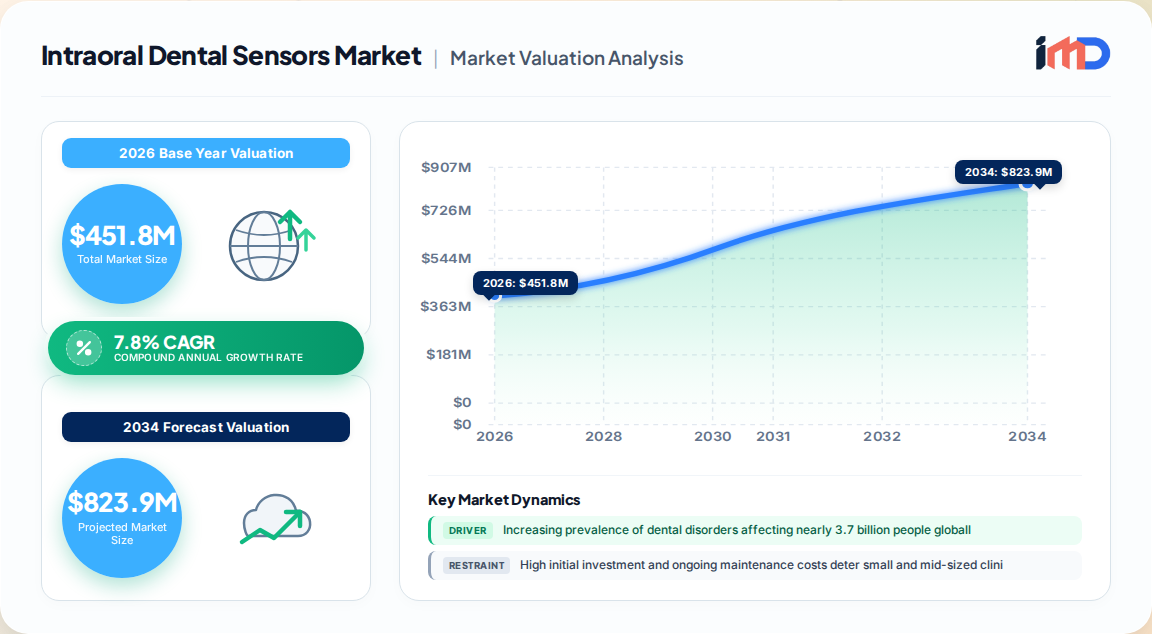
The global intraoral dental sensors market is a high-utility, infrastructure-aligned diagnostic segment undergoing structural expansion as dentistry accelerates its analog-to-digital transition. Our proprietary primary research estimates the market at USD 451.8 million in 2026, with a projected valuation of USD 821.3 million by 2034, expanding at a CAGR of 7.8%. This growth is not speculative; it is anchored in recurring clinical demand, replacement cycles, and the deepening integration of imaging hardware with AI-enabled software ecosystems.
Intraoral sensors—predominantly complementary metal-oxide-semiconductor (CMOS) and charge-coupled device (CCD) platforms—have become the standard of care in digitally mature markets, replacing film-based radiography by delivering instant image acquisition, reduced radiation exposure, and seamless interoperability with practice management software. The market's trajectory reflects a structural shift rather than a cyclical uptick, underpinned by a global oral disease burden affecting nearly 3.7 billion people (WHO estimates) and a rapidly aging population requiring frequent diagnostic imaging.
The market is structured around sensor technology and connectivity architecture, each reflecting distinct clinical workflows, ergonomic requirements, and capital replacement cycles.
| Segment | 2026 Share (Est.) | Growth Outlook | Key Characteristics |
|---|---|---|---|
| CMOS Sensors | ~68% | Steady, dominant | Lower power consumption, compact form factor, fast image capture, scalable for portable X-ray systems |
| CCD Sensors | ~32% | Mature, replacement-driven | Higher image uniformity, bulkier design, concentrated in legacy and premium diagnostic environments |
| Wired Sensors | ~72% | Stable, baseline revenue | Reliable signal transmission, lower upfront cost, compatibility with fixed operatory layouts |
| Wireless Sensors | ~28% | Fastest-growing (>9% CAGR) | Improved ergonomics, reduced chairside clutter, favored in pediatric, geriatric, and multi-chair settings |
CMOS technology remains the backbone of new installations and replacement purchases. Continuous improvements in resolution, noise reduction, and dose efficiency—reducing patient exposure by up to 40% without compromising image clarity—reinforce its dominance. Wireless sensors, while a smaller revenue share, represent the most innovation-driven segment, with adoption accelerating as battery performance, data security, and real-time image transfer improve.
Dental clinics constitute the largest end-use segment, accounting for approximately 58.6% of total revenue in 2024 (latest full-year verified data). Their dominance reflects high-frequency imaging for routine diagnostics, restorative procedures, and preventive care. Hospitals and specialty care centers represent roughly 18.4%, driven by maxillofacial surgery, trauma care, and complex diagnostic cases. DSOs hold about 15.2%, with centralized procurement models shaping demand toward uniform sensor platforms and long-term service agreements. Academic and research institutes contribute an estimated 7.8%, playing a critical role in training, clinical trials, and early technology exposure.
By application, restorative dentistry commands the largest share at approximately 39.3%, followed by orthodontics, endodontics, implantology, and oral surgery. The growing emphasis on early and accurate diagnosis in endodontics and implant planning is fueling demand for high-performance sensors with enhanced resolution and dynamic range.
North America leads the global market with an estimated 33% revenue share in 2026, supported by early digitization, strong DSO penetration, and high reimbursement availability for digital imaging. The U.S. market alone is projected to grow from USD 146.8 million in 2024 to USD 221.7 million by 2030 at a 7.1% CAGR.
Europe represents the second-largest regional market, growing at a moderate 5.7% CAGR, shaped by regulatory standards, government-led oral health screening programs, and replacement demand across established practices. Germany, France, the UK, and the Nordic bloc lead adoption, while Eastern Europe lags due to slower infrastructure modernization.
Asia-Pacific is the fastest-growing region, forecast to expand at a 9.8% CAGR, driven by rapid clinic expansion, urbanization, rising disposable incomes, and the analog-to-digital transition. China and India are witnessing a surge in private dental chains and hospital-attached clinics, while South Korea and Japan benefit from native OEMs with advanced R&D capabilities. Latin America and the Middle East & Africa remain white-space-rich regions, with adoption concentrated in high-income countries and private practices.
| Region | 2026 Share (Est.) | CAGR (2026–2034) | Key Growth Factors |
|---|---|---|---|
| North America | ~33% | 7.1% | Early digitization, DSO penetration, reimbursement support |
| Europe | ~26% | 5.7% | Regulatory standards, screening programs, replacement demand |
| Asia-Pacific | ~28% | 9.8% | Clinic expansion, urbanization, rising incomes |
| South America | ~8% | 7.5% | Public-private partnerships, digitalization efforts |
| Middle East & Africa | ~5% | 6.5% | International dental chains, private practice adoption |
The intraoral dental sensors market features a dynamic blend of global dental imaging specialists, vertically integrated equipment firms, and software-focused innovators. Competition is intensifying around image fidelity, software interoperability, ergonomic design, and service ecosystems rather than standalone hardware differentiation. Leading players are pursuing strategies that bundle sensors with imaging software, cloud PACS, and AI-enabled diagnostic modules to lock in customers and drive recurring revenue.
Recent developments include:
The intraoral sensor value chain spans component suppliers (CMOS/CCD dies, scintillator materials, USB/wireless modules), sensor OEMs, software integrators, and distribution channels serving dental clinics, hospitals, and DSOs. Procurement decisions are increasingly influenced by total cost of ownership, software compatibility, and warranty terms rather than unit price alone. DSOs are driving volume consolidation through centralized purchasing, while independent clinics prioritize plug-and-play compatibility and ease of integration with existing practice management systems.
Key procurement considerations include sensor lifespan, replacement frequency, DICOM compliance, and interoperability with cloud-based PACS and CAD/CAM platforms. Vendors offering subscription-based "sensor-as-a-service" models are gaining traction among budget-sensitive practices seeking predictable capital expenditure.
| Aspects | Details |
|---|---|
| Study Period | 2020-2034 |
| Base Year | 2026 |
| Estimated Year | 2026 |
| Forecast Period | 2026-2034 |
| Historical Period | 2020-2025 |
| Growth Rate | CAGR of 7.8% from 2020-2034 |
| Segmentation |
|
By Application
By End User
| By Geography |
|
The global intraoral dental sensors market is valued at approximately USD 451.8 million in 2026 and is projected to reach USD 821.3 million by 2034, expanding at a CAGR of 7.8%.
North America leads the market with an estimated 33% revenue share in 2026, driven by early digitization, strong DSO penetration, and high reimbursement availability for digital imaging.
Key drivers include the rising prevalence of dental disorders affecting nearly 3.7 billion people globally, growing demand for restorative dental procedures, and increasing investments in digital dentistry infrastructure.
Wireless intraoral sensors represent the fastest-growing connectivity segment, expected to grow at a CAGR exceeding 9.2%, driven by improved ergonomics, reduced chairside clutter, and adoption in pediatric and multi-chair settings.
Leading companies include Carestream Dental, DEXIS (Envista Holdings), Planmeca, Acteon Group, VATECH, Owandy Radiology, Dürr Dental, KaVo Dental, Cefla Medical Equipment, and XDR Radiology.
Our rigorous research methodology combines multi-layered approaches with comprehensive quality assurance, ensuring precision, accuracy, and reliability in every market analysis.
| Stakeholder Role | Interview Share (%) |
|---|---|
| Chief Dental Officers | 25% |
| Director of Clinical Operations | 30% |
| Procurement Directors | 25% |
| Radiology/Imaging Specialists | 20% |
| Company Type | Representation (%) |
|---|---|
| Intraoral Sensor OEMs & Component Manufacturers | 35% |
| Dental Imaging Software & AI Platform Developers | 25% |
| DSO Procurement & Clinical Operations Teams | 20% |
| Dental Equipment Distributors & Dealers | 12% |
| Specialist Clinics & Hospital Radiology Departments | 8% |