1How big is the India EMR market in 2025?
The India EMR market is estimated at USD 0.79 billion in 2025 and is forecast to reach USD 1.13 billion by 2030, expanding at a CAGR of 7.56% over the period.
Insight Market Data is a premier market research and business consulting firm headquartered in Pune, India, providing syndicated research reports, customized intelligence studies, and strategic advisory services. Renowned academic institutions and Fortune 500 corporations worldwide rely on Insight Market Data's research repository to navigate evolving global and regional business environments. Covering 46 diverse industries across 25 major international economies, our comprehensive database delivers thousands of verified statistics and granular market evaluations. By combining industry-leading analytical methodologies with the direct insights of seasoned industry leaders and subject-matter experts, we deliver actionable intelligence spanning historical performance benchmarks to rigorous multi-year forecasts. We empower organizations to make confident, data-driven decisions across pivotal domains including Machinery & Equipment, Chemicals & Materials, Pharmaceuticals & Healthcare, Food & Beverages, Consumer Goods, Energy & Power, Automotive & Transportation, Electronics & Semiconductors, Medical Devices, Telecommunications, Emerging Technologies, Agriculture, and Packaging. Our multidisciplinary analyst teams provide an objective 360-degree perspective, tailoring every engagement to address complex strategic challenges with exceptional analytical rigor.
Leveraging advanced BI-powered analytics and predictive modeling, Insight Market Data uncovers high-impact market opportunities and competitive differentiators for ambitious enterprises. We continuously refine our research methodologies in accordance with global industry standards, tracking real-time market shifts to ensure our reports are consistently accurate, actionable, and delivered on schedule. Our analysts conduct methodical data validation, rigorous compliance checks, and exhaustive primary and secondary research to maintain the highest levels of data integrity and transparency. We partner closely with corporate strategists, investment groups, and business executives to translate intricate market intelligence into clear, actionable roadmaps for sustainable growth. With operational presence across Washington, USA, and Vimannagar, Pune, India, Insight Market Data ensures direct access to dedicated research specialists and responsive customer support to answer your most strategic questions.

 India EMR (Electronic Medical Records) Market
 by Component (Hardware, Software, Service), by Deployment Model (Cloud-based, On-premise), by Type (General EMR, Specialty EMR), by End User (Hospitals and Clinics, Ambulatory Surgical Centers, Other Users(Diagnostic Centers, Medical Academic Centers, Other End Users)), by Application (Cardiology, Neurology, Radiology, Oncology, Mental and Behavioral Health, Nephrology and Urology, Gastroenterology, Pediatrics, General Medicine, Physical Therapy and Rehabilitation), by North India, by South India, by East India, by West India Forecast 2026-2034

Research Analyst

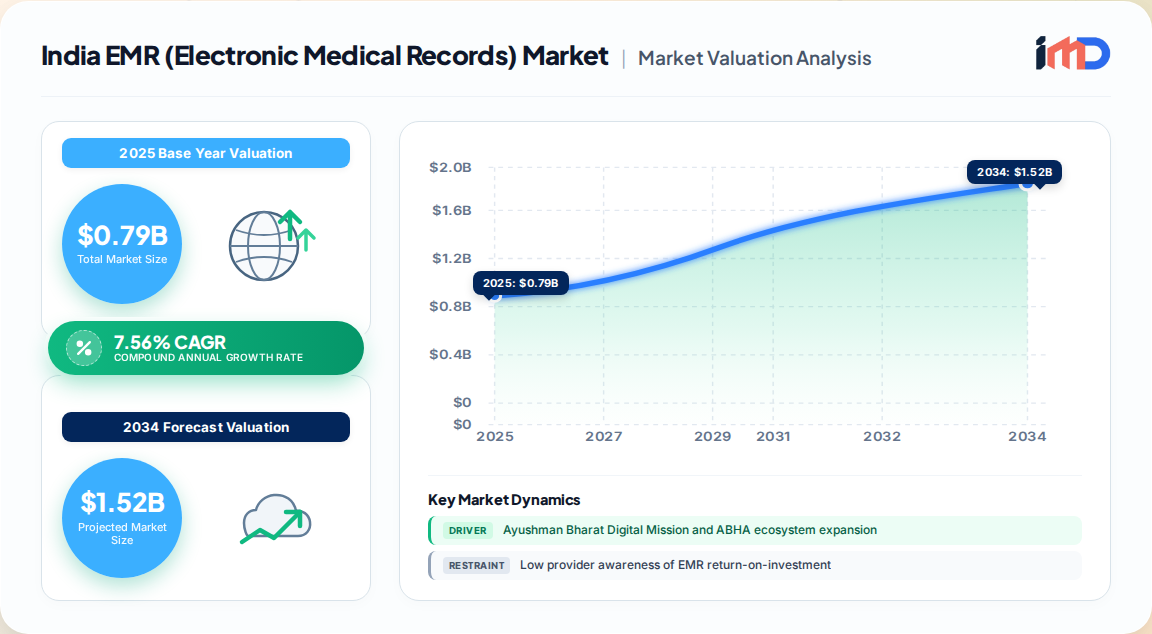
The India Electronic Medical Records (EMR) market is estimated at USD 0.79 billion in 2025 and is forecast to reach USD 1.13 billion by 2030, expanding at a CAGR of 7.56% over the forecast period. This growth trajectory is underpinned by accelerating healthcare digitalisation, landmark public digital health infrastructure, and intensifying private-sector investment across hospital and ambulatory care settings.
India's EMR adoption curve is steepening, yet remains shallow relative to penetration levels observed in OECD markets, where more than 93% of primary care practices used EMRs in 2021. This gap represents the market's principal structural opportunity: a large, under-digitised provider base now being pulled forward by regulation, interoperability mandates and cloud economics.
Cloud-based EMR is expected to hold the significant share of the India market and register the fastest growth through 2030.
| Deployment Model | 2025 Position | Growth Outlook | Core Buyer Profile |
|---|---|---|---|
| Cloud-based | Dominant share | Fastest CAGR | Single-specialty clinics, mid-tier hospitals, diagnostic chains |
| On-premise | Established installed base | Moderate | Large tertiary hospitals, government facilities with data-residency constraints |
Feature innovation is concentrated in the cloud tier. The launch of a Drug-to-Drug Interaction (DDI) engine on HealthPlix's interactive cloud-based EMR platform in August 2022, and MyHealthcare's single-screen general EMR launch in July 2022, illustrate how vendors are differentiating on clinical utility rather than storage alone. Cloud-based systems also enable real-time revenue tracking, staff access management, configurable templates and remote retrieval of longitudinal records.
Specialty EMR is positioned for the highest annual growth rate, driven by the rising prevalence of chronic conditions, growth in multispecialty hospital counts, and cross-border clinical collaborations between Indian and developed-market institutions.
| Segment Dimension | Leading / Fastest Categories |
|---|---|
| By Component | Software, Service, Hardware |
| By Deployment Model | Cloud-based, On-premise |
| By Type | General EMR, Specialty EMR (fastest growing) |
| By End User | Hospitals and Clinics (leading), Ambulatory Surgical Centers, Diagnostic Centers, Medical Academic Centers |
| By Application | Cardiology, Neurology, Radiology, Oncology, Mental and Behavioral Health, Nephrology and Urology, Gastroenterology, Pediatrics, General Medicine, Physical Therapy and Rehabilitation |
Hospitals and clinics remain the anchor end-user segment, reflecting both bed capacity growth and the ABDM onboarding of large provider networks. Ambulatory surgical centres represent a high-value niche where workflow-specific templates and billing integration command premium pricing.
Adoption is geographically uneven, tracking private healthcare investment density, medical education infrastructure and digital connectivity.
| Region | Share of Market | Attractiveness Rationale |
|---|---|---|
| South India | 31% | Highest concentration of multispecialty and quaternary care institutions; strong healthtech startup base (Bengaluru, Hyderabad, Chennai) |
| North India | 28% | National capital region policy influence, large public procurement programmes, dense private hospital networks |
| West India | 24% | Mumbai-Ahmedabad-Pune corridor with high corporate hospital penetration and insurance-linked digitisation |
| East India | 17% | Emerging adoption; significant headroom in tier-2/3 facilities and public health infrastructure |
Investment priority should favour the South and West for enterprise-grade specialty deployments, while the East offers volume-led, price-sensitive cloud EMR opportunities through channel partnerships.
The India EMR market is highly concentrated, with domestic healthtech platforms competing against global clinical software incumbents. Competitive differentiation now rests on three axes: interoperability with ABDM registries, specialty-specific clinical content, and pricing models accessible to small providers.
Key participants include DocEngage Informatics, Practo Technologies Pvt. Ltd., Veradigm LLC, Medical Information Technology, Inc. (MEDITECH), athenaHealth, HealthPlix, Eka Care, MyHealthcare, Docplix, Cerner Corporation, Epic Systems Corporation, eClinicalWorks, GE HealthCare Technologies, McKesson Corp, NextGen Healthcare, Greenway Health, AdvancedMD and CureMD Healthcare.
Winning strategies observed in the market include:
Three underpenetrated opportunity zones merit prioritisation:
EMR is a software-and-services market rather than a tradable commodity, so conventional trade flow analysis is limited. However, supplier dynamics are shaped by cross-border technology dependence and data residency requirements.
The India EMR market is set to add roughly USD 0.34 billion in incremental value between 2025 and 2030, with cloud-based and specialty EMR segments capturing a disproportionate share of that growth. Procurement patterns will increasingly favour platforms that demonstrate ABDM interoperability, specialty workflow depth and transparent subscription pricing. Vendors that close the provider awareness gap and deliver measurable workflow productivity gains will outperform the market's 7.56% CAGR baseline.
| Aspects | Details |
|---|---|
| Study Period | 2020-2034 |
| Base Year | 2025 |
| Estimated Year | 2026 |
| Forecast Period | 2026-2034 |
| Historical Period | 2020-2025 |
| Growth Rate | CAGR of 7.56% from 2020-2034 |
| Segmentation |
|
By Type
By End User
By Application
| By Geography |
|
The India EMR market is estimated at USD 0.79 billion in 2025 and is forecast to reach USD 1.13 billion by 2030, expanding at a CAGR of 7.56% over the period.
Cloud-based EMR holds the significant market share and is also the fastest-growing segment, driven by lower capex, remote accessibility and rapid feature innovation such as drug-to-drug interaction tools.
Specialty EMR is expected to register the highest annual growth rate, supported by rising chronic disease prevalence, multispecialty hospital expansion and specialty-specific clinical documentation needs in cardiology, oncology and diabetes care.
Key participants include DocEngage Informatics, Practo Technologies, Veradigm, MEDITECH, athenaHealth, HealthPlix, Eka Care, MyHealthcare, Cerner Corporation, Epic Systems and eClinicalWorks.
Government initiatives such as the Ayushman Bharat Digital Mission and ABHA registries, hospital capacity expansion, cloud cost economics and rising vendor investment are the primary adoption drivers.
Our rigorous research methodology combines multi-layered approaches with comprehensive quality assurance, ensuring precision, accuracy, and reliability in every market analysis.
| Stakeholder Role | Interview Share (%) |
|---|---|
| Chief Information Officer / Health IT Director | 30% |
| Clinical Informatics Lead | 22% |
| Practice Owner / Medical Director | 28% |
| EMR Vendor Product & Strategy Head | 20% |
| Company Type | Representation (%) |
|---|---|
| EMR Software Platform Developers | 32% |
| Cloud Infrastructure & Hosting Providers | 18% |
| Hospital IT & Health Informatics Departments | 24% |
| Diagnostic & Ambulatory Care Chains | 14% |
| Clinical Content & Terminology Licensors | 12% |
 Related Reports
