1What is the size of the India cosmetics market in 2025?
Our proprietary research values the India cosmetics market at USD 21.50 Billion in 2025, projected to reach USD 43.85 Billion by 2033 at a CAGR of 9.3%.
Insight Market Data is a premier market research and business consulting firm headquartered in Pune, India, providing syndicated research reports, customized intelligence studies, and strategic advisory services. Renowned academic institutions and Fortune 500 corporations worldwide rely on Insight Market Data's research repository to navigate evolving global and regional business environments. Covering 46 diverse industries across 25 major international economies, our comprehensive database delivers thousands of verified statistics and granular market evaluations. By combining industry-leading analytical methodologies with the direct insights of seasoned industry leaders and subject-matter experts, we deliver actionable intelligence spanning historical performance benchmarks to rigorous multi-year forecasts. We empower organizations to make confident, data-driven decisions across pivotal domains including Machinery & Equipment, Chemicals & Materials, Pharmaceuticals & Healthcare, Food & Beverages, Consumer Goods, Energy & Power, Automotive & Transportation, Electronics & Semiconductors, Medical Devices, Telecommunications, Emerging Technologies, Agriculture, and Packaging. Our multidisciplinary analyst teams provide an objective 360-degree perspective, tailoring every engagement to address complex strategic challenges with exceptional analytical rigor.
Leveraging advanced BI-powered analytics and predictive modeling, Insight Market Data uncovers high-impact market opportunities and competitive differentiators for ambitious enterprises. We continuously refine our research methodologies in accordance with global industry standards, tracking real-time market shifts to ensure our reports are consistently accurate, actionable, and delivered on schedule. Our analysts conduct methodical data validation, rigorous compliance checks, and exhaustive primary and secondary research to maintain the highest levels of data integrity and transparency. We partner closely with corporate strategists, investment groups, and business executives to translate intricate market intelligence into clear, actionable roadmaps for sustainable growth. With operational presence across Washington, USA, and Vimannagar, Pune, India, Insight Market Data ensures direct access to dedicated research specialists and responsive customer support to answer your most strategic questions.
 India Cosmetics Market
 by Product (Skin Care, Oral Care, Hair Care, Color Cosmetics, Bath & Shower Products, Perfume & Fragrance), by End User (Women, Men), by Distribution Channel (General Trade, Supermarkets/Hypermarkets, Specialty Stores, Pharmacies/Drug Stores, Online Retail, Quick Commerce, Other), by Category (Conventional, Organic), by Formulation (Organic, Natural, Synthetic), by Gender (Female, Male, Unisex), by Region (North, West, South, East, Central & North-East), by India (North India, West India, South India, East India, Central & North-East India) Forecast 2026-2034

Research Analyst


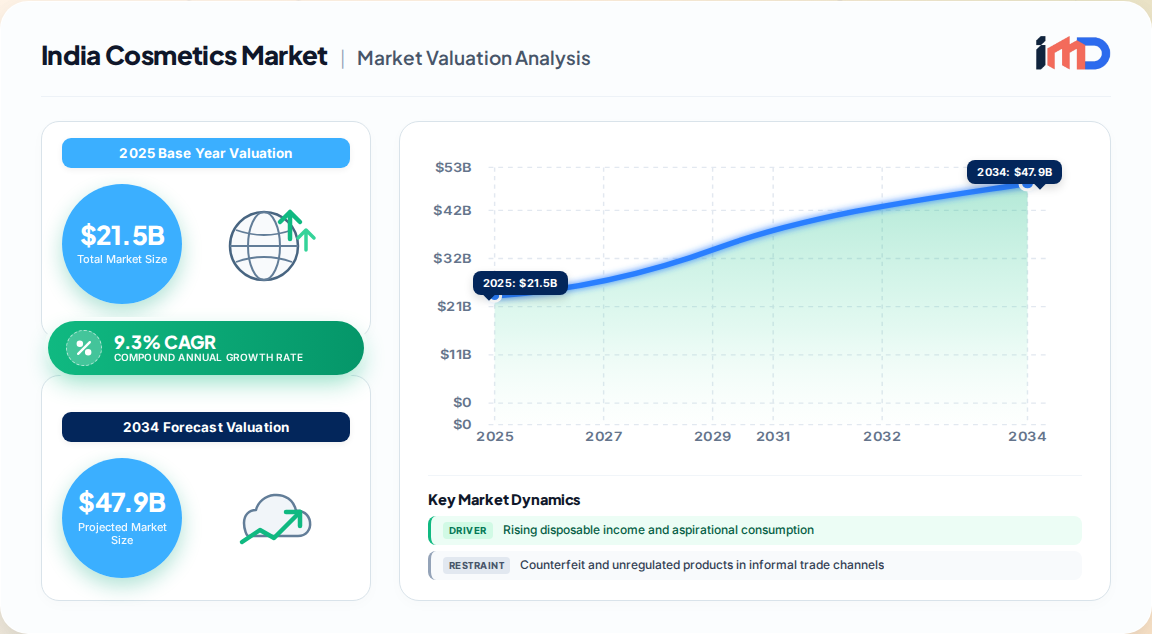
India has transitioned from a fringe beauty-consumption market into one of the world's most closely watched cosmetics economies. Our proprietary first-party research pegs the India cosmetics market at USD 21.50 Billion in 2025, with a projected expansion to USD 43.85 Billion by 2033, representing a CAGR of 9.3% across the 2026–2033 forecast window.
The structural engine behind this trajectory is demographic rather than cyclical. India carries over 1.4 billion people with a median age near 28, and per-capita income climbed to roughly USD 2,485 in 2024. That figure matters because historical consumption modeling places the beauty trade-up inflection near the USD 2,000–2,500 per-capita mark — precisely where India now sits.
Equally important is the widening gap between organized penetration and latent demand. Over 9 million retail outlets serve the country, yet modern trade and e-commerce remain concentrated in urban corridors. This mismatch is the single largest source of incremental revenue over the forecast period.
| Metric | Value |
|---|---|
| Base Year Market Size (2025) | USD 21.50 Billion |
| Projected Market Size (2033) | USD 43.85 Billion |
| CAGR (2026–2033) | 9.3% |
| Leading End-User Segment | Women (68.9%, 2025) |
| Leading Distribution Channel | General Trade (33.0%, 2025) |
| Fastest-Growing Category | Organic (~9.2% CAGR) |
| E-commerce Share of Sales | Over 22% |
A parallel premiumization story is unfolding at the top of the pyramid. The luxury beauty sub-segment, currently a smaller slice of overall beauty and personal care at roughly 4% share, is growing at approximately 14% annually — nearly 1.5x the mass-market growth rate. This bifurcation defines the competitive arena: mass brands battle on distribution and price, while prestige players compete on localization, education, and experiential retail.
Beauty and grooming now rank among the top five consumer expenditure categories in urban India. Premium-tier spending is expanding fastest, with the premium segment expected to grow approximately 20% in the coming years as households allocate a rising share of discretionary income to personal care.
India counts over 950 million internet users as of 2025, and beauty content accounts for roughly 18% of total social media engagement on Instagram and YouTube India. Nearly 70% of consumers report that social media influences their purchase decisions. D2C brands leveraging influencer marketing achieve structurally lower customer acquisition costs than legacy retail-led brands.
The male segment, at 18.32% of revenue in 2025, is the fastest-growing gender category at roughly 8.4% CAGR, with observed annual growth near 9.8% in 2023–2024. Face wash, beard care, moisturizers, and anti-dandruff solutions are the volume drivers, supported by dedicated brands and men's extensions from established franchises.
The organic segment holds 17.46% share in 2025 but grows at an estimated 9.2% CAGR — approximately 1.6x the overall market rate. Consumer searches for "paraben-free" and "natural" formulations are climbing steadily on e-commerce platforms, and Ayurvedic heritage brands are converting that intent into premium price realization.
Organized beauty retail is penetrating cities such as Kanpur, Coimbatore, Surat, and Bhopal. Quick-commerce platforms delivering in minutes have collapsed the accessibility gap for discretionary SKUs, converting infrequent buyers into recurring ones.
Bath & shower products led with 28.9% share in 2025, reflecting high-frequency, low-consideration purchasing. Skin care remains the value engine, while color cosmetics is the fastest-growing product cluster as hybrid formats — serum foundations, tinted sunscreens, BB/CC creams — blur category lines.
Women commanded 68.9% of revenue in 2025 (alternate segmentation places this near 70.46%), sustained by rising female workforce participation — urban female labor participation reached 33% in 2024. Men remain the fastest-growing cohort.
General trade retains leadership at 33.0% share in 2025, but e-commerce now exceeds 22% of total sales through Nykaa, Myntra Beauty, Amazon India, Flipkart, and quick-commerce entrants. Retail stores are the fastest-growing physical format as organized chains expand into Tier-2 cities.
Conventional cosmetics hold 82.54% of the category split, anchored by affordability and mass reach. Organic holds 17.46% and is compounding at roughly 9.2% CAGR.
| Segment Dimension | Largest Segment | Share (2025) | Fastest-Growing Segment |
|---|---|---|---|
| Product | Bath & Shower | 28.9% | Color Cosmetics |
| End User | Women | 68.9% | Men (~8.4% CAGR) |
| Distribution | General Trade | 33.0% | Retail Stores / Online |
| Category | Conventional | 82.54% | Organic (~9.2% CAGR) |
| Formulation | Organic | — | Natural |
India is best understood as a portfolio of distinct regional markets rather than a single national one. North India leads with 32% of revenue in 2025, anchored by Delhi NCR, Lucknow, and Chandigarh, where modern trade and quick-commerce density is highest. East India is the fastest-growing region, benefiting from a lower base and rapid organized retail entry.
| Region | Revenue Share (2025) | Growth Profile |
|---|---|---|
| North India | 32% | Mature, premium-skewed |
| West India | ~24% | High urban density, Mumbai/Pune/Ahmedabad |
| South India | ~23% | Strong skincare and hair care adoption |
| East India | ~13% | Fastest-growing, emerging modern trade |
| Central & North-East | ~8% | Underpenetrated, long-run upside |
Climate, complexion diversity, and language fragmentation mean that a single national strategy underperforms. Brands tailoring shade ranges to brown complexions with neutral and warm undertones, and launching mini-SKUs for price accessibility, consistently report superior trial-to-repeat conversion.
The market is contested by three distinct cohorts: multinational FMCG majors, domestic Ayurvedic and heritage brands, and digital-native D2C challengers. Multinationals bring portfolio breadth and R&D depth; domestic players own trust, ingredient authenticity, and rural distribution; D2C brands control narrative and community.
Three strategic pillars separate winners from the field:
Notably, roughly 90% of India's luxury beauty landscape is comprised of international brands against only 10% local — a striking contrast with Japan and South Korea, where homegrown luxury brands approach 40% of the market. This gap represents the clearest long-run white space for domestic premiumization.
India's cosmetics value chain has three structural pressure points. First, specialty actives, pigments, and premium packaging components are substantially imported, creating exposure to landed-cost volatility and customs clearance timelines. Second, contract manufacturing capacity is concentrated in a handful of clusters, limiting flexibility for small-batch innovation. Third, cold-chain and shelf-life integrity requirements for natural and preservative-light formulations raise logistics cost.
Official DPIIT data shows cumulative FDI equity inflows into the "Soaps, Cosmetics & Toilet Preparations" sector have grown steadily since 2000, signaling sustained foreign confidence in domestic manufacturing and distribution build-out. Brands able to localize formulation while retaining imported hero ingredients — and to dual-source packaging — will protect gross margin most effectively.
Our base case sees the India cosmetics market compounding at 9.3% through 2033 to USD 43.85 Billion, with upside scenarios driven by three accelerants: faster-than-modeled income growth pushing households across the discretionary threshold, quick-commerce converting non-buyers in Tier-3 cities, and premiumization of the men's category beyond current penetration.
Key watchpoints include counterfeit enforcement, BIS and CDSCO harmonization at the state level, and import cost inflation in specialty ingredients. On balance, the market's growth is structural, not promotional — a distinction that favors operators willing to invest in localization depth rather than short-cycle discounting.
| Aspects | Details |
|---|---|
| Study Period | 2020-2034 |
| Base Year | 2025 |
| Estimated Year | 2026 |
| Forecast Period | 2026-2034 |
| Historical Period | 2020-2025 |
| Growth Rate | CAGR of 9.3% from 2020-2034 |
| Segmentation |
|
By End User
By Distribution Channel
By Category
By Formulation
By Gender
By Region
| By Geography |
|
Our proprietary research values the India cosmetics market at USD 21.50 Billion in 2025, projected to reach USD 43.85 Billion by 2033 at a CAGR of 9.3%.
Women commanded 68.9% of revenue in 2025, while the men's grooming segment at roughly 18.32% share is the fastest-growing at approximately 8.4% CAGR.
E-commerce now accounts for over 22% of total cosmetics sales in India as of 2025, supported by platforms like Nykaa, Amazon India, Flipkart, and quick-commerce players such as Zepto and Blinkit.
North India holds the largest regional share at 32% of revenue in 2025, anchored by Delhi NCR, Lucknow, and Chandigarh, while East India is the fastest-growing region.
The organic segment holds 17.46% share in 2025 and grows at roughly 9.2% CAGR — about 1.6x the overall market — driven by demand for paraben-free, Ayurvedic, and plant-based formulations.
Key participants include Unilever, L'Oréal SA, Procter & Gamble, Estée Lauder, Coty, Shiseido, Revlon, Beiersdorf, Avon, Emami Ltd., and Marico.
Our rigorous research methodology combines multi-layered approaches with comprehensive quality assurance, ensuring precision, accuracy, and reliability in every market analysis.
| Stakeholder Role | Interview Share (%) |
|---|---|
| Category Head – Beauty & Personal Care | 32% |
| Supply Chain & Sourcing Director | 26% |
| Chief Marketing Officer | 24% |
| Regulatory Affairs Manager | 18% |
| Company Type | Representation (%) |
|---|---|
| Multinational Cosmetic Brand Subsidiaries | 28% |
| Domestic Ayurvedic & Herbal Manufacturers | 24% |
| D2C Digital-Native Beauty Brands | 20% |
| Contract Manufacturers & Formulators | 16% |
| Beauty Retail & Quick-Commerce Platforms | 12% |
 Related Reports
