1What is the drone swarm system market size and growth rate?
The global drone swarm system market is valued at approximately USD 3.2 billion in 2025 and is projected to reach USD 20 billion by 2035, growing at a CAGR of 20.1% from 2026 to 2035.
Insight Market Data is a premier market research and business consulting firm headquartered in Pune, India, providing syndicated research reports, customized intelligence studies, and strategic advisory services. Renowned academic institutions and Fortune 500 corporations worldwide rely on Insight Market Data's research repository to navigate evolving global and regional business environments. Covering 46 diverse industries across 25 major international economies, our comprehensive database delivers thousands of verified statistics and granular market evaluations. By combining industry-leading analytical methodologies with the direct insights of seasoned industry leaders and subject-matter experts, we deliver actionable intelligence spanning historical performance benchmarks to rigorous multi-year forecasts. We empower organizations to make confident, data-driven decisions across pivotal domains including Machinery & Equipment, Chemicals & Materials, Pharmaceuticals & Healthcare, Food & Beverages, Consumer Goods, Energy & Power, Automotive & Transportation, Electronics & Semiconductors, Medical Devices, Telecommunications, Emerging Technologies, Agriculture, and Packaging. Our multidisciplinary analyst teams provide an objective 360-degree perspective, tailoring every engagement to address complex strategic challenges with exceptional analytical rigor.
Leveraging advanced BI-powered analytics and predictive modeling, Insight Market Data uncovers high-impact market opportunities and competitive differentiators for ambitious enterprises. We continuously refine our research methodologies in accordance with global industry standards, tracking real-time market shifts to ensure our reports are consistently accurate, actionable, and delivered on schedule. Our analysts conduct methodical data validation, rigorous compliance checks, and exhaustive primary and secondary research to maintain the highest levels of data integrity and transparency. We partner closely with corporate strategists, investment groups, and business executives to translate intricate market intelligence into clear, actionable roadmaps for sustainable growth. With operational presence across Washington, USA, and Vimannagar, Pune, India, Insight Market Data ensures direct access to dedicated research specialists and responsive customer support to answer your most strategic questions.
 Growth Trajectories in Drone Swarm System
 by Component (Platforms(Attritable/Expendable UAVs, Collaborative Combat Aircraft), Software(Swarm Coordination/Autonomy, Mesh Networking, Counter-Swarm Systems)), by Application (Reconnaissance/ISR, Electronic Warfare, Saturation Strike, Logistics/Commercial, Search & Rescue), by Autonomy (Human-Supervised, Fully Autonomous, Semi-Autonomous), by End User (Defense/Military, Homeland Security, Commercial(Logistics, Agriculture)), by Platform (Rotary-Wing, Hybrid VTOL, Fixed-Wing), by Technology (Semi-Autonomous, Fully Autonomous), by North America (USA, Canada, Mexico), by Europe (Germany, UK, France, Russia), by Asia Pacific (China, Japan, India, South Korea, Australia), by South America (Brazil, Argentina), by Middle East & Africa (Saudi Arabia, UAE, South Africa) Forecast 2026-2034

Research Associate


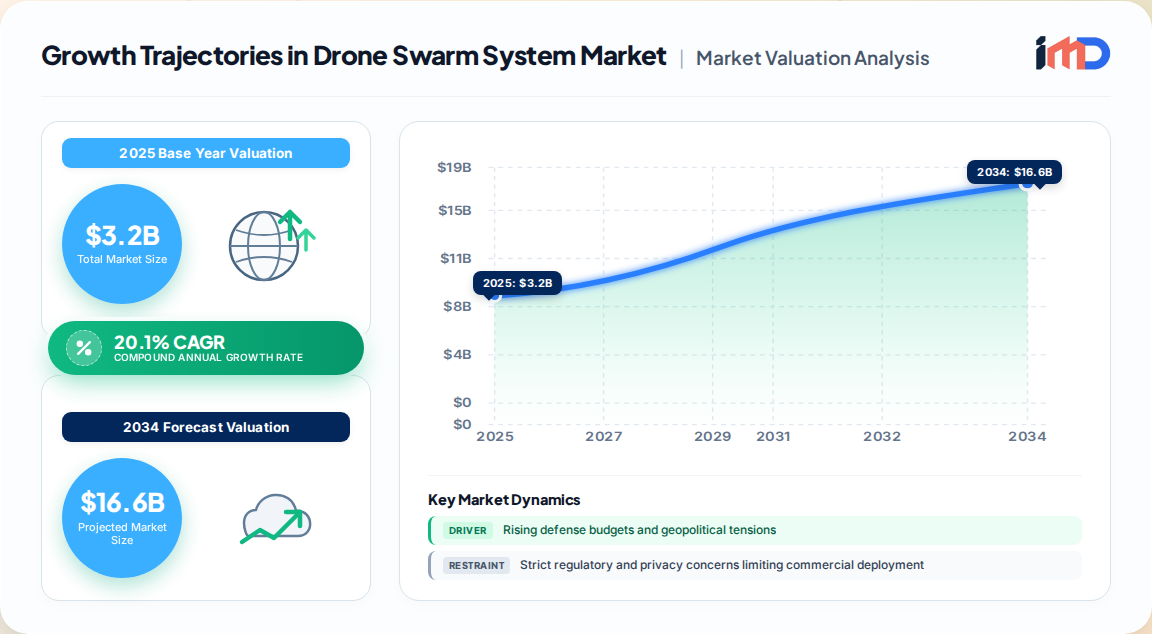
The drone swarm system market has decisively transitioned from experimental research to operational procurement. Our proprietary primary research estimates the global market at USD 3.2 billion in 2025, with a projected trajectory to USD 20 billion by 2035, representing a CAGR of 20.1% over the 2026–2035 forecast period. This growth is not merely incremental; it signals a structural rewiring of defense procurement and commercial aerial automation.
Three forces converge to define the current growth trajectory. First, asymmetric cost dynamics are forcing a rethink of inventory depth and attrition economics in global defense. Second, sub-millisecond edge AI latency is unlocking true peer-to-peer swarm autonomy, removing the vulnerability of central command nodes. Third, the commercial sector is translating AI-driven swarm capacity into measurable ROI across precision agriculture, logistics, and industrial security.
The financial architecture of modern defense is being reshaped by attrition economics. A 100-drone swarm can be launched for roughly USD 50,000, whereas conventional Western missile interception systems demand expenditures orders of magnitude higher. Against multi-million-dollar armor, FPV swarms routinely generate an asymmetric cost-to-kill ratio of 2,000-to-1.
Driven by Wright's Law, defense factories have aggressively scaled attritable manufacturing, pushing cumulative production in global conflict zones past 6 million units as of 2026. This mass capability is not confined to land. Unmanned maritime swarms have neutralized at least 11 major combat vessels since 2022.
Nation-states are accelerating indigenous programs. India's DRDO recently validated a synchronized 75-drone strike and surveillance test, while the U.S. Air Force's "Golden Horde" demonstrated live-fire networked munition communication.
However, a gap remains between tactical and strategic mass. COTS tactical systems restrict a single operator to managing 4 to 6 reconnaissance nodes, while next-generation platforms are breaking these barriers. Shield AI's V-BAT 5.3 recently scored 100% on Key Performance Parameters aboard U.S. Coast Guard cutters. In hostile airspace, V-BAT clusters have executed over 35 missions, penetrating 80 kilometers deep into electronically jammed territory to identify over 200 high-value targets.
| Procurement Metric | Legacy Manned/Missile Systems | Drone Swarm Systems |
|---|---|---|
| Unit cost (attritable FPV) | USD 500+ (2022) | USD 200 (self-assembled, 2024) |
| Swarm launch cost (100 units) | Not applicable | USD 50,000 |
| Cost-to-kill ratio vs. armor | 1:5 to 1:10 | 2,000:1 |
| Cumulative conflict-zone production | — | 6 million+ units (2026) |
The technological inflection point lies in the eradication of latency. Collaborative obstacle avoidance requires swarm mesh networks to maintain sub-20 ms response timing. Historically, each relay hop added 5 ms, limiting scalability. Today, 5G integration allows maximum download speeds of 10 Gbps and 1 ms latency, enabling real-time LiDAR streaming across the swarm. Advanced layer-2 mesh routing now supports resilient networks extending over 50 kilometers while keeping latency strictly under 100 ms.
Edge AI is untethering the market from cloud reliance. Optimized models like YOLOv8n allow onboard edge processors to perform object detection in 7.5 milliseconds (133 FPS). Micro-drones using edge TPU accelerators achieve 2.4 ms processing speeds for MobileNet architectures. By utilizing decentralized reinforcement learning—where AI prioritizes a "collective swarm reward"—intra-swarm collision rates have plummeted.
Crucially, the architecture has evolved to be hardware-agnostic and peer-to-peer, eliminating the vulnerable central command node. AI platforms like Hivemind now allow a single human operator to command a multi-drone strike swarm that autonomously handles mid-flight rerouting. In post-disaster Search and Rescue, heterogeneous swarms using Flying Ad Hoc Networks (FANET) can reliably manage up to 20 UAVs before network degradation occurs.
Industrial applications are proving that the commercial drone swarm market is a powerhouse for operational efficiency. In agriculture, deploying a two-person drone swarm operations team over a 1,000-hectare farm saves 300 to 500 manual labor hours annually. A coordinated swarm can map and spray 500 to 1,000 hectares per day, traversing fields exceeding 100 acres in a single flight.
The financial ROI is staggering. AI-integrated swarms generate variable-rate prescription maps in minutes, allowing farms to reduce nitrogen fertilizer application by up to 31 kg per hectare. This precision drives overall input efficiency up by 18% to 31% while increasing crop yields by 15% to 20%. Consequently, mainstream adoption is surging; 27% of U.S. agricultural retailers now offer drone-applied crop inputs, up sharply from 14%.
Beyond agriculture, logistics drone swarms utilize decentralized routing to autonomously adjust delivery paths mid-flight, bypassing weather anomalies and ground delays. In security, industrial swarms equipped with real-time X-ray and Convolutional Neural Networks conduct non-destructive chemical and structural threat analysis in minutes without human exposure.
| Commercial Application | Key ROI Metric |
|---|---|
| Precision agriculture | 300–500 labor hours saved per 1,000 ha annually |
| Input efficiency | 18%–31% improvement; up to 31 kg/ha nitrogen reduction |
| Crop yield uplift | 15%–20% |
| U.S. retailer adoption | 27% offer drone-applied inputs (up from 14%) |
| Security inspection | Non-destructive threat analysis in minutes |
The financial mechanics of the market are bifurcating between hardware commoditization and software premiumization. The factory cost of a highly capable kamikaze FPV dropped from USD 500 in 2022 to roughly USD 200 for self-assembled variants by 2024. Conversely, intelligent nodes—such as the LUCAS one-way attack drone designed to carry complex AI—command roughly USD 35,000 per unit, while advanced VTOLs like the V-BAT sit in the mid-six-figure range, establishing a highly capable middle-tier of attritable assets.
Venture capitalists are aggressively backing software-first integrators. Shield AI has raised over USD 500 million from heavyweights like Palantir and Lockheed Martin, scaling a 200,000-square-foot facility to produce over 200 V-BATs annually. Maturation is evident as pure-play command software firms like Swarmer file for 2026 IPO listings.
| Tier | Example Platform | Unit Cost Range | Strategic Role |
|---|---|---|---|
| Attritable FPV | Self-assembled kamikaze | ~USD 200 | Mass attrition |
| Intelligent node | LUCAS one-way attack | ~USD 35,000 | AI-enabled strike |
| Advanced VTOL | V-BAT | Mid-six figures | Persistent ISR/strike |
| Software layer | Hivemind, Swarmer | Contract-based | Autonomy and coordination |
As swarm threats become more sophisticated, so does the counter-swarm segment. The counter-swarm drone technology market is valued at roughly USD 2.03 billion in 2026, growing at approximately 25% CAGR through 2030, driven by advances in radar detection, electronic jamming, directed-energy systems, and AI-enabled real-time threat tracking.
Regulatory frameworks are tightening. The U.S. Pentagon's "Unleashing U.S. Military Drone Dominance" policy (2025) and the DoD Replicator initiative prioritize rapid, scalable production of autonomous systems. NATO modernization programs are accelerating R&D in stealth, 5G-enabled real-time communication, and counter-drone defenses. However, strict regulatory and privacy concerns—particularly in commercial airspace—remain a restraint on deployment velocity.
Cybersecurity and electronic warfare vulnerabilities are a critical restraint. Modern UAVs rely heavily on interconnected digital systems, autonomous software, and wireless communication links. This growing digital dependency exposes drones to sophisticated cyber intrusions, requiring investment in resilient mesh networking and encryption.
The competitive environment is highly fragmented, defense-technology-driven, and innovation-intensive. UAV manufacturers, autonomous defense technology companies, aerospace and defense primes, AI-enabled drone specialists, and regional swarm-technology developers compete across different layers of the value chain.
| Company | Competitive Strength |
|---|---|
| AeroVironment | Dedicated swarm architectures, autonomous platforms, multi-domain coordination |
| Shield AI | Hivemind autonomy platform, multi-agent teaming, V-BAT production |
| Kratos Defense & Security Solutions | Collaborative combat aircraft, heterogeneous swarms |
| General Atomics Aeronautical Systems | Autonomous aircraft, defense integration |
| Elbit Systems | Secure communications, command systems, sensors |
| Anduril Industries | AI pilots, command-and-control systems |
| RTX Corporation | Sensors, resilient communications, defense-system integration |
| Northrop Grumman | Autonomous mission execution, defense primes |
| EDGE Group/ADASI | Regional swarm-technology development |
| NewSpace Research & Technologies | Regional swarm-technology development |
| Boeing | Aerospace and defense primes |
| Lockheed Martin | Aerospace and defense primes, funding |
| BAE Systems | Defense-system integration |
| Thales | Sensors, secure communications |
North America remains the leading regional market in 2025, driven by defense-driven swarm adoption, the Replicator initiative, and a concentration of software-first integrators. Asia-Pacific is the fastest-growing region, propelled by defense modernization in India and China, and rapid adoption of commercial swarm applications in agriculture and logistics.
Europe follows with NATO modernization programs and cross-border security concerns. The Middle East & Africa and South America represent emerging opportunities, particularly in border surveillance and precision agriculture.
| Region | 2025 Share | Growth Outlook | Key Driver |
|---|---|---|---|
| North America | 38% | Steady | Defense procurement, software ecosystem |
| Europe | 24% | Moderate | NATO modernization, counter-swarm |
| Asia-Pacific | 27% | Fastest | Defense modernization, commercial adoption |
| Middle East & Africa | 6% | Emerging | Border surveillance, security |
| South America | 5% | Niche | Agriculture, infrastructure monitoring |
The most significant white space lies at the intersection of autonomy software and counter-swarm defense. While hardware commoditization accelerates, software-first integrators command premium valuations. Opportunities include:
The market remains constrained by high development and operational costs, technical limitations in autonomous coordination, and integration complexity with existing airspace management systems. Firms that solve these challenges will capture disproportionate value as the market scales toward USD 20 billion by 2035.
| Aspects | Details |
|---|---|
| Study Period | 2020-2034 |
| Base Year | 2025 |
| Estimated Year | 2026 |
| Forecast Period | 2026-2034 |
| Historical Period | 2020-2025 |
| Growth Rate | CAGR of 20.1% from 2020-2034 |
| Segmentation |
|

Analyst at Providence Strategic Partners at Petaling Jaya
I have received the report already. Thanks you for your help.it has been a pleasure working with you. Thank you again for a good quality report

Internationalization Director
Yes, as a matter of fact we are totally satisfied with both reports that we have purchased and will continue to do so during this process of the internationalization of our brand.

Head of Product Management and Marketing
We are using your report, and it gave us valuable information."

Regional Director, Marketing and Business Development
We've received the report and have reviewed the content. Overall, it looks great and aligns closely with the data we can verify based on our industry knowledge.

VP of Sales
Thank you very much for sharing the report. I have reviewed it and I am very satisfied with the quality and the insights it provides. It will certainly be valuable for our internal discussions.
By Application
By Autonomy
By End User
By Platform
By Technology
| By Geography |
|
The global drone swarm system market is valued at approximately USD 3.2 billion in 2025 and is projected to reach USD 20 billion by 2035, growing at a CAGR of 20.1% from 2026 to 2035.
Asia-Pacific is the fastest-growing regional market, driven by defense modernization initiatives in India and China, while North America remains the largest market with a 38% share in 2025.
Leading players include AeroVironment, Shield AI, Kratos Defense & Security Solutions, General Atomics Aeronautical Systems, Elbit Systems, Anduril Industries, RTX Corporation, and Northrop Grumman, among others.
Asymmetric cost dynamics are a primary driver. A 100-drone swarm launch costs roughly USD 50,000, generating a cost-to-kill ratio of up to 2,000-to-1 against multi-million-dollar armor, accelerating military procurement worldwide.
Edge AI enables sub-20 ms mesh response timing and onboard object detection in as little as 7.5 milliseconds (133 FPS), eliminating cloud dependency and enabling resilient, peer-to-peer swarm autonomy without a central command node.
Key commercial applications include precision agriculture (mapping and spraying 500–1,000 hectares per day), logistics with decentralized routing, and industrial security inspections using real-time X-ray and CNNs for threat analysis.
The counter-swarm drone technology market is valued at approximately USD 2.03 billion in 2026 and is growing at a CAGR of about 25% through 2030, driven by advances in radar, electronic jamming, and directed-energy systems.
Our rigorous research methodology combines multi-layered approaches with comprehensive quality assurance, ensuring precision, accuracy, and reliability in every market analysis.
| Stakeholder Role | Interview Share (%) |
|---|---|
| Chief Technology Officer | 30% |
| Program Director for Unmanned Systems | 30% |
| Procurement Director | 20% |
| Head of Autonomy Engineering | 20% |
| Company Type | Representation (%) |
|---|---|
| Swarm Platform OEMs | 30% |
| Autonomy & Mesh Software Developers | 25% |
| Counter-Swarm Defense Integrators | 20% |
| Sensor & Edge-Computing Suppliers | 15% |
| Commercial Swarm Service Providers | 10% |
 Related Reports
