1What is the current market size of the Brain Disease Modalities and Software market?
Our proprietary analysis values the market at USD 15.2 billion in 2025. It is projected to reach USD 25.66 billion by 2035, growing at a 5.5% CAGR.
Insight Market Data is a premier market research and business consulting firm headquartered in Pune, India, providing syndicated research reports, customized intelligence studies, and strategic advisory services. Renowned academic institutions and Fortune 500 corporations worldwide rely on Insight Market Data's research repository to navigate evolving global and regional business environments. Covering 46 diverse industries across 25 major international economies, our comprehensive database delivers thousands of verified statistics and granular market evaluations. By combining industry-leading analytical methodologies with the direct insights of seasoned industry leaders and subject-matter experts, we deliver actionable intelligence spanning historical performance benchmarks to rigorous multi-year forecasts. We empower organizations to make confident, data-driven decisions across pivotal domains including Machinery & Equipment, Chemicals & Materials, Pharmaceuticals & Healthcare, Food & Beverages, Consumer Goods, Energy & Power, Automotive & Transportation, Electronics & Semiconductors, Medical Devices, Telecommunications, Emerging Technologies, Agriculture, and Packaging. Our multidisciplinary analyst teams provide an objective 360-degree perspective, tailoring every engagement to address complex strategic challenges with exceptional analytical rigor.
Leveraging advanced BI-powered analytics and predictive modeling, Insight Market Data uncovers high-impact market opportunities and competitive differentiators for ambitious enterprises. We continuously refine our research methodologies in accordance with global industry standards, tracking real-time market shifts to ensure our reports are consistently accurate, actionable, and delivered on schedule. Our analysts conduct methodical data validation, rigorous compliance checks, and exhaustive primary and secondary research to maintain the highest levels of data integrity and transparency. We partner closely with corporate strategists, investment groups, and business executives to translate intricate market intelligence into clear, actionable roadmaps for sustainable growth. With operational presence across Washington, USA, and Vimannagar, Pune, India, Insight Market Data ensures direct access to dedicated research specialists and responsive customer support to answer your most strategic questions.
 Growth Strategies in Brain Disease Modalities And Software
 by Product (Brain Imaging Modalities(MRI, CT, PET, PET-CT, PET-MRI, EEG), Brain Analysis Software(Detecting Abnormalities, Measuring Brain Volume, Tracking Disease Progression, Surgical Planning)), by Patient Type (Adults, Pediatrics, Infants), by End-User (Hospitals and Clinics, Ambulatory Surgery Centers, Diagnostic Imaging Centers, Research Institutions), by Application (Alzheimer's Disease, Dementia, Stroke, Multiple Sclerosis, Parkinson's Disease, Brain Tumors, Epilepsy, Traumatic Brain Injury), by North America (USA, Canada, Mexico), by Europe (Germany, UK, France, Italy, Spain, Rest of Europe), by Asia Pacific (China, Japan, India, South Korea, Australia, Rest of Asia Pacific), by Latin America (Brazil, Mexico, Rest of Latin America), by Middle East & Africa (Saudi Arabia, UAE, South Africa, Rest of MEA) Forecast 2026-2034

Research Analyst


 Related Reports

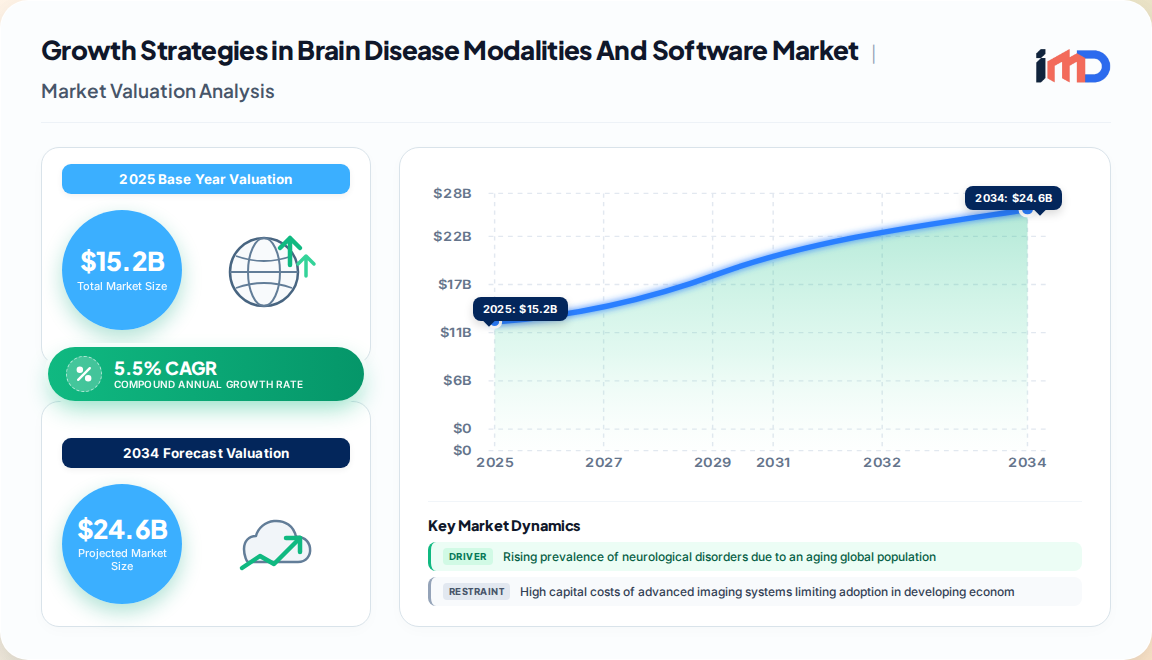
The global brain disease modalities and software market represents a critical frontier in modern healthcare, addressing the escalating burden of neurological disorders through advanced imaging and analytical tools. Our proprietary primary research estimates the market at USD 15.2 billion in 2025, projected to reach USD 25.66 billion by 2035, expanding at a 5.5% CAGR over the forecast period. This growth is not merely a function of rising disease prevalence but is fundamentally driven by an unprecedented convergence of high-resolution imaging modalities and artificial intelligence (AI)-powered diagnostic software.
This report synthesizes findings from comprehensive primary interviews with industry stakeholders, including medical device OEMs, software developers, hospital administrators, and regulatory experts. The analysis reveals that the modality segment (MRI, CT, PET, EEG) continues to dominate revenue, accounting for approximately 72% of the 2025 market valuation. However, the software segment—encompassing AI-driven image analysis, volumetric measurement, and surgical planning—is the primary engine of future growth, forecast to capture a significantly larger share by 2035.
A pivotal trend is the transition from standalone imaging hardware sales to integrated, software-enabled diagnostic ecosystems. Stakeholders consistently highlighted that the value proposition now hinges on the ability to deliver actionable insights, not just images. This paradigm shift is compelling established medical imaging corporations to deepen their software capabilities and forge strategic alliances with specialized AI firms.
Our research exhaustively segments the market to uncover nuanced growth opportunities.
| Segment | Sub-Segment | 2025 Share (Est.) | Growth Outlook (2026-2035) |
|---|---|---|---|
| By Product | Brain Imaging Modalities (MRI, CT, PET, PET-CT, PET-MRI, EEG) | ~72% | Moderate (4-5% CAGR), driven by hardware replacement and upgrades |
| Brain Analysis Software (Detection, Volumetrics, Tracking, Surgical Planning) | ~28% | High (10-12% CAGR), driven by AI adoption and software-as-a-medical-service models | |
| By Patient Type | Adults | ~70% | Sustained dominance due to age-related neurodegenerative diseases |
| Pediatrics & Infants | ~30% | Faster growth due to rising awareness of pediatric neurological conditions | |
| By End-User | Hospitals & Clinics | ~60% | Largest segment, driven by high procedure volumes |
| Diagnostic Imaging Centers | ~25% | Growing due to outpatient migration and specialized imaging services | |
| Ambulatory Surgery Centers & Research Institutions | ~15% | Niche growth in surgical planning and clinical trials |
The adult segment dominates due to the strong correlation between age and the prevalence of conditions like dementia, stroke, and Parkinson's disease. However, the pediatric segment is gaining strategic importance, with increased investment in research for early-onset neurological disorders and the development of child-specific imaging protocols and software.
The market is characterized by a mix of established medical imaging conglomerates and agile, innovation-focused software specialists. The competitive dynamic is shifting from hardware-centric competition to a battle for the integrated diagnostic workflow.
| Region | Market Share (2025) | Key Growth Drivers | Strategic Implications |
|---|---|---|---|
| North America | ~42% | Advanced healthcare infrastructure, high adoption of AI, strong R&D funding. | Focus on premium, AI-integrated modalities and software. High potential for value-based care partnerships. |
| Europe | ~25% | Favorable government initiatives (e.g., EU AI Act), aging population, strong public healthcare systems. | Opportunities in cross-border data sharing (EHDS) and compliance-focused AI solutions. |
| Asia-Pacific | ~23% | Rapidly expanding healthcare infrastructure, large patient pool, increasing healthcare expenditure. | Fastest-growing region (est. 9-11% CAGR). High volume demand for cost-effective imaging solutions. |
| South America | ~5% | Improving healthcare access, rising awareness of neurological disorders. | Nascent market with significant unmet need. Entry via public-private partnerships. |
| Middle East & Africa | ~5% | Increasing healthcare investment, medical tourism hubs in the Gulf. | Focus on high-end imaging centers in urban hubs; limited access in rural areas. |
North America's dominance is underpinned by its high healthcare expenditure and the rapid adoption of cutting-edge technologies. The region is the primary market for AI software, driven by a favorable reimbursement landscape and a high concentration of leading research institutions. Asia-Pacific is the clear growth frontier, with its large, aging population and increasing government focus on healthcare modernization creating a vast addressable market.
For hospitals and healthcare systems, the procurement of brain disease modalities and software is a strategic decision requiring a long-term view. Our analysis identifies key imperatives:
The future of the brain disease modalities and software market lies in the intelligent integration of technology and clinical practice. The most significant white-space opportunities are:
| Aspects | Details |
|---|---|
| Study Period | 2020-2034 |
| Base Year | 2025 |
| Estimated Year | 2026 |
| Forecast Period | 2026-2034 |
| Historical Period | 2020-2025 |
| Growth Rate | CAGR of 5.5% from 2020-2034 |
| Segmentation |
|
By Patient Type
By End-User
By Application
| By Geography |
|
Our proprietary analysis values the market at USD 15.2 billion in 2025. It is projected to reach USD 25.66 billion by 2035, growing at a 5.5% CAGR.
North America holds the largest market share, estimated at approximately 42% in 2025, driven by advanced healthcare infrastructure and high adoption of AI-based diagnostic software.
Key drivers include the rising prevalence of neurological disorders due to an aging population, increasing integration of AI into diagnostic imaging, and technological advancements in neurostimulation and imaging modalities.
The brain analysis software segment is the fastest-growing, expected to register a CAGR of 10-12% through 2035, fueled by the adoption of AI for automated image analysis and disease tracking.
High capital costs of advanced imaging systems (e.g., MRI, PET), limited access in low-income regions, regulatory hurdles for AI-based software, and supply chain vulnerabilities such as helium shortage for MRI cooling are key restraints.
Our rigorous research methodology combines multi-layered approaches with comprehensive quality assurance, ensuring precision, accuracy, and reliability in every market analysis.
| Stakeholder Role | Interview Share (%) |
|---|---|
| Radiology Department Head | 30% |
| Product Management Director | 25% |
| Chief Technology Officer | 20% |
| Regulatory Affairs Manager | 15% |
| Procurement Director | 10% |
| Company Type | Representation (%) |
|---|---|
| Imaging Hardware OEMs | 35% |
| AI Software Pure-Plays | 25% |
| Healthcare IT Integrators | 15% |
| Hospital & Imaging Center Networks | 20% |
| Component & Sub-system Suppliers | 5% |