1What is the projected growth rate of the fire curtain market?
The global fire curtain market is projected to grow at a CAGR of 6.2% from 2026 to 2033, reaching USD 6.9 billion by 2033.
Insight Market Data is a premier market research and business consulting firm headquartered in Pune, India, providing syndicated research reports, customized intelligence studies, and strategic advisory services. Renowned academic institutions and Fortune 500 corporations worldwide rely on Insight Market Data's research repository to navigate evolving global and regional business environments. Covering 46 diverse industries across 25 major international economies, our comprehensive database delivers thousands of verified statistics and granular market evaluations. By combining industry-leading analytical methodologies with the direct insights of seasoned industry leaders and subject-matter experts, we deliver actionable intelligence spanning historical performance benchmarks to rigorous multi-year forecasts. We empower organizations to make confident, data-driven decisions across pivotal domains including Machinery & Equipment, Chemicals & Materials, Pharmaceuticals & Healthcare, Food & Beverages, Consumer Goods, Energy & Power, Automotive & Transportation, Electronics & Semiconductors, Medical Devices, Telecommunications, Emerging Technologies, Agriculture, and Packaging. Our multidisciplinary analyst teams provide an objective 360-degree perspective, tailoring every engagement to address complex strategic challenges with exceptional analytical rigor.
Leveraging advanced BI-powered analytics and predictive modeling, Insight Market Data uncovers high-impact market opportunities and competitive differentiators for ambitious enterprises. We continuously refine our research methodologies in accordance with global industry standards, tracking real-time market shifts to ensure our reports are consistently accurate, actionable, and delivered on schedule. Our analysts conduct methodical data validation, rigorous compliance checks, and exhaustive primary and secondary research to maintain the highest levels of data integrity and transparency. We partner closely with corporate strategists, investment groups, and business executives to translate intricate market intelligence into clear, actionable roadmaps for sustainable growth. With operational presence across Washington, USA, and Vimannagar, Pune, India, Insight Market Data ensures direct access to dedicated research specialists and responsive customer support to answer your most strategic questions.

 Growth Patterns in Fire Curtain Market
 by Product (Fire Curtains, Smoke Curtains), by End-use (Commercial Buildings, Industrial & Manufacturing, Warehouses & Distribution Centers, Healthcare, Transportation, Residential), by Installation (New Construction, Retrofit), by Asia Pacific (China, India, Japan, South Korea, Australia), by North America (USA, Canada, Mexico), by Europe (Germany, UK, France, Italy, Spain), by Middle East & Africa (UAE, Saudi Arabia, South Africa), by Latin America (Brazil, Argentina) Forecast 2026-2034

Research Associate

 Related Reports

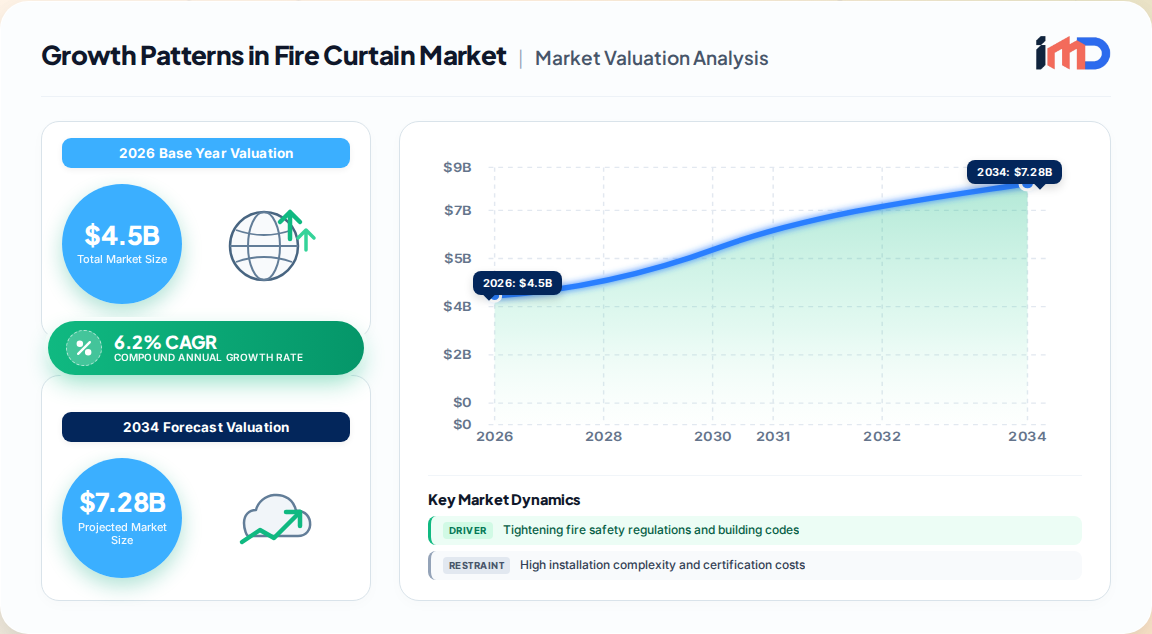
The global fire curtain market is experiencing robust expansion, driven by tightening fire safety regulations and the increasing adoption of passive fire protection solutions in modern building design. Our proprietary primary research estimates the market at USD 4.5 billion in 2026, with a projected rise to USD 6.9 billion by 2033, reflecting a CAGR of 6.2%. Fire curtains, a critical sub-segment of the broader fire and smoke curtain industry, accounted for 68.5% of total product revenue in 2025, underscoring their dominance in compartmentation strategies.
Growth patterns are highly regionalized. Asia Pacific commands a 44.9% revenue share, led by China's aggressive urbanization and infrastructure investments. North America and Europe follow, with retrofit activity and stringent energy-fire codes fueling demand. This report dissects these patterns, offering a data-driven roadmap for stakeholders across the value chain.
The fire curtain value chain is highly specification-driven, involving multiple stakeholders from design to maintenance.
| Stage | Key Activities | Stakeholders |
|---|---|---|
| Raw Material Supply | Production of specialty fabrics (fiberglass, ceramic), metals, and control components | Material suppliers, chemical companies |
| Manufacturing | Fabrication of curtains, housing, and control systems; testing and certification | OEMs, testing labs |
| Design & Specification | Integration into building plans; fire safety engineering | Architects, fire consultants, engineers |
| Installation & Commissioning | On-site assembly, wiring, and testing | Contractors, system integrators |
| Maintenance & Inspection | Periodic testing, servicing, and compliance checks | Facility managers, service providers |
A critical characteristic is the long product lifecycle and the need for reliable deployment after years of inactivity. This drives demand for high-quality control electronics and monitoring features.
Asia Pacific dominates with a 44.9% share, led by China's construction boom and India's smart city initiatives. Growth is fueled by new commercial and industrial projects requiring advanced fire safety.
North America exhibits steady growth, with the U.S. market driven by stringent fire codes (e.g., NFPA) and a strong retrofit culture. The region is a hub for technological innovation in automated curtains.
Europe emphasizes energy efficiency and fire safety, with green building mandates often incorporating passive fire protection. Germany, the UK, and France are key markets, with a focus on high-performance, certified products.
Middle East & Africa shows high growth potential, particularly in the GCC countries, where mega-projects (e.g., NEOM) demand advanced fire safety solutions. Latin America is an emerging market, with Brazil and Mexico leading adoption.
| Region | 2025 Share | Key Growth Drivers |
|---|---|---|
| Asia Pacific | 44.9% | Urbanization, infrastructure spending, tightening codes |
| North America | 21.8% | Retrofit activity, stringent fire codes, technological adoption |
| Europe | 18.7% | Green building mandates, renovation wave |
| Middle East & Africa | 8.3% | Mega-projects, increasing safety awareness |
| Latin America | 6.3% | Emerging construction, regulatory upgrades |
The market is moderately concentrated, with dedicated fire protection manufacturers and regional engineering firms. Competition hinges on certification, product reliability, and integration capabilities. Key players are focusing on strategic expansions and product innovations.
Companies are also investing in R&D for sustainable materials and enhanced control systems to meet evolving building codes.
Significant untapped opportunities exist in:
Additionally, emerging markets in Southeast Asia and Africa offer white space due to low current penetration and rapidly improving regulatory frameworks.
Global trade in fire curtains is significant, with major manufacturing hubs in China, Europe, and North America. China is a net exporter, supplying cost-effective products to Asia Pacific, Africa, and Latin America. Europe and North America export high-end, certified systems to the Middle East and Asia Pacific.
Key supply chain risks include:
Suppliers are increasingly localizing production to mitigate these risks and better serve regional customers.
The fire curtain market is poised for sustained growth, with a CAGR of 6.2% from 2026 to 2033. Key growth patterns include:
By 2033, the market is expected to reach USD 6.9 billion, with fire curtains maintaining their majority share. Stakeholders should focus on innovation, certification, and strategic partnerships to capitalize on these trends.
| Aspects | Details |
|---|---|
| Study Period | 2020-2034 |
| Base Year | 2026 |
| Estimated Year | 2026 |
| Forecast Period | 2026-2034 |
| Historical Period | 2020-2025 |
| Growth Rate | CAGR of 6.2% from 2020-2034 |
| Segmentation |
|
By Installation
| By Geography |
|
The global fire curtain market is projected to grow at a CAGR of 6.2% from 2026 to 2033, reaching USD 6.9 billion by 2033.
Asia Pacific dominates the market with a 44.9% revenue share in 2025, driven by rapid urbanization and infrastructure development, particularly in China.
Stringent fire safety regulations, increasing construction activities, and the growing integration of passive fire protection systems in building designs are primary drivers.
Installation complexity, certification costs, and varying national fire codes pose significant challenges, especially for retrofit projects and market entry.
Fire curtains are increasingly integrated with fire detection, alarm, and building management systems to enable automated deployment and remote monitoring, enhancing overall safety.
Our rigorous research methodology combines multi-layered approaches with comprehensive quality assurance, ensuring precision, accuracy, and reliability in every market analysis.
| Stakeholder Role | Interview Share (%) |
|---|---|
| Fire Protection Engineers | 35% |
| Procurement Directors | 25% |
| Facility Managers | 20% |
| Building Code Officials | 20% |
| Company Type | Representation (%) |
|---|---|
| Fire Curtain OEMs | 40% |
| Specialty Fabric Suppliers | 20% |
| Control System Integrators | 15% |
| Installation Contractors | 15% |
| Certification & Testing Bodies | 10% |