1What is the current size of the global golf course construction market?
The global golf course construction market was valued at $4.11 billion in 2025 and is projected to reach $5.89 billion by 2032, growing at a 5.3% CAGR.
Insight Market Data is a premier market research and business consulting firm headquartered in Pune, India, providing syndicated research reports, customized intelligence studies, and strategic advisory services. Renowned academic institutions and Fortune 500 corporations worldwide rely on Insight Market Data's research repository to navigate evolving global and regional business environments. Covering 46 diverse industries across 25 major international economies, our comprehensive database delivers thousands of verified statistics and granular market evaluations. By combining industry-leading analytical methodologies with the direct insights of seasoned industry leaders and subject-matter experts, we deliver actionable intelligence spanning historical performance benchmarks to rigorous multi-year forecasts. We empower organizations to make confident, data-driven decisions across pivotal domains including Machinery & Equipment, Chemicals & Materials, Pharmaceuticals & Healthcare, Food & Beverages, Consumer Goods, Energy & Power, Automotive & Transportation, Electronics & Semiconductors, Medical Devices, Telecommunications, Emerging Technologies, Agriculture, and Packaging. Our multidisciplinary analyst teams provide an objective 360-degree perspective, tailoring every engagement to address complex strategic challenges with exceptional analytical rigor.
Leveraging advanced BI-powered analytics and predictive modeling, Insight Market Data uncovers high-impact market opportunities and competitive differentiators for ambitious enterprises. We continuously refine our research methodologies in accordance with global industry standards, tracking real-time market shifts to ensure our reports are consistently accurate, actionable, and delivered on schedule. Our analysts conduct methodical data validation, rigorous compliance checks, and exhaustive primary and secondary research to maintain the highest levels of data integrity and transparency. We partner closely with corporate strategists, investment groups, and business executives to translate intricate market intelligence into clear, actionable roadmaps for sustainable growth. With operational presence across Washington, USA, and Vimannagar, Pune, India, Insight Market Data ensures direct access to dedicated research specialists and responsive customer support to answer your most strategic questions.
 Golf Course Construction Market
 by Type (New Construction, Renovation, Others), by Course Layout (18-Hole Championship Course, 9-Hole Executive Course, Other), by Acreage Requirement (Small Acreage (< 100 Acres), Medium Acreage (100 – 150 Acres), Large Acreage (> 150 Acres)), by Application (Private Golf Club, Municipal Golf Course, Golf Academy, Others), by Golf Course Type (Public, Private, Resort, Municipal), by Design Style (Traditional, Modern, Links, Parkland), by Service Type (Engineering Services, Project Management, Landscape Services), by North America (United States, Canada, Mexico), by Europe (United Kingdom, Germany, France, Italy, Spain, Russia, Benelux, Nordics), by Asia Pacific (China, India, Japan, South Korea, ASEAN, Oceania), by Latin America (Brazil, Argentina, Rest of South America), by Middle East & Africa (Turkey, Israel, GCC Countries, North Africa, South Africa) Forecast 2026-2034

Research Analyst


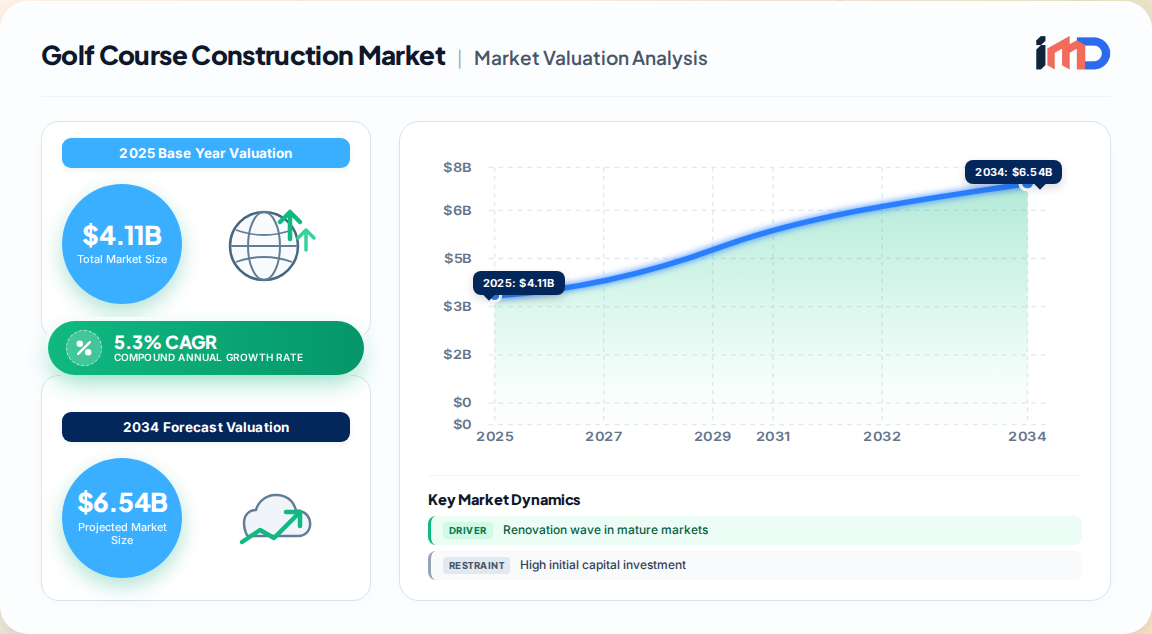
The global golf course construction market represents a specialized segment within the broader construction and leisure infrastructure industry, valued at $4.11 billion in 2025 and projected to reach $5.89 billion by 2032, expanding at a 5.3% CAGR over the forecast period. This growth is underpinned by a structural shift toward renovation and modernization of aging courses in mature markets, alongside new development in emerging golf tourism destinations.
Our proprietary analysis, drawing on primary interviews with industry executives and first-party market modeling, reveals a market in transition. The traditional emphasis on new 18-hole championship construction is giving way to a more diversified landscape. Renovation projects now account for the largest share of activity, driven by the need to upgrade irrigation systems, adopt drought-resistant turfgrass varieties, and comply with increasingly stringent environmental regulations. Simultaneously, short-course formats (Par-3 and 9-hole layouts) are gaining traction due to land scarcity and changing player preferences for shorter, more accessible rounds.
From a regional standpoint, North America remains the dominant market, commanding an estimated 39% revenue share, supported by a deeply entrenched golf culture and the highest concentration of existing courses requiring renovation. Asia-Pacific emerges as the fastest-growing region, with a projected 6.5% CAGR, fueled by rising affluence, golf tourism development, and government-backed leisure initiatives in countries such as Vietnam, China, and India.
The market outlook is further shaped by technological integration—3D design, drone mapping, and smart turf management—enhancing project efficiency and precision. However, the industry faces headwinds from high initial capital costs, land scarcity in urban areas, labor shortages, and strict environmental regulations limiting water usage. These dynamics create a complex but opportunity-rich environment for stakeholders across the value chain.
The golf course construction value chain comprises several distinct stages, each critical to project success. Upstream, design and engineering firms (e.g., Nicklaus Design, Gil Hanse Golf Design) provide architectural plans, often integrating 3D modeling and environmental assessments. Specialized construction contractors (e.g., Landscapes Unlimited, Heritage Links, Fusion Golf) execute earthworks, irrigation installation, and turfgrass establishment. Material suppliers, including turfgrass seed providers and irrigation equipment manufacturers, form a crucial input layer. Downstream, course operators (private clubs, municipal courses, resorts) and management companies (e.g., Troon, ClubCorp) drive demand and influence design specifications. Supporting services such as landscaping, drainage solutions, and heavy equipment rental are integral throughout.
Our primary research indicates that vertical integration is limited, with most firms specializing in specific niches. However, leading contractors often form strategic partnerships with design firms to offer turnkey solutions, enhancing competitiveness. The renovation segment particularly benefits from long-term relationships between contractors and course operators, as ongoing maintenance and periodic upgrades are common.
| Region | 2025 Market Share | 2026-2032 CAGR | Key Growth Drivers |
|---|---|---|---|
| North America | 39% | 3.9% | Renovation of aging courses, technological upgrades, strong golf culture |
| Europe | 24% | 4.3% | Heritage course restoration, sustainability compliance, golf tourism |
| Asia-Pacific | 22% | 6.5% | New resort development, rising affluence, government initiatives (Vietnam, China, India) |
| Latin America | 8% | 5.6% | Resort and residential integrated projects, tourism growth (Mexico, Brazil) |
| Middle East & Africa | 7% | 4.9% | Luxury tourism developments, government leisure investments (UAE, Saudi Arabia, South Africa) |
North America retains its dominance through a robust renovation cycle. The United States alone hosts over 14,000 golf courses, many built decades ago and requiring modernization. Asia-Pacific is the standout growth region, with Vietnam emerging as a hotspot for luxury golf resorts, and China's golf industry rebounding after regulatory adjustments. India's nascent market shows promise with increasing corporate investment. Europe focuses on preserving heritage while upgrading infrastructure, with links courses in the UK and Ireland commanding premium investments. The Middle East is witnessing significant government-backed projects, particularly in Saudi Arabia and the UAE, aimed at boosting tourism.
The market is characterized by a mix of large, multi-service construction firms and specialized golf course contractors. Key players include Landscapes Unlimited, Heritage Links, Fusion Golf, Wadsworth Golf Construction Company, Duininck Golf, and Nicklaus Companies, among others. These firms compete on expertise, project portfolio, geographic reach, and ability to deliver sustainable solutions.
Recent strategic developments underscore the industry's direction:
These collaborations reflect a trend toward integrated service offerings and geographic expansion, particularly in high-growth markets. Companies are also investing in advanced technologies to differentiate themselves, such as drone-based site surveys and AI-driven irrigation management.
Sustainability has moved from a niche consideration to a core strategic imperative. Regulatory pressures and consumer expectations are driving adoption of water-efficient irrigation systems, drought-tolerant turfgrass, and native landscaping. Certification programs, such as those from Audubon International, are increasingly sought after, signaling a course's commitment to environmental stewardship. Renovation projects frequently incorporate rainwater harvesting, greywater recycling, and advanced drainage solutions to minimize water usage and runoff.
Technological integration is transforming construction processes. 3D design and drone mapping enable precise earthmoving and reduced waste. Smart turf management systems leverage sensors and data analytics to optimize irrigation and fertilization, lowering operational costs and environmental impact. These innovations not only enhance project efficiency but also contribute to the long-term viability and appeal of golf courses.
Several untapped opportunities exist for stakeholders:
While golf course construction is primarily a service-based industry, it relies on specialized materials and equipment that are traded globally. Key imported components include advanced irrigation systems (often from Israel, the US, and Europe), turfgrass seed (with major suppliers in the US and Europe), and heavy construction equipment (from global manufacturers like Caterpillar and John Deere). Trade flows are influenced by tariffs and logistics costs. For instance, the US–China trade dynamics affect equipment pricing, while European environmental standards drive demand for certified sustainable materials. Suppliers of eco-friendly products, such as water-saving irrigation technology, are gaining leverage as regulations tighten. However, the service nature of construction means that cross-border trade in services (design, project management) is also significant, with leading design firms operating globally.
The golf course construction market is poised for steady growth, with a 5.3% CAGR through 2032. Investors should focus on regions with favorable demographics and tourism growth, such as Asia-Pacific and the Middle East. Renovation projects offer lower-risk, shorter-cycle opportunities compared to new construction. Companies that prioritize sustainability and technological innovation are likely to outperform, as course owners seek partners who can deliver environmentally compliant and cost-efficient solutions. The integration of smart technologies and water management systems will be a key differentiator. Overall, the market presents a balanced mix of mature-market renovation demand and emerging-market new construction, creating a resilient investment landscape.
| Aspects | Details |
|---|---|
| Study Period | 2020-2034 |
| Base Year | 2025 |
| Estimated Year | 2026 |
| Forecast Period | 2026-2034 |
| Historical Period | 2020-2025 |
| Growth Rate | CAGR of 5.3% from 2020-2034 |
| Segmentation |
|
By Acreage Requirement
By Application
By Golf Course Type
By Design Style
By Service Type
| By Geography |
|
The global golf course construction market was valued at $4.11 billion in 2025 and is projected to reach $5.89 billion by 2032, growing at a 5.3% CAGR.
North America holds the largest share, accounting for approximately 39% of global revenue in 2025, driven by a high concentration of existing courses requiring renovation and a strong golf culture.
Key drivers include the renovation wave in mature markets, sustainability imperatives, expansion in Asia-Pacific, demand for short courses, and technological advancements in construction and irrigation.
Leading companies include Landscapes Unlimited, Heritage Links, Fusion Golf, Wadsworth Golf Construction Company, Duininck Golf, and Nicklaus Companies, among others.
Asia-Pacific is the fastest-growing region, with a projected CAGR of 6.5% from 2026 to 2032, fueled by new resort developments and rising affluence in countries like Vietnam, China, and India.
Our rigorous research methodology combines multi-layered approaches with comprehensive quality assurance, ensuring precision, accuracy, and reliability in every market analysis.
| Stakeholder Role | Interview Share (%) |
|---|---|
| Director of Golf Course Construction | 30% |
| Chief Agronomist | 25% |
| Project Manager (Golf Course Development) | 25% |
| Procurement Director | 20% |
| Company Type | Representation (%) |
|---|---|
| Golf Course Design & Architecture Firms | 25% |
| Specialized Construction Contractors | 30% |
| Irrigation & Turfgrass Suppliers | 20% |
| Course Operators & Management Companies | 15% |
| Landscaping & Drainage Solution Providers | 10% |
 Related Reports


Analyst at Providence Strategic Partners at Petaling Jaya
I have received the report already. Thanks you for your help.it has been a pleasure working with you. Thank you again for a good quality report

Internationalization Director
Yes, as a matter of fact we are totally satisfied with both reports that we have purchased and will continue to do so during this process of the internationalization of our brand.

Head of Product Management and Marketing
We are using your report, and it gave us valuable information."

Regional Director, Marketing and Business Development
We've received the report and have reviewed the content. Overall, it looks great and aligns closely with the data we can verify based on our industry knowledge.

VP of Sales
Thank you very much for sharing the report. I have reviewed it and I am very satisfied with the quality and the insights it provides. It will certainly be valuable for our internal discussions.