1What is the size of the fiber-reinforced polymer (FRP) composites market?
The global FRP composites market is estimated at USD 83.17 billion in 2026 and is projected to reach USD 107.16 billion by 2031, growing at a CAGR of 5.20%.
Insight Market Data is a premier market research and business consulting firm headquartered in Pune, India, providing syndicated research reports, customized intelligence studies, and strategic advisory services. Renowned academic institutions and Fortune 500 corporations worldwide rely on Insight Market Data's research repository to navigate evolving global and regional business environments. Covering 46 diverse industries across 25 major international economies, our comprehensive database delivers thousands of verified statistics and granular market evaluations. By combining industry-leading analytical methodologies with the direct insights of seasoned industry leaders and subject-matter experts, we deliver actionable intelligence spanning historical performance benchmarks to rigorous multi-year forecasts. We empower organizations to make confident, data-driven decisions across pivotal domains including Machinery & Equipment, Chemicals & Materials, Pharmaceuticals & Healthcare, Food & Beverages, Consumer Goods, Energy & Power, Automotive & Transportation, Electronics & Semiconductors, Medical Devices, Telecommunications, Emerging Technologies, Agriculture, and Packaging. Our multidisciplinary analyst teams provide an objective 360-degree perspective, tailoring every engagement to address complex strategic challenges with exceptional analytical rigor.
Leveraging advanced BI-powered analytics and predictive modeling, Insight Market Data uncovers high-impact market opportunities and competitive differentiators for ambitious enterprises. We continuously refine our research methodologies in accordance with global industry standards, tracking real-time market shifts to ensure our reports are consistently accurate, actionable, and delivered on schedule. Our analysts conduct methodical data validation, rigorous compliance checks, and exhaustive primary and secondary research to maintain the highest levels of data integrity and transparency. We partner closely with corporate strategists, investment groups, and business executives to translate intricate market intelligence into clear, actionable roadmaps for sustainable growth. With operational presence across Washington, USA, and Vimannagar, Pune, India, Insight Market Data ensures direct access to dedicated research specialists and responsive customer support to answer your most strategic questions.

 Fiber-Reinforced Polymer (FRP) Composites Market
 by Resin Type (Thermoset, Thermoplastic), by Fiber Type (Glass Fiber-Reinforced Polymer (GFRP), Carbon Fiber-Reinforced Polymer (CFRP), Other), by Reinforcement Form (Rovings, Prepreg, Other), by End-User Industry (Transportation, Building and Construction, Aerospace, Wind Energy, Marine, Other), by Asia-Pacific (China, India, Japan, South Korea, Rest of APAC), by North America (USA, Canada, Mexico), by Europe (Germany, UK, France, Italy, Rest of Europe), by South America (Brazil, Argentina, Rest of South America), by Middle East & Africa (Saudi Arabia, UAE, South Africa, Rest of MEA) Forecast 2026-2034

Senior Analyst

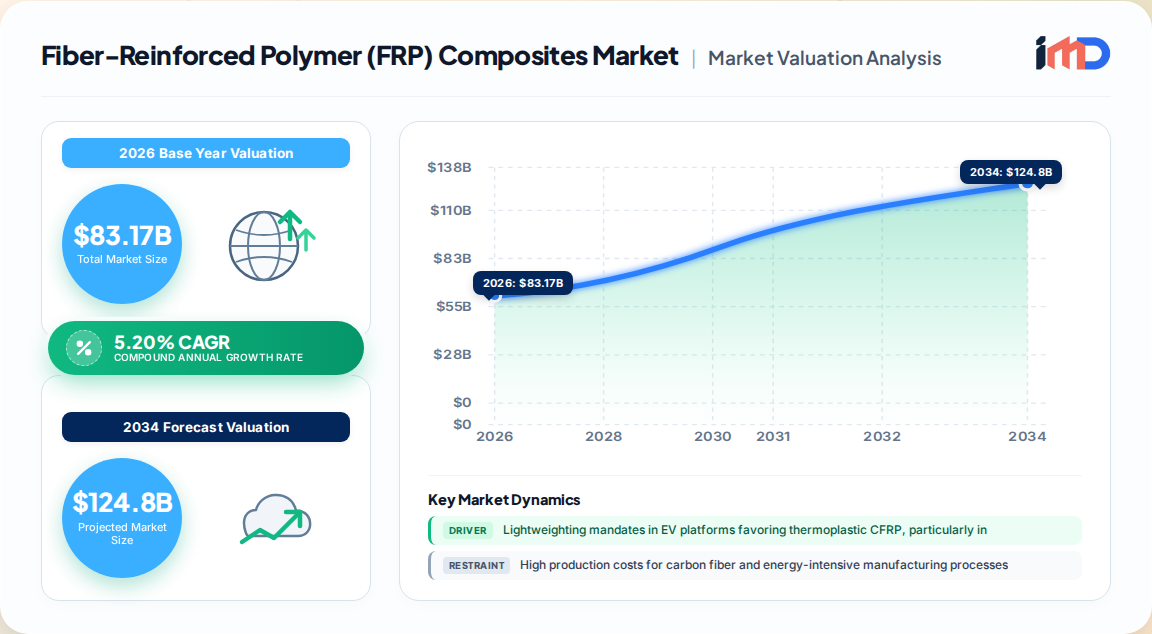
The global fiber-reinforced polymer (FRP) composites market is undergoing a structural transformation, driven by the confluence of decarbonization mandates, infrastructure renewal cycles, and material science breakthroughs. Our proprietary primary research estimates the market at USD 83.17 billion in 2026, on a trajectory to reach USD 107.16 billion by 2031, expanding at a CAGR of 5.20% during the forecast period. This growth, while moderate, masks significant underlying segment-level volatility; carbon fiber-reinforced polymer (CFRP) is expanding at more than double the market average, while thermoplastic matrices are rapidly displacing incumbents in high-throughput manufacturing environments.
The market's center of gravity has decisively shifted to Asia-Pacific, which commanded a 45.22% revenue share in 2025 and is forecast to post the highest regional CAGR of 6.08% through 2031. This dominance is anchored in China's renewable energy build-out and EV manufacturing ecosystem, with India and Southeast Asia emerging as important secondary growth engines. North America and Europe remain critical innovation hubs, particularly for aerospace-grade CFRP and advanced recycling technologies, but face margin pressure from commoditization in baseline GFRP product lines.
Our analysis reveals a market characterized by low concentration, with a long tail of regional pultruders and molders competing alongside diversified multinationals. The competitive frontier is no longer defined solely by resin chemistry or fiber modulus, but by the ability to deliver circularity, digital-traceable supply chains, and application-specific engineering services.
Three primary demand vectors are propelling volume growth, each with distinct geographic and temporal footprints as quantified through our driver impact analysis.
Wind-Turbine Blade Length Exceeding 120 Meters (+1.2% CAGR impact): Turbine OEMs are now deploying rotor diameters above 240 meters, pushing blade lengths past 120 meters and requiring spar caps with tensile strength over 1,200 MPa. Vestas' 15 MW platform incorporating high-modulus glass fiber has demonstrated an 8-tonne blade mass reduction per unit. China installed 75 GW of wind capacity in 2025, 60% offshore, driving demand for low-void resin-transfer molding grades that withstand ten-million-cycle fatigue loads. This driver is most pronounced in APAC through 2028, with spill-over to European and North American offshore projects.
Lightweighting Mandates in EV Platforms (+1.5% CAGR impact): European targets of 93.6 g CO₂/km for 2025 vehicles and China's dual-credit policy are forcing OEMs to adopt CFRP battery housings, floor pans, and pillars. BMW's iX5 Hydrogen uses a PA6-CFRP monocoque saving 150 kg over aluminum. Thermoplastic matrices cut cycle times to under three minutes and allow welding instead of adhesive bonding, reducing assembly labor by 15%. This is the highest-impact driver in our model, concentrated in Europe and China with early adoption in North American premium segments.
Corrosion-Free Rebar and Bridge Deck Retrofits (+0.8% and +0.6% CAGR impact respectively): In 2025, 42% of the 617,000 U.S. bridges were over 50 years old, with corrosion repairs costing USD 8.3 billion annually. GFRP retrofits offer a 35% life-cycle cost advantage over conventional repair. Japan has mandated FRP rebar in coastal highways following 15 years of exposure testing along the Tokyo Bay Aqua-Line. Saudi Arabia's NEOM project adopted GFRP for 80% of concrete structures to avoid steel oxidation in 45°C ambient conditions.
Despite robust demand fundamentals, the market faces persistent headwinds that constrain faster adoption, particularly in price-sensitive construction and automotive segments.
High Production Costs: The energy intensity of carbon fiber precursor conversion and the capital intensity of autoclave and RTM equipment create a cost floor that remains 3-5x higher than steel or aluminum on a per-kilogram basis for many applications. This is particularly acute for small-series aerospace components where tooling amortization dominates unit economics.
Lack of Standardized Testing and Certification: The absence of harmonized international standards for long-term durability, fire performance, and recycling output quality creates certification bottlenecks. This is most pronounced in construction, where building codes evolve slowly and liability concerns deter specification of novel composite systems.
Supply Chain Concentration: Precursor materials and high-modulus fiber grades remain concentrated among a small number of global producers, creating vulnerability to geopolitical disruption and pricing volatility.
Recycling Infrastructure Immaturity: While thermoplastic matrices offer theoretical recyclability, collection and sorting infrastructure for end-of-life composites remains fragmented, limiting closed-loop economics.
The market's segmentation reveals a classic disruption pattern: incumbents retain commanding share while challengers post superior growth rates.
By Resin Type: Thermoset resins led with 71.06% of market share in 2025, underpinned by their established processing windows, broad application validation, and lower raw material costs. However, thermoplastic matrices are forecast to grow at a 6.15% CAGR to 2031, driven by recyclability mandates (EU 2028 recycling rule), weldability, and rapid cycle times for automotive and consumer goods. This is not a niche phenomenon; we expect thermoplastic share to approach 35% by 2031 in high-volume applications.
By Fiber Type: Glass fiber-reinforced polymer (GFRP) captured 91.18% of revenue share in 2025, a testament to its cost-performance balance in construction, marine, and industrial applications. Carbon fiber-reinforced polymer (CFRP), while smaller in absolute terms, is projected to expand at an 11.14% CAGR through 2031, driven by aerospace recovery, EV lightweighting, and wind blade spar caps. The GFRP-CFRP growth differential represents the single largest portfolio rebalancing opportunity in the market.
By Reinforcement Form: Rovings held 33.72% of market size in 2025, serving as the foundational input for pultrusion, filament winding, and textile processes. Prepreg is advancing at a 6.26% CAGR, favored for aerospace primary structures and high-performance automotive where fiber alignment and resin content consistency are paramount.
By End-User Industry: Transportation accounted for 29.12% share in 2025 and is progressing at a 5.61% CAGR, driven by automotive lightweighting and commercial vehicle applications. Building and construction remains the largest volume segment but is growing more slowly, constrained by project cycles and specification inertia. Aerospace, marine, and wind energy represent smaller but higher-value segments with superior margin profiles.
Asia-Pacific is the market's gravitational center, holding 45.22% revenue share in 2025 and forecast to post a 6.08% CAGR through 2031. China dominates demand across wind, EV, and construction, while India and Southeast Asia offer diversification benefits. The region is also becoming a manufacturing base for FRP components, not merely a consumption market, with Chinese pultruders and molders increasingly exporting to global OEMs.
North America remains the second-largest market, anchored by a robust aerospace sector, aging infrastructure retrofit demand, and a growing EV supply chain. U.S. construction spending on FRP rebar and bridge decks is supported by federal programs, with the Bridge Investment Program assigning USD 2.4 billion in 2025, of which 18% was directed to FRP wraps on 1,200 West-Coast bridges.
Europe presents a mixed picture: slow automotive volume growth but strong regulatory tailwinds for recyclable materials and thermoplastic composites. The EU's 2028 recycling rule and stringent CO₂ targets are forcing OEMs to reconsider material choices, creating opportunities for thermoplastic CFRP and bio-based resin systems.
South America and the Middle East & Africa represent smaller but strategically important markets. Brazil's infrastructure needs and Middle East megaprojects (e.g., NEOM's GFRP adoption) create niche demand pockets with high specification value.
The FRP composites value chain is characterized by distinct capability tiers and margin pools.
| Stage | Key Activities | Representative Participants | Margin Profile |
|---|---|---|---|
| Raw Materials | Fiber precursor production, resin synthesis | Fiber producers, chemical companies | Low to moderate; commodity exposure |
| Intermediate | Weaving, knitting, prepregging, compounding | Converters, specialty material firms | Moderate; technical differentiation |
| Component Manufacturing | Pultrusion, RTM, compression molding, filament winding | Tier 1 and Tier 2 processors | Variable; scale-dependent |
| OEM Integration | Design, assembly, qualification | Automotive, aerospace, construction OEMs | High; brand and systems integration |
A critical vulnerability lies in the raw material stage, where carbon fiber precursor (PAN) production is concentrated among a handful of global suppliers. This concentration creates pricing power asymmetry and supply risk for downstream converters, particularly in periods of aerospace demand recovery. Conversely, the component manufacturing stage is highly fragmented, with low barriers to entry in commodity GFRP but steep learning curves in aerospace-grade CFRP.
The market is characterized by low concentration, with no single player commanding dominant share. Competition is intensifying along three axes:
Material Innovation: Companies are investing in high-modulus glass fibers, recyclable thermoplastic matrices, and bio-based resins to differentiate offerings. Toray Industries' Torayca carbon fabric has been validated in Japanese infrastructure retrofits, demonstrating the value of application-specific product development.
Vertical Integration and Partnerships: Owens Corning, China Jushi, and Hexcel are pursuing vertical integration and strategic collaborations to secure feedstock and expand application reach. Gurit Services AG's focus on wind blade tooling and materials exemplifies the shift toward solution-based offerings.
Circularity as a Competitive Weapon: Covestro's PolyLoop plant recovered 500 tonnes of end-of-life CFRP in 2025 with 90% retained fiber strength, signaling that closed-loop material recovery is moving from pilot to commercial scale. This capability is expected to become a prerequisite for automotive OEM relationships by 2027.
We assess the competitive intensity as moderate but rising, with differentiation shifting from price to performance validation, supply reliability, and circularity credentials.
Our opportunity mapping identifies three high-potential white spaces:
Modular Composite Rebar for 3D-Printed Concrete Structures: Currently in pilot phase in the Middle East and APAC, this application could unlock a new volume segment for GFRP rebar, with a potential CAGR contribution of 0.4% over the long term.
Thermoplastic CFRP for Battery Electric Vehicle Structures: While early adoption is focused on premium segments, cost reduction in thermoplastic prepreg and automated tape laying could democratize CFRP for mass-market EVs by 2030.
Recycled Fiber-Reinforced Composites for Non-Structural Applications: The emergence of low-cost recycled fiber grades (from wind blade and aerospace offal) creates opportunities in automotive interiors, consumer goods, and construction formwork, where performance requirements are less stringent but sustainability credentials are valued.
For buyers of FRP composites, our analysis suggests a tiered sourcing strategy based on application criticality:
Commodity GFRP Components: Prioritize multi-sourcing from regional pultruders to minimize logistics costs and ensure supply redundancy. The low switching cost and fragmented supplier base favor competitive bidding.
Aerospace-Grade CFRP: Establish strategic partnerships with qualified suppliers (e.g., Hexcel, Toray) and consider co-development agreements for novel applications. Supply security and certification continuity outweigh price considerations.
Thermoplastic Composites: Early engagement with material suppliers is critical due to evolving product portfolios. OEMs should evaluate supplier recyclability capabilities as a future-proofing criterion.
Given the fragmented market structure, procurement teams should leverage supplier development programs to build capability in circular supply and digital traceability, rather than focusing solely on price negotiation.
| Aspects | Details |
|---|---|
| Study Period | 2020-2034 |
| Base Year | 2026 |
| Estimated Year | 2026 |
| Forecast Period | 2026-2034 |
| Historical Period | 2020-2025 |
| Growth Rate | CAGR of 5.20% from 2020-2034 |
| Segmentation |
|
By Reinforcement Form
By End-User Industry
| By Geography |
|
The global FRP composites market is estimated at USD 83.17 billion in 2026 and is projected to reach USD 107.16 billion by 2031, growing at a CAGR of 5.20%.
Asia-Pacific is the largest and fastest-growing region, holding 45.22% of revenue share in 2025 and forecast to grow at a CAGR of 6.08% through 2031, driven by wind energy and EV manufacturing in China.
Key drivers include the increasing adoption of lightweight materials in electric vehicles, the shift to corrosion-resistant rebar and bridge decks in construction, and the demand for ultra-high-strength GFRP in wind turbine blades exceeding 120 meters in length.
CFRP is growing at an 11.14% CAGR through 2031, versus the market average, due to its superior strength-to-weight ratio and rising adoption in aerospace, premium automotive, and wind energy applications where performance trumps cost.
Leading companies include Owens Corning, Toray Industries, Hexcel Corporation, China Jushi Co., Ltd., and Gurit Services AG, alongside a highly fragmented base of regional processors.
High production costs for carbon fiber, lack of standardized testing and certification for long-term durability, and the immature recycling infrastructure for thermoset composites are the primary restraints.
Our rigorous research methodology combines multi-layered approaches with comprehensive quality assurance, ensuring precision, accuracy, and reliability in every market analysis.
| Stakeholder Role | Interview Share (%) |
|---|---|
| Procurement Director | 30% |
| Chief Technology Officer | 25% |
| Plant Operations Manager | 25% |
| Senior Materials Engineer | 20% |
| Company Type | Representation (%) |
|---|---|
| Fiber Producers (Glass & Carbon) | 25% |
| Resin Formulators | 15% |
| Intermediate Converters (Prepreg, Weaving) | 20% |
| Component Manufacturers (Pultruders, Molders) | 30% |
| OEMs & End-Users | 10% |

Analyst at Providence Strategic Partners at Petaling Jaya
I have received the report already. Thanks you for your help.it has been a pleasure working with you. Thank you again for a good quality report

Internationalization Director
Yes, as a matter of fact we are totally satisfied with both reports that we have purchased and will continue to do so during this process of the internationalization of our brand.

Head of Product Management and Marketing
We are using your report, and it gave us valuable information."

Regional Director, Marketing and Business Development
We've received the report and have reviewed the content. Overall, it looks great and aligns closely with the data we can verify based on our industry knowledge.

VP of Sales
Thank you very much for sharing the report. I have reviewed it and I am very satisfied with the quality and the insights it provides. It will certainly be valuable for our internal discussions.
 Related Reports
