1What is the size of the extended stay hotel market in 2026?
The global extended stay hotel market is valued at USD 59.86 billion in 2026 and is projected to reach USD 99.15 billion by 2031, growing at a CAGR of 10.62%.
Insight Market Data is a premier market research and business consulting firm headquartered in Pune, India, providing syndicated research reports, customized intelligence studies, and strategic advisory services. Renowned academic institutions and Fortune 500 corporations worldwide rely on Insight Market Data's research repository to navigate evolving global and regional business environments. Covering 46 diverse industries across 25 major international economies, our comprehensive database delivers thousands of verified statistics and granular market evaluations. By combining industry-leading analytical methodologies with the direct insights of seasoned industry leaders and subject-matter experts, we deliver actionable intelligence spanning historical performance benchmarks to rigorous multi-year forecasts. We empower organizations to make confident, data-driven decisions across pivotal domains including Machinery & Equipment, Chemicals & Materials, Pharmaceuticals & Healthcare, Food & Beverages, Consumer Goods, Energy & Power, Automotive & Transportation, Electronics & Semiconductors, Medical Devices, Telecommunications, Emerging Technologies, Agriculture, and Packaging. Our multidisciplinary analyst teams provide an objective 360-degree perspective, tailoring every engagement to address complex strategic challenges with exceptional analytical rigor.
Leveraging advanced BI-powered analytics and predictive modeling, Insight Market Data uncovers high-impact market opportunities and competitive differentiators for ambitious enterprises. We continuously refine our research methodologies in accordance with global industry standards, tracking real-time market shifts to ensure our reports are consistently accurate, actionable, and delivered on schedule. Our analysts conduct methodical data validation, rigorous compliance checks, and exhaustive primary and secondary research to maintain the highest levels of data integrity and transparency. We partner closely with corporate strategists, investment groups, and business executives to translate intricate market intelligence into clear, actionable roadmaps for sustainable growth. With operational presence across Washington, USA, and Vimannagar, Pune, India, Insight Market Data ensures direct access to dedicated research specialists and responsive customer support to answer your most strategic questions.
 Extended Stay Hotel Market
 by Service Level (Economy, Mid-Range, Upscale, Luxury), by Stay Duration (Weekly, Monthly, Quarterly, Longer-Term), by Booking Channel (OTAs, Direct Digital, Offline/Corporate), by End User (Business, Trainers/Trainees, Government/Defense, Leisure/Families, Relocating/Insurance-displaced), by Room Range (Economic Range, Middle Range, Luxury Range), by Age Group (15-25, 26-35, 36-45, 46-55, 66-75), by Tourist Type (Domestic, International), by North America (USA, Canada, Mexico), by Europe (Germany, UK, France, Spain, Italy), by Asia-Pacific (China, India, Japan, Australia, Southeast Asia), by South America (Brazil, Argentina, Chile), by Middle East & Africa (UAE, Saudi Arabia, South Africa) Forecast 2026-2034

Research Associate


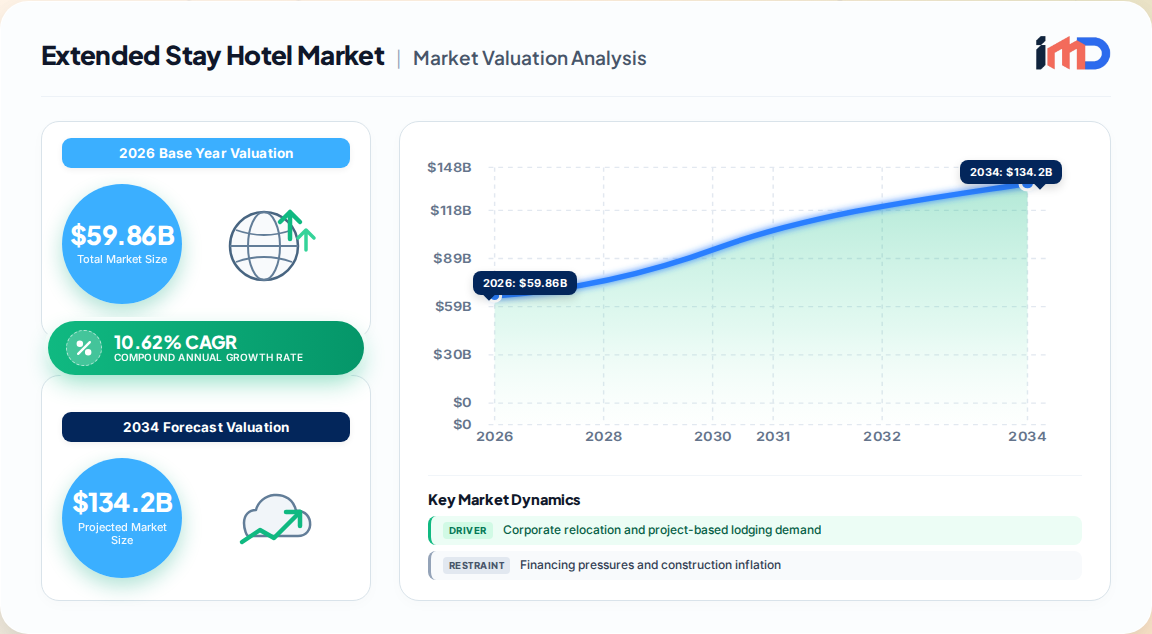
The global extended stay hotel market is experiencing a structural shift in lodging demand, driven by the convergence of project-based employment, hybrid work patterns, and persistent workforce housing gaps. Our proprietary primary research estimates the market at USD 59.86 billion in 2026, advancing at a robust CAGR of 10.62% to reach USD 99.15 billion by 2031. This growth trajectory reflects a fundamental change in guest behavior, where stays of five nights or more are increasingly preferred over traditional transient bookings.
The segment’s operational model—characterized by lighter labor requirements, limited food and beverage services, and standardized room layouts—continues to attract developers and investors seeking defensive lodging assets with strong return visibility. Unlike full-service hotels, extended stay properties benefit from longer average stays, lower room turnover, and enhanced revenue resilience across economic cycles.
Key Market Metrics (2026–2031):
| Metric | Value |
|---|---|
| Market Size (2026) | USD 59.86 Billion |
| Market Size (2031) | USD 99.15 Billion |
| CAGR (2026–2031) | 10.62% |
| Largest Market | North America (36.86% share in 2025) |
| Fastest Growing Region | Asia-Pacific (11.04% CAGR) |
| Leading Service Level | Mid-range (46.52% share in 2025) |
| Leading Stay Duration | Monthly stays (40.14% share in 2025) |
Mid-range properties dominate the market, accounting for 46.52% of the extended stay hotel market share in 2025. This segment’s appeal lies in its balanced offering of affordability and comfort, providing essential conveniences such as in-room kitchens, laundry facilities, and workspaces without the high costs of luxury accommodations. Upscale and luxury properties are projected to grow at an 11.13% CAGR through 2031, driven by affluent travelers and business executives seeking premium extended-stay experiences.
Monthly stays represented 40.14% of the market in 2025, reflecting the core demand from relocating professionals and project-based workers. Weekly stays are projected to grow at the fastest rate, with an 11.73% CAGR, as hybrid work and bleisure trends extend typical business trips into multi-week stays.
Direct digital bookings accounted for 38.92% of transactions in 2025, supported by improved brand websites and loyalty programs. However, Online Travel Agencies (OTAs) are projected to grow at a 12.94% CAGR, as extended stay properties increasingly leverage OTA distribution to reach leisure and family segments.
Business customers contributed 34.31% of demand in 2025. The fastest-growing end-user segment is relocating residents and insurance-displaced guests, projected to grow at a 12.57% CAGR, driven by housing shortages and disaster recovery needs.
North America remains the largest market, holding 36.86% share in 2025, supported by a mature branded pipeline, corporate relocation activity, and workforce housing demand from industrial projects. The U.S. alone is expected to grow at a 9.5% CAGR through 2031.
Asia-Pacific is the fastest-growing region, with an 11.04% CAGR forecast. Rapid urbanization, infrastructure development, and a growing middle class are driving demand for extended stay accommodations in countries such as India, China, and Southeast Asian nations. Europe represents a significant market, characterized by strong domestic travel and cross-border corporate assignments.
Regional Market Share (2025):
| Region | Share |
|---|---|
| North America | 36.86% |
| Europe | 24.31% |
| Asia-Pacific | 21.42% |
| South America | 9.13% |
| Middle East & Africa | 8.28% |
The extended stay hotel market is moderately concentrated, with major global chains and dedicated operators competing alongside regional brands. Key players include Marriott International, Hilton Worldwide Holdings, Extended Stay America, InterContinental Hotels Group (IHG), and Choice Hotels International. These companies are actively expanding their extended stay portfolios through new brand launches, conversions, and strategic partnerships.
Recent developments include:
The extended stay hotel value chain encompasses property developers, management companies, OTAs and direct booking platforms, and corporate clients. The labor-light operating model provides a structural cost advantage, with lower housekeeping frequency, limited food and beverage services, and reduced front-desk staffing requirements. This model yields higher profit margins compared to full-service hotels, making extended stay properties an attractive asset class for institutional investors.
Technology integration is playing an increasingly important role, with contactless check-in, digital keys, and virtual concierge services enhancing operational efficiency and guest experience. Data analytics are being used to optimize pricing and occupancy rates, further supporting margin expansion.
The extended stay hotel value chain comprises five primary stages: real estate development and conversion, brand franchising and management, operational service delivery, distribution and booking, and corporate/guest demand generation.
While the extended stay hotel market is service-based and not directly traded as a commodity, its supply chain is influenced by global construction materials, furniture, fixtures, and equipment (FF&E) sourcing. Key risks include:
| Aspects | Details |
|---|---|
| Study Period | 2020-2034 |
| Base Year | 2026 |
| Estimated Year | 2026 |
| Forecast Period | 2026-2034 |
| Historical Period | 2020-2025 |
| Growth Rate | CAGR of 10.62% from 2020-2034 |
| Segmentation |
|
 Related Reports


Analyst at Providence Strategic Partners at Petaling Jaya
I have received the report already. Thanks you for your help.it has been a pleasure working with you. Thank you again for a good quality report

Internationalization Director
Yes, as a matter of fact we are totally satisfied with both reports that we have purchased and will continue to do so during this process of the internationalization of our brand.

Head of Product Management and Marketing
We are using your report, and it gave us valuable information."

Regional Director, Marketing and Business Development
We've received the report and have reviewed the content. Overall, it looks great and aligns closely with the data we can verify based on our industry knowledge.

VP of Sales
Thank you very much for sharing the report. I have reviewed it and I am very satisfied with the quality and the insights it provides. It will certainly be valuable for our internal discussions.
By Booking Channel
By End User
By Room Range
By Age Group
By Tourist Type
| By Geography |
|
The global extended stay hotel market is valued at USD 59.86 billion in 2026 and is projected to reach USD 99.15 billion by 2031, growing at a CAGR of 10.62%.
North America led the market with a 36.86% share in 2025, driven by corporate relocation activity and workforce housing demand.
Corporate relocation and project-based lodging demand, hybrid work and bleisure trends, workforce housing spillover from industrial megaprojects, and the labor-light operating model are the primary drivers.
Mid-range properties accounted for 46.52% of the market share in 2025, offering a balance of affordability and comfort.
Major players include Marriott International, Hilton Worldwide Holdings, Extended Stay America, InterContinental Hotels Group (IHG), and Choice Hotels International.
Our rigorous research methodology combines multi-layered approaches with comprehensive quality assurance, ensuring precision, accuracy, and reliability in every market analysis.
| Stakeholder Role | Interview Share (%) |
|---|---|
| Chief Operating Officer | 30% |
| Director of Development | 25% |
| Head of Corporate Sales | 25% |
| Asset Manager | 20% |
| Company Type | Representation (%) |
|---|---|
| Hotel Brand Franchisors | 30% |
| Property Management Companies | 25% |
| Real Estate Developers | 20% |
| Institutional Investors | 15% |
| Corporate Travel Managers | 10% |