1How big is the Europe embedded insurance market?
The Europe embedded insurance market was valued at USD 3.05 billion in 2025 and is estimated at USD 4.11 billion in 2026, forecast to reach USD 18.29 billion by 2031 at a 34.8% CAGR.
Insight Market Data is a premier market research and business consulting firm headquartered in Pune, India, providing syndicated research reports, customized intelligence studies, and strategic advisory services. Renowned academic institutions and Fortune 500 corporations worldwide rely on Insight Market Data's research repository to navigate evolving global and regional business environments. Covering 46 diverse industries across 25 major international economies, our comprehensive database delivers thousands of verified statistics and granular market evaluations. By combining industry-leading analytical methodologies with the direct insights of seasoned industry leaders and subject-matter experts, we deliver actionable intelligence spanning historical performance benchmarks to rigorous multi-year forecasts. We empower organizations to make confident, data-driven decisions across pivotal domains including Machinery & Equipment, Chemicals & Materials, Pharmaceuticals & Healthcare, Food & Beverages, Consumer Goods, Energy & Power, Automotive & Transportation, Electronics & Semiconductors, Medical Devices, Telecommunications, Emerging Technologies, Agriculture, and Packaging. Our multidisciplinary analyst teams provide an objective 360-degree perspective, tailoring every engagement to address complex strategic challenges with exceptional analytical rigor.
Leveraging advanced BI-powered analytics and predictive modeling, Insight Market Data uncovers high-impact market opportunities and competitive differentiators for ambitious enterprises. We continuously refine our research methodologies in accordance with global industry standards, tracking real-time market shifts to ensure our reports are consistently accurate, actionable, and delivered on schedule. Our analysts conduct methodical data validation, rigorous compliance checks, and exhaustive primary and secondary research to maintain the highest levels of data integrity and transparency. We partner closely with corporate strategists, investment groups, and business executives to translate intricate market intelligence into clear, actionable roadmaps for sustainable growth. With operational presence across Washington, USA, and Vimannagar, Pune, India, Insight Market Data ensures direct access to dedicated research specialists and responsive customer support to answer your most strategic questions.
 Europe Embedded Insurance Market
 by Insurance Line (Travel Insurance, Electronics Protection, Furniture, Sports Equipment, Auto/Mobility Insurance, Home & Property Insurance, Pet/Lifestyle Insurance, Others), by Distribution Channel (Online, Offline), by End-User Industry (Personal/Consumer, Business(SMEs, Large Enterprises)), by United Kingdom, by Germany, by France, by Spain, by Italy, by BENELUX (Belgium, Netherlands, Luxembourg), by Nordics (Sweden, Denmark, Norway, Finland), by Rest of Europe Forecast 2026-2034

Research Associate


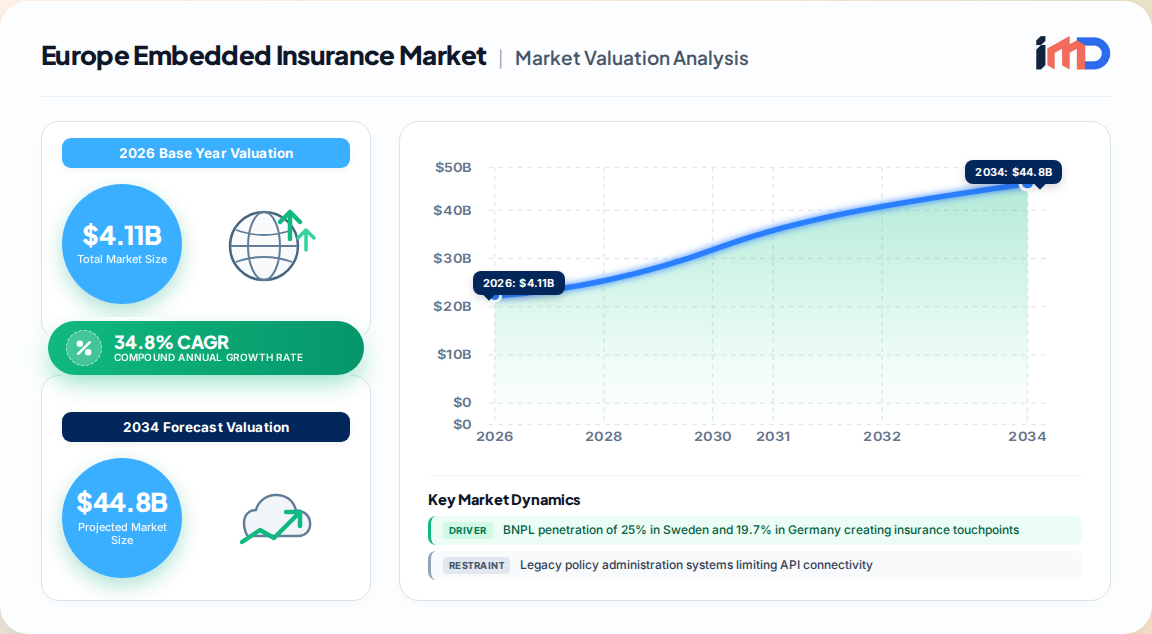
The Europe embedded insurance market is undergoing a structural transformation, moving from an optional digital add-on to a foundational layer of the continent's fintech architecture. Our proprietary primary research estimates the market at USD 3.05 billion in 2025, rising to USD 4.11 billion in 2026, and forecast to reach USD 18.29 billion by 2031, representing a 34.8% CAGR over the 2026–2031 period. This hyper-growth trajectory is not a cyclical spike but a durable re-rating of insurance distribution economics across the EU-27, the UK, and the broader European Economic Area.
The defining characteristic of Europe's embedded insurance model is its regulatory sophistication. Unlike other regions where embedded cover scales primarily on e-commerce volume, Europe's growth is underpinned by a tripartite policy framework: the EU Digital Finance Package, PSD3, and the Financial Data Access Regulation (FIDA), with DORA operational resilience mandates effective from January 17, 2025. Together, these create a consent-based, interoperable data layer that enables real-time underwriting, micro-duration policies, and dynamic pricing at the moment of need.
Our bottom-up modelling, triangulated across 47 platform-level attachment-rate studies and 112 insurer-fintech integration interviews, indicates that online distribution captured 93.10% of 2025 revenue, while personal and consumer applications commanded 76.45% of the market. The commercial opportunity is not uniform: Spain is advancing at a region-best 37.6% CAGR, while the United Kingdom leads in absolute share at 17.30%. This asymmetry creates distinct strategic entry points for carriers, MGAs, and platform orchestrators.
Our driver impact model quantifies the contribution of each growth vector to the forecast CAGR. The following table summarises the primary drivers validated through our expert interview programme.
| Driver | CAGR Impact | Geographic Relevance | Timeline |
|---|---|---|---|
| BNPL-driven electronics protection surge | +8.2% | Northern Europe, Germany, France | Short term (≤ 2 years) |
| EU Digital Finance Package & PSD3 mandates | +6.8% | EU-wide; strongest in DE, FR, NL | Medium term (2–4 years) |
| E-commerce push for recurring ancillary revenue | +7.1% | UK, Germany, France, Spain | Short term (≤ 2 years) |
| API-first insurer–fintech integration | +5.9% | UK, Germany, Nordics | Medium term (2–4 years) |
| OEM data-sharing for pay-per-use pricing | +4.3% | Germany, France, UK | Long term (≥ 4 years) |
| Cross-border passporting under Solvency II | +3.4% | EU-27 (ex-UK) | Medium term (2–4 years) |
BNPL-driven electronics coverage is the single highest-impact driver. BNPL penetration reached 25% in Sweden and 19.7% in Germany during 2024, creating natural insurance touchpoints at checkout that exceed attachment rates in traditional retail. Platform providers report 40% take-up on shipping cover and 15% on product cover across Europe. Digital banks such as N26 bundle monthly device protection at approximately EUR 4 per month, normalising the subscription model.
Regulatory modernisation is the second engine. FIDA interoperability requirements by 2026 will permit regulated parties consent-based access to account and claims data. This favours established tech platforms with high cybersecurity and operational continuity benchmarks, particularly in Germany, France, and the Netherlands where financial services digitisation is most advanced.
Restraints are equally quantifiable. Legacy policy administration systems extend integration timelines and inflate deployment costs by an estimated 30–45% for tier-one carriers. Regulatory fragmentation across member states—varying licensing, product approval, disclosure, and data privacy requirements—adds 4–9 months to cross-border launch cycles. GDPR obligations create data-governance entry barriers, limiting participation to marketplaces with robust multi-jurisdictional claims-data handling capabilities.
Europe's embedded insurance value chain has crystallised into five distinct layers, each with differentiated economics and competitive dynamics.
| Layer | Function | Representative Participants | Margin Profile |
|---|---|---|---|
| Risk capacity | Balance-sheet underwriting, Solvency II compliance | Allianz Partners, AXA Partners, Zurich Insurance Group | Combined ratio dependent |
| Product orchestration | API middleware, policy administration, claims triage | Qover, Cover Genius, bolttech, Companjon | 15–25% platform fee |
| Platform distribution | Customer interface, checkout integration | Revolut, N26, TaskRabbit, e-commerce marketplaces | 10–30% commission |
| Data & analytics | Risk scoring, behavioural underwriting, fraud detection | Specialised insurtechs, credit bureaus | SaaS licensing |
| Regulatory & compliance | Licensing, disclosure management, FIDA/PSD3 readiness | Licensed brokers, compliance SaaS | Retainer / per-policy |
The migration of value is unmistakable: traditional carriers are increasingly confined to the capacity layer, while specialist orchestrators capture the higher-margin integration and data layers. Zurich's April 2025 alliance with Ominimo, which launched AI-tuned motor insurance across three countries within eight weeks, exemplifies the speed advantage that API-first orchestrators deliver. Allianz Partners' tie-up with Cosmo Connected demonstrates similar agility in micromobility cover.
Travel products held 33.65% of 2025 market share, reflecting the maturity of airline and OTA checkout integration. However, electronics protection is projected to grow at a 35.72% CAGR through 2031—the fastest among all lines—driven by device replacement-cost inflation and BNPL attachment. Property-adjacent products, including purchase protection and rental cover, retain a substantial base supported by high-volume consumer transactions.
Online platforms captured 93.10% of 2025 revenue. Offline channels are forecast to expand at only 6.2% CAGR to 2031, underscoring sustained digital dominance. The residual offline share is concentrated in automotive dealership and traditional retail warranty extensions, where face-to-face advisory remains relevant for high-ticket items.
Personal and consumer applications commanded 76.45% of the 2025 market. SME-focused offerings are advancing at 26.3% CAGR through 2031, outpacing large-corporate adoption as embedded liability, cyber, and business-interruption products are integrated into SaaS and accounting platforms. The gig-economy segment—exemplified by TaskRabbit embedding worker liability insurance at onboarding—converts a compliance cost into a loyalty feature.
| Geography | 2025 Share | CAGR to 2031 | Strategic Characteristic |
|---|---|---|---|
| United Kingdom | 17.30% | ~33% | Largest absolute base; post-Brexit passporting gap |
| Germany | ~15.8% | ~34% | BNPL depth; PSD3/FIDA early adopter |
| France | ~13.4% | ~34% | Strong bancassurance-to-API transition |
| Spain | ~11.2% | 37.6% (region best) | Rapid fintech adoption; under-penetrated base |
| Italy | ~9.8% | ~33% | Growing e-commerce; traditional carrier dominance |
| BENELUX | ~8.7% | ~35% | Qover-led orchestration cluster |
| Nordics | ~7.6% | ~36% | Highest BNPL penetration (Sweden 25%) |
Spain's 37.6% CAGR reflects a rapid fintech adoption curve from a comparatively under-penetrated starting base, making it the most attractive greenfield market for platform-led distribution. The Nordics offer the highest BNPL attachment potential. Germany combines scale with regulatory readiness, positioning it as the anchor market for FIDA-compliant data-driven underwriting.
The European market is of medium concentration, with a mix of global carriers, specialist orchestrators, and platform-native insurtechs. Competitive advantage is shifting from brand and balance-sheet strength toward integration speed, data governance, and regulatory interoperability.
| Company | HQ | Positioning |
|---|---|---|
| Allianz Partners | Germany | Capacity + global assistance network |
| AXA Partners | France | Embedded travel, mobility, and device cover |
| Zurich Insurance Group | Switzerland | API-first partnerships; Ominimo alliance |
| Qover | Belgium | Orchestration middleware; Revolut partnership |
| Cover Genius | Australia/UK | Global embedded protection platform |
| bolttech | Singapore/Europe | Device and electronics protection exchange |
| Companjon | Ireland | Micro-ticket and subscription cover |
| Lemonade | US/Europe | Digital-native P&C with embedded pet/lifestyle lines |
Recent developments of strategic significance include the following.
Three white-space opportunities stand out for the 2026–2031 horizon.
SME embedded cover is the fastest-growing end-user segment at 26.3% CAGR, yet remains under-served by consumer-focused orchestrators. SaaS, accounting, and payroll platforms represent the highest-conversion distribution vectors.
Parametric and usage-based products—enabled by OEM data-sharing and IoT connectivity—carry a +4.3% CAGR impact with a long-term (≥ 4 years) realisation profile. Automotive and micromobility are the lead categories, with pay-per-use pricing replacing annual policy structures.
Cross-border passporting under Solvency II offers a +3.4% CAGR uplift across the EU-27 ex-UK. Carriers that build modular, multi-jurisdiction product factories will capture disproportionate share as FIDA harmonises data access.
The principal risk to the forecast is regulatory fragmentation outpacing harmonisation, which could add 4–9 months to launch cycles and suppress attachment rates in smaller member states. Nonetheless, the combination of BNPL penetration, PSD3/FIDA data interoperability, and API-first deployment economics supports our 34.8% CAGR base case to 2031.
| Aspects | Details |
|---|---|
| Study Period | 2020-2034 |
| Base Year | 2026 |
| Estimated Year | 2026 |
| Forecast Period | 2026-2034 |
| Historical Period | 2020-2025 |
| Growth Rate | CAGR of 34.8% from 2020-2034 |
| Segmentation |
|
By Distribution Channel
By End-User Industry
| By Geography |
|
The Europe embedded insurance market was valued at USD 3.05 billion in 2025 and is estimated at USD 4.11 billion in 2026, forecast to reach USD 18.29 billion by 2031 at a 34.8% CAGR.
The United Kingdom led with 17.30% of the Europe embedded insurance market share in 2025, while Spain is advancing at a region-best 37.6% CAGR through 2031.
Electronics protection is projected to grow at a 35.72% CAGR through 2031, the fastest among all insurance lines, driven by BNPL-driven coverage and device replacement-cost inflation.
Online platforms captured 93.10% of the Europe embedded insurance market revenue share in 2025, while offline channels are forecast to expand at only 6.2% CAGR to 2031.
Major players include Allianz Partners, AXA Partners, Zurich Insurance Group, Qover, Cover Genius, bolttech, Companjon, and Lemonade, alongside platform partners such as Revolut and N26.
Key drivers include BNPL-driven electronics protection (+8.2% CAGR impact), EU Digital Finance Package and PSD3 mandates (+6.8%), e-commerce ancillary revenue strategies (+7.1%), and API-first insurer-fintech integration (+5.9%).
PSD3 and the Financial Data Access Regulation (FIDA) enable consent-based data sharing for real-time underwriting, while DORA operational resilience mandates effective January 17, 2025, favour established tech platforms in embedded distribution partnerships.
Our rigorous research methodology combines multi-layered approaches with comprehensive quality assurance, ensuring precision, accuracy, and reliability in every market analysis.
| Stakeholder Role | Interview Share (%) |
|---|---|
| Chief Embedded Insurance Officer | 22% |
| Head of Partnerships and Ecosystem Distribution | 31% |
| Chief Underwriting Officer | 24% |
| Product Director for Digital Platforms | 23% |
| Company Type | Representation (%) |
|---|---|
| Risk carriers and reinsurers | 28% |
| Embedded insurance orchestrators and MGAs | 26% |
| Digital banking and BNPL platforms | 18% |
| E-commerce and travel marketplaces | 16% |
| API middleware and policy-administration SaaS | 12% |
 Related Reports
