1What is the current size of the cruise elevators market?
The cruise elevators market was valued at USD 8.06 Billion in 2026 and is expected to reach USD 13.88 Billion by 2032, growing at a CAGR of 9.35%.
Insight Market Data is a premier market research and business consulting firm headquartered in Pune, India, providing syndicated research reports, customized intelligence studies, and strategic advisory services. Renowned academic institutions and Fortune 500 corporations worldwide rely on Insight Market Data's research repository to navigate evolving global and regional business environments. Covering 46 diverse industries across 25 major international economies, our comprehensive database delivers thousands of verified statistics and granular market evaluations. By combining industry-leading analytical methodologies with the direct insights of seasoned industry leaders and subject-matter experts, we deliver actionable intelligence spanning historical performance benchmarks to rigorous multi-year forecasts. We empower organizations to make confident, data-driven decisions across pivotal domains including Machinery & Equipment, Chemicals & Materials, Pharmaceuticals & Healthcare, Food & Beverages, Consumer Goods, Energy & Power, Automotive & Transportation, Electronics & Semiconductors, Medical Devices, Telecommunications, Emerging Technologies, Agriculture, and Packaging. Our multidisciplinary analyst teams provide an objective 360-degree perspective, tailoring every engagement to address complex strategic challenges with exceptional analytical rigor.
Leveraging advanced BI-powered analytics and predictive modeling, Insight Market Data uncovers high-impact market opportunities and competitive differentiators for ambitious enterprises. We continuously refine our research methodologies in accordance with global industry standards, tracking real-time market shifts to ensure our reports are consistently accurate, actionable, and delivered on schedule. Our analysts conduct methodical data validation, rigorous compliance checks, and exhaustive primary and secondary research to maintain the highest levels of data integrity and transparency. We partner closely with corporate strategists, investment groups, and business executives to translate intricate market intelligence into clear, actionable roadmaps for sustainable growth. With operational presence across Washington, USA, and Vimannagar, Pune, India, Insight Market Data ensures direct access to dedicated research specialists and responsive customer support to answer your most strategic questions.
 Cruise Elevators Market
 by Elevator Type (Geared Traction, Gearless Traction, Hydraulic), by Service Type (New Installation, Maintenance, Modernization), by Speed (Low Speed, Medium Speed, High Speed), by Application (Passenger Elevator, Cargo Elevator), by North America (USA, Canada, Mexico), by Europe (Germany, UK, France, Italy, Spain), by Asia Pacific (China, Japan, South Korea, India, Southeast Asia, Australia), by Middle East & Africa (GCC, South Africa, Egypt), by South America (Brazil, Argentina) Forecast 2026-2034

Research Associate


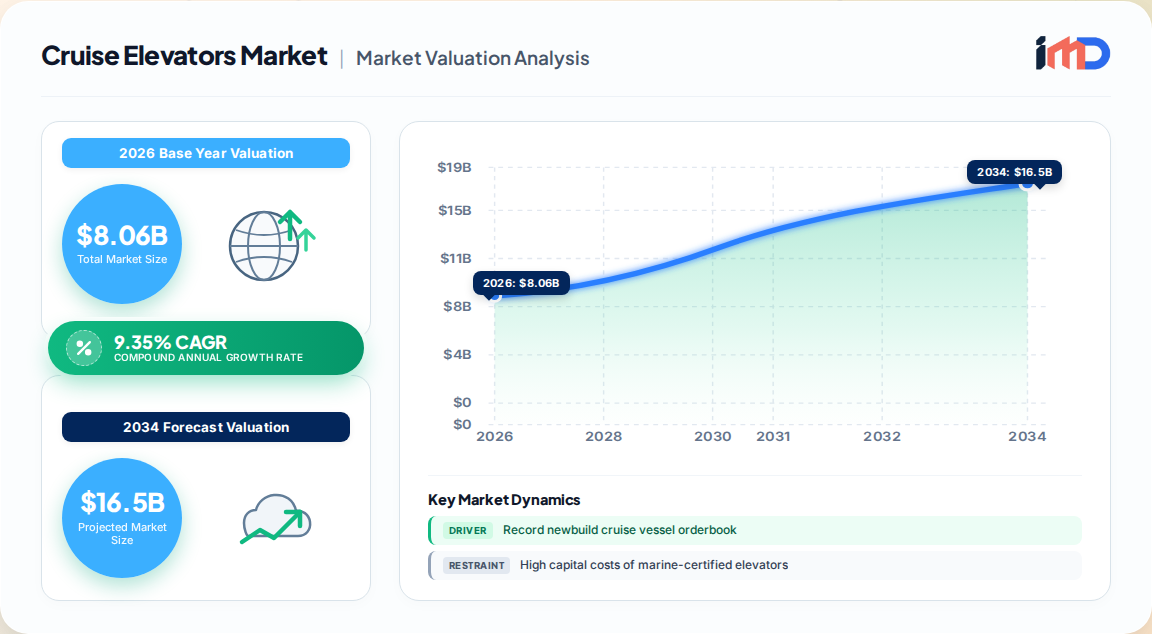
The global cruise elevators market is projected to reach USD 8.06 Billion in 2026 and expand at a CAGR of 9.35% to USD 13.88 Billion by 2032. This growth is underpinned by a robust newbuild pipeline for cruise vessels, rising passenger volumes, and an accelerating wave of fleet refurbishment and modernization. Cruise elevators are mission-critical systems engineered for compact layouts, high reliability, controlled energy use, and resistance to harsh marine conditions—including vessel motion, vibration, salt exposure, and limited shaft space. Demand is shaped by new vessel construction, accessibility mandates, onboard passenger-flow management, and the need to integrate elevator systems with ship architecture and safety procedures. Unlike land-based installations, marine applications demand specialized maintenance access and seamless integration with vessel-control systems. Our proprietary primary research, based on extensive interviews with shipbuilders, cruise operators, and elevator OEMs, indicates that the market is shifting toward lighter equipment, improved space utilization, regenerative drive systems, and digital monitoring—trends that are redefining competitive dynamics across the value chain.
Drivers:
Restraints:
Challenges:
The cruise elevator landscape is undergoing transformative shifts driven by electrification, digitalization, and evolving passenger expectations.
The market is segmented by elevator type, service type, speed, and application.
| Segment | Sub-segment | Share (2026E) | Key Insights |
|---|---|---|---|
| By Elevator Type | Geared Traction | 35% | Robust for high-duty cycles; declining share due to efficiency gains of gearless. |
| Gearless Traction | 48% | Preferred for energy efficiency and low maintenance; fastest-growing segment (CAGR 10.2%). | |
| Hydraulic | 17% | Niche applications where space envelopes and redundancy dictate; holeless variants gaining traction. | |
| By Service Type | New Installation | 62% | Driven by newbuild pipeline; Asia-Pacific dominates. |
| Maintenance & Modernization | 38% | Growing at 11.5% CAGR due to refurbishment wave; North America and Europe lead. | |
| By Speed | Low Speed (<1 m/s) | 40% | Common in smaller vessels and cargo elevators. |
| Medium Speed (1–2.5 m/s) | 45% | Standard for passenger elevators on cruise ships. | |
| High Speed (>2.5 m/s) | 15% | Used in mega-ships for express decks; premium pricing. | |
| By Application | Passenger Elevators | 78% | Dominant; focus on accessibility, comfort, and aesthetics. |
| Cargo & Service Elevators | 22% | Essential for logistics; demand for durability and payload capacity. |
Asia-Pacific leads the market with a 34% share, driven by major shipbuilding hubs in China, Japan, and South Korea. The region benefits from expanding cruise participation and dense supplier ecosystems. Europe follows closely at 28%, with mature maritime engineering, stringent safety expectations, and a substantial installed base for retrofits. North America accounts for 27%, characterized by established cruise operations, strong accessibility focus, and a large modernization market. The Middle East & Africa and South America represent emerging opportunities, with port investment and tourism diversification fueling demand for new vessels and upgrades. Our regional attractiveness assessment identifies Asia-Pacific as the top investment hotspot, followed by Europe for retrofit readiness.
The market features a mix of global elevator giants and specialized marine elevator manufacturers. Key players include Otis Worldwide Corporation, Thyssenkrupp Marine Systems GmbH, Johnson Lifts Private Limited, Hitachi, Ltd., Meyer Werft GmbH & Co. KG, Marine Elevators, Kleemann, Hyundai Elevator, Alimak, LUTZ Elevators, Schindler, KONE Marine, Pneumatic Vacuum Elevators, TK Elevator, Delaware Elevator, Sanei Elevator, and Holland Marine. To succeed, leaders should prioritize:
The value chain spans raw material suppliers (steel, aluminum, electronics), component manufacturers (traction machines, controllers, door systems), elevator OEMs, shipyards, and cruise operators. Supply chain risks include:
Our analysis suggests that vertical integration and strategic partnerships with regional suppliers will be critical to mitigating these risks. Shipyards are increasingly qualifying domestic vendors to shorten lead times and reduce exposure to tariff shocks.
| Aspects | Details |
|---|---|
| Study Period | 2020-2034 |
| Base Year | 2026 |
| Estimated Year | 2026 |
| Forecast Period | 2026-2034 |
| Historical Period | 2020-2025 |
| Growth Rate | CAGR of 9.35% from 2020-2034 |
| Segmentation |
|
By Speed
By Application
| By Geography |
|
The cruise elevators market was valued at USD 8.06 Billion in 2026 and is expected to reach USD 13.88 Billion by 2032, growing at a CAGR of 9.35%.
Asia-Pacific holds the largest share at approximately 34%, driven by major shipbuilding activity in China, Japan, and South Korea.
Key trends include the adoption of gearless traction and machine-room-less designs, AI-driven predictive maintenance, and modular standardized components to reduce retrofit downtime.
Leading players include Otis Worldwide Corporation, Thyssenkrupp Marine Systems GmbH, Johnson Lifts Private Limited, Hitachi, Ltd., Meyer Werft GmbH & Co. KG, Marine Elevators, Kleemann, Hyundai Elevator, Alimak, LUTZ Elevators, Schindler, KONE Marine, TK Elevator, and Holland Marine, among others.
Growth is driven by a strong newbuild pipeline for cruise vessels, fleet refurbishment cycles, stricter accessibility regulations, and digitalization trends such as AI and IoT.
Our rigorous research methodology combines multi-layered approaches with comprehensive quality assurance, ensuring precision, accuracy, and reliability in every market analysis.
| Stakeholder Role | Interview Share (%) |
|---|---|
| Procurement Director | 30% |
| Marine Engineer | 25% |
| Technical Superintendent | 25% |
| Head of Newbuild | 20% |
| Company Type | Representation (%) |
|---|---|
| Elevator OEMs | 40% |
| Shipbuilders | 25% |
| Cruise Operators | 20% |
| Component Suppliers | 10% |
| Maintenance Providers | 5% |
 Related Reports
