Insight Market Data is a premier market research and business consulting firm headquartered in Pune, India, providing syndicated research reports, customized intelligence studies, and strategic advisory services. Renowned academic institutions and Fortune 500 corporations worldwide rely on Insight Market Data's research repository to navigate evolving global and regional business environments. Covering 46 diverse industries across 25 major international economies, our comprehensive database delivers thousands of verified statistics and granular market evaluations. By combining industry-leading analytical methodologies with the direct insights of seasoned industry leaders and subject-matter experts, we deliver actionable intelligence spanning historical performance benchmarks to rigorous multi-year forecasts. We empower organizations to make confident, data-driven decisions across pivotal domains including Machinery & Equipment, Chemicals & Materials, Pharmaceuticals & Healthcare, Food & Beverages, Consumer Goods, Energy & Power, Automotive & Transportation, Electronics & Semiconductors, Medical Devices, Telecommunications, Emerging Technologies, Agriculture, and Packaging. Our multidisciplinary analyst teams provide an objective 360-degree perspective, tailoring every engagement to address complex strategic challenges with exceptional analytical rigor.
Leveraging advanced BI-powered analytics and predictive modeling, Insight Market Data uncovers high-impact market opportunities and competitive differentiators for ambitious enterprises. We continuously refine our research methodologies in accordance with global industry standards, tracking real-time market shifts to ensure our reports are consistently accurate, actionable, and delivered on schedule. Our analysts conduct methodical data validation, rigorous compliance checks, and exhaustive primary and secondary research to maintain the highest levels of data integrity and transparency. We partner closely with corporate strategists, investment groups, and business executives to translate intricate market intelligence into clear, actionable roadmaps for sustainable growth. With operational presence across Washington, USA, and Vimannagar, Pune, India, Insight Market Data ensures direct access to dedicated research specialists and responsive customer support to answer your most strategic questions.
Financial Services and Investment Intelligence / MARKET REPORT
Critical Illness Insurance Market | Insight Market Data
Critical Illness Insurance Market by Premium Type (Monthly, Quarterly, Half Yearly, Yearly), by Type (Individual Insurance, Family Insurance), by Disease (Cancer, Heart Attack, Stroke, Organ Transplant, Others), by North America (USA, Canada, Mexico), by Europe (Germany, UK, France, Italy, Spain, Rest of Europe), by Asia Pacific (China, Japan, India, Australia, South Korea, Rest of APAC), by Latin America (Brazil, Argentina, Rest of LATAM), by Middle East & Africa (UAE, Saudi Arabia, South Africa, Rest of MEA) Forecast 2026-2034
Executive Overview: A Market at an Inflection Point
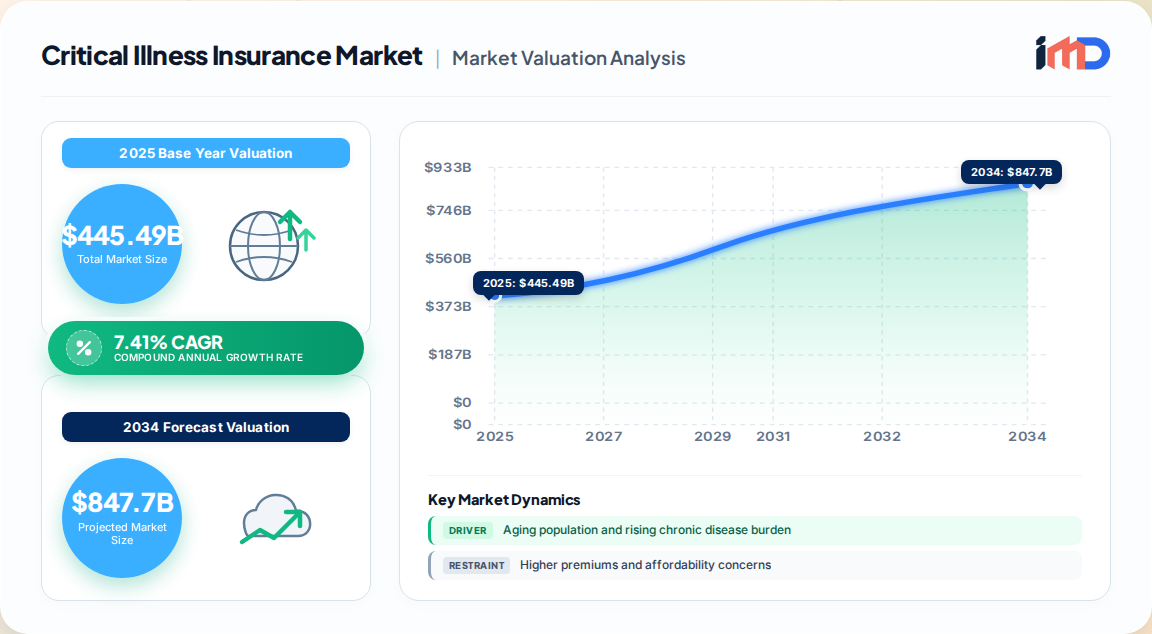
The global critical illness insurance market stands at a pivotal juncture, transitioning from a niche supplemental product to a mainstream financial safeguard. Our proprietary primary research estimates the market at USD 445.49 billion in 2025, with a clear trajectory to reach USD 910.93 billion by 2035, expanding at a robust CAGR of 7.41%.
Critical Illness Insurance Market Market Size (In Billion)
750.0B
600.0B
450.0B
300.0B
150.0B
0
445.5 B
2025
478.5 B
2026
514.0 B
2027
552.0 B
2028
592.9 B
2029
636.9 B
2030
684.1 B
2031
This growth is not merely a post-pandemic rebound but a structural shift in consumer behavior and insurer capability. The fundamental value proposition—a lump-sum cash benefit upon diagnosis of a severe condition like cancer, heart attack, or stroke—is being redefined by technological integration and a deeper understanding of holistic financial wellness.
Market Size (2025): USD 445.49 Billion
Forecast (2035): USD 910.93 Billion
CAGR (2026–2035): 7.41%
Largest Region: North America (36.8% revenue share in 2025)
Fastest-Growing Region: Asia-Pacific
Key Market Drivers: The Convergence of Demography and Economics
The expansion of the critical illness insurance market is underpinned by powerful, interconnected forces that are reshaping the risk landscape for individuals and insurers alike.
Aging Population and Chronic Disease Burden
Global demographic shifts are a primary catalyst. The United Nations projects that the population aged 65 and older will reach 1.6 billion by 2050. This cohort faces a significantly higher incidence of critical illnesses. Concurrently, the World Health Organization reports that noncommunicable diseases (NCDs) account for 74% of all global deaths, with cardiovascular conditions, cancer, and diabetes responsible for nearly 41 million deaths annually. This epidemiological reality creates an urgent, non-discretionary demand for financial protection against catastrophic health events.
Escalating Healthcare Costs
Out-of-pocket medical expenses are soaring. In the United States, average annual healthcare spending exceeds USD 13,000 per person, according to WHO data. Critical illness policies serve as a vital financial buffer, covering not just direct medical bills but also indirect costs such as lost income, rehabilitation, and home modifications. As deductibles and co-pays rise, consumers are increasingly viewing these policies as essential rather than optional.
Enhanced Consumer Awareness and Financial Literacy
Post-pandemic, there is a heightened global consciousness regarding health and financial resilience. Awareness campaigns by organizations like the Pan American Health Organization have underscored the financial devastation that can accompany a diagnosis. This has led to a more informed consumer base actively seeking products that offer comprehensive, lump-sum protection.
Market Restraints and Challenges: Navigating Affordability and Relevance
Despite strong fundamentals, the market faces headwinds that require strategic navigation.
Premium Affordability and Product Complexity
As insurers expand coverage to include more diseases and advanced stages of illness, premiums inevitably rise. For lower- and middle-income demographics—precisely those most vulnerable to financial shocks—affordability remains a significant barrier. Consumers often prioritize basic health or life insurance, viewing critical illness coverage as a secondary expense. Insurers are challenged to balance comprehensive benefits with accessible pricing structures.
Keeping Pace with Medical Advancements
Rapid innovation in diagnostics (e.g., biomarkers, genetic screening) and treatments (e.g., minimally invasive surgery, targeted therapies) complicates policy definitions. Traditional policies rely on predefined diagnostic criteria that can become obsolete. Insurers must continuously review and update policy wording to ensure claims adjudication remains fair and relevant, without introducing ambiguity or unsustainable complexity.
Underwriting Complexity and Pre-existing Conditions
The rising prevalence of pre-existing conditions (e.g., controlled diabetes, hypertension) presents challenges for risk assessment. Manual underwriting processes are time-consuming and can lead to inconsistent decisions. This is driving the adoption of AI and automation to streamline assessments while maintaining accuracy.
Technology and Innovation: The AI-Driven Transformation
Technology is not just an enabler but a strategic differentiator in the critical illness insurance market. Artificial intelligence is shifting the industry from a reactive "detect and repair" model to a proactive "predict and prevent" paradigm.
AI in Underwriting and Claims
Insurers are deploying AI-powered tools to summarize medical reports, flag risks, and accelerate underwriting decisions. For example, Aviva recently expanded its AI-powered underwriting summarisation tool to individual critical illness applications, reducing processing times and improving accuracy. This allows human underwriters to focus on complex cases, enhancing operational efficiency.
Flexible Product Design
Consumer demand is moving toward customized solutions. Insurers are responding with products that offer choices in payout structure. Generali Central Life Insurance introduced a Critical Illness Rider in 2026 allowing policyholders to select a lump-sum payout, an income payout, or a hybrid—a clear signal of the market's direction toward personalization.
Digital Distribution and Engagement
Mobile apps and digital platforms are streamlining policy management and claims filing. This resonates with tech-savvy consumers and expands access in emerging markets where digital penetration is leapfrogging traditional channels.
Market Segmentation Analysis
The market is segmented by premium type, insurance type, and disease, revealing distinct growth patterns.
Segment
Sub-Segment
Market Share (2025)
Growth Outlook
By Premium Type
Monthly
46.5%
Dominant due to affordability and budgeting convenience
Yearly
—
Fastest-growing (CAGR 8.2%) as insurers incentivize annual payments
Quarterly / Half-Yearly
—
Steady demand for balanced payment frequency
By Type
Individual Insurance
61.0%
Largest segment, driven by personal financial planning
Family Insurance
—
Fastest-growing as families seek comprehensive protection
By Disease
Cancer
36.8% (to 58% in some estimates)
Largest segment; rising incidence and early detection drive claims
Heart Attack
—
Fastest-growing segment due to cardiovascular disease prevalence
Stroke, Organ Transplant, Others
—
Specialized coverage for targeted needs
Premium Type Insight: Monthly premiums dominate because they align with salary cycles and enable automatic payroll or bank deductions, making coverage more accessible. However, the yearly segment is gaining traction, particularly among affluent consumers who prefer simplified administration and potential premium discounts.
Disease Insight: Cancer remains the leading claims driver, reflecting its high global incidence and the financial toxicity of prolonged treatment. Heart attack coverage is expanding rapidly, fueled by lifestyle-related risk factors and an aging population. Insurers are increasingly offering modular policies that allow consumers to prioritize specific disease coverage.
Regional Outlook: North America Leads, Asia-Pacific Accelerates
North America
The region held the largest revenue share of 36.8% in 2025, generating approximately USD 163.8 billion. The U.S. accounts for roughly 60% of regional revenue, driven by high healthcare expenditure, strong insurance penetration, and a well-developed employer benefits ecosystem. Canada contributes around 20%, with a mix of public and private coverage. Market maturity means growth is moderate but steady, with innovation focused on product flexibility and digital experiences.
Asia-Pacific
This is the fastest-growing region, projected to expand at a CAGR of 10.7% through 2035. Drivers include rapid economic development, a burgeoning middle class, and increasing health awareness. Countries like China, India, and Southeast Asian nations are witnessing a surge in demand for private health and critical illness coverage as public systems strain under rising costs. Insurers are deploying digital-first strategies to reach vast, under-penetrated populations.
Europe
Europe represents a mature, regulated market with a strong tradition of social security. However, fiscal pressures on public health systems are creating space for supplemental private coverage. The market is characterized by customization and integration with life insurance products. Growth is steady, with a focus on value-added services like preventative health screenings.
Latin America and Middle East & Africa
These regions offer significant white-space opportunities. Rising chronic disease burdens and growing middle classes are driving demand, but distribution challenges and regulatory fragmentation persist. Insurers are forming partnerships with local banks and telecom providers to expand reach.
Competitive Landscape and Strategic Developments
The market is highly competitive, featuring a mix of global insurance giants and regional specialists. Key players are pursuing distinct strategies to capture share.
Prudential (GB): Focus on integrated health and wealth solutions, leveraging digital platforms to engage younger demographics.
AIA Group (HK): Dominates Asia-Pacific through an extensive agency network and innovative critical illness products tailored to local markets.
MetLife (US): Strong in group benefits, embedding critical illness coverage into employer-sponsored plans.
Allianz (DE): Leverages its global footprint to offer multi-country policies and cross-border claims handling.
Aviva (GB): Investing heavily in AI and automation to streamline underwriting and enhance customer experience.
Sun Life Financial (CA): Focus on preventative health and wellness programs integrated with critical illness policies.
Cigna (US), Manulife Financial (CA), Legal & General (GB): Each maintaining strong regional positions with tailored product suites.
Recent Strategic Developments
January 2026: Generali Central Life Insurance launched a flexible Critical Illness Rider with multiple payout options.
March 2026: Aviva expanded its AI-powered underwriting summarisation tool to individual critical illness applications, improving efficiency.
Value Chain and Distribution Dynamics
The critical illness insurance value chain spans product development, underwriting, distribution, and claims management.
Product Development: Insurers collaborate with actuarial firms and medical experts to design coverage that balances market needs with sustainable risk. Reinsurers play a critical role in absorbing catastrophic risk.
Distribution: Multi-channel strategies are essential. Agency networks remain dominant in Asia, while digital aggregators and bancassurance are growing in North America and Europe. Employers are a key channel for group critical illness policies.
Claims Management: Automation is transforming this stage. AI-driven claims triage can reduce processing times from weeks to days, enhancing customer satisfaction and reducing administrative costs.
Strategic White-Space and Investment Opportunities
Our analysis identifies several high-potential avenues for growth:
Hybrid Products: Combining critical illness coverage with life insurance, savings, or long-term care features appeals to consumers seeking integrated financial planning. Insurers that offer modular, customizable solutions can capture a premium segment.
Preventative Health Integration: Policies that incentivize wellness programs (e.g., discounted premiums for health screenings) can reduce claims and improve retention. Partnerships with digital health platforms are a key enabler.
Under-Penetrated Markets: Asia-Pacific and Africa offer substantial room for growth. Microinsurance and digital-first products can address affordability and distribution challenges.
AI and Data Analytics: Investment in predictive analytics can enhance underwriting, reduce fraud, and personalize pricing. Early movers will gain a competitive advantage in efficiency and customer experience.
In conclusion, the critical illness insurance market is on a strong growth trajectory, driven by demographic and economic realities. Success will belong to insurers that can innovate products, embrace technology, and expand distribution to underserved populations while managing affordability and regulatory complexity.
Table 44: Saudi Arabia Critical Illness Insurance Market Revenue (Billion) Forecast, by Application 2020 & 2034
Table 45: South Africa Critical Illness Insurance Market Revenue (Billion) Forecast, by Application 2020 & 2034
Table 46: Rest of MEA Critical Illness Insurance Market Revenue (Billion) Forecast, by Application 2020 & 2034
Frequently Asked Questions
1How large is the critical illness insurance market?
The global critical illness insurance market was valued at approximately USD 445.49 billion in 2025 and is projected to reach USD 910.93 billion by 2035, growing at a CAGR of 7.41% according to our primary research.
2Which region dominates the critical illness insurance market?
North America holds the largest revenue share at 36.8% in 2025, driven by high healthcare expenditure and strong insurance penetration. However, Asia-Pacific is the fastest-growing region with a projected CAGR of 10.7%.
3What are the key drivers of the critical illness insurance market?
Major drivers include an aging global population (with those aged 65+ expected to reach 1.6 billion by 2050), rising healthcare costs, increasing awareness of financial protection, and technological advancements like AI in underwriting.
4What is the most common disease covered in critical illness insurance?
Cancer leads the disease segment with a share of approximately 36.8% to 58% depending on the metric, reflecting its high global incidence. Heart attack coverage is the fastest-growing sub-segment due to rising cardiovascular disease prevalence.
5Who are the leading companies in the critical illness insurance market?
Key players include Prudential, AIA Group, MetLife, Allianz, Aviva, Sun Life Financial, Cigna, Manulife Financial, and Legal & General. These companies are investing in AI, product flexibility, and digital distribution to maintain market share.
Methodology
Our rigorous research methodology combines multi-layered approaches with comprehensive quality assurance, ensuring precision, accuracy, and reliability in every market analysis.
Primary Research
Our analysis is anchored in an extensive primary research program, accounting for 70–80% of the total research effort. This involved direct engagement with senior executives across the critical illness insurance value chain.
We conducted in-depth interviews with product heads at life and health insurers, chief underwriting officers, reinsurance specialists, digital distribution platform managers, and healthcare provider partnership leads.
Stakeholder interviews included Chief Medical Officers at insurance firms, claims directors, regulatory compliance heads, and actuarial consultants.
Primary data collection was structured to capture granular insights on premium pricing, claims ratios, product design trends, and regional expansion strategies.
This approach ensures that all market estimates reflect real-world, on-the-ground intelligence rather than mere desk research.
Key Stakeholders Interviewed
Key Stakeholders Interviewed
Stakeholder Role
Interview Share (%)
Chief Underwriting Officer
25%
Product Development Head
30%
Claims Director
20%
Regulatory Compliance Head
15%
Digital Distribution Manager
10%
Industry Ecosystem Breakdown
Industry Ecosystem Breakdown
Company Type
Representation (%)
Life & Health Insurance Carriers
35%
Reinsurance Companies
20%
Insurance Brokers & Aggregators
18%
Digital Health Platforms & TPAs
15%
Actuarial & Consulting Firms
12%
Secondary Research & Industry Benchmarking
Secondary research constitutes 20–30% of our methodology, focusing on authoritative public benchmarks and regulatory filings.
We systematically reviewed data from official multilateral institutions such as the World Health Organization (WHO), the Institute for Health Metrics and Evaluation (IHME), the United Nations Population Fund (UNFPA), and the Pan American Health Organization (PAHO) to validate disease burden and demographic trends.
Regulatory frameworks were analyzed through publications from the European Insurance and Occupational Pensions Authority (EIOPA), the National Association of Insurance Commissioners (NAIC) in the U.S., and the Insurance Regulatory and Development Authority of India (IRDAI).
Financial databases including Bloomberg, Factiva, Hoovers, and PitchBook were used to triangulate company financials and strategic moves.
Trade association reports from the International Federation of Health Plans (iFHP) and the Geneva Association provided additional context on insurance penetration and product innovation.
Demand Modeling & Market Estimation
We employed a dual-methodology approach, simultaneously applying top-down and bottom-up models to estimate market size and forecast growth.
The bottom-up model aggregated premium volumes from key insurers across regions, segmented by premium type (monthly, quarterly, half-yearly, yearly), insurance type (individual, family), and disease (cancer, heart attack, stroke, organ transplant, others).
Specific quantitative metrics used in the bottom-up calculation included average annual premium per policy, number of active policies by segment, claims frequency and severity ratios, and insurer-level revenue from critical illness lines.
The top-down model leveraged macroeconomic indicators such as national health expenditure as a percentage of GDP, insurance penetration rates, and disposable income levels to cross-check bottom-up results.
Multi-level data triangulation was performed to reconcile discrepancies, ensuring that the final market size aligns with both micro-level insurer data and macro-level economic realities.
Data Accuracy & Quality Check
We guarantee an estimated data accuracy level of 85–90%, achieved through a rigorous multi-stage validation process.
All primary interview transcripts were coded and analyzed using qualitative data analysis software to extract consensus estimates and identify outliers.
Secondary data points were cross-referenced across at least three independent official sources before incorporation.
A Delphi-style expert review panel, comprising senior analysts and external advisors, reviewed the final model assumptions and outputs to ensure logical consistency and market plausibility.
Every report is updated to the date of purchase, incorporating the latest available data from regulatory filings, company announcements, and market developments. Our proprietary forecasting engine dynamically adjusts for emerging trends such as AI adoption and regulatory changes.
German Insurance Market to reach USD 136.32 Billion by 2031 at 6.12% CAGR. In-depth analysis of life, non-life, P&C, distribution channels and key players.
Australia auto finance industry market valued at $10.13 Billion in 2025, growing at 7.38% CAGR to reach $20.6 Billion by 2035. Full analysis inside.
Nov 2026|191 pages
$2900.00
Shared Power Bank Rental Service market valued at $9.4B in 2025, projected to reach $25.9B by 2032 at 15.6% CAGR. In-depth analysis of trends and regional outlook.
Nov 2026|233 pages
$2900.00
Global legal expense insurance market to reach $12.8B by 2031 at 6.3% CAGR. Discover drivers, segmentation, and regional insights in our 2025 report.
Nov 2026|230 pages
$2900.00
India auto loan market valued at USD 43.45 Billion in 2025, projected to reach USD 61.13 Billion by 2030 at 7.07% CAGR. Explore trends, drivers, and competitive landscape.