1What is the coffee machines market size in 2025?
The global coffee machines market was valued at USD 11.6 billion in 2025 and is projected to reach USD 21.2 billion by 2035, growing at a 6.3% CAGR.
Insight Market Data is a premier market research and business consulting firm headquartered in Pune, India, providing syndicated research reports, customized intelligence studies, and strategic advisory services. Renowned academic institutions and Fortune 500 corporations worldwide rely on Insight Market Data's research repository to navigate evolving global and regional business environments. Covering 46 diverse industries across 25 major international economies, our comprehensive database delivers thousands of verified statistics and granular market evaluations. By combining industry-leading analytical methodologies with the direct insights of seasoned industry leaders and subject-matter experts, we deliver actionable intelligence spanning historical performance benchmarks to rigorous multi-year forecasts. We empower organizations to make confident, data-driven decisions across pivotal domains including Machinery & Equipment, Chemicals & Materials, Pharmaceuticals & Healthcare, Food & Beverages, Consumer Goods, Energy & Power, Automotive & Transportation, Electronics & Semiconductors, Medical Devices, Telecommunications, Emerging Technologies, Agriculture, and Packaging. Our multidisciplinary analyst teams provide an objective 360-degree perspective, tailoring every engagement to address complex strategic challenges with exceptional analytical rigor.
Leveraging advanced BI-powered analytics and predictive modeling, Insight Market Data uncovers high-impact market opportunities and competitive differentiators for ambitious enterprises. We continuously refine our research methodologies in accordance with global industry standards, tracking real-time market shifts to ensure our reports are consistently accurate, actionable, and delivered on schedule. Our analysts conduct methodical data validation, rigorous compliance checks, and exhaustive primary and secondary research to maintain the highest levels of data integrity and transparency. We partner closely with corporate strategists, investment groups, and business executives to translate intricate market intelligence into clear, actionable roadmaps for sustainable growth. With operational presence across Washington, USA, and Vimannagar, Pune, India, Insight Market Data ensures direct access to dedicated research specialists and responsive customer support to answer your most strategic questions.
 Coffee Machines Market
 by Product Type (Drip/Filter, Pod/Capsule, Espresso, Bean-to-Cup), by Automation Level (Semi-Automatic, Fully Automatic/Super-Automatic), by End User (Residential, Commercial), by Distribution Channel (B2C, B2B), by Price Range (Low/Entry, Mid-Range, Premium/Luxury), by North America (USA, Canada, Mexico), by Europe (Germany, UK, France, Italy, Switzerland), by Asia Pacific (China, Japan, India, South Korea, Australia), by South America (Brazil, Argentina, Colombia), by Middle East & Africa (Saudi Arabia, UAE, South Africa) Forecast 2026-2034

Research Associate


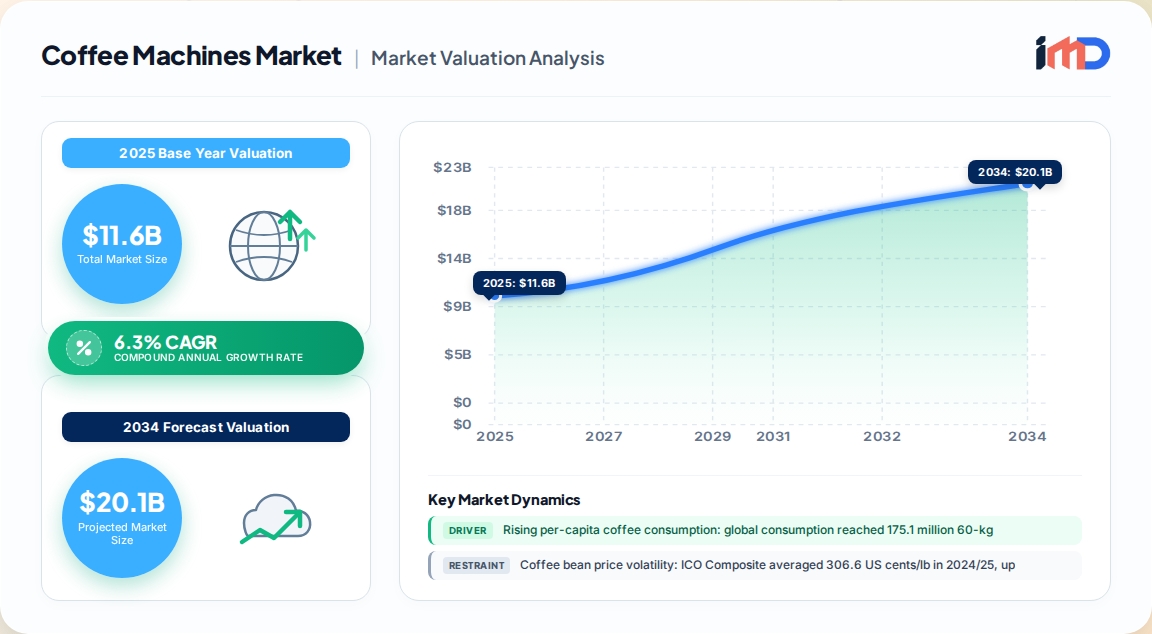
The global coffee machines market was valued at USD 11.6 billion in 2025 and is forecast to reach USD 21.2 billion by 2035, expanding at a 6.3% CAGR (2026–2035). This growth is anchored in a durable structural shift: coffee machines have evolved from basic kitchen utilities into connected, premium lifestyle appliances that deliver café-quality beverages at home and in commercial settings.
Our proprietary bottom-up modeling—triangulated across manufacturer shipment data, household penetration surveys, and foodservice equipment spending—indicates that residential premiumization and commercial automation are mutually reinforcing. Europe remains the largest regional revenue pool, while Asia-Pacific is the fastest-growing frontier, registering a 7.8% CAGR through the forecast period.
| Driver | Estimated CAGR Impact | Geographic Relevance | Impact Timeline |
|---|---|---|---|
| Shift toward home-brewing lifestyles | +1.8% | North America & Europe, expanding to urban APAC | Short term (≤2 years) |
| Smart, connected brewer innovation | +1.4% | North America & Europe early adoption; APAC following | Medium term (2–4 years) |
| Rising per-capita coffee consumption | +1.2% | Global, strongest in APAC | Medium term (2–4 years) |
| Single-serve convenience formats | +1.1% | Global, strongest in developed markets | Short term (≤2 years) |
Fully automatic/super-automatic machines commanded 74.6% of market share in 2025 and are forecast to grow at a 6.5% CAGR, as both households and commercial operators prioritize consistency and reduced labor dependency.
B2C channels represented 67.2% of 2025 revenue and are forecast to expand at a 6.9% CAGR, with e-commerce and direct-to-consumer platforms gaining share as consumers research and purchase higher-ASP machines online.
| Region | 2025 Share / Position | Growth Trajectory | Key Characteristics |
|---|---|---|---|
| Europe | Largest market, ~38.6% share | Moderate growth | Deep coffee culture, strong manufacturer presence, stringent energy and packaging regulation |
| North America | Second-largest, ~29% | Moderate growth | High household penetration, specialty coffee boom, replacement-cycle driven |
| Asia-Pacific | ~24% | Fastest-growing at 7.8% CAGR | Urbanization, rising incomes, specialty-coffee adoption; China and India lead |
| South America | ~6% | Above-average growth | Brazil and Colombia rising espresso adoption; local production advantage |
| Middle East & Africa | ~5% | Steady growth | Hospitality-driven demand; Gulf states premiumize |
The market is moderately concentrated, with the top five players—De’Longhi Group (18.2% share in 2025), Koninklijke Philips (Versuni), Robert Bosch (BSH), Nestlé Nespresso, and Keurig Dr Pepper—collectively holding 47% of global revenue.
Key strategic developments include:
Manufacturers are differentiating through smart-home integration, energy-efficient heating systems, and sustainability-aligned capsule solutions. We anticipate consolidation in the mid-tier as commodity cost pressure squeezes margins.
Supply-chain risk: EU packaging regulation and energy-labeling requirements are pushing redesign costs onto capsule-dependent OEMs, potentially accelerating consumer migration to open-system formats.
The coffee machine trade is dominated by intra-European flows (Italy, Germany, Switzerland, Romania) and China-origin exports. Official customs data indicate that China remains the largest volume exporter of small household coffee appliances, while Italy and Switzerland lead in high-value espresso and bean-to-cup machinery. U.S. import volumes are concentrated from Europe and China, with tariff exposure a watch item. Component sourcing—particularly pumps, grinders, and electronic controls—is increasingly diversified across Vietnam and Eastern Europe to mitigate single-country risk.
| Aspects | Details |
|---|---|
| Study Period | 2020-2034 |
| Base Year | 2025 |
| Estimated Year | 2026 |
| Forecast Period | 2026-2034 |
| Historical Period | 2020-2025 |
| Growth Rate | CAGR of 6.3% from 2020-2034 |
| Segmentation |
|
By End User
By Distribution Channel
By Price Range
| By Geography |
|
The global coffee machines market was valued at USD 11.6 billion in 2025 and is projected to reach USD 21.2 billion by 2035, growing at a 6.3% CAGR.
Europe is the largest regional market, accounting for approximately 38.6% of global revenue in 2025, driven by deep coffee culture and strong manufacturer presence.
Pod/capsule machines are the fastest-growing product type, projected to expand at a 7.6% CAGR through 2031, while the Asia-Pacific region leads regional growth at 7.8% CAGR.
De’Longhi Group leads with over 18.2% market share in 2025, followed by Koninklijke Philips (Versuni), Robert Bosch (BSH), Nestlé Nespresso, and Keurig Dr Pepper, which together hold 47% of the market.
Coffee bean price volatility—with the ICO Composite Indicator averaging 306.6 US cents per pound in 2024/25—and EU packaging regulations for capsules are key restraints, elongating replacement cycles and raising compliance costs.
Our rigorous research methodology combines multi-layered approaches with comprehensive quality assurance, ensuring precision, accuracy, and reliability in every market analysis.
| Stakeholder Role | Interview Share (%) |
|---|---|
| VP of Product Development | 30% |
| Commercial Channel Director | 25% |
| Head of Sustainability & Compliance | 25% |
| Senior Procurement Manager | 20% |
| Company Type | Representation (%) |
|---|---|
| Coffee machine OEMs | 30% |
| Component suppliers | 25% |
| Capsule/pod manufacturers | 20% |
| Foodservice distributors | 15% |
| Specialty coffee chains | 10% |
 Related Reports
