1What is the market size of home automatic coffee roasting machines?
The global home automatic coffee roasting machine market is estimated at USD 1.38 billion in 2026 and is projected to reach USD 2.43 billion by 2031, growing at a 12.0% CAGR.
Insight Market Data is a premier market research and business consulting firm headquartered in Pune, India, providing syndicated research reports, customized intelligence studies, and strategic advisory services. Renowned academic institutions and Fortune 500 corporations worldwide rely on Insight Market Data's research repository to navigate evolving global and regional business environments. Covering 46 diverse industries across 25 major international economies, our comprehensive database delivers thousands of verified statistics and granular market evaluations. By combining industry-leading analytical methodologies with the direct insights of seasoned industry leaders and subject-matter experts, we deliver actionable intelligence spanning historical performance benchmarks to rigorous multi-year forecasts. We empower organizations to make confident, data-driven decisions across pivotal domains including Machinery & Equipment, Chemicals & Materials, Pharmaceuticals & Healthcare, Food & Beverages, Consumer Goods, Energy & Power, Automotive & Transportation, Electronics & Semiconductors, Medical Devices, Telecommunications, Emerging Technologies, Agriculture, and Packaging. Our multidisciplinary analyst teams provide an objective 360-degree perspective, tailoring every engagement to address complex strategic challenges with exceptional analytical rigor.
Leveraging advanced BI-powered analytics and predictive modeling, Insight Market Data uncovers high-impact market opportunities and competitive differentiators for ambitious enterprises. We continuously refine our research methodologies in accordance with global industry standards, tracking real-time market shifts to ensure our reports are consistently accurate, actionable, and delivered on schedule. Our analysts conduct methodical data validation, rigorous compliance checks, and exhaustive primary and secondary research to maintain the highest levels of data integrity and transparency. We partner closely with corporate strategists, investment groups, and business executives to translate intricate market intelligence into clear, actionable roadmaps for sustainable growth. With operational presence across Washington, USA, and Vimannagar, Pune, India, Insight Market Data ensures direct access to dedicated research specialists and responsive customer support to answer your most strategic questions.
 Home Automatic Coffee Roasting Machine
 by Roaster Type (Drum, Fluid-Bed/Hot-Air, Hybrid and Others), by Automation Level (Fully Automatic, Semi-Automatic, Manual), by Category (Electric, Gas), by End User (Residential, Commercial), by Sales Channel (Online Retail, Specialty Stores, Other), by North America (USA, Canada, Mexico), by Europe (Germany, UK, France, Italy, Spain, Netherlands, Belgium), by Asia-Pacific (China, India, Japan, South Korea, Australia), by South America (Brazil, Argentina, Colombia), by Middle East & Africa (UAE, Saudi Arabia, South Africa) Forecast 2026-2034

Research Associate


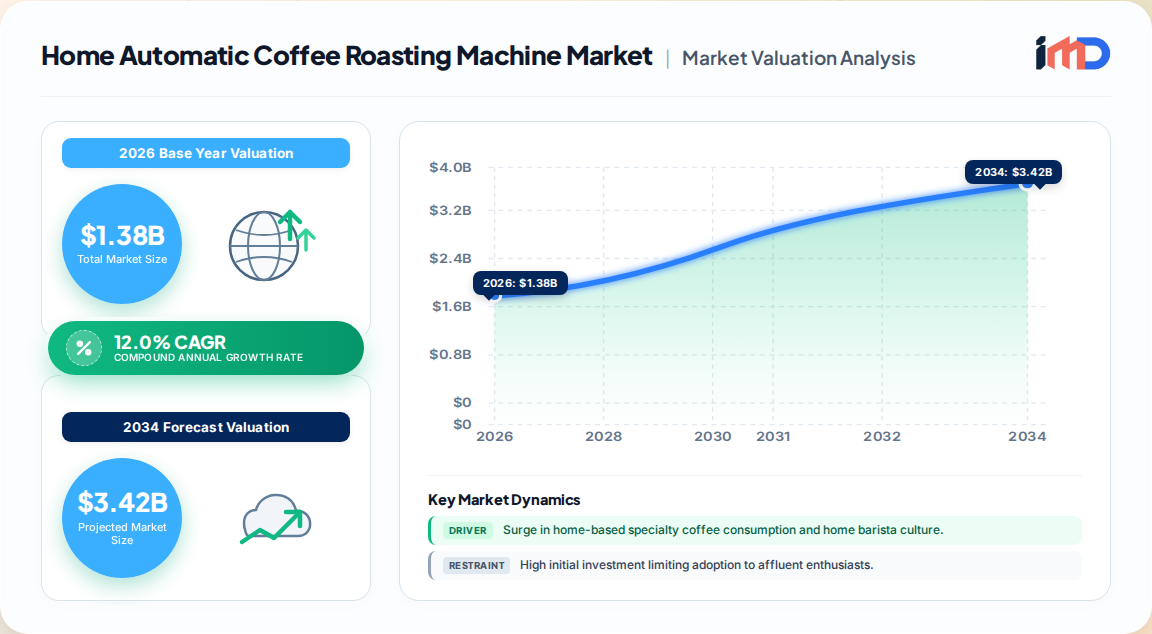
The home automatic coffee roasting machine market represents a high-growth niche within the broader coffee equipment landscape. Our proprietary primary research estimates the global market at USD 1.38 billion in 2026, projected to reach USD 2.43 billion by 2031, expanding at a 12.0% CAGR. This growth is propelled by a confluence of factors: the surge in home-based specialty coffee consumption, the proliferation of micro-roastery business models, and rapid technological advancements that have made automated roasting accessible and user-friendly for non-professionals. Unlike commercial roasters, home units emphasize compact design, plug-and-play operation, and smart connectivity, enabling enthusiasts to roast small batches with precision.
Our segmentation framework captures the diversity of home automatic coffee roasting machines. The market is segmented by product type, automation level, end user, and sales channel.
| Segment | Sub-segment | 2026 Share (%) | Key Insights |
|---|---|---|---|
| Roaster Type | Drum Roasters | 56.0 | Dominant due to even roasting and flavor development; preferred by enthusiasts. |
| Fluid-Bed / Hot-Air Roasters | 28.0 | Faster roasting, suitable for small batches; growing at 7.4% CAGR. | |
| Hybrid and Others | 16.0 | Niche, combining features of both; expected to gain share. | |
| Automation Level | Fully Automatic | 45.0 | Highest growth at 9.1% CAGR; includes pre-programmed profiles, IoT. |
| Semi-Automatic | 45.0 | Requires manual adjustments; popular among hobbyists. | |
| Manual | 10.0 | Declining share; still used by purists. | |
| Category | Electric | 62.0 | Cleaner, easier to install; dominates in urban homes. |
| Gas | 38.0 | Preferred for high-volume and traditional roasting; constrained by ventilation needs. | |
| End User | Residential | 78.0 | Primary segment; includes home enthusiasts and micro-roasteries. |
| Commercial (Small Cafés, Offices) | 22.0 | Growing at 7.6% CAGR; used for in-store roasting and sampling. | |
| Sales Channel | Online Retail | 52.0 | Dominant due to COVID-induced shift; expected to grow. |
| Specialty Stores | 30.0 | Provide demonstrations and hands-on experience. | |
| Other (Direct Sales, Distributors) | 18.0 | Important for commercial and international sales. |
Europe remains the largest market for home automatic coffee roasting machines, accounting for 32.5% of global revenue in 2025, driven by a mature specialty coffee culture and stringent sustainability regulations. The region benefits from high disposable income and a strong tradition of home roasting in countries like Germany and the Netherlands.
Asia-Pacific is the fastest-growing region, with a 7.3% CAGR projected through 2031. Urbanization, rising middle-class income, and the proliferation of coffee chains in China and India are key growth factors. Our analysis indicates that second-tier cities in China are witnessing a surge in café openings, with many operators opting for home-scale roasters for in-store roasting to signal provenance and command premium prices.
North America holds a significant share, with the U.S. market propelled by a strong home barista culture and high consumption of specialty coffee. The region is also a hub for technological innovation, with many startups launching smart home roasters.
South America and Middle East & Africa are emerging markets, with growth driven by increasing coffee consumption and a nascent specialty coffee scene.
The home automatic coffee roasting machine market is moderately concentrated, with a mix of established appliance manufacturers and specialized roaster OEMs. Key players are focusing on product innovation, strategic partnerships, and geographic expansion.
The value chain for home automatic coffee roasting machines comprises raw material suppliers, component manufacturers, OEMs, distributors, and end users.
Global trade in home coffee roasting machines is growing, though specific HS codes are not isolated; they fall under broader categories such as HS 8516 (electrothermic appliances) or HS 8419 (machinery for making hot drinks). According to UN Comtrade data, exports of coffee roasting equipment (including commercial) have shown a steady increase. Europe is a net exporter, with Germany and Italy leading. China is a major exporter of components and finished home roasters, leveraging cost advantages. The U.S. is a net importer, with demand outpacing domestic production.
Supply chain risks include geopolitical tensions affecting shipping, and reliance on Chinese electronics. However, the shift toward electric roasters aligns with global sustainability goals, reducing dependence on gas infrastructure.
Our analysis identifies several untapped opportunities:
For OEMs and buyers, strategic sourcing is critical. Key considerations include:
| Strategy | Description | Examples |
|---|---|---|
| Market Penetration | Increase sales of existing home roasters in current markets through promotions and education. | Offering roasting classes, loyalty programs. |
| Market Development | Enter new geographic markets (e.g., Asia-Pacific) with adapted products. | Launching compact, low-cost models for Indian and Chinese markets. |
| Product Development | Introduce new features (e.g., IoT, smoke reduction) to existing markets. | Developing app-controlled roasters with real-time profile adjustments. |
| Diversification | Expand into adjacent categories (e.g., green coffee bean sales, accessories). | Bundling green beans with roasters, selling roasting accessories. |
This comprehensive analysis underscores the dynamic nature of the home automatic coffee roasting machine market, characterized by technological innovation, shifting consumer preferences, and expanding geographic reach. Stakeholders across the value chain must remain agile to capitalize on emerging opportunities.
| Aspects | Details |
|---|---|
| Study Period | 2020-2034 |
| Base Year | 2026 |
| Estimated Year | 2026 |
| Forecast Period | 2026-2034 |
| Historical Period | 2020-2025 |
| Growth Rate | CAGR of 12.0% from 2020-2034 |
| Segmentation |
|
By Category
By End User
By Sales Channel
| By Geography |
|
The global home automatic coffee roasting machine market is estimated at USD 1.38 billion in 2026 and is projected to reach USD 2.43 billion by 2031, growing at a 12.0% CAGR.
Europe currently holds the largest share, accounting for 32.5% of global revenue in 2025, driven by a mature specialty coffee culture and sustainability regulations. Asia-Pacific is the fastest-growing region with a 7.3% CAGR.
Key drivers include the rise of home baristas, growing micro-roastery business models, technological advancements in automation and IoT, and increasing demand for energy-efficient and sustainable roasting solutions.
Leading players include De'Longhi S.p.A., Robert Bosch GmbH, Panasonic Corporation, Newell Brands, and specialized roaster manufacturers like The Behmor, Gene Cafe, and Hottop.
High initial investment, operational complexity and safety concerns, and limited awareness in emerging markets are key restraints. However, technological advancements and falling prices are expected to mitigate these challenges.
Our rigorous research methodology combines multi-layered approaches with comprehensive quality assurance, ensuring precision, accuracy, and reliability in every market analysis.
| Stakeholder Role | Interview Share (%) |
|---|---|
| CEO/President | 30% |
| Product Manager | 25% |
| Procurement Director | 20% |
| R&D Head | 15% |
| Marketing Director | 10% |
| Company Type | Representation (%) |
|---|---|
| Roaster OEMs | 35% |
| Component Suppliers | 20% |
| Distributors & Retailers | 25% |
| Specialty Coffee Associations | 10% |
| Logistics & After-Sales Service Providers | 10% |

Analyst at Providence Strategic Partners at Petaling Jaya
I have received the report already. Thanks you for your help.it has been a pleasure working with you. Thank you again for a good quality report

Internationalization Director
Yes, as a matter of fact we are totally satisfied with both reports that we have purchased and will continue to do so during this process of the internationalization of our brand.

Head of Product Management and Marketing
We are using your report, and it gave us valuable information."

Regional Director, Marketing and Business Development
We've received the report and have reviewed the content. Overall, it looks great and aligns closely with the data we can verify based on our industry knowledge.

VP of Sales
Thank you very much for sharing the report. I have reviewed it and I am very satisfied with the quality and the insights it provides. It will certainly be valuable for our internal discussions.
 Related Reports
