1What is the current market size of lab-grown meat?
The global lab-grown meat market was valued at USD 412.7 million in 2025 and is projected to reach USD 4,000.0 million by 2033, growing at a CAGR of 33.4% from 2026 to 2033.
Insight Market Data is a premier market research and business consulting firm headquartered in Pune, India, providing syndicated research reports, customized intelligence studies, and strategic advisory services. Renowned academic institutions and Fortune 500 corporations worldwide rely on Insight Market Data's research repository to navigate evolving global and regional business environments. Covering 46 diverse industries across 25 major international economies, our comprehensive database delivers thousands of verified statistics and granular market evaluations. By combining industry-leading analytical methodologies with the direct insights of seasoned industry leaders and subject-matter experts, we deliver actionable intelligence spanning historical performance benchmarks to rigorous multi-year forecasts. We empower organizations to make confident, data-driven decisions across pivotal domains including Machinery & Equipment, Chemicals & Materials, Pharmaceuticals & Healthcare, Food & Beverages, Consumer Goods, Energy & Power, Automotive & Transportation, Electronics & Semiconductors, Medical Devices, Telecommunications, Emerging Technologies, Agriculture, and Packaging. Our multidisciplinary analyst teams provide an objective 360-degree perspective, tailoring every engagement to address complex strategic challenges with exceptional analytical rigor.
Leveraging advanced BI-powered analytics and predictive modeling, Insight Market Data uncovers high-impact market opportunities and competitive differentiators for ambitious enterprises. We continuously refine our research methodologies in accordance with global industry standards, tracking real-time market shifts to ensure our reports are consistently accurate, actionable, and delivered on schedule. Our analysts conduct methodical data validation, rigorous compliance checks, and exhaustive primary and secondary research to maintain the highest levels of data integrity and transparency. We partner closely with corporate strategists, investment groups, and business executives to translate intricate market intelligence into clear, actionable roadmaps for sustainable growth. With operational presence across Washington, USA, and Vimannagar, Pune, India, Insight Market Data ensures direct access to dedicated research specialists and responsive customer support to answer your most strategic questions.

 Lab-grown Meat Market
 by Source (Poultry, Beef, Pork, Seafood, Duck, Others), by End-Use (Burgers and Patties, Nuggets, Sausages and Hot Dogs, Meatballs and Mince, Fillets and Whole-Cuts), by Application (Human Food, Pet Food), by End User (Foodservice, Retail/Household, E-commerce), by North America (USA, Canada, Mexico), by Europe (Germany, UK, France, Netherlands, Spain), by Asia Pacific (China, Japan, Singapore, South Korea, Australia), by South America (Brazil, Argentina), by Middle East & Africa (Israel, UAE, South Africa) Forecast 2026-2034

Research Associate

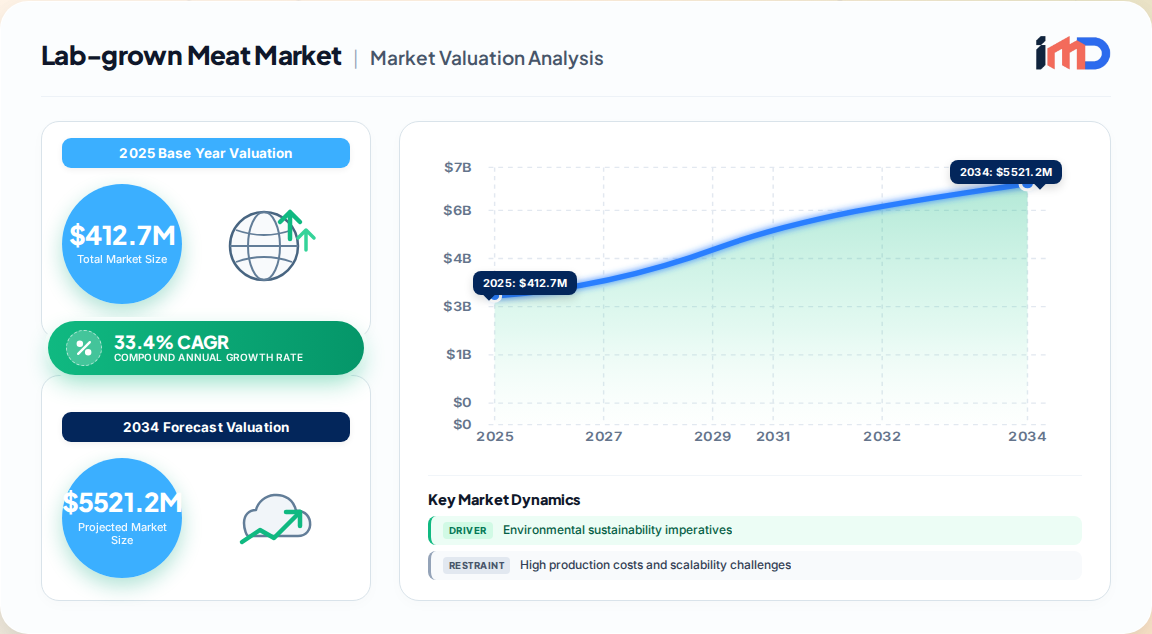
The global lab-grown meat market, also referred to as cultured or cultivated meat, is in a pre-commercial but rapidly accelerating phase of development. Our proprietary primary research and expert interviews estimate the market at USD 412.7 million in 2025, with a projected expansion to USD 4,000.0 million by 2033, representing a compound annual growth rate (CAGR) of 33.4% from 2026 to 2033. This growth is underpinned by a confluence of technological breakthroughs in cellular agriculture, increasing public and private investment, and a global imperative to decarbonize protein production.
North America currently dominates the global landscape, accounting for an estimated 35.0% revenue share in 2025. This leadership is attributable to a pioneering regulatory framework, particularly in the United States, where the FDA and USDA-FSIS have established a clear path to market for cultivated animal cells. The region also benefits from a dense ecosystem of innovative startups, established food-tech incumbents, and venture capital firms. However, the fastest-growing region is Asia-Pacific, where food security imperatives and proactive government support are driving a surge in R&D and commercialization activities.
Drivers
Restraints
The lab-grown meat market is segmented by source, end-use product form, application, and end-user channel. Our analysis reveals clear preferences and growth patterns within each segment.
By Source
By End-Use Product Form
By End-User Channel
North America
North America is the largest regional market, with an estimated 35.0% revenue share in 2025, projected to reach a 38.7% share by 2035. The region's leadership is built on a clear regulatory framework, strong venture capital funding, and a concentration of key players. The United States is at the forefront, with multiple companies having received FDA "no questions" letters and USDA grants of inspection. Canada and Mexico are also emerging markets, with regulatory bodies actively developing frameworks for cultivated meat.
Asia-Pacific
Asia-Pacific is the fastest-growing region, with an expected CAGR of 53.3% from 2026 to 2035. The region's growth is fueled by food security concerns, proactive government support, and a large consumer base open to innovative food technologies. Singapore is a pioneer, having established a regulatory framework as early as 2020 and being the first to grant approval for cultivated meat sales. Other countries such as China, Japan, and South Korea are investing heavily in R&D, with China's government including cultivated meat in its agricultural development plans.
Europe
Europe represents a significant market, driven by strong consumer interest in sustainable food and a robust research ecosystem. The regulatory pathway is governed by the EU Novel Foods Regulation, and companies like Mosa Meat have filed applications for approval. The region is also seeing substantial public investment, such as the Dutch government's €60 million commitment. However, the approval process is rigorous and may slow market entry compared to North America and Asia.
South America and Middle East & Africa
These regions are in earlier stages of development. South America, particularly Brazil and Argentina, has a strong traditional meat industry and a growing interest in alternative proteins. The Middle East and Africa are seeing government-backed initiatives, such as Israel's approval of cultivated beef, positioning the region as a potential innovation hub. However, infrastructure and investment gaps remain significant.
The lab-grown meat market is characterized by a mix of well-funded startups and strategic partnerships with established food companies. Our primary research indicates that no single company holds a dominant share; instead, the ecosystem is fragmented, with over 175 companies operating globally. The competitive landscape is defined by:
The lab-grown meat value chain is complex and spans multiple industries, from biotechnology to food processing and distribution.
Our analysis identifies several high-potential white spaces for investment and product development:
Given the nascent stage of the market, there is limited import/export data for finished lab-grown meat products. However, the supply chain for inputs and equipment is global. Key input suppliers include:
We anticipate that as the market matures, trade patterns will evolve, with countries that have strong biotech and manufacturing capabilities exporting finished products and specialized inputs. Regulatory harmonization will be critical to facilitating international trade in cultivated meat products. Currently, the lack of uniform standards across borders creates friction in trade flows, but initiatives by international bodies such as the Codex Alimentarius Commission are expected to address this in the coming years.
| Aspects | Details |
|---|---|
| Study Period | 2020-2034 |
| Base Year | 2025 |
| Estimated Year | 2026 |
| Forecast Period | 2026-2034 |
| Historical Period | 2020-2025 |
| Growth Rate | CAGR of 33.4% from 2020-2034 |
| Segmentation |
|
By End-Use
By Application
By End User
| By Geography |
|
The global lab-grown meat market was valued at USD 412.7 million in 2025 and is projected to reach USD 4,000.0 million by 2033, growing at a CAGR of 33.4% from 2026 to 2033.
North America currently dominates the market, accounting for a 35.0% revenue share in 2025. However, Asia-Pacific is expected to be the fastest-growing region, driven by food security needs and government support.
The industry faces significant challenges, including high production costs, scalability issues in bioreactor design, and consumer acceptance barriers. Regulatory labeling requirements also vary by region, creating compliance complexities.
Poultry is the dominant source, holding over 39.0% of the market share in 2025, followed by beef, pork, and seafood. Poultry's faster cell growth cycles make it more commercially viable in the near term.
Key players include UPSIDE Foods, GOOD Meat (Eat Just), Mosa Meat, Aleph Farms, Meatable, and Believer Meats (Future Meat Technologies). These companies are at the forefront of regulatory approvals and product commercialization.
Hybrid products that blend cultivated cells with plant proteins are lowering cost barriers and enabling early market entry. For example, GOOD Meat's Singapore offering contains only 3% cultivated chicken cells, significantly reducing production costs.
Our rigorous research methodology combines multi-layered approaches with comprehensive quality assurance, ensuring precision, accuracy, and reliability in every market analysis.
| Stakeholder Role | Interview Share (%) |
|---|---|
| Chief Technology Officers | 30% |
| Regulatory Affairs Directors | 25% |
| Bioprocess Engineers | 25% |
| Procurement Directors | 20% |
| Company Type | Representation (%) |
|---|---|
| Cultivated Meat Startups | 40% |
| Bioreactor and Equipment Suppliers | 20% |
| Cell Culture Media Providers | 15% |
| Food Processing and Distribution Companies | 15% |
| Regulatory and Consulting Firms | 10% |
 Related Reports
