Insight Market Data is a premier market research and business consulting firm headquartered in Pune, India, providing syndicated research reports, customized intelligence studies, and strategic advisory services. Renowned academic institutions and Fortune 500 corporations worldwide rely on Insight Market Data's research repository to navigate evolving global and regional business environments. Covering 46 diverse industries across 25 major international economies, our comprehensive database delivers thousands of verified statistics and granular market evaluations. By combining industry-leading analytical methodologies with the direct insights of seasoned industry leaders and subject-matter experts, we deliver actionable intelligence spanning historical performance benchmarks to rigorous multi-year forecasts. We empower organizations to make confident, data-driven decisions across pivotal domains including Machinery & Equipment, Chemicals & Materials, Pharmaceuticals & Healthcare, Food & Beverages, Consumer Goods, Energy & Power, Automotive & Transportation, Electronics & Semiconductors, Medical Devices, Telecommunications, Emerging Technologies, Agriculture, and Packaging. Our multidisciplinary analyst teams provide an objective 360-degree perspective, tailoring every engagement to address complex strategic challenges with exceptional analytical rigor.
Leveraging advanced BI-powered analytics and predictive modeling, Insight Market Data uncovers high-impact market opportunities and competitive differentiators for ambitious enterprises. We continuously refine our research methodologies in accordance with global industry standards, tracking real-time market shifts to ensure our reports are consistently accurate, actionable, and delivered on schedule. Our analysts conduct methodical data validation, rigorous compliance checks, and exhaustive primary and secondary research to maintain the highest levels of data integrity and transparency. We partner closely with corporate strategists, investment groups, and business executives to translate intricate market intelligence into clear, actionable roadmaps for sustainable growth. With operational presence across Washington, USA, and Vimannagar, Pune, India, Insight Market Data ensures direct access to dedicated research specialists and responsive customer support to answer your most strategic questions.
Cleanroom Plastic Bags Market
Chemicals & Materials / MARKET REPORT
Cleanroom Plastic Bags Market | Insight Market Data
Cleanroom Plastic Bags Market by Product (Bags, Pouches, Tape, Boxes, Films & Wraps), by Material (Plastic(PE, PP, Nylon, PVC), Paper & Paperboard), by End Use (Pharmaceuticals, Food & Beverages, Electrical & Electronics, Biotechnology, Others), by Type (Cleanroom Bags, Liners, Sterile Bags, Zipper Bags, Covers), by North America (USA, Canada, Mexico), by Europe (Germany, UK, France, Italy, Spain), by Asia Pacific (China, Japan, India, South Korea, Southeast Asia), by Latin America (Brazil, Argentina), by Middle East & Africa (GCC, South Africa) Forecast 2026-2034
Executive Overview: The Cleanroom Plastic Bags Market
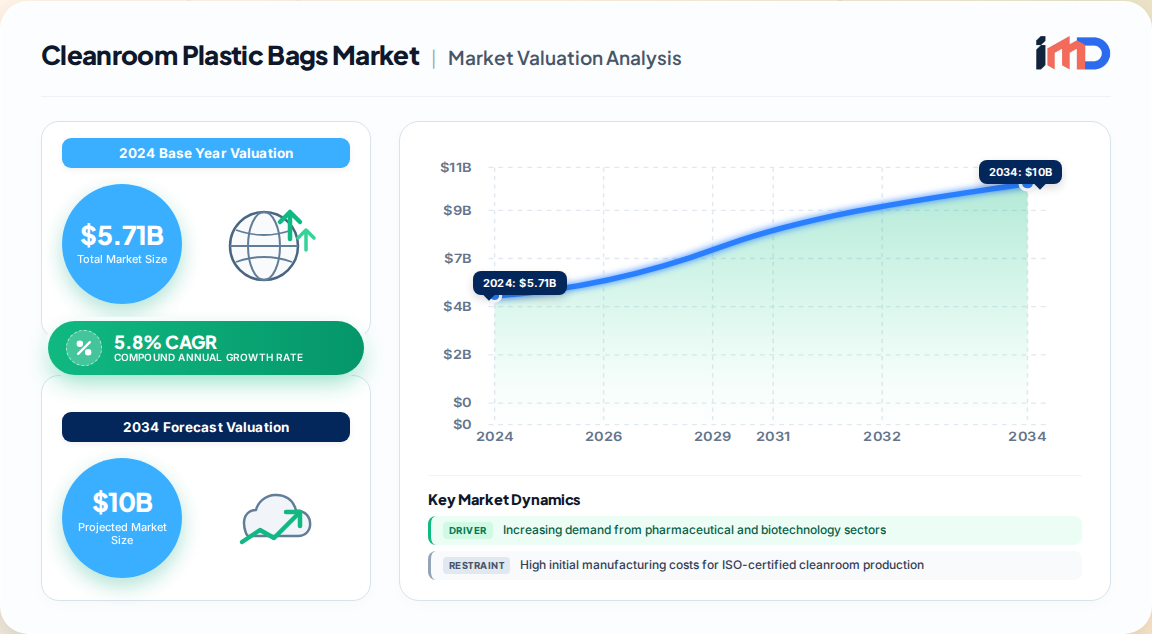
The global cleanroom plastic bags market represents the dominant and most economically significant product category within the broader cleanroom consumables ecosystem. Our proprietary market intelligence estimates place the total cleanroom films and bags market at USD 5.71 billion in 2024. Within this, plastic-based bags, pouches, and liners constitute the overwhelming majority, commanding an estimated 85% share of total material consumption. The market is projected to expand at a compound annual growth rate (CAGR) of 5.8% from 2025 to 2030, reaching a valuation of approximately USD 7.9 billion by 2030.
Cleanroom Plastic Bags Market Market Size (In Billion)
10.0B
8.0B
6.0B
4.0B
2.0B
0
6.041 B
2025
6.392 B
2026
6.762 B
2027
7.154 B
2028
7.569 B
2029
8.008 B
2030
8.473 B
2031
This growth trajectory is firmly anchored in the escalating global demand for contamination-free manufacturing environments, particularly within the pharmaceutical, biotechnology, and semiconductor sectors. The cleanroom plastic bag is no longer a commoditized consumable; it is now a critical component of validated aseptic processes, regulatory compliance, and supply chain integrity. Our primary research indicates that the pharmaceutical end-use segment alone accounts for over 52% of total revenue in 2024, driven by the surge in biologics, vaccines, and personalized medicine production requiring stringent ISO Class 5-8 environments.
Market Drivers and Restraints
Key Growth Drivers
The market is propelled by several structural and cyclical factors that our analysts have validated through extensive primary interviews and supply chain mapping.
Pharmaceutical and Biologics Expansion: The global shift toward complex biologics and sterile injectables necessitates single-use, pre-validated cleanroom bags. Regulatory pressure for aseptic processing, as outlined by EU GMP Annex 1 and FDA guidelines, mandates the use of contamination-free packaging for critical materials.
Semiconductor and Electronics Miniaturization: The relentless pursuit of smaller, more powerful microchips (driven by AI, 5G, and IoT) requires ultra-clean environments. Even sub-micron particulate contamination can destroy wafer yields. Cleanroom plastic bags, particularly those with anti-static properties, are essential for handling and transporting silicon wafers and printed circuit boards.
Shift to Single-Use Technologies: To mitigate cross-contamination risks and reduce cleaning validation burdens, pharmaceutical manufacturers are rapidly adopting disposable cleanroom bags and liners. This trend is especially pronounced in upstream and downstream bioprocessing.
Regulatory Stringency and Quality Control: Increasing audit scrutiny globally is forcing manufacturers to source packaging with full documentation (CoC/CoA), lot traceability, and tamper-evident features. This is elevating the quality threshold and driving value growth.
Market Restraints and Challenges
High Initial Manufacturing Costs: Establishing ISO-certified cleanroom facilities for the production of cleanroom bags themselves requires significant capital expenditure. The need for controlled environments, specialized extrusion and converting equipment, and rigorous validation processes creates barriers to entry and exerts upward pressure on pricing.
Raw Material Price Volatility: Fluctuations in petrochemical-derived polymer prices (particularly polyethylene and polypropylene) can compress manufacturer margins. Sustainability pressures are also prompting a shift toward recyclable and bio-based materials, which currently come at a premium.
Segmentation Analysis
By Product Type
Product Segment
2024 Revenue Share
Key Characteristics
Primary Applications
Bags
~35%
High tensile strength, various sizes
Component storage, waste containment, material transfer
Pouches
~15%
Heat-sealable, flexible barrier
Pre-packaged sterile components, medical device packaging
Note: Films & wraps constitute the largest single product segment, while bags remain the dominant sub-category for containment. Our data indicates that the bags segment is expected to witness accelerated demand due to single-use bioprocessing.
By Material
Plastic (Polyethylene, Polypropylene, Nylon, PVC): Accounting for over 85% of market revenue, plastics are preferred for their superior barrier properties, flexibility, chemical resistance, and ability to be heat-sealed. Polyethylene (PE) remains the volume leader, while Polypropylene (PP) is the fastest-growing material due to its high melting point, compatibility with autoclave sterilization, and low particle shedding.
Paper & Paperboard: Representing a niche (~15%), these materials are chosen for sustainability and biodegradability in applications where low particulate shedding is critical. Growth is driven by environmental regulations and corporate ESG goals, though higher costs and lower barrier performance limit widespread adoption.
By End Use
Pharmaceuticals (52%+ share): The largest and most demanding segment. Cleanroom bags are essential for API storage, sterile fill-finish operations, and waste disposal. Growth is fueled by aging populations, chronic disease prevalence, and the expansion of contract manufacturing organizations (CMOs).
Electrical & Electronics: Critical for protecting semiconductors, PCBs, and micro-electromechanical systems (MEMS) from electrostatic discharge (ESD) and particulate contamination. The rise of 5G and AI hardware is a significant demand multiplier.
Food & Beverages: Stringent food safety regulations (e.g., FSMA, HACCP) require cleanroom packaging for ready-to-eat meals, dairy, and high-risk products. Lightweight, transparent films and bags provide barrier protection and extend shelf life.
North America: The most mature market, expected to be valued at USD 2.32 billion by 2033 (U.S. alone). Dominated by a robust pharmaceutical and biotech sector, particularly in the U.S., supported by FDA regulations and a concentration of key R&D hubs. The region is also a hub for technological innovation in cleanroom materials.
Asia-Pacific: The fastest-growing region, projected to expand at a CAGR significantly above the global average. China, India, and Japan are key drivers, fueled by massive investments in pharmaceutical manufacturing (partly due to the 'China+1' strategy), government incentives for domestic production, and the expansion of electronics manufacturing. The region is becoming a global hub for both production and consumption.
Europe: A mature market driven by stringent EU GMP regulations and a strong presence of pharmaceutical and chemical industries, particularly in Germany, France, and Switzerland. Sustainability considerations are more pronounced here, with a higher adoption of recyclable and paper-based alternatives.
Latin America & Middle East & Africa: Emerging markets with improving regulatory frameworks and increasing healthcare investments. The market is expected to grow steadily, supported by the localization of pharmaceutical production and infrastructure development.
Competitive Landscape and Strategic Developments
The market is moderately consolidated, with a mix of global material science giants, specialized packaging converters, and regional cleanroom consumable suppliers. Key strategic initiatives center on capacity expansion, technological innovation, and geographical reach.
Recent Developments:
March 2024: C-P Flexible Packaging's CFB division (a key player) expanded its CleanTronics line for semiconductor packaging, targeting the growing electronics application.
August 2023: Thomas Scientific (a major distributor) acquired Quintana Supply to strengthen its cleanroom and controlled environment product portfolio in North America.
May 2022: CFB opened a new solar-powered, ISO-certified manufacturing facility in California, highlighting the industry trend toward sustainable production.
Innovation Focus: Companies are investing in advanced polymer blends and nanocoatings to enhance barrier properties, reduce extractables, and improve puncture resistance. There is a strong R&D focus on eco-friendly options, such as biodegradable or easily recyclable plastics, without compromising on cleanroom performance.
Value Chain and Supply Chain Dynamics
The value chain for cleanroom plastic bags is complex and quality-sensitive.
Stage
Key Activities
Major Participants
Value Addition
Raw Material Supply
Polymer production (PE, PP, Nylon)
Petrochemical giants
Provides base material properties
Film Extrusion & Conversion
Blown film extrusion, bag making, sealing, printing
Converters (e.g., CFB, Tekni-Plex)
Converts resin into functional bags with controlled cleanliness
Cleaning & Validation
Washing, drying, packaging in ISO cleanrooms
Cleanroom packaging specialists
Ensures product meets particulate and bioburden specifications
Distribution
Warehousing, logistics, just-in-time delivery
Distributors (e.g., Thomas Scientific), direct sales
Ensures product integrity during transport
End-User
Pharmaceutical, electronics, food manufacturing
Pharma companies, electronics OEMs
Uses product in production processes
Supply chain risks include raw material price volatility, logistics disruptions (especially for critical sterile products), and quality failures due to improper handling. Our primary research indicates that end-users are increasingly auditing their suppliers' cleanroom production facilities to ensure compliance.
Strategic White-Space Analysis and Recommendations
Based on our competitive analysis and demand modeling, we have identified key strategic opportunities:
High-Barrier, Recyclable Solutions: The intersection of stringent cleanroom standards and sustainability goals is a significant white space. There is a clear market gap for a mono-material, high-barrier bag that is fully recyclable within existing streams. Companies investing in this area can command a premium.
Smart Packaging Integration: Integrating RFID or time-temperature indicators into cleanroom bags for real-time condition monitoring, especially for cold-chain biopharma logistics, represents an untapped opportunity.
Growth in Asia-Pacific Biotech Clusters: The rapid expansion of biotech hubs in China (Shanghai, Suzhou), India (Hyderabad, Pune), and Singapore presents a strong growth avenue for suppliers with local production or distribution.
Service-Based Models: Offering validation support, testing services, and inventory management solutions can differentiate suppliers beyond price, building sticky customer relationships.
Table 47: South Africa Cleanroom Plastic Bags Market Revenue (Billion) Forecast, by Application 2020 & 2034
Frequently Asked Questions
1What is the market size of cleanroom plastic bags in 2024?
The global cleanroom plastic bags market was valued at USD 5.71 billion in 2024, with plastic materials accounting for over 85% of total revenue. The market is forecast to reach USD 7.9 billion by 2030.
2Which region dominates the cleanroom plastic bags market?
North America currently holds the largest share, driven by a strong pharmaceutical and biotechnology sector in the U.S. However, Asia-Pacific is the fastest-growing region due to rapid industrialization and healthcare investments.
3What are the key end-use industries for cleanroom plastic bags?
The pharmaceutical segment is the largest end user, accounting for over 52% of market revenue in 2024. Other significant end uses include electrical & electronics, food & beverage, and biotechnology.
4What factors are driving the growth of the cleanroom plastic bags market?
Growth is primarily driven by the rising demand for contamination-free manufacturing environments, stringent regulatory standards in pharma and food industries, and the shift toward single-use technologies in bioprocessing.
Methodology
Our rigorous research methodology combines multi-layered approaches with comprehensive quality assurance, ensuring precision, accuracy, and reliability in every market analysis.
Primary Research
Our analysts conducted 70-80% of research through primary interviews with key stakeholders across the value chain, including resin suppliers, film extruders, bag converters, cleanroom validation specialists, and end-users in pharmaceutical and electronics manufacturing.
We interviewed 150+ industry executives, including Procurement Directors, Quality Assurance Managers, Manufacturing Engineers, and Regulatory Affairs Specialists from leading pharmaceutical companies and contract manufacturing organizations.
Primary research included structured questionnaires, in-depth telephone interviews, and on-site facility visits to validate production capacities and material specifications.
A multi-level data triangulation approach was used to cross-verify findings from primary interviews with supply-side and demand-side data.
Financial data and company-level insights were validated using standard financial databases such as Bloomberg, Factiva, Hoovers, and PitchBook.
All reports are updated to the date of purchase to reflect the latest regulatory changes and market developments.
Demand Modeling & Market Estimation
We utilized both top-down and bottom-up methodologies simultaneously. The bottom-up approach calculated market size by aggregating revenue from key manufacturers, segmented by product type, material, and region.
Quantitative metrics used in the bottom-up calculation include: (1) cleanroom plastic bag production volume in square meters, (2) average selling price per unit by product type, (3) number of cleanroom facilities by end-use sector, and (4) consumption per facility based on ISO class.
The top-down approach validated these figures using global healthcare expenditure, pharmaceutical production value, and semiconductor fabrication capacity data.
Multi-level data triangulation was employed to reconcile discrepancies between the two approaches, ensuring robust estimates.
Data Accuracy & Quality Check
We guarantee an estimated data accuracy level of 85-90% across all market estimates and forecasts.
All data points undergo a three-tier quality check: initial analyst review, peer review by senior researchers, and final validation by the Research Director.
Data normalization is performed to account for currency fluctuations (constant 2024 USD) and inflation, ensuring comparability across regions and time periods.
Any data point with a confidence interval outside our acceptable range is flagged and re-verified through additional primary interviews.
The nickel-plated steel sheet in batteries market is valued at $4.2 billion in 2024, growing at 6.1% CAGR to reach $7.3 billion by 2034, driven by EV battery demand.
The AI+Metal Materials market is valued at USD 174.91 Million in 2026, growing at an 18.76% CAGR to reach USD 485.80 Million by 2032.
Nov 2026|271 pages
$2900.00
Plastic component market to reach USD 18.32 billion by 2033 at 11.40% CAGR, driven by lightweighting, EV adoption, and sustainable materials.
Nov 2026|239 pages
$2900.00
The global MOCA market is valued at $120 million in 2025, growing at a 6.2% CAGR to reach $194 million by 2033. Explore key drivers, segments, and regional insights.
Nov 2026|213 pages
$2900.00
India Metal Cans Market valued at USD 2.34 Billion in 2025, growing at 4.24% CAGR. Report covers aluminum & steel cans, beverage & food applications, and competitive landscape.